There is a moment in almost every counselling session we have with Indian parents that goes like this.
The fees make sense. The universities look good. The FMGE data is encouraging. And then a mother leans forward slightly and asks the question she has been holding back since the conversation started.
"But is my child actually going to be safe there?"
Everything else in the conversation, the numbers, the rankings, the timelines, becomes secondary at that moment. Because at the end of it all, what every parent is really asking is not about a university or a degree or a career. They are asking about their child. Their 17-year-old. Flying alone to a country they have never been to, to live independently for the first time in their life.
That question deserves a real answer. Not a marketing answer. Not a reassuring line that sounds good but means nothing. A real, ground-level, honest answer from people who have been operating in Georgia since 2015 and have walked thousands of Indian families through exactly this decision.
That is what this guide is.
Start Here: What Kind of Safety Are We Actually Talking About?
When Indian parents ask about safety in Georgia, they are usually worried about four distinct things, though they often ask them all as one question.
- They worry about geopolitical safety. Is Georgia in a conflict zone? Is there a war nearby?
- They worry about street crime. Will my child be robbed, attacked, or harassed?
- They worry about institutional safety. Are the hostels secure? Is the university campus controlled?
- They worry about social safety, particularly for daughters. Will my child be respected? Will she be pressured into unsafe situations?
Each of these deserves a separate, honest answer. Let us go through all four.
Geopolitical Safety: Is Georgia in a Conflict Zone?
This is the first thing families ask after the situation in Ukraine affected thousands of Indian MBBS students who had to return home mid-degree. That experience, understandably, made every Indian family ask harder questions about political stability before sending their child abroad.
Georgia is not in an active conflict zone.
Georgia is a small country in the South Caucasus region, bordered by Russia to the north, Turkey and Armenia to the south, and Azerbaijan to the east. It has had its own historical tensions, particularly with Russia over the regions of South Ossetia and Abkhazia, and a brief war in 2008. These are documented facts that any honest guide must acknowledge.
What is equally true, and what the data since 2008 shows clearly, is that Tbilisi and the major student cities in Georgia have remained stable, functioning, and welcoming to international students throughout this period. Over 100,000 foreign students, from India, Nigeria, Egypt, and across the world, study in Georgia today. The country's economy is significantly tied to international education and tourism. Georgia's leaders have publicly recognised the contribution of Indian students to the country's academic and economic landscape.
After Russia's invasion of Ukraine in 2022, tens of thousands of Indian students who had been studying in Ukraine needed to evacuate. Many of them came to Georgia. The Georgian government and universities handled this influx. That response, under genuine pressure, tells you something real about Georgia's stability and institutional functioning.
For a family still nervous about geopolitics after the Ukraine experience, the honest comparison is this. Georgia has been stable for international students for over fifteen consecutive years. Ukraine had been the same until it was not. No counsellor can guarantee any country's future with absolute certainty. What can be said is that Georgia's risk profile today is among the lowest of any MBBS destination available to Indian students.
Street Crime and Personal Safety: The Real Ground Picture
Georgia consistently ranks as one of the safest countries in its region when it comes to violent crime. Independent international safety indices place it comfortably below many European capitals and significantly below major Indian cities on most violent crime metrics.
Tbilisi, where the majority of Indian MBBS students are based, is a capital city with a visible police presence, CCTV coverage across central zones, and strict legal consequences for serious offences. Public transport is functioning and affordable. The areas around most top universities in Georgia and student hostels are well-lit, commercially active, and populated around the clock.
This does not mean Georgia is crime-free. No country is. Petty theft, pickpocketing, and opportunistic crime happen in Tbilisi as they happen in every major city in the world. The level of risk is not meaningfully different from what a student would face in Pune, Nagpur, or Mumbai.
What is different, and genuinely better, is the level of violent crime. Armed robbery, assault of foreigners, and targeted attacks on students are rare events in Tbilisi, not a statistical pattern. In over a decade of placing Indian students in Georgia, AV Global has handled health emergencies, document losses, accommodation issues, and the ordinary range of challenges young people face abroad. Serious violent incidents have been the exception, not the pattern.
Hostel and Campus Safety: What the Infrastructure Actually Looks Like
The physical safety environment inside Georgian medical universities and their associated hostels is, for the most part, well-structured.
Most NMC approved universities maintain controlled-access campuses with security personnel stationed at entry points, ID-based registration for all entrants, and CCTV coverage across key areas. University administration is reachable during working hours, and most institutions have a student welfare officer or equivalent contact.
Hostels associated with these universities typically operate with a warden system, visitor registration requirements, and curfew or check-in norms for junior students. These rules exist precisely because the universities understand that 17 and 18-year-olds living independently for the first time need structure.
For AV Global students specifically, the safety infrastructure goes further.
AV Global owns and operates its own student hostel in Tbilisi, located close to the major medical universities. These hostels are managed by staff who know our students by name, not by room number. Indian food is available. Safety norms are actively enforced. The warden and support team are reachable at any hour, not just during office hours.
The difference this makes in practice is significant. A student in an AV Global hostel who gets sick at 2am has someone to call who will respond and help. A student who found a cheap independent flat online has no such certainty. Most safety incidents involving Indian students abroad happen not because the country is dangerous, but because the student was in an unsupported, unstructured environment that no one was monitoring.
Safety for Girl Students: The Honest, Complete Answer
A large and growing number of Indian girls now go to Georgia for MBBS. This is not accidental. Georgia has proven, over years of data and thousands of students, to be one of the more supportive environments for Indian girl students among all MBBS abroad destinations.
Here is what parents of daughters should know.
Georgian society is generally respectful toward foreign women, including Indian students. Tbilisi is an internationally oriented city with a cosmopolitan culture. The kind of street harassment that is depressingly common in many Indian cities is not a defining feature of student life in Tbilisi.
Universities and hostels managed specifically for girl students maintain stricter entry and exit norms, visitor controls, and warden supervision. These rules can feel restrictive to students who want complete independence, and they are designed to feel that way. The restrictions exist because they work.
AV Global's policy for girl students, particularly in the first two years, is to strongly recommend managed hostel accommodation over independent flats. The few safety incidents we have seen involving girl students over the years have almost always involved students who moved to independent accommodation without informing anyone, in unfamiliar neighbourhoods, with people they had not known long enough to trust.
What parents can do on their end is equally important.
Have an open, frank conversation with your daughter before she leaves. Talk about local customs and clothing norms in different parts of the city. Talk about the importance of trusting instincts in friendships and relationships. Talk about not ignoring early warning signs. Talk about calling the AV Global ground team and calling you without hesitation if something feels wrong.
A daughter who knows her parents trust her judgment, combined with a ground team she trusts to support her without judgment, is the combination that actually works.
The AV Global Ground Team: What It Means in Practice
One of the most undervalued parts of choosing an experienced, physically present consultancy for MBBS in Georgia is what happens after the student lands.
AV Global has operated in Georgia since 2015. We have a local office in Tbilisi with a team that includes both Indian and Georgian staff. We have student hostels. We have relationships with university administrations. We have contacts at hospitals and clinics that handle student health situations. We have people who know how to navigate local police procedures if something goes wrong.
When a parent in Nagpur gets a 3am call from their child saying they are unwell, confused, or in trouble, the value of having a team thirty minutes away in Tbilisi, rather than a call centre representative who has never been to Georgia, is not abstract. It is everything.
The ground team handles airport arrivals for every new student batch, without exception. A known face, not a stranger holding a sign, receives every AV Global student at Tbilisi's Shota Rustaveli International Airport. That first moment of being received by someone familiar, in an unfamiliar country, late at night, sets the emotional tone for the first month.
The ground team also conducts regular welfare check-ins through the first semester, flags academic or personal concerns to counsellors in India who can loop in parents where appropriate, and provides genuine day-to-day guidance on navigating life in Tbilisi. This is what long-term support actually looks like, as opposed to what it looks like in a brochure.
Common Sense Safety Rules Every Student and Parent Must Know
Even in one of the safest student environments in the region, risk does not fall to zero. The following rules are non-negotiable for every AV Global student, and honestly for any student going abroad.
- Do not walk alone very late at night, especially in unfamiliar or poorly lit areas. Even in safe cities, darkness and isolation increase risk. This applies equally to male and female students.
- Do not accept drinks, food, or transport from strangers. This sounds obvious. It is mentioned here because incidents involving spiked drinks happen in every country in the world and affect students who were certain it would never happen to them.
- Keep the original passport, residence permit, and bank cards secured at the hostel. Carry only photocopies of essential documents when going out. Losing an original passport abroad is a weeks-long administrative nightmare.
- Use official taxis or known ride-sharing apps. Georgia has functioning app-based ride options. Random unlicensed drivers are an unnecessary risk.
- Maintain regular, structured contact with parents and the AV Global ground team. A weekly check-in call is not surveillance. It is the system that allows everyone to catch small problems before they become large ones.
What Parents Visiting Georgia Actually See
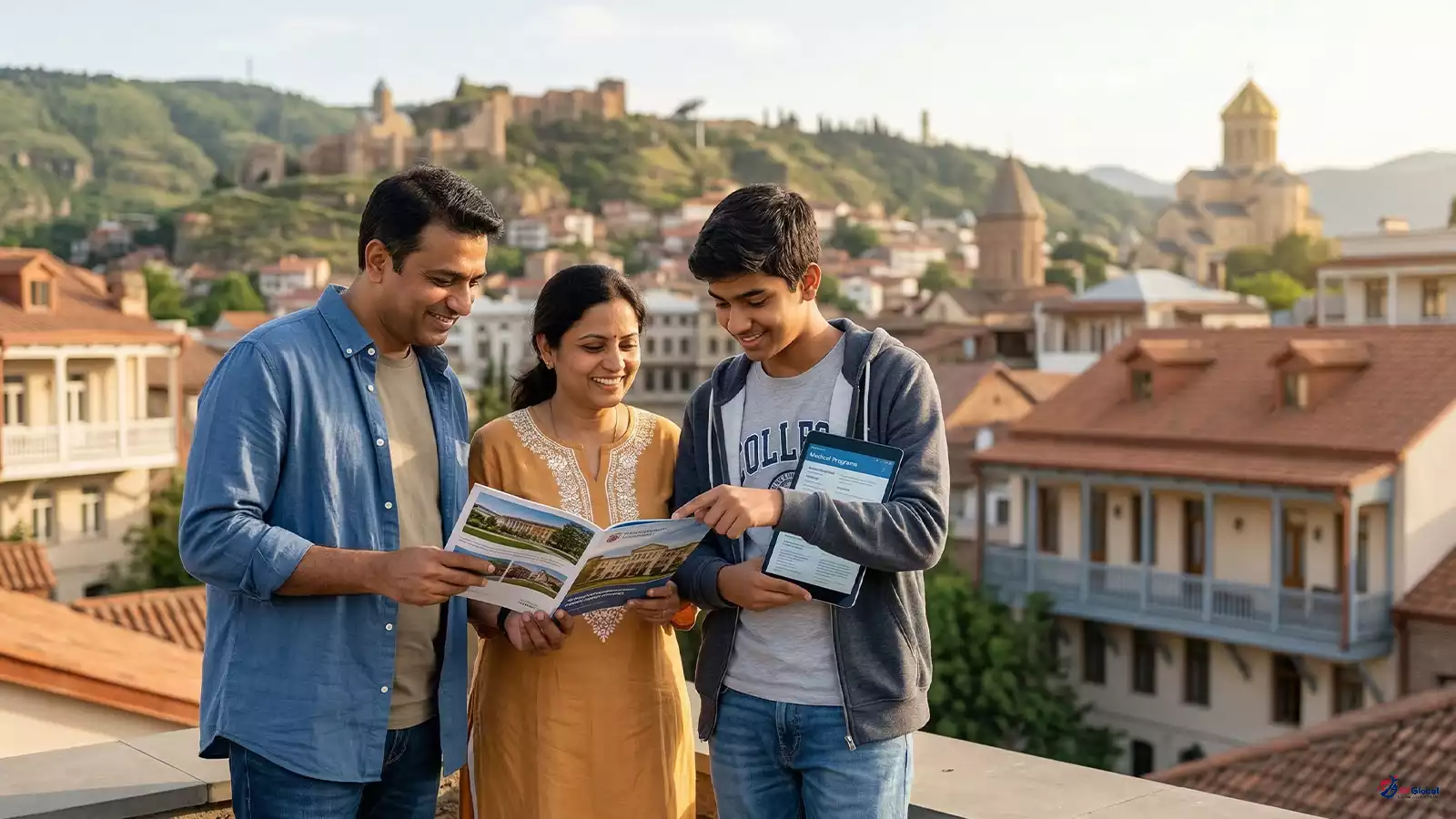
Every year, a small number of AV Global parents visit their children in Tbilisi. Some come because they planned to. Others come because they needed to see it themselves before they could feel settled.
Almost all of them say the same thing when they return to India.
"It is cleaner than I expected. It is calmer than I expected. My child looks settled and confident in a way I did not quite believe was possible from the phone calls alone. I wish I had visited earlier so I could have stopped worrying sooner."
Georgia is not the safest country in the world. No such country exists. But for an Indian MBBS student, living in a managed hostel, studying at an NMC-approved university, with an experienced ground team available around the clock, Georgia offers a level of safety and stability that very few MBBS destinations can match.
Frequently Asked Questions: Safety in Georgia for Indian MBBS Students 2026
Based on years of operational experience placing Indian students in multiple countries, Georgia ranks among the safer destinations. Crime rates in Tbilisi are low relative to many comparable cities. The established Indian student community and available ground support further reduce practical risks.
Serious incidents have been rare exceptions over more than a decade of operations. Minor incidents, health issues, document losses, and accommodation adjustments are a normal part of any student's time abroad and are handled by the ground team as a matter of routine.
Yes, with appropriate accommodation choices and sensible personal safety habits. Georgia has a large and well-established population of Indian girl students. Managed hostel accommodation, particularly in the first two years, significantly reduces risk.
AV Global's Tbilisi ground team responds to student health situations around the clock. We have relationships with hospitals and clinics in Tbilisi and coordinate directly with parents in India during any medical situation.
The areas immediately surrounding major medical universities in Tbilisi are well-lit, commercially active, and generally safe for students to navigate during reasonable hours. Students are advised against walking alone in unfamiliar areas late at night, as in any city.
Most university-affiliated and managed hostels in Georgia operate with warden systems, registered visitor policies, CCTV coverage at entry points, and structured check-in norms for younger students. AV Global's own hostels have additional oversight and Indian support staff.
The Bottom Line Every Parent Needs to Read
No honest counsellor will tell you that sending your child to a foreign country involves zero risk. Anyone who tells you that is lying to make a sale.
What can be said with complete confidence, based on over a decade of sending Indian students to Georgia, is this.
Georgia is a stable, functional country with low violent crime. Its cities are used to foreign students. Its universities have structured safety systems. And for AV Global students specifically, there is a real team with real offices and real people on the ground in Tbilisi who know your child by name.
Thousands of Indian parents who were sitting exactly where you are now, asking the same question you are asking, made the decision to send their child to Georgia. The overwhelming majority of them report the same thing two years later: my child is safe, settled, and becoming the doctor we always believed they could be.
If safety is your primary concern before starting the admission process, book a free counselling session with AV Global Overseas. We will walk you through the real safety systems in place, the real incidents we have handled over the years and how they were resolved, and the specific arrangements we make for your child from the moment they land in Tbilisi. No reassuring half-answers. Just the complete picture.
Book Your Free Counselling Session Today
If you're reviewing country-wise FMGE/NExT passing rates, don't miss our analysis on MBBS in Kazakhstan.