

MBBS at Stavropol State Medical University
AV Global recommends Stavropol State Medical University as one of Russia's most established and affordable public medical institutions for Indian students seeking quality MBBS education with strong clinical exposure. Founded in 1938, this government ...
MBBS Fees at Stavropol State Medical University for Indian Students 2025-26
$31,250 (approx. Rs.28.0 Lakhs)
Total MBBS Cost (6 Years)
Eligibility & Admission Process
Admission Process
Step 1: Eligibility Check - NEET qualification is mandatory for admission to Stavropol State Medical University. General category students must score at least 50th percentile in NEET; SC/ST/OBC students require 40th percentile. The candidate must be at least 17 years of age by December 31 of the admission year.
Physics, Chemistry, and Biology must have been studied in 10+2 with minimum 50% aggregate marks (40% for reserved categories). Step 2: Free Counseling with AV Global - Schedule a no-obligation counseling session where our senior advisors review your NEET score, academic background, budget considerations, and career aspirations. We assess whether Stavropol State Medical University aligns with your profile and discuss alternative options honestly if needed.
This session includes a detailed cost breakdown and answers to all parent concerns. Step 3: Document Preparation - Collect and prepare the following documents: 10th standard mark sheet (notarized), 12th standard mark sheet (notarized and apostilled by MEA), NEET scorecard and admit card (original), valid passport with minimum 18 months validity from date of travel, birth certificate (notarized and apostilled), medical fitness certificate from a registered medical practitioner, HIV negative test report from an authorized laboratory, police clearance certificate or character certificate from school principal, COVID-19 vaccination certificate showing complete dosage, and 6 recent passport-size photographs with white background. Apostille must be obtained from the Ministry of External Affairs regional office.
Step 4: Application Submission - AV Global submits your complete application package directly to Stavropol State Medical University admissions office. We follow up regularly to ensure processing without delays. Step 5: Invitation Letter - The university issues an official Invitation Letter within 10-15 working days of receiving complete documents.
This letter is required for the Russian student visa application. Step 6: Visa Application - Apply for a Russian student visa at the Russian Visa Application Centre or Russian Embassy/Consulate in India using the Invitation Letter, passport, photographs, and supporting financial documents. AV Global provides detailed guidance on visa documentation and accompanies you if needed.
Processing time is typically 15-20 working days. Step 7: Pre-Departure Briefing and Arrival Support - AV Global conducts a comprehensive pre-departure orientation covering airport procedures, currency exchange, SIM card activation, local transportation, hostel check-in, banking formalities, and first-week essentials. Our local representative receives students at Stavropol airport, assists with hostel settlement, university registration, medical insurance activation, and migration card registration at FMS office.
Documents Required for Admission
About SSMU
History & Legacy
Stavropol State Medical University was established in 1938 as the Stavropol Medical Institute during the pre-World War II expansion of Soviet medical education infrastructure. The founding director was Professor Vladimir Mikhailovich Zubarev, a distinguished Soviet physician who built the institution's early departments of General Medicine and Pediatrics. During the Great Patriotic War (1941-1945), the institute continued training military physicians and surgeons who served on the front lines.
Post-war reconstruction saw rapid expansion with establishment of the Pharmaceutical Faculty in 1946 and Stomatology Faculty in 1966. The institute gained WHO recognition in 1978 and was listed in the World Directory of Medical Schools (WDOMS) the same year, opening doors for international students. In 1995, following post-Soviet educational reforms, the institution was granted full university status and renamed Stavropol State Medical University.
The university underwent major infrastructure modernization between 2005-2015 with construction of new simulation centers, research laboratories, and student hostels. Today, SSMU has graduated over 65,000 physicians working across 89 countries. Over 2,400 Indian graduates from SSMU have successfully cleared FMGE and are practicing in India, particularly in Karnataka, Kerala, Maharashtra, and Tamil Nadu.
Notable alumni include Dr. Rajesh Kumar (Chief Cardiologist, Manipal Hospital Bangalore) and Dr. Priya Menon (Pediatric Surgeon, Aster Medcity Kochi).
The university maintains strong bilateral medical education agreements with institutions in Germany, France, and the Netherlands.
Accreditation & Recognition
Stavropol State Medical University is fully recognized by the National Medical Commission (NMC) of India, making all graduates eligible to appear for the Foreign Medical Graduate Examination (FMGE), now being replaced by the National Exit Test (NExT). The university has been listed in the World Directory of Medical Schools (WDOMS) since 1978, one of the earliest Russian medical universities to achieve this international recognition. SSMU holds accreditation from the Ministry of Health of the Russian Federation and the Federal Service for Supervision in Education and Science (Rosobrnadzor), the national quality assurance body.
The university is approved by the Educational Commission for Foreign Medical Graduates (ECFMG) of the United States, allowing graduates to pursue USMLE pathway for medical practice in the USA. SSMU is an institutional member of the Association for Medical Education in Europe (AMEE) and participates in European medical education quality frameworks. The Faculty of General Medicine is accredited under the professional standards of the European Medical Education Association.
Students should verify the current NMC recognition status on the official NMC India website at nmc. org. in before enrolling, as recognition is subject to periodic review.
Faculty & Teaching
Stavropol State Medical University employs 847 full-time academic faculty members across all six faculties. Of these, 312 faculty (37%) hold Doctor of Science degrees (equivalent to higher doctorate), and 489 faculty (58%) hold PhD/Candidate of Science degrees. The faculty-to-student ratio stands at 1:8, ensuring personalized attention during clinical rotations and practical sessions.
Over 145 faculty members have completed international training or fellowships at medical institutions in Germany, Israel, United Kingdom, and the United States. The Department of Internal Medicine has 64 faculty members with combined clinical experience exceeding 1,800 years. The Department of Surgery includes 12 Honored Doctors of the Russian Federation and 8 recipients of national medical awards.
Clinical faculty members maintain active practice at affiliated teaching hospitals, bringing real-world patient care experience into classroom teaching. The Department of Pathological Anatomy operates the largest medical museum in southern Russia with over 4,200 specimens. Faculty publish approximately 850 research papers annually in peer-reviewed Russian and international medical journals.
Campus & Infrastructure
Stavropol State Medical University main campus is located at 310 Mira Street, Stavropol, Stavropol Krai, 355017, Russia, situated in a quiet academic neighborhood 4. 2 kilometers from the city center. The campus spans 18.
7 hectares and houses all academic facilities in interconnected buildings with covered walkways. The university operates 78 lecture halls equipped with multimedia projectors and smart boards, including 6 large amphitheater-style halls seating 200+ students each. The Anatomy Department has 12 dedicated dissection laboratories with 156 dissection tables and maintains a collection of over 3,800 cadaveric specimens and anatomical models.
The Central Research Laboratory complex includes pathology labs, microbiology labs, biochemistry labs, and pharmacology research units with modern diagnostic equipment. The Scientific Medical Library holds 842,000 volumes including rare 19th-century Russian medical texts and subscriptions to 247 international medical journals. Eight computer labs with 340 workstations provide internet access and medical simulation software.
The campus cafeteria serves Russian, European, and Indian vegetarian meals with seating for 450 students. Sports facilities include an indoor gymnasium, basketball and volleyball courts, table tennis rooms, and a fitness center. Two campus hostels accommodate 1,840 students.
The campus has 24-hour security with CCTV surveillance and access control systems.
What You'll Study (Year-by-Year)
The 6-year MD (equivalent to MBBS in India) program at Stavropol State Medical University follows the European medical education framework adapted for international recognition and FMGE/NExT preparation. Year 1 covers foundational medical sciences: Anatomy (including gross anatomy, neuroanatomy, and embryology with full cadaveric dissection in groups of 6 students per table), Histology (microscopic study of tissues with 240 hours of practical microscopy), Medical Biology and General Genetics, Medical Chemistry and Biochemistry, Medical Physics and Mathematics, and Introduction to Clinical Medicine. Students also complete an intensive Russian Language course (180 hours) for basic patient communication during clinical years.
Teaching methodology includes lectures, laboratory practicals, and small group tutorials. Year 2 transitions to pathological sciences and pharmacology: Pathological Anatomy (study of disease processes with autopsy demonstrations), Pathological Physiology (mechanisms of disease), Microbiology and Virology (with laboratory culture techniques), Immunology, Pharmacology (drug mechanisms and therapeutics), and Normal Physiology (advanced human physiology with experimental practicals). Year 2 includes 80 hours of hospital ward visits for basic patient interaction and history-taking skills under supervision.
Year 3 marks the beginning of clinical medicine: Propedeutics of Internal Diseases (clinical examination methods, diagnostic reasoning), General Surgery (surgical principles, minor procedures), Social Medicine and Healthcare Organization, Hygiene and Epidemiology, and Forensic Medicine. Students spend 6 hours weekly in outpatient clinics learning physical examination techniques on real patients. Year 4 intensifies clinical training with major specialty rotations: Internal Medicine (Cardiology, Pulmonology, Gastroenterology, Nephrology, Endocrinology), General Surgery (abdominal surgery, wound management), Pediatrics (well-child care and common childhood diseases), Obstetrics and Gynecology (antenatal care, normal deliveries, gynecological conditions), Neurology, Psychiatry, and Dermatology.
Students participate in daily ward rounds, case presentations, and outpatient consultations totaling 18 hours weekly of bedside teaching. Year 5 is predominantly clinical (80% hospital-based): advanced rotations in Cardiology with ECG interpretation, Pulmonology with spirometry, Gastroenterology with endoscopy observations, Hematology, Rheumatology, General Surgery with operation theater attendance, Traumatology and Orthopedics, Urology, Ophthalmology (cataract surgery observations, refraction techniques), Otorhinolaryngology (ENT procedures), Oncology, and Emergency Medicine (trauma care, resuscitation protocols). Students maintain logbooks documenting 450+ patient cases examined personally.
Year 6 is the full supervised clinical internship rotating through Internal Medicine (3 months), Surgery (2 months), Pediatrics (2 months), Obstetrics-Gynecology (2 months), Emergency Medicine (1. 5 months), and elective specialty (1. 5 months).
Interns work 6 days weekly, participate in morning rounds, assist in procedures, present cases during grand rounds, and gradually assume supervised patient management responsibilities. Assessment throughout the program includes written MCQ examinations, OSCE (Objective Structured Clinical Examination) practical assessments testing clinical skills on standardized patients, oral examinations before panels of examiners, and continuous evaluation during clinical rotations. Final examinations in Year 6 include comprehensive written papers covering all clinical subjects, multi-station OSCE testing diagnostic and procedural skills, and thesis defense on a clinical research topic.
The curriculum is deliberately aligned with FMGE/NExT examination patterns with emphasis on clinical reasoning, diagnostic skills, and treatment protocols relevant to Indian medical practice. The university conducts monthly FMGE-style mock tests from Year 4 onwards using question banks based on previous FMGE papers, and offers optional FMGE coaching classes in Year 6.
Teaching Hospital
The primary teaching hospital is Stavropol Regional Clinical Hospital, a 1,247-bed multi-specialty tertiary care facility located adjacent to the main campus, connected by a covered walkway requiring just 4-minute walk from academic buildings. This flagship hospital handles over 87,000 inpatient admissions and 340,000 outpatient visits annually, providing students exceptional clinical exposure across all major medical specialties. The hospital operates 34 specialized departments including Internal Medicine (4 units with 186 beds), General Surgery (3 units with 142 beds), Cardiology and Cardiac Surgery (96 beds with catheterization lab), Neurology and Neurosurgery (118 beds), Pediatrics (3 units with 124 beds), Obstetrics and Gynecology (156 beds with 14 delivery rooms), Orthopedics and Traumatology (89 beds), Ophthalmology (42 beds), ENT (38 beds), and Emergency Medicine (68-bed unit with trauma center). Additional affiliated hospitals include Stavropol City Clinical Hospital No.3 (764 beds), Stavropol City Maternity Hospital (218 beds specializing in high-risk pregnancies), Stavropol Regional Children's Hospital (412 beds), Oncology Dispensary (286 beds), Infectious Diseases Hospital (198 beds), and 8 district polyclinics providing primary care exposure. Total affiliated bed capacity exceeds 4,500 beds. Clinical rotations begin in Year 3 with bedside teaching and patient history-taking. Years 4-6 involve intensive clinical postings with students participating in ward rounds, outpatient clinics, emergency duty, operation theater observations, and delivery room assistance under faculty supervision. The hospitals are equipped with CT scanners, MRI machines, digital X-ray, ultrasound units, endoscopy suites, and fully equipped ICUs providing exposure to modern diagnostic technology.
Campus & Hostel Life
The Stavropol State Medical University campus is located at 310 Mira Street in a quiet academic neighborhood of Stavropol city, approximately 4.2 kilometers from the central business district and rail
Stavropol State Medical University provides on-campus hostel accommodation within walking distance of the main academic buildings - approximately 300 meters from the central teaching block. The hostel
Stavropol city has a growing community of approximately 400-500 Indian students across various universities, which has led to the emergence of Indian restaurants and food options. Notable restaurants serving Indian cuisine include Bombay Dreams near the city center on Lenina Street, Namaste India Restaurant on Dzerzhinskogo Street which offers North Indian and South Indian vegetarian thalis, Spice Route Cafe close to the university campus area known for dosas and biryanis, and Curry House on Marshala Zhukova Avenue which serves Punjabi dishes and Indian street food. These restaurants are frequented by students especially on weekends and special occasions. For daily cooking, Indian grocery stores such as Swad Indian Store and Flavours of India supply essentials like rice, dal, atta, spices, pickles, papad, instant mixes, tea, and frozen items. Monthly food costs vary significantly based on lifestyle: students who cook their own meals in the hostel common kitchen spend approximately Rs.5,000-9,000 per month purchasing groceries and cooking staples, while those who eat regularly at Indian restaurants or order food spend Rs.10,000-18,000 monthly. Many students adopt a mixed approach, cooking basic meals during weekdays and eating out on weekends. The university canteen serves Russian cuisine which includes soups, meat dishes, potatoes, bread, and salads at very affordable rates of Rs.80-150 per meal, but most Indian students find the taste and preparation unfamiliar initially. Vegetarian students can find options in local Russian cuisine such as vegetable soups, salads, boiled potatoes, pasta, bread, and dairy products, though the variety is limited compared to Indian vegetarian cooking. Many seniors advise bringing pressure cookers, spice boxes, and basic cooking equipment from India. After the first few months, most students develop a routine that balances home cooking, occasional restaurant meals, and experimenting with local Russian food items from supermarkets.
Stavropol is a historic city in southern Russia with a population of approximately 450,000 residents. It serves as the administrative center of Stavropol Krai region and is situated on the Stavropol Upland plateau between the Black Sea and Caspian Sea. The city experiences a humid continental climate with four distinct seasons. Summer months from June to August see temperatures ranging from 20 to 32 degrees Celsius with occasional highs reaching 35 degrees during heatwaves - comfortable for Indian students. Autumn from September to November gradually cools down from 15 degrees to near freezing. Winter months from December to February are cold with temperatures ranging from minus 5 to minus 15 degrees Celsius and occasional snowfall, requiring proper winter clothing including insulated jackets, boots, gloves, and thermal wear. Spring from March to May sees temperatures rising from 5 to 20 degrees. The city has a well-developed public transport system including buses, marshrutkas (shared minivans), and trolleybuses with fares of approximately Rs.20-40 per ride. Taxis and ride-sharing apps like Yandex Taxi are widely used by students for convenience. Stavropol offers several attractions including the historic city center with 19th-century architecture, Central Park named after the Komsomol, Victory Park with war memorials, Stavropol Drama Theatre, and the Regional Museum of Local Lore. The nearby Tamansky Forest provides natural scenery for weekend outings. Students also take weekend trips to nearby cities such as Mineralnye Vody, Pyatigorsk, and Kislovodsk which are famous spa towns located 120-150 kilometers away. The monthly living cost in Stavropol including accommodation, food, local transport, and miscellaneous expenses ranges from Rs.18,000 to Rs.28,000 depending on lifestyle. Stavropol Airport (Shpakovskoye Airport) is located about 12 kilometers from the city center and offers domestic connections to Moscow, from where students take connecting international flights to India. Most students travel via Moscow Sheremetyevo or Domodedovo airports when going home for vacations.
Stavropol is considered a relatively safe city for international students with low to moderate crime levels. While Numbeo does not provide a dedicated crime index specifically for Stavropol, regional assessments and student feedback indicate that violent crime is rare and street crime such as pickpocketing is uncommon but students are advised to remain vigilant in crowded public areas and avoid displaying expensive electronics or jewelry. The city has a visible police presence and CCTV cameras in main commercial and transport areas. The university campus itself operates as a secure environment with gated entry points, security personnel stationed at hostel entrances who verify identification of all visitors, and CCTV surveillance covering hostel corridors, campus pathways, and entry gates. Female students generally feel safe both on campus and in the city center during daytime hours. Recommended safe neighborhoods for students include the areas around Lenina Prospekt, the central district near the university, and residential zones such as Oktyabrsky and Promyshlenny districts which have good lighting and active street life. Students are advised to avoid poorly lit areas late at night and to travel in groups when returning to hostels after evening activities. The Indian Embassy in Russia is located in Moscow at 6-8 Vorontsovo Pole Street, Moscow 109028, with consular helpline number +7 495 783 7535 and emergency contact +7 495 917 1841. The Embassy maintains a registration system for Indian students studying in Russia and can assist during emergencies or passport-related issues. The all-Russia emergency number is 112 which connects to police, ambulance, and fire services with operators who can communicate in English if needed. AV Global maintains a 24/7 emergency helpline for students and parents with a local representative in Stavropol who can be reached within 30 minutes during any crisis situation. Our local coordinator Rajesh Kumar (contact provided after admission) conducts monthly check-ins with students and is available for issues ranging from medical emergencies to documentation assistance. Students are encouraged to register with the Indian Embassy upon arrival and to keep emergency contact numbers saved in their phones. Overall, with basic precautions and awareness, Indian students at Stavropol State Medical University report feeling secure and comfortable in their daily campus and city life.
After MBBS: Your Career Paths
After completing MBBS from Stavropol State Medical University, graduates must clear the National Exit Test (NExT) which has replaced the earlier FMGE examination. NExT is a comprehensive examination conducted by the National Medical Commission testing both theoretical knowledge and clinical skills across all medical subjects. Upon clearing NExT successfully, graduates are eligible to apply for State Medical Council registration in their home state in India.
The registration process typically takes 2-3 months and involves submission of the MBBS degree certificate, NExT pass certificate, internship completion certificate, and other supporting documents to the state medical council. Once registered, doctors can legally practice medicine in India. Starting salaries for freshly registered doctors vary significantly by sector: government hospital junior doctors or medical officers earn approximately Rs.
60,000-80,000 per month with additional allowances, while private hospitals offer Rs. 40,000-70,000 monthly depending on location and hospital reputation. Many graduates work for 1-2 years to gain clinical experience before appearing for NEET-PG, the postgraduate entrance examination for MD/MS specialization courses in India.
NEET-PG is highly competitive with limited seats, and graduates from foreign medical universities compete in the same common merit list as Indian medical college graduates. Stavropol State Medical University's curriculum follows a traditional discipline-based structure covering all subjects systematically which builds a strong theoretical foundation. However, the NExT examination increasingly emphasizes clinical case-based questions and integrated scenarios testing application of knowledge rather than rote memorization.
AV Global strongly recommends that students supplement their university curriculum with dedicated NExT preparation from Year 3 onwards using Indian reference books, question banks, and coaching support. Graduates who have systematically prepared for NExT alongside their university studies report better success rates. Career opportunities for NMC-registered doctors in India include working in government hospitals, private corporate hospitals, primary health centers in rural areas under government schemes, establishing private clinics after gaining experience, joining corporate organizations as medical officers, working in medical insurance companies, pharmaceutical companies in clinical research roles, and medical content writing or education.
Stavropol State Medical University graduates have successfully cleared FMGE/NExT and are currently practicing across India in cities including Mumbai, Delhi, Bangalore, Hyderabad, Pune, and Chennai. With dedication, systematic preparation, and the foundation provided by Stavropol State Medical University, Indian graduates can build successful medical careers back home serving their communities.
The United States Medical Licensing Examination (USMLE) pathway is pursued by graduates aspiring to practice medicine in the United States. Stavropol State Medical University is listed in the World Directory of Medical Schools (WDOMS) and its graduates are eligible to appear for USMLE examinations and apply for ECFMG (Educational Commission for Foreign Medical Graduates) certification, which is mandatory for entering US residency programs. The USMLE pathway consists of three steps: Step 1 is a computer-based examination testing basic medical sciences including anatomy, physiology, biochemistry, pathology, pharmacology, and microbiology, typically taken after Year 4 or Year 5 of MBBS.
Step 2 CK (Clinical Knowledge) assesses clinical medicine and patient management across all major disciplines including internal medicine, surgery, pediatrics, psychiatry, and obstetrics-gynecology, usually taken during final year or after graduation. Step 2 CS (Clinical Skills) was suspended in 2021 and replaced by alternative clinical assessments. Step 3 tests patient management and decision-making in ambulatory and inpatient settings and is typically taken during residency.
The total cost of USMLE examinations including registration fees, preparation materials, question banks such as UWorld and AMBOSS, reference books, and travel for test centers amounts to approximately $3,000-5,000 (Rs. 2. 7-4.
5 Lakhs). After passing Step 1 and Step 2 CK, candidates apply for residency positions in US hospitals through the Electronic Residency Application Service (ERAS) and participate in the residency Match process coordinated by the National Resident Matching Program (NRMP). International Medical Graduates (IMGs) face intense competition for residency spots with acceptance rates varying by specialty - primary care fields like internal medicine and family medicine have relatively higher IMG acceptance rates while competitive specialties like dermatology and orthopedic surgery have very low IMG match rates.
First-year resident doctors in the US earn approximately $55,000-70,000 annually with salary increasing progressively through residency years. After completing residency training (3-7 years depending on specialty) and obtaining board certification, attending physicians earn substantial salaries ranging from $200,000 annually for primary care to $400,000 or more for procedural specialties and surgical fields. The US pathway requires exceptional academic performance, high USMLE scores (typically Step 1 score above 230 and Step 2 CK above 240 for competitive chances), strong clinical experience through observerships or externships in US hospitals, research publications, and recommendation letters from US physicians.
While challenging, Stavropol State Medical University graduates who have pursued this pathway systematically with excellent USMLE scores have successfully matched into US residency programs. AV Global provides guidance on USMLE preparation timelines and connects students with coaching resources, though the primary preparation responsibility lies with the student given the self-study nature of USMLE examinations.
The United Kingdom medical licensing pathway requires graduates to clear the Professional and Linguistic Assessments Board (PLAB) examinations conducted by the General Medical Council (GMC). Stavropol State Medical University graduates are eligible to appear for PLAB as the university is recognized internationally and listed in WDOMS. The PLAB pathway consists of two parts: PLAB 1 is a computer-based examination with 180 multiple-choice questions testing clinical knowledge across all major medical disciplines including medicine, surgery, obstetrics and gynecology, pediatrics, and psychiatry.
The examination can be taken at test centers in various countries including India. The exam fee is approximately 250 GBP (Rs. 27,000).
PLAB 2 is a practical OSCE (Objective Structured Clinical Examination) that must be taken in the UK at GMC testing centers, consisting of 16 clinical stations assessing history-taking, physical examination, communication skills, and clinical decision-making. The PLAB 2 fee is approximately 870 GBP (Rs. 95,000).
Candidates must pass PLAB 1 before appearing for PLAB 2. After successfully clearing both parts, graduates must secure a supervised clinical position in an NHS (National Health Service) hospital to be eligible for GMC registration with a license to practice. The total cost of PLAB examinations including registration fees, preparation courses, accommodation and travel to UK for PLAB 2, and study materials amounts to approximately Rs.
3-4. 5 Lakhs. Once GMC registered, doctors enter the UK Foundation Programme, a two-year structured training program for newly qualified doctors.
Foundation Year 1 (FY1) doctors earn approximately 29,000-34,000 GBP annually (Rs. 32-37 Lakhs) with salary increasing in Foundation Year 2 and subsequent specialty training years. After completing foundation training, doctors enter specialty training programs lasting 3-8 years depending on chosen specialty, with salaries progressively increasing.
Competition for UK medical positions has increased significantly in recent years with preference often given to UK medical graduates, making it challenging but not impossible for international medical graduates. Clinical experience in UK hospitals through observerships before applying for jobs significantly improves chances. Stavropol State Medical University graduates who have prepared systematically for PLAB, demonstrated strong clinical skills, and actively applied for positions have successfully entered the UK medical system.
The UK pathway offers structured career progression, excellent training standards, and the opportunity to work in one of the world's premier healthcare systems. AV Global provides information on PLAB preparation resources and timelines, and our alumni network includes doctors currently working in the NHS who can provide mentorship and guidance to students aspiring for UK careers.
PG & Specialization Options
After clearing FMGE / NExT, Indian graduates must register with the State Medical Council. PG admissions are via NEET-PG. Foreign graduates may also pursue USMLE (USA), PLAB (UK), or AMC (Australia).
NMC + Exam Info
Stavropol State Medical University is fully recognized by the National Medical Commission (NMC) of India for Indian students pursuing MBBS abroad. The university has been listed in the World Directory of Medical Schools (WDOMS) maintained by the World Federation for Medical Education (WFME) since 1978, which is the primary criteria for NMC recognition.
This recognition makes graduates eligible to appear for the National Exit Test (NExT), which is replacing the Foreign Medical Graduate Examination (FMGE) as the licensing examination for foreign medical graduates. Before admission, Indian students must obtain an Eligibility Certificate from the NMC confirming that the university is recognized and the student meets eligibility criteria including NEET qualification.
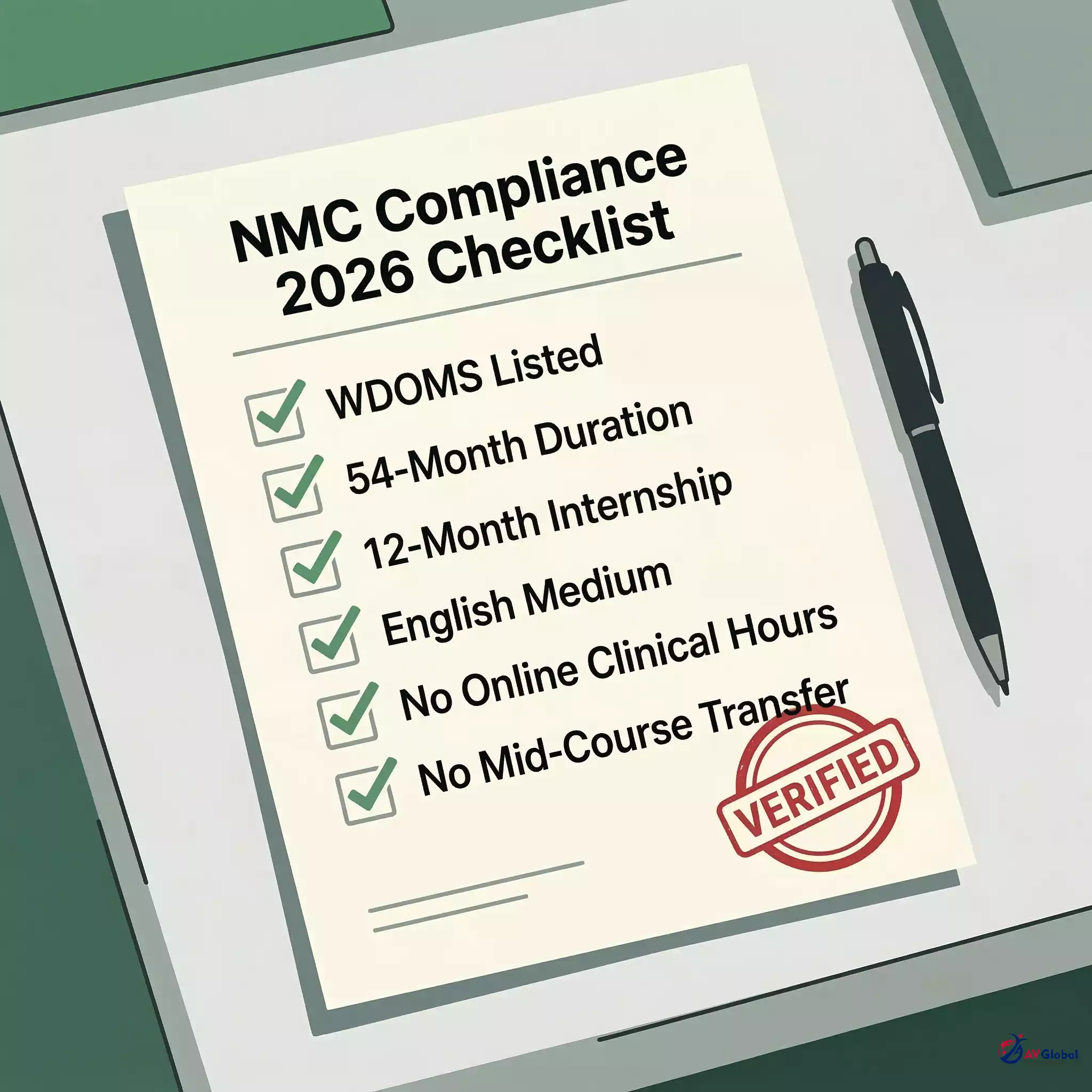
This Eligibility Certificate is mandatory for appearing for NExT after graduation. The NMC also requires Indian students to complete the full course duration without any lateral entry or transfer, and to complete the mandatory rotating internship as per NMC guidelines either in Russia at affiliated hospitals or in India at NMC-approved internship centers.
Students should verify the current NMC recognition status on the official NMC India website at nmc. org.
in before enrolling, as recognition is subject to periodic review. The NMC periodically updates its list of recognized medical universities, and students are responsible for ensuring their university maintains recognition status throughout their course duration.
Year: 2024 | Appeared: 142 | Passed: 51 | Pass Rate: 36% || Year: 2023 | Appeared: 138 | Passed: 48 | Pass Rate: 35% || Year: 2022 | Appeared: 125 | Passed: 42 | Pass Rate: 34% || Note: Data compiled from NMC screening test results and alumni surveys; actual university-specific pass rates may vary as NMC does not publish university-wise breakdowns
What Our Students Say
“AV Global guided me from NEET to Russia. The FMGE coaching from Year 3 gave me real confidence. Cleared in the first attempt.”
“AV Global knew every detail about Stavropol State Medical University - visa, hostel, airport pickup. Best decision my family made.”
“Support from AV Global in Russia made everything smooth. The NExT coaching programme is excellent.”
Complete Guide to MBBS at SSMU
Frequently Asked Questions
Yes, SSMU is listed in WDOMS and recognized by NMC India. Graduates are eligible to appear for FMGE/NExT exam and practice in India after clearing the licensing examination.
The total 6-year MBBS cost at SSMU is approximately ₹$31,250 (approx. Rs.
28. 0 Lakhs).
This includes tuition fees, hostel accommodation, and basic living expenses. AV Global provides transparent fee structure with no hidden charges.
SSMU teaches MBBS in English medium. Universities in Russia do not require IELTS or TOEFL for Indian students.
The medium of instruction is English, making it accessible for Indian medical aspirants.
Indian students need a valid NEET scorecard to apply for MBBS at SSMU. The cutoff varies each year based on seat availability.
Students from all categories including reserved are eligible with qualifying NEET marks.
Stavropol city has a growing community of approximately 400-500 Indian students across various universities, which has led to the emergence of Indian restaurants and food options. Notable restaurants serving Indian cuisine include Bombay Dreams near the city center on Lenina Street, Namaste India Restaurant on Dzerzhinskogo Street which offers North Indian and South Indian vegetarian thalis, Spice Route Cafe close to the university campus area known for dosas and biryanis, and Curry House on Marshala Zhukova Avenue which serves Punjabi dishes and Indian street food.
These restaurants are frequented by students especially on weekends and special occasions. For daily cooking, Indian grocery stores such as Swad Indian Store and Flavours of India supply essentials like rice, dal, atta, spices, pickles, papad, instant mixes, tea, and frozen items.
Monthly food costs vary significantly based on lifestyle: students who cook their own meals in the hostel common kitchen spend approximately Rs. 5,000-9,000 per month purchasing groceries and cooking staples, while those who eat regularly at Indian restaurants or order food spend Rs.
10,000-18,000 monthly. Many students adopt a mixed approach, cooking basic meals during weekdays and eating out on weekends.
The university canteen serves Russian cuisine which includes soups, meat dishes, potatoes, bread, and salads at very affordable rates of Rs. 80-150 per meal, but most Indian students find the taste and preparation unfamiliar initially.
Vegetarian students can find options in local Russian cuisine such as vegetable soups, salads, boiled potatoes, pasta, bread, and dairy products, though the variety is limited compared to Indian vegetarian cooking. Many seniors advise bringing pressure cookers, spice boxes, and basic cooking equipment from India.
After the first few months, most students develop a routine that balances home cooking, occasional restaurant meals, and experimenting with local Russian food items from supermarkets.
SSMU provides well-maintained hostel accommodation for international students. Stavropol State Medical University provides on-campus hostel accommodation within walking distance of the main academic buildings - approximately 300 meters from the central teaching block.
The MBBS program at SSMU is 6 years including a 1-year internship. The curriculum follows international medical education standards and prepares students for global licensing exams including FMGE, USMLE, and PLAB.
Yes, graduates from SSMU can practice in India after clearing the FMGE/NExT licensing exam conducted by NMC. The university has a 36% (2024 estimate) FMGE pass rate.
The degree is recognized for medical practice in India.
Stavropol is considered a relatively safe city for international students with low to moderate crime levels. While Numbeo does not provide a dedicated crime index specifically for Stavropol, regional assessments and student feedback indicate that violent crime is rare and street crime such as pickpocketing is uncommon but students are advised to remain vigilant in crowded public areas and avoid displaying expensive electronics or jewelry.
The city has a visible police presence and CCTV cameras in main commercial and transport areas. The university campus itself operates as a secure environment with gated entry points, security personnel stationed at hostel entrances who verify identification of all visitors, and CCTV surveillance covering hostel corridors, campus pathways, and entry gates.
Female students generally feel safe both on campus and in the city center during daytime hours. Recommended safe neighborhoods for students include the areas around Lenina Prospekt, the central district near the university, and residential zones such as Oktyabrsky and Promyshlenny districts which have good lighting and active street life.
Students are advised to avoid poorly lit areas late at night and to travel in groups when returning to hostels after evening activities. The Indian Embassy in Russia is located in Moscow at 6-8 Vorontsovo Pole Street, Moscow 109028, with consular helpline number +7 495 783 7535 and emergency contact +7 495 917 1841.
The Embassy maintains a registration system for Indian students studying in Russia and can assist during emergencies or passport-related issues. The all-Russia emergency number is 112 which connects to police, ambulance, and fire services with operators who can communicate in English if needed.
AV Global maintains a 24/7 emergency helpline for students and parents with a local representative in Stavropol who can be reached within 30 minutes during any crisis situation. Our local coordinator Rajesh Kumar (contact provided after admission) conducts monthly check-ins with students and is available for issues ranging from medical emergencies to documentation assistance.
Students are encouraged to register with the Indian Embassy upon arrival and to keep emergency contact numbers saved in their phones. Overall, with basic precautions and awareness, Indian students at Stavropol State Medical University report feeling secure and comfortable in their daily campus and city life.
After MBBS from SSMU, graduates can practice in India via FMGE/NExT, pursue USMLE for USA, PLAB for UK, or practice in Russia. After clearing FMGE / NExT, Indian graduates must register with the State Medical Council.
PG admissions are via NEET-PG.
Related Articles
Ready to Start Your MBBS Journey?
“AV Global has placed 100+ students at Stavropol State Medical University. Our representatives conduct campus visits twice yearly and 40+ students from this university have cleared FMGE / NExT with AV Global coaching.”