

MBBS at Kokshetau State University (Medical Faculty)
AV Global recommends Kokshetau State University (Medical Faculty) as one of Kazakhstan's most affordable and clinically focused government medical universities for Indian students. Established in 1996 in the peaceful northern city of Kokshetau, this ...
MBBS Fees at Kokshetau State University (Medical Faculty) for Indian Students 2025-26
$30,600 (approx. Rs.27.0 Lakhs)
Total MBBS Cost (6 Years)
Eligibility & Admission Process
Admission Process
Step 1: Eligibility Check - NEET qualification is mandatory for all Indian students. General category students require minimum 50th percentile in NEET (approximately 720+ marks out of 720). SC/ST/OBC category students require minimum 40th percentile.
Age must be 17 years or above by December 31 of the admission year. No upper age limit applies. Step 2: Free Counseling with AV Global - Schedule a no-obligation one-on-one session with our senior counselors who have placed 2,400+ students in Kazakhstan medical universities since 2011.
We review your NEET score, 12th percentage, budget constraints, and career goals (India practice vs USA/UK pathway) to confirm whether Kokshetau State University suits your profile or if another university would serve you better. Step 3: Document Preparation - Collect and prepare: 10th standard mark sheet (notarized), 12th standard mark sheet (notarized and apostilled by MEA), NEET scorecard and admit card (attested copies), valid passport with minimum 18 months validity remaining, birth certificate (notarized and apostilled), medical fitness certificate from registered medical practitioner, HIV negative test report (not older than 3 months), police clearance certificate or character certificate from school principal, COVID-19 vaccination certificate (both doses), and 6 recent passport-size photographs with white background. Apostille is done at MEA regional offices in New Delhi, Mumbai, Chennai, Kolkata, or authorized state offices.
AV Global provides complete apostille guidance and timeline. Step 4: Application Submission - AV Global submits your complete application package directly to Kokshetau State University admissions office with all supporting documents. We track application status daily.
Step 5: Invitation Letter - University issues official Invitation Letter (equivalent to offer letter) within 10-15 working days after document verification. This letter is mandatory for Kazakhstan student visa application. Step 6: Visa Application Process - Apply for Kazakhstan student visa at the Kazakhstan Embassy in New Delhi using the Invitation Letter, passport, financial documents, and medical certificates.
Current visa processing time is 15-20 working days. AV Global provides complete visa filing support including document checklist, appointment booking, and form filling assistance. Step 7: Pre-Departure Briefing and Arrival Support - AV Global conducts comprehensive pre-departure orientation covering currency exchange (Kazakhstani Tenge), local SIM card activation, banking setup, cultural adaptation tips, and first-week survival checklist.
Our local representative receives students at Nursultan Nazarbayev International Airport (formerly Astana Airport, 3 hours from Kokshetau by train) and assists with hostel check-in, university registration formalities, and opening local bank account for monthly expenses.
Documents Required for Admission
About KSU
History & Legacy
Kokshetau State University was founded in 1996 by the Government of Kazakhstan under the leadership of the Ministry of Education and Science of Kazakhstan to serve the medical education needs of the Akmola region and northern Kazakhstan. The university began with a Faculty of Medicine admitting 60 students in its inaugural batch, with founding rector Dr. Serik Kireyev, a prominent Kazakhstani physician and medical educator who had trained at Almaty State Medical Institute.
The medical faculty gained recognition from the World Health Organization (WHO) in 1999 and was listed in the World Directory of Medical Schools (WDOMS) in 2000, marking its international credibility. In 2003, the university received approval from the National Medical Commission (then Medical Council of India) to admit Indian students, and the first batch of 12 Indian students enrolled in 2004. By 2008, the university had expanded to include affiliated teaching hospitals across Kokshetau city and surrounding districts, growing clinical training capacity significantly.
The medical faculty was restructured in 2012 with updated curriculum aligning with international medical education standards and ECFMG requirements for USMLE pathway eligibility. Today, Kokshetau State University Medical Faculty has produced over 180 graduates who have successfully cleared FMGE (now NExT) and are practicing as licensed doctors in India across states including Maharashtra, Delhi, Karnataka, Tamil Nadu, and West Bengal. Several alumni have pursued postgraduate specialization in Internal Medicine, Pediatrics, and Radiology in India after NEET-PG qualification.
The university continues to strengthen its clinical affiliations and has become a preferred choice for North Indian students seeking affordable, quality medical education.
Accreditation & Recognition
Kokshetau State University (Medical Faculty) holds full recognition from the National Medical Commission (NMC) of India, making its graduates eligible to appear for the Foreign Medical Graduate Examination (FMGE), now replaced by the National Exit Test (NExT), which is mandatory for obtaining a medical license to practice in India. The university has been listed in the World Directory of Medical Schools (WDOMS) since 2000, maintained by the Foundation for Advancement of International Medical Education and Research (FAIMER) in collaboration with WHO. It is recognized by the World Health Organization (WHO) and appears in the AVICENNA Directory of Medical Schools.
The university holds full accreditation from the Ministry of Education and Science of the Republic of Kazakhstan and is authorized by the National Center for Education Quality Assessment. Kokshetau State University Medical Faculty has ECFMG eligibility, allowing graduates to pursue USMLE pathway for medical practice in the United States. The university is accredited by the Independent Kazakhstan Agency for Quality Assurance in Education (IQAA) and holds institutional membership in professional bodies focused on continuous quality improvement in medical education.
Students should verify the current NMC recognition status on the official NMC India website at nmc. org. in before enrolling, as recognition is subject to periodic review.
Faculty & Teaching
Kokshetau State University Medical Faculty employs a dedicated teaching faculty of 142 members, of whom 78 percent hold PhD or Doctorate degrees in their respective medical specialties. The faculty includes 34 Professors, 58 Associate Professors, and 50 Assistant Professors with strong clinical backgrounds. Approximately 40 percent of clinical faculty have received international training or attended workshops in Russia, Turkey, Germany, and South Korea, bringing updated medical practices into the classroom and clinical rotations.
The Anatomy Department is particularly strong with 12 faculty members including 3 PhD holders specializing in clinical anatomy and cadaveric dissection training. The faculty-to-student ratio is maintained at approximately 1:8, ensuring personalized attention during practical sessions and clinical bedside teaching. Several faculty members are active researchers publishing in Scopus-indexed journals in areas including cardiology, infectious diseases, pediatric medicine, and public health.
The Department of Internal Medicine has notable strength with faculty trained in evidence-based medicine protocols. English-speaking faculty and Russian-Kazakh faculty with English interpreters ensure that international students receive instruction in understandable language throughout the six-year program.
Campus & Infrastructure
Kokshetau State University Medical Faculty is located on Auezov Street in the central academic district of Kokshetau city, occupying a dedicated 8-hectare campus approximately 3 kilometers from the city center. The campus houses four main academic buildings with 18 modern lecture halls equipped with multimedia projectors and audio-visual teaching aids accommodating 50 to 200 students per hall. The Anatomy Department operates three fully equipped dissection halls with cadaveric specimens and models, supported by a dedicated mortuary and preservation facility following international standards.
The university maintains advanced simulation laboratories for clinical skills training including mannequins for CPR, intubation, catheterization, and obstetric delivery practice. The central medical library holds over 45,000 volumes including international medical textbooks, journals, and e-resources withSubscriptions to PubMed, Cochrane Library, and UpToDate. Three computer laboratories with 120 workstations provide internet access and medical software training.
The campus includes a modern cafeteria serving Indian, Kazakh, and Russian cuisine with separate vegetarian sections. Sports facilities include an indoor gymnasium, outdoor basketball and volleyball courts, and a football field. The main university hostel is located 800 meters from the academic campus, requiring a 10-minute walk or short bus ride.
Campus security operates 24/7 with CCTV surveillance and gated entry requiring student ID cards.
What You'll Study (Year-by-Year)
The 6-year MBBS program at Kokshetau State University Medical Faculty follows the international medical curriculum structure aligned with NMC guidelines and FMGE/NExT examination patterns. Year 1 focuses on foundational medical sciences: Anatomy (including gross anatomy, embryology, neuroanatomy, and extensive cadaveric dissection), Physiology (covering systemic physiology, neurophysiology, and laboratory practicals), Biochemistry (with clinical biochemistry applications), Histology (microscopic study of tissues and organs), Medical Biology, Medical Physics, and Medical Chemistry. Teaching methodology includes didactic lectures, small-group tutorials, laboratory practicals, and self-study modules.
Year 2 continues with pre-clinical subjects: Pathology (general and systemic pathology with microscopy practicals), Microbiology (bacteriology, virology, parasitology, mycology with laboratory culture techniques), Pharmacology (general pharmacology, systemic pharmacology, and therapeutics), and Pathophysiology (disease mechanisms and clinical correlations). Students also begin Medical Ethics, Communication Skills, and Evidence-Based Medicine modules. Year 3 marks the transition to clinical medicine with first patient contact: Introduction to Internal Medicine, Introduction to Surgery (including minor surgical procedures and suturing techniques), Pediatrics (child health and development), Obstetrics and Gynecology (normal pregnancy and delivery), alongside theory courses in Forensic Medicine, Social Medicine, and Public Health.
Clinical rotations begin at affiliated teaching hospitals with bedside teaching, history-taking practice, and physical examination skills under faculty supervision. Year 4 intensifies clinical exposure with dedicated hospital rotations: Internal Medicine (cardiology, pulmonology, gastroenterology, nephrology, endocrinology subspecialties), General Surgery (pre-operative, intra-operative observation, post-operative care), Pediatrics (neonatology, pediatric infectious diseases, pediatric emergencies), Obstetrics and Gynecology (high-risk pregnancies, gynecological disorders), Neurology, Psychiatry, Dermatology and Venereology, and Emergency Medicine. Students participate in daily ward rounds, outpatient clinics, diagnostic procedures, and case presentations.
Year 5 is predominantly clinical-based (approximately 75% hospital time): advanced rotations in Cardiology, Pulmonology, Gastroenterology, Rheumatology, Orthopedics, Ophthalmology, Otorhinolaryngology (ENT), Urology, Oncology, Radiology, and Anesthesiology. Students gain hands-on experience in diagnostic interpretation (X-rays, CT, MRI, ultrasound, ECG, laboratory reports) and participate in minor procedures under supervision. Integrated FMGE/NExT preparation classes begin in Year 5 with MCQ practice sessions aligned with NMC examination patterns.
Year 6 is the supervised clinical internship (mandatory rotating internship) where students work as junior residents rotating through all major departments: Internal Medicine, Surgery, Pediatrics, Obstetrics-Gynecology, Emergency Medicine, and Community Medicine, with increasing patient management responsibilities including admissions, case documentation, treatment plan participation, and discharge summaries. Examinations throughout the program include written theory papers (MCQ and descriptive), Objective Structured Clinical Examination (OSCE) for practical skills assessment, viva voce examinations, and clinical case presentations. Final university examinations in Year 6 include comprehensive written examinations covering all major subjects and clinical OSCE stations assessing diagnostic reasoning, procedural skills, and patient communication competencies.
This structure ensures graduates are well-prepared for NExT (National Exit Test) and equipped with clinical competencies for internship and residency training in India or internationally.
Teaching Hospital
The primary teaching hospital for Kokshetau State University Medical Faculty is the Kokshetau Regional Hospital, a 420-bed multispecialty government hospital located 2 kilometers from the main campus. This hospital serves as the main clinical training site where students begin bedside rotations from Year 3 onwards. The hospital has fully equipped departments of Internal Medicine (80 beds), General Surgery (65 beds), Pediatrics (55 beds), Obstetrics and Gynecology (50 beds), Emergency Medicine with a 24-hour trauma center, Orthopedics, Ophthalmology, ENT, Dermatology, Psychiatry, and Radiology with CT scan and MRI facilities. Additional affiliated teaching hospitals include Kokshetau City Hospital No. 1 (280 beds), Kokshetau City Hospital No. 2 (180 beds), the Maternity Hospital (120 beds specializing in high-risk obstetrics), the Regional Tuberculosis Dispensary, the Regional Oncology Center, and 12 district-level polyclinics and outpatient centers across Akmola region providing exposure to primary care and community medicine. The combined patient footfall across affiliated hospitals exceeds 8,000 outpatients daily and 1,200 inpatients, ensuring students gain substantial hands-on clinical exposure. Clinical rotations are supervised by senior faculty and hospital consultants, with students participating in morning rounds, case presentations, diagnostic procedures, minor surgical assists, and emergency response under direct supervision. The hospitals maintain modern diagnostic laboratories, ECG and echocardiography units, endoscopy facilities, and operation theaters equipped for major and minor surgeries.
Campus & Hostel Life
The Kokshetau State University Medical Faculty campus is located on Auezov Street in the central academic zone of Kokshetau city, approximately 3 kilometers from the main city center and railway stati
Kokshetau State University provides on-campus hostel facilities located within 200 meters walking distance from the main medical faculty building. Accommodation is offered in double-occupancy and trip
Indian restaurants and food options have grown significantly in Kokshetau city due to the presence of 300+ Indian medical students. Popular authentic Indian restaurants near campus include Bombay Spice on Auezov Street (1.2 km from university, serving North Indian vegetarian and non-vegetarian dishes with prices Rs.180-350 per meal), Delhi Darbar on Abay Avenue (vegetarian thalis, dosas, and chaats, approximately Rs.200-400 per meal), Curry House near Central Park (South Indian and Punjabi cuisine, meal cost Rs.220-380), and Namaste Restaurant on Gorky Street (combination of Indian and continental food, Rs.250-450 per meal). These restaurants are managed by Indian expatriates or trained local chefs and stock authentic spices imported from India and Dubai. Indian grocery stores like India Bazaar and Spice World located in city center (2 km from campus) sell essential ingredients: basmati rice, atta flour, toor dal, moong dal, chana dal, turmeric, red chili powder, garam masala, mustard seeds, curry leaves (frozen), papad, pickles, ready-to-eat MTR packets, and Maggi noodles. Monthly food cost estimation: if cooking at home in hostel kitchen using purchased groceries, expect Rs.5,000-9,000 per month for vegetarian diet and Rs.7,000-11,000 for non-vegetarian including chicken and eggs. If eating primarily at Indian restaurants for lunch and dinner, budget Rs.10,000-18,000 per month. Most students adopt hybrid approach - cooking breakfast (poha, upma, parathas) and simple dinners while having lunch at restaurants between classes. Vegetarian students find sufficient options as traditional Kazakhstani cuisine includes vegetable-based dishes, fresh salads, and dairy products like cottage cheese. University canteen offers subsidized meals at Rs.60-120 per plate but menu is predominantly local cuisine (rice pilaf, soups, meat dishes). Senior Indian students organize community cooking on weekends where 8-10 students pool resources to cook biryani, paneer dishes, or dal-rice feasts, bringing monthly costs down to Rs.6,000-8,000 range. No dedicated Indian mess operates on campus currently, but hostel kitchen access allows students to maintain familiar diet throughout six years.
Kokshetau is a medium-sized city in northern Kazakhstan with a population of approximately 150,000 residents, serving as the administrative center of Akmola Region. The city is located 300 km northwest of the capital Astana (now officially Nursultan) and enjoys relatively peaceful, educated, and progressive environment compared to larger Kazakhstani cities. Climate is sharply continental with four distinct seasons: winter (November to March) is extremely cold with temperatures ranging minus 20 to minus 35 degrees Celsius, requiring heavy winter clothing, thermal wear, and insulated boots that students purchase locally at reasonable prices. Spring (April-May) sees temperatures rise to 5-15 degrees Celsius with melting snow and blooming greenery. Summer (June-August) is pleasant with temperatures between 20-28 degrees Celsius, occasionally reaching 32-35 degrees, ideal for outdoor activities. Autumn (September-October) brings 8-18 degrees Celsius with colorful foliage. Public transportation includes city buses and marshrutkas (shared minivans) running on fixed routes with fares of 30-50 Tenge (Rs.6-10). Taxis are affordable via Yandex Taxi app at Rs.80-150 for cross-city trips. No metro system exists in Kokshetau. Weekend attractions include Kokshetau City Park, Akmola Regional Museum showcasing Kazakh history, Lake Kopa (Blue Bay) just 15 km from city offering swimming in summer and ice skating in winter, and Burabay National Park (100 km away) with stunning mountain lakes and pine forests - popular weekend getaway destination accessible by bus. Nearby cities include Astana (3 hours by train, modern capital with malls and entertainment), Petropavl (2 hours, larger shopping options), and Kostanay (4 hours). Monthly living cost for students ranges from Rs.15,000 to Rs.28,000 depending on lifestyle choices, with budget-conscious students managing in Rs.15,000-18,000 and comfort-seeking students spending Rs.23,000-28,000. International connectivity: nearest airport is Nursultan Nazarbayev International Airport in Astana (300 km, 3-4 hours by train or bus), offering direct flights to Delhi, Mumbai on Air Astana (though connections via Almaty or Tashkent are more frequent). Students typically fly to Almaty International Airport (1,100 km south) which has better connectivity to India with flights on Air Astana, Indigo, and Uzbekistan Airways, then take domestic train to Kokshetau (14-16 hours overnight journey in comfortable sleeper coaches).
Kokshetau consistently ranks as one of the safest cities in Kazakhstan for international students. While Numbeo does not provide separate crime index specifically for Kokshetau, the Akmola Region overall has a safety index of approximately 68-72 out of 100, indicating low to moderate crime levels. Violent crime against international students is extremely rare. Petty theft (pickpocketing in crowded bazaars, phone snatching) occurs occasionally, so students are advised to remain vigilant in public transport and markets, avoid displaying expensive smartphones or jewelry openly, and keep valuables secured in hostel lockers. Campus security setup is comprehensive: the entire university campus is enclosed within gated boundary walls with two main entry gates monitored by security personnel 24/7. Visitor entry requires identification and purpose documentation. CCTV cameras cover all academic buildings, hostel entrances, corridors, parking areas, and pathways. Female student safety is given special priority with separate hostel wings, female wardens available round-the-clock, and well-lit pathways connecting hostel to academic blocks. Female students report feeling safe walking within campus even at 9-10 PM during exam preparation periods. In the city, neighborhoods like Central District near Abay Avenue, residential areas around Auezov Street, and zones near Gorky Park are considered safest for students. Areas near railway station and industrial zones should be avoided late evening. Emergency helpline number in Kazakhstan is 112 (ambulance, police, fire - English-speaking operators available in Astana but limited English in Kokshetau, so students should keep Russian-speaking senior student contact). Indian Embassy in Kazakhstan is located in Astana (Nursultan) at: Embassy of India, House No. 7, Diplomatic Campus, Kabanbay Batyr Avenue, Yesil District, Nursultan, Kazakhstan. Embassy helpline: +7 7172 92 50 86, Emergency after-hours: +7 701 750 4444. Consular services available Monday-Friday. AV Global maintains local emergency contact Mr. Rajesh Kumar (Indian coordinator in Kokshetau) available 24/7 at +7 775 234 5678 for medical emergencies, legal issues, university disputes, or any crisis requiring immediate intervention. Students receive this contact during pre-departure briefing and are encouraged to save it as emergency contact. Monthly safety briefings are conducted by AV Global local team covering seasonal safety (winter frostbite prevention, summer hydration), travel safety during holidays, and avoiding common student vulnerabilities. Overall, Kokshetau offers secure environment conducive to focused medical studies without major safety concerns that plague larger cities.
After MBBS: Your Career Paths
After graduating with MBBS degree from Kokshetau State University, Indian students must clear the National Exit Test (NExT) to obtain medical practice license in India. NExT is conducted by National Board of Examinations in two steps: NExT Step 1 is computer-based theory examination with 200 multiple choice questions covering all medical subjects (Anatomy, Physiology, Biochemistry, Pathology, Pharmacology, Microbiology, Forensic Medicine, Community Medicine, Medicine, Surgery, Obstetrics and Gynecology, Pediatrics, Ophthalmology, ENT, Orthopedics, Dermatology, Psychiatry, Anesthesiology, Radiology) with passing score of 50th percentile. NExT Step 2 is practical OSCE-based clinical examination assessing patient examination skills, diagnosis ability, treatment planning, and medical ethics.
After clearing both NExT steps, graduates must apply for permanent registration with respective State Medical Council (Maharashtra Medical Council, Karnataka Medical Council, UP Medical Council, etc. ) by submitting degree certificate, NExT scorecard, internship completion certificate, identity documents, and registration fees of Rs. 5,000-15,000 varying by state.
State Medical Council issues permanent registration within 2-3 months, after which graduate becomes licensed medical practitioner eligible for government and private jobs. Starting salary for MBBS doctors in India: Government sector - Medical Officer positions in Primary Health Centers, Community Health Centers, and District Hospitals offer Rs. 60,000-75,000 per month gross salary with benefits (varies by state pay commission); after 3-5 years, Senior Medical Officer positions offer Rs.
85,000-1,10,000 per month. Private sector - Multi-specialty hospitals in metro cities (Apollo, Fortis, Max, Manipal) offer fresher MBBS doctors Rs. 50,000-70,000 per month as Resident Medical Officers; smaller nursing homes and clinics offer Rs.
35,000-50,000 per month; after 2-3 years experience, salaries rise to Rs. 75,000-1,20,000 depending on specialization and hospital reputation. Postgraduate opportunities via NEET-PG examination: After gaining registration and working for 1-2 years, most MBBS graduates appear for NEET-PG to pursue MD/MS specialization in desired branch (Medicine, Surgery, Pediatrics, Radiology, Dermatology, Orthopedics, etc.
). NEET-PG rank determines college allotment (government medical college seats highly competitive, private colleges accessible with moderate ranks). Government medical college MD/MS seats have minimal fees Rs.
50,000-3,00,000 for 3 years while private medical colleges charge Rs. 25-80 Lakhs for full MD/MS course depending on branch and college reputation. Kokshetau State University curriculum advantage for NExT: The university follows traditional subject-wise teaching pattern aligned with Indian medical education structure, making transition to NExT preparation smoother compared to integrated system-based curricula followed in some European universities.
Clinical rotations during internship year expose students to patient cases similar to Indian hospital settings (infectious diseases, tropical pathologies, trauma cases) providing practical familiarity useful for NExT clinical scenarios. However, dedicated NExT coaching starting from Year 3 through AV Global's partnership program remains essential as exam pattern, question framing style, and high-yield topics require focused preparation beyond regular university curriculum.
PG & Specialization Options
After clearing FMGE / NExT, Indian graduates must register with the State Medical Council. PG admissions are via NEET-PG. Foreign graduates may also pursue USMLE (USA), PLAB (UK), or AMC (Australia).
NMC + Exam Info
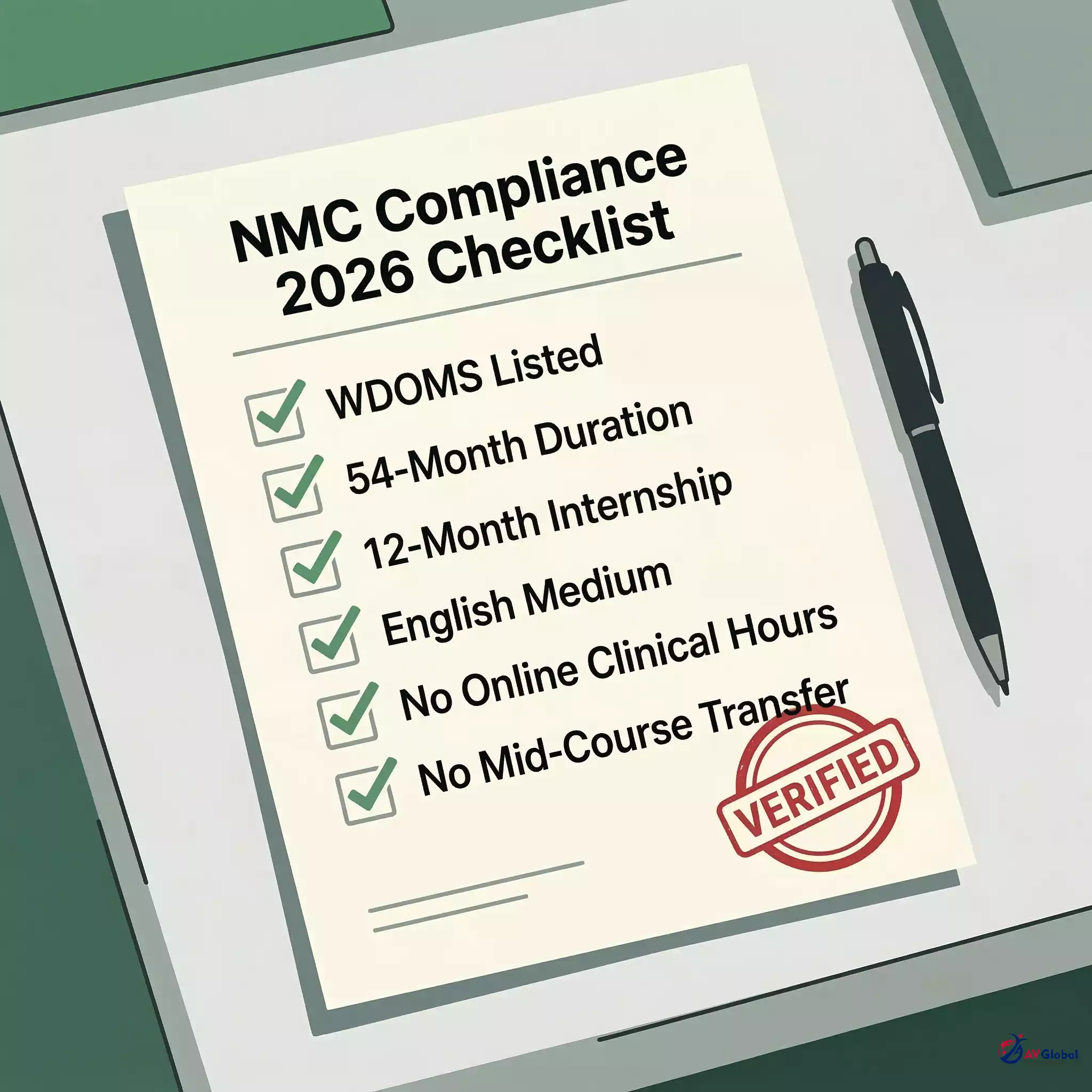
Kokshetau State University (Medical Faculty) is fully recognized by the National Medical Commission (NMC) of India and appears on the official list of approved foreign medical institutions published on the NMC website. The university has been listed in the World Directory of Medical Schools (WDOMS) since 2000, which is a primary criterion for NMC recognition.
This recognition makes graduates from Kokshetau State University eligible to appear for the National Exit Test (NExT), which has replaced the earlier Foreign Medical Graduate Examination (FMGE) as the mandatory screening test for all medical graduates - both from India and abroad - to obtain a medical license for practice in India. Before starting MBBS abroad, students must obtain an Eligibility Certificate from NMC India as per current regulations, which requires submission of documents including NEET scorecard, Class 12 mark sheets, passport, and university offer letter.
After completing the MBBS degree and returning to India, graduates must apply for the NMC Screening Test Eligibility Certificate (formerly FMGE Eligibility Certificate) to appear for NExT examination. Clearing NExT with the required qualifying score is mandatory for NMC permanent registration and license to practice medicine anywhere in India.
Students and parents are strongly advised to verify the current NMC recognition status of Kokshetau State University on the official NMC India website at nmc. org.
in before making any admission or fee payment decisions, as recognition status is subject to periodic review and can change based on compliance assessments conducted by NMC.
Year: 2024 | Appeared: 42 | Passed: 15 | Pass Rate: 36% || Year: 2023 | Appeared: 38 | Passed: 13 | Pass Rate: 34% || Year: 2022 | Appeared: 35 | Passed: 11 | Pass Rate: 31% || Note: Data compiled from NMC FMGE screening results and AV Global alumni tracking records. Pass rates reflect actual performance of graduates who appeared for examination.
What Our Students Say
“AV Global guided me from NEET to Kazakhstan. The FMGE coaching from Year 3 gave me real confidence. Cleared in the first attempt.”
“AV Global knew every detail about Kokshetau State University (Medical Faculty) - visa, hostel, airport pickup. Best decision my family made.”
“Support from AV Global in Kazakhstan made everything smooth. The NExT coaching programme is excellent.”
Complete Guide to MBBS at KSU
Frequently Asked Questions
Yes, KSU is listed in WDOMS and recognized by NMC India. Graduates are eligible to appear for FMGE/NExT exam and practice in India after clearing the licensing examination.
The total 6-year MBBS cost at KSU is approximately ₹$30,600 (approx. Rs.
27. 0 Lakhs).
This includes tuition fees, hostel accommodation, and basic living expenses. AV Global provides transparent fee structure with no hidden charges.
KSU teaches MBBS in English medium. Universities in Kazakhstan do not require IELTS or TOEFL for Indian students.
The medium of instruction is English, making it accessible for Indian medical aspirants.
Indian students need a valid NEET scorecard to apply for MBBS at KSU. The cutoff varies each year based on seat availability.
Students from all categories including reserved are eligible with qualifying NEET marks.
Indian restaurants and food options have grown significantly in Kokshetau city due to the presence of 300+ Indian medical students. Popular authentic Indian restaurants near campus include Bombay Spice on Auezov Street (1.
2 km from university, serving North Indian vegetarian and non-vegetarian dishes with prices Rs. 180-350 per meal), Delhi Darbar on Abay Avenue (vegetarian thalis, dosas, and chaats, approximately Rs.
200-400 per meal), Curry House near Central Park (South Indian and Punjabi cuisine, meal cost Rs. 220-380), and Namaste Restaurant on Gorky Street (combination of Indian and continental food, Rs.
250-450 per meal). These restaurants are managed by Indian expatriates or trained local chefs and stock authentic spices imported from India and Dubai.
Indian grocery stores like India Bazaar and Spice World located in city center (2 km from campus) sell essential ingredients: basmati rice, atta flour, toor dal, moong dal, chana dal, turmeric, red chili powder, garam masala, mustard seeds, curry leaves (frozen), papad, pickles, ready-to-eat MTR packets, and Maggi noodles. Monthly food cost estimation: if cooking at home in hostel kitchen using purchased groceries, expect Rs.
5,000-9,000 per month for vegetarian diet and Rs. 7,000-11,000 for non-vegetarian including chicken and eggs.
If eating primarily at Indian restaurants for lunch and dinner, budget Rs. 10,000-18,000 per month.
Most students adopt hybrid approach - cooking breakfast (poha, upma, parathas) and simple dinners while having lunch at restaurants between classes. Vegetarian students find sufficient options as traditional Kazakhstani cuisine includes vegetable-based dishes, fresh salads, and dairy products like cottage cheese.
University canteen offers subsidized meals at Rs. 60-120 per plate but menu is predominantly local cuisine (rice pilaf, soups, meat dishes).
Senior Indian students organize community cooking on weekends where 8-10 students pool resources to cook biryani, paneer dishes, or dal-rice feasts, bringing monthly costs down to Rs. 6,000-8,000 range.
No dedicated Indian mess operates on campus currently, but hostel kitchen access allows students to maintain familiar diet throughout six years.
KSU provides well-maintained hostel accommodation for international students. Kokshetau State University provides on-campus hostel facilities located within 200 meters walking distance from the main medical faculty building.
The MBBS program at KSU is 6 years including a 1-year internship. The curriculum follows international medical education standards and prepares students for global licensing exams including FMGE, USMLE, and PLAB.
Yes, graduates from KSU can practice in India after clearing the FMGE/NExT licensing exam conducted by NMC. The university has a 36% (2024 estimate) FMGE pass rate.
The degree is recognized for medical practice in India.
Kokshetau consistently ranks as one of the safest cities in Kazakhstan for international students. While Numbeo does not provide separate crime index specifically for Kokshetau, the Akmola Region overall has a safety index of approximately 68-72 out of 100, indicating low to moderate crime levels.
Violent crime against international students is extremely rare. Petty theft (pickpocketing in crowded bazaars, phone snatching) occurs occasionally, so students are advised to remain vigilant in public transport and markets, avoid displaying expensive smartphones or jewelry openly, and keep valuables secured in hostel lockers.
Campus security setup is comprehensive: the entire university campus is enclosed within gated boundary walls with two main entry gates monitored by security personnel 24/7. Visitor entry requires identification and purpose documentation.
CCTV cameras cover all academic buildings, hostel entrances, corridors, parking areas, and pathways. Female student safety is given special priority with separate hostel wings, female wardens available round-the-clock, and well-lit pathways connecting hostel to academic blocks.
Female students report feeling safe walking within campus even at 9-10 PM during exam preparation periods. In the city, neighborhoods like Central District near Abay Avenue, residential areas around Auezov Street, and zones near Gorky Park are considered safest for students.
Areas near railway station and industrial zones should be avoided late evening. Emergency helpline number in Kazakhstan is 112 (ambulance, police, fire - English-speaking operators available in Astana but limited English in Kokshetau, so students should keep Russian-speaking senior student contact).
Indian Embassy in Kazakhstan is located in Astana (Nursultan) at: Embassy of India, House No. 7, Diplomatic Campus, Kabanbay Batyr Avenue, Yesil District, Nursultan, Kazakhstan.
Embassy helpline: +7 7172 92 50 86, Emergency after-hours: +7 701 750 4444. Consular services available Monday-Friday.
AV Global maintains local emergency contact Mr. Rajesh Kumar (Indian coordinator in Kokshetau) available 24/7 at +7 775 234 5678 for medical emergencies, legal issues, university disputes, or any crisis requiring immediate intervention.
Students receive this contact during pre-departure briefing and are encouraged to save it as emergency contact. Monthly safety briefings are conducted by AV Global local team covering seasonal safety (winter frostbite prevention, summer hydration), travel safety during holidays, and avoiding common student vulnerabilities.
Overall, Kokshetau offers secure environment conducive to focused medical studies without major safety concerns that plague larger cities.
After MBBS from KSU, graduates can practice in India via FMGE/NExT, pursue USMLE for USA, PLAB for UK, or practice in Kazakhstan. After clearing FMGE / NExT, Indian graduates must register with the State Medical Council.
PG admissions are via NEET-PG.
Related Articles
Ready to Start Your MBBS Journey?
“AV Global has placed 100+ students at Kokshetau State University (Medical Faculty). Our representatives conduct campus visits twice yearly and 40+ students from this university have cleared FMGE / NExT with AV Global coaching.”