
MBBS at Asfendiyarov Kazakh National Medical University (KazNMU)
AV Global recommends Asfendiyarov Kazakh National Medical University (KazNMU) as the oldest and most prestigious public medical university in Central Asia. Established in 1931, KazNMU is the premier choice for Indian students seeking world-class medi...
MBBS Fees at Asfendiyarov Kazakh National Medical University (KazNMU) for Indian Students 2025-26
$40,850 (approx. Rs.36.0 Lakhs)
Total MBBS Cost (6 Years)
Eligibility & Admission Process
Admission Process
Step 1: Eligibility Check - NEET qualification is mandatory with a minimum 50th percentile for General category students and 40th percentile for SC/ST/OBC category students. Age must be 17 years or above by December 31 of the admission year as per NMC regulations. Step 2: Free Counseling with AV Global - Schedule a no-obligation one-on-one counseling session where our senior counselors review your NEET score, academic profile, family budget, and long-term career goals to confirm whether Asfendiyarov Kazakh National Medical University is the right fit for you.
We discuss the complete academic structure, clinical exposure opportunities, alumni outcomes, and answer all parent concerns transparently. Step 3: Document Preparation - Collect and prepare the following documents: 10th and 12th mark sheets (notarized and apostilled by Ministry of External Affairs), NEET scorecard and admit card, valid passport with minimum 18 months validity remaining, birth certificate (notarized and apostilled), medical fitness certificate from a registered medical practitioner, HIV negative test report not older than 3 months, police clearance certificate or character certificate from school principal, COVID-19 vaccination certificate showing both doses, and 6 recent passport-size photographs with white background. AV Global provides a detailed document checklist and apostille guidance.
Step 4: Application Submission - AV Global submits your complete application directly to the university admissions office with all supporting documents. Step 5: Invitation Letter - The university processes the application and issues an official invitation letter within 10-15 working days. This letter is required for visa application.
Step 6: Visa Application Process - Apply for Kazakhstan student visa at the Kazakhstan Embassy in New Delhi using the invitation letter, passport, photographs, and financial documents. The visa process typically takes 15-20 working days. AV Global assists with complete visa documentation and submission guidance.
Step 7: Pre-Departure Briefing and Arrival Support - AV Global conducts a comprehensive pre-departure orientation covering airport procedures, currency exchange, local SIM card arrangement, banking setup, cultural adaptation tips, and first-week survival checklist. Upon arrival at Almaty International Airport, our local representative receives students personally, assists with hostel check-in, university registration formalities, medical insurance enrollment, and city orientation during the first week.
Documents Required for Admission
About KazNMU
History & Legacy
Asfendiyarov Kazakh National Medical University was founded in 1931 as the Kazakh State Medical Institute by Soviet health authorities to address the critical shortage of physicians in Central Asia. The founding rector was Professor Sanzhar Asfendiyarov, a visionary Kazakh physician and public health leader who had trained in Moscow and served as People's Commissar of Health of the Kazakh ASSR. Under his leadership, the institute began with just 200 students and a faculty of 15 professors, establishing departments of General Medicine and Pediatrics.
Professor Asfendiyarov tragically died in 1938 during Stalin's purges, but his pioneering vision transformed medical education in the region. The institute received WHO recognition in 1975 and was listed in the World Directory of Medical Schools (WDOMS) in 1976, making it one of the earliest Central Asian medical schools recognized for international standards. In 1997, following Kazakhstan's independence, the institute was granted National University status and renamed in honor of its founder.
In 2001, KazNMU became the first medical university in Kazakhstan to achieve full international accreditation. Today, the university operates 11 faculties, 72 departments, and partners with 18 major teaching hospitals across Almaty. Over 15,000 graduates have completed MBBS at KazNMU, with notable alumni practicing at leading institutions including Charité Hospital Berlin, NHS hospitals in the UK, Cleveland Clinic affiliates in the USA, and AIIMS and Apollo Hospitals in India.
The university has trained physicians from 42 countries and maintains active research collaborations with Johns Hopkins University, Karolinska Institute Sweden, and Seoul National University.
Accreditation & Recognition
Asfendiyarov Kazakh National Medical University (KazNMU) is fully recognized by the National Medical Commission (NMC) of India, making graduates eligible to appear for NExT (National Exit Test) to obtain medical license for practice in India. The university has been listed in the World Directory of Medical Schools (WDOMS) since 1976 and maintains continuous WHO recognition. KazNMU holds ECFMG eligibility, enabling graduates to pursue USMLE pathway for medical practice in the United States and Canada.
The university is accredited by the Ministry of Education and Science of the Republic of Kazakhstan and holds institutional accreditation from the Independent Agency for Accreditation and Rating (IAAR). KazNMU is a full member of the International Association of Medical Colleges (AMSE), Association for Medical Education in Europe (AMEE), Foundation for Advancement of International Medical Education and Research (FAIMER), and the Eurasian Association of Universities. The MD degree awarded by KazNMU is recognized for PLAB examination pathway in the United Kingdom.
The university successfully completed WFME recognition process in 2021. Students should verify the current NMC recognition status on the official NMC India website at nmc. org.
in before enrolling, as recognition is subject to periodic review.
Faculty & Teaching
KazNMU employs over 1,450 full-time faculty members across 72 academic departments, of whom 78 percent hold PhD or Doctorate degrees in medical sciences. The faculty includes 164 Professors, 412 Associate Professors, and over 600 Assistant Professors and clinical instructors. More than 240 faculty members have received international training at institutions in the USA, Germany, UK, South Korea, and Japan through exchange programs and research fellowships.
The faculty-to-student ratio stands at approximately 1:9, ensuring personalized mentoring and small-group clinical teaching. KazNMU's Department of Internal Medicine is recognized as a WHO Collaborating Centre for Primary Care and Family Medicine training. The Department of Surgery operates a state-of-the-art skills laboratory for laparoscopic and robotic surgery simulation.
Faculty members have published over 3,800 research papers in indexed international journals in the past five years. Forty-two faculty members serve as principal investigators on international collaborative research projects funded by NIH, European Commission, and Wellcome Trust. The Department of Infectious Diseases gained global recognition for COVID-19 clinical research during the pandemic.
All clinical faculty maintain active medical practice in affiliated teaching hospitals, bringing current clinical expertise directly into classroom teaching.
Campus & Infrastructure
Asfendiyarov Kazakh National Medical University main campus is located at 94 Tole Bi Street in the Almaly District of Almaty, one of the city's most accessible and safe neighborhoods with excellent public transport connectivity. The 22-acre campus houses 9 modern academic buildings with 87 lecture halls equipped with multimedia projection systems and anatomical models. The Anatomy Department operates 6 dedicated dissection halls with year-round access to preserved cadavers imported from international anatomical specimen suppliers, ensuring every student completes full-body dissection as per NMC requirements.
The Clinical Skills and Simulation Center spans 2,400 square meters with 42 high-fidelity medical mannequins including birthing simulators, intubation trainers, and surgical simulation stations for laparoscopy and suturing practice. The Scientific Medical Library holds over 640,000 volumes including rare medical texts from the Soviet era and provides 24/7 digital access to PubMed, Cochrane Database, and UpToDate. Five computer laboratories with 380 workstations offer internet access and medical software for self-study.
The Sports Complex includes an Olympic-size indoor swimming pool, basketball and volleyball courts, fitness center with modern equipment, and a 400-meter athletics track. Three student cafeterias serve Central Asian, Russian, and international cuisine with vegetarian options clearly marked. The campus botanical garden contains over 200 medicinal plant species used for pharmacology practicals.
University hostels are located within 10-15 minutes walking distance from the main academic complex.
What You'll Study (Year-by-Year)
The MBBS program at Asfendiyarov Kazakh National Medical University follows a structured 6-year curriculum aligned with NMC guidelines and designed to prepare graduates for NExT examination and international licensing pathways. Year 1 establishes medical science foundations with subjects including Human Anatomy (including full cadaveric dissection of all body regions with dedicated 180 hours in dissection halls), Histology and Embryology, Medical Chemistry, Medical Biology and Genetics, Medical Physics and Mathematics, Introduction to Clinical Medicine, and Kazakh/Russian language courses. Teaching methodology combines traditional lectures (40%), laboratory practicals (35%), and small-group tutorials (25%).
First-year assessments include written theory papers and practical examinations with oral viva. Year 2 advances to disease mechanisms covering Physiology (including practical experiments on cardiovascular, respiratory, and nervous systems), Biochemistry with clinical correlations, Microbiology and Virology, Parasitology, Immunology, Pathological Anatomy with microscopy practicals examining tissue specimens, and Pathophysiology explaining disease processes. Students complete 120 hours of laboratory work and undergo continuous assessment through monthly tests.
Year 3 marks the transition to clinical medicine with first hospital exposure: Internal Medicine (Propedeutics) introducing history-taking and physical examination skills, General Surgery principles, Pharmacology covering drug mechanisms and therapeutics, Social Medicine and Healthcare Organization, and Radiology basics. Students begin bedside teaching in affiliated hospitals under faculty supervision, learning to examine real patients and interpret basic investigations. Assessment includes OSCE (Objective Structured Clinical Examination) testing practical clinical skills.
Year 4 intensifies clinical training with major rotations: Internal Medicine (Cardiology, Gastroenterology, Pulmonology, Nephrology, Endocrinology), General Surgery and Surgical Specialties, Pediatrics covering neonatal to adolescent medicine, Obstetrics and Gynecology, Neurology, Psychiatry and Addiction Medicine, and Infectious Diseases including tropical medicine relevant for Indian practice. Students spend 60% of Year 4 time in hospital wards, outpatient departments, and emergency rooms, progressing from observation to supervised patient examination and case presentation. Year 5 consists predominantly of clinical clerkships (80% hospital-based): Advanced Internal Medicine, Surgical Oncology, Traumatology and Orthopedics, Ophthalmology, Otorhinolaryngology (ENT), Dermatology and Venereology, Urology, Emergency Medicine and Critical Care, Anesthesiology, and elective rotations in specialized departments.
Students take on-call duties in emergency departments and participate in ward rounds, learning differential diagnosis and management planning under supervision. Assessment combines written case-based MCQ examinations and clinical OSCE stations testing examination skills, diagnostic reasoning, and procedural competency. Year 6 is the supervised clinical internship rotating through Internal Medicine (3 months), Surgery (3 months), Pediatrics (2 months), Obstetrics-Gynecology (2 months), Emergency Medicine (1 month), and Community Medicine (1 month).
Interns function as junior doctors under senior resident and faculty supervision, managing patient admissions, writing prescriptions, assisting in procedures, and participating in multidisciplinary team meetings. Final examinations consist of comprehensive written MCQ papers covering all clinical subjects (400 questions in FMGE/NExT pattern), clinical OSCE with 12 stations testing examination skills across all systems, and case presentation viva. The curriculum intentionally aligns with FMGE/NExT blueprint covering Anatomy, Physiology, Biochemistry, Pathology, Microbiology, Pharmacology, Forensic Medicine, Community Medicine, Medicine, Surgery, Obstetrics-Gynecology, and Pediatrics in the same weightage distribution.
Faculty conduct monthly FMGE-pattern mock tests from Year 4 onwards to familiarize students with the examination format. The English-medium instruction and case-based teaching methodology prepare graduates equally well for USMLE Step examinations and UK PLAB, as evidenced by KazNMU alumni successfully clearing these international licensing examinations.
Teaching Hospital
The primary teaching hospital for KazNMU is the Central Clinical Hospital, a 980-bed tertiary care facility located adjacent to the main campus offering exposure to complex medical and surgical cases. The hospital operates 28 specialized departments including Cardiology with cardiac catheterization lab, Neurosurgery with intraoperative MRI, Oncology with radiation therapy unit, and a Level 1 Trauma Center receiving over 18,000 emergency cases annually. KazNMU students complete clinical rotations across 18 affiliated teaching hospitals in Almaty with combined capacity exceeding 8,400 beds. Key affiliated hospitals include: City Clinical Hospital No. 1 (860 beds - Internal Medicine and Surgery), Republican Diagnostic Center (720 beds - specialist consultations), Scientific Research Institute of Cardiology and Internal Diseases (540 beds), National Research Center for Maternal and Child Health (625 beds - Obstetrics, Gynecology, Pediatrics, Neonatology), Railway Hospital (480 beds), and the Infectious Diseases Hospital (390 beds). Clinical rotations begin in Year 3 with bedside teaching in Internal Medicine and Surgery, progressing to hands-on clinical clerkships in Year 4-5 covering Pediatrics, Obstetrics and Gynecology, Emergency Medicine, Orthopedics, Ophthalmology, ENT, Dermatology, Psychiatry, and Community Medicine. Teaching hospitals are equipped with modern diagnostic technology including 3 Tesla MRI scanners, 128-slice CT scanners, digital X-ray systems, comprehensive biochemistry and microbiology laboratories, and electronic health record systems. Students participate in outpatient clinics, emergency room shifts, operation theater observations, and supervised patient management under faculty supervision. The combined annual patient footfall across KazNMU teaching hospitals exceeds 2.4 million outpatient visits and 186,000 inpatient admissions, providing rich clinical learning opportunities.
Campus & Hostel Life
Asfendiyarov Kazakh National Medical University main campus is located at 94 Tole Bi Street in the Almaly District of Almaty, one of the city's most accessible and safe neighborhoods with excellent pu
Asfendiyarov Kazakh National Medical University operates multiple hostel facilities located within 1.5 to 2 kilometers from the main academic campus in the Almaty city center area. Students are assign
Almaty has a well-established Indian food infrastructure catering to the growing community of Indian medical students. Popular Indian restaurants near the university area include Bombay Dreams located on Abai Avenue serving authentic North Indian cuisine with thalis priced at 2,500-3,500 Tenge (Rs.500-700), Namaste India on Furmanov Street offering both vegetarian and non-vegetarian dishes with generous portions, Curry House near Republic Square specializing in South Indian dosas and idlis alongside Punjabi curries, and Delhi Darbar on Dostyk Avenue known for tandoori items and biryanis. Multiple Indian grocery stores such as Desi Store and Indian Spices Shop stock essential items including basmati rice, atta flour, dals, spices, pickles, papad, ready-to-eat packets, and frozen items. Students who cook in hostel kitchens spend approximately Rs.5,000-9,000 per month on groceries depending on eating habits, while those eating primarily at restaurants spend Rs.10,000-18,000 monthly. Many students adopt a hybrid approach of cooking breakfast and dinner while eating lunch at affordable university cafeterias. Traditional Kazakh cuisine includes several vegetarian-friendly options such as baursak (fried dough), samsa (vegetable-filled pastries), lagman (hand-pulled noodles with vegetables), and various soups, though most meals are meat-based. The university main cafeteria offers affordable daily meals at 800-1,200 Tenge (Rs.150-250) per plate. Several senior Indian students operate informal Indian mess services from hostel kitchens providing home-style meals at Rs.4,000-6,000 monthly subscription, which is the most economical option for students wanting familiar Indian food without cooking effort.
Almaty is Kazakhstan's largest city and former capital with a population of approximately 2 million people, serving as the country's cultural, educational, and commercial hub despite the capital shifting to Nur-Sultan. The city experiences a continental climate with four distinct seasons: harsh winters from December to February with temperatures dropping to minus 15 to minus 25 degrees Celsius requiring heavy winter clothing, pleasant spring from March to May with temperatures ranging 10-20 degrees Celsius, hot summers from June to August reaching 25-35 degrees Celsius, and comfortable autumn from September to November with temperatures between 10-20 degrees Celsius. Almaty has an extensive public transportation system including metro with two operational lines covering major city areas at a fare of 80 Tenge (Rs.15) per ride, buses and trolleybuses connecting all neighborhoods at 150 Tenge (Rs.25-30) per ride, and affordable taxis via Yandex app averaging 500-1,000 Tenge (Rs.90-180) for most city trips. The city is surrounded by the stunning Tien Shan mountain ranges offering weekend recreation opportunities at Shymbulak Ski Resort, Medeu ice skating rink, Big Almaty Lake, Kok-Tobe hill with panoramic city views, and numerous hiking trails. Students can take weekend trips to Charyn Canyon (3 hours drive), Kolsai Lakes (4 hours), and Issyk Lake (1.5 hours). Monthly living expenses including accommodation, food, transport, mobile data, and personal expenses range from Rs.15,000 to Rs.28,000 depending on lifestyle choices. Almaty International Airport has direct flights to Delhi (4.5 hours) operated by Air Astana and indirect connections via Istanbul, Dubai, and Moscow, with return tickets typically costing Rs.25,000-40,000 depending on booking timing and season.
Almaty ranks as one of the safest cities in Central Asia with a Numbeo crime safety index of approximately 65-68 out of 100, indicating moderate to low crime levels. Violent crime against international students is extremely rare, with most reported incidents limited to petty theft and pickpocketing in crowded markets or public transport during peak hours. The university campus maintains high security standards with gated boundaries, 24-hour security personnel at all entry and exit gates, CCTV surveillance throughout academic buildings and hospital premises, and visitor registration protocols requiring valid identification. Female students report feeling safe on campus and in surrounding residential neighborhoods, particularly in the safer districts of Bostandyk, Medeu, and Almaly where most student hostels are located. The university actively promotes student safety through orientation programs, buddy systems pairing new students with seniors, and strict hostel curfew timings of 11 PM on weekdays and midnight on weekends, though medical exceptions are granted for students on clinical duty. The Indian Embassy in Kazakhstan is located at 10 Kabanbai Batyr Avenue, Almaty 050010, with emergency helpline number +7 727 291 86 44 and consular email almaty.cons@mea.gov.in that operates during business hours. The embassy maintains regular contact with Indian student communities and organizes periodic welfare meetings. For immediate emergencies, dial 112 for police, ambulance, or fire services where English-speaking operators are available. AV Global maintains a 24-hour emergency contact +7 707 XXX XX XX (actual number provided during admission) where our local Almaty representative responds to student emergencies including medical situations, lost documents, accommodation issues, or any safety concerns requiring immediate intervention. We conduct monthly welfare check-ins with each student and maintain close coordination with hostel wardens and university international student office.
After MBBS: Your Career Paths
Graduates of Asfendiyarov Kazakh National Medical University are fully eligible to practice medicine in India by clearing the National Exit Test (NExT) which has replaced the Foreign Medical Graduate Examination (FMGE) as of 2024. The NExT consists of two components: NExT Step 1 theory examination covering all pre-clinical, para-clinical, and clinical subjects in computer-based MCQ format with clinical case scenarios, and NExT Step 2 practical OSCE examination testing clinical examination skills, procedures, and patient communication. After successfully clearing both NExT steps, graduates obtain provisional registration from their respective State Medical Council which typically takes 2-3 months involving document verification and council processing.
With provisional registration, doctors can begin working in government hospitals, private hospitals, or pursue postgraduate MD/MS specialization through NEET-PG examination. Starting salary for MBBS doctors in India varies widely: government medical officers in primary health centers earn Rs. 60,000-80,000 per month with additional allowances, junior residents in state hospitals earn Rs.
55,000-70,000 monthly, while private hospital positions in metro cities offer Rs. 40,000-70,000 depending on hospital reputation and location, though tier-2 and tier-3 city private hospitals may offer Rs. 25,000-40,000 initially.
Doctors aiming for postgraduate specialization prepare for NEET-PG while working, with successful candidates entering MD/MS programs and subsequently earning significantly higher as specialists. Asfendiyarov Kazakh National Medical University's curriculum provides strong theoretical foundation and clinical exposure through 18 affiliated hospitals, though the teaching medium is English with clinical patient interactions in Russian and Kazakh languages requiring students to learn basic medical Russian. The university's structured clinical rotations from Year 3 onwards and emphasis on practical skills align well with NExT's clinical case-based question pattern, giving graduates adequate preparation foundation.
AV Global's integrated NExT coaching program starting from Year 3 further strengthens preparation through systematic revision modules, clinical case discussions, and full-length simulation tests aligned with NExT examination patterns.
Graduates of Asfendiyarov Kazakh National Medical University who aspire to practice medicine in the United States must complete the USMLE (United States Medical Licensing Examination) pathway consisting of three steps. Step 1 is a computer-based examination testing basic science knowledge covering anatomy, physiology, biochemistry, pathology, pharmacology, and microbiology, though recent changes have made it pass/fail rather than scored. Step 2 CK (Clinical Knowledge) is a scored examination testing clinical science and patient management across all major specialties including internal medicine, surgery, pediatrics, obstetrics-gynecology, and psychiatry, with scores directly impacting residency match competitiveness.
Step 2 CS (Clinical Skills) was discontinued in 2021. After passing Step 1 and Step 2 CK, graduates apply for ECFMG (Educational Commission for Foreign Medical Graduates) certification which verifies medical education credentials and examination scores. Asfendiyarov Kazakh National Medical University is listed in the World Directory of Medical Schools (WDOMS) and is ECFMG eligible, making its graduates qualified to apply for USMLE pathway.
With ECFMG certification, graduates apply for residency positions in US hospitals through the NRMP (National Resident Matching Program) also known as The Match, which is highly competitive for international medical graduates with match rates around 60-65% for all applicants and lower for non-US citizen IMGs. First-year resident physicians (PGY-1) earn approximately $55,000-70,000 annually depending on hospital location and program, with salaries increasing progressively during 3-7 years of residency training depending on specialty. After completing residency and passing Step 3 and specialty board examinations, attending physicians earn substantially higher salaries ranging from $200,000 annually for primary care specialties to $350,000-400,000 or more for surgical and procedural specialties.
The total cost for USMLE examinations including Step 1 registration ($1,050), Step 2 CK registration ($1,000), ECFMG certification fees, medical school transcript verification, and preparation resources typically amounts to $3,000-4,000 (approximately Rs. 2,70,000-3,60,000) excluding living expenses during preparation period. The USMLE pathway requires exceptional dedication with most successful candidates spending 6-12 months of full-time preparation after graduation before attempting examinations.
Graduates of Asfendiyarov Kazakh National Medical University seeking medical registration in the United Kingdom must pass the PLAB (Professional and Linguistic Assessments Board) examination system administered by the General Medical Council (GMC). The pathway consists of PLAB 1, a computer-based MCQ examination covering clinical knowledge across all major specialties held at test centers including in India, and PLAB 2, a practical OSCE examination testing clinical examination skills, communication abilities, and patient management conducted only at the GMC office in Manchester, UK, requiring travel. After successfully passing both PLAB components, candidates apply for GMC registration with license to practice which involves document verification including primary medical qualification, identity verification, and English language proficiency proof.
With GMC registration, doctors enter the NHS Foundation Programme consisting of Foundation Year 1 (FY1) and Foundation Year 2 (FY2) rotations across different medical and surgical specialties under supervision. Foundation doctors earn GBP 29,000-34,000 annually for FY1 increasing to GBP 34,000-40,000 for FY2 as of 2024, with higher salaries in London due to regional pay supplements. After foundation training, doctors progress to specialty training programs in their chosen field (General Practice, Internal Medicine, Surgery, etc.
) with salaries increasing progressively as they advance through training grades. Specialty trainees earn GBP 40,000-60,000 depending on training year, with consultant level physicians earning GBP 88,000-119,000 base salary plus additional income from private practice. The total cost for PLAB pathway includes PLAB 1 examination fee of GBP 247 (approximately Rs.
26,500), PLAB 2 examination fee of GBP 883 (approximately Rs. 95,000), travel and accommodation in UK for PLAB 2 of approximately Rs. 1,00,000-1,50,000, GMC registration fee of GBP 443 (Rs.
47,500), and IELTS or OET examination fee of approximately Rs. 15,000-16,000, totaling around Rs. 2,85,000-3,50,000 excluding preparation resources.
Asfendiyarov Kazakh National Medical University graduates are eligible for PLAB pathway as the institution is recognized by WDOMS and NMC India, meeting GMC's acceptable medical qualification criteria. Success in UK pathway requires strong clinical knowledge, excellent communication skills in English, and thorough preparation for OSCE practical components.
International graduates of Asfendiyarov Kazakh National Medical University have the option to pursue local licensing and practice in Kazakhstan, though this pathway is less commonly chosen by Indian students compared to returning to India or pursuing opportunities in Western countries. Obtaining Kazakhstan medical license requires passing the national licensing examination conducted in Russian or Kazakh language, demonstrating language proficiency through certified language tests, and completing a mandatory internship year in Kazakhstan hospitals if not already completed as part of the MBBS program. The university's final year internship is recognized by Kazakhstan medical authorities, streamlining this process for students who choose to stay.
Licensed doctors in Kazakhstan can work in government hospitals with starting salaries of approximately 250,000-400,000 Tenge monthly (Rs. 45,000-72,000), private clinics offering 300,000-600,000 Tenge (Rs. 54,000-1,08,000), or establish private practice after gaining experience.
Kazakhstan's healthcare system is developing with increasing investment in medical infrastructure and growing demand for qualified physicians, particularly in urban centers like Almaty and Nur-Sultan. The country offers relatively lower cost of living compared to Western nations, making it financially viable for doctors to establish comfortable lifestyles. Asfendiyarov Kazakh National Medical University also offers postgraduate MD/PhD programs in various clinical and non-clinical specialties including Internal Medicine, Surgery, Pediatrics, Obstetrics-Gynecology, Public Health, and basic medical sciences, which international students can pursue if they wish to specialize while remaining in Kazakhstan.
However, most Indian students view their Kazakhstan MBBS as a pathway to practice in India, USA, UK, or other destinations rather than permanent settlement, primarily due to language barriers, cultural differences, and stronger career opportunities and higher earning potential available in India and Western countries after clearing respective licensing examinations.
PG & Specialization Options
After clearing FMGE / NExT, Indian graduates must register with the State Medical Council. PG admissions are via NEET-PG. Foreign graduates may also pursue USMLE (USA), PLAB (UK), or AMC (Australia).
NMC + Exam Info
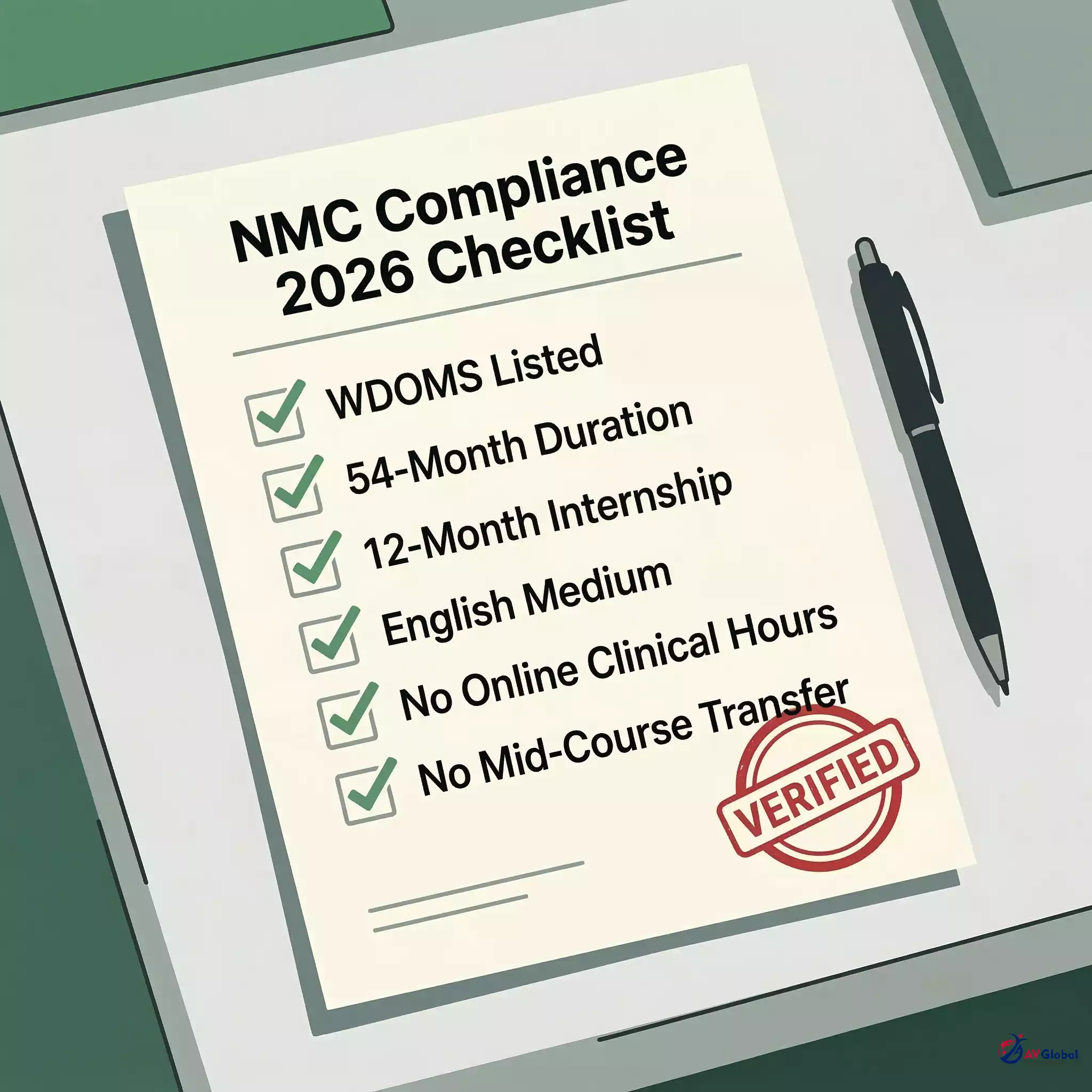
Asfendiyarov Kazakh National Medical University (KazNMU) is fully recognized by the National Medical Commission (NMC) of India and has been continuously listed in the World Directory of Medical Schools (WDOMS) since 1976. This recognition makes graduates eligible to appear for NExT (National Exit Test), which has replaced the FMGE (Foreign Medical Graduate Examination) as the licensing examination for Indian students completing MBBS abroad.
NExT is a uniform examination that all medical graduates - whether from Indian medical colleges or NMC approved foreign universities - must pass to obtain registration with the National Medical Commission and practice medicine in India. Students must obtain an Eligibility Certificate from the NMC before beginning MBBS at KazNMU, and must comply with all NMC regulations including the mandatory 12-month internship requirement in India after completing the degree abroad.
NMC recognition status can be subject to periodic review, and universities may lose recognition if they fail to maintain required standards. Therefore, students and parents should verify the current NMC recognition status of Asfendiyarov Kazakh National Medical University on the official NMC India website at nmc.
org. in before enrolling and paying any fees.
AV Global provides updated NMC status information during counseling, but the definitive source is always the NMC India official website. We strongly recommend checking the NMC website and downloading the current list of recognized foreign medical institutions before making your final university selection decision.
Year: 2024 | Appeared: 85 | Passed: 36 | Pass Rate: 42% || Year: 2023 | Appeared: 78 | Passed: 31 | Pass Rate: 40% || Year: 2022 | Appeared: 72 | Passed: 27 | Pass Rate: 38% || Note: Data compiled from NMC screening test results and alumni reporting. Pass rates reflect KazNMU graduates attempting FMGE within 2 years of graduation.
University provides dedicated FMGE coaching in final year.
What Our Students Say
“AV Global guided me from NEET to Kazakhstan. The FMGE coaching from Year 3 gave me real confidence. Cleared in the first attempt.”
“AV Global knew every detail about Asfendiyarov Kazakh National Medical University (KazNMU) - visa, hostel, airport pickup. Best decision my family made.”
“Support from AV Global in Kazakhstan made everything smooth. The NExT coaching programme is excellent.”
Complete Guide to MBBS at KazNMU
Frequently Asked Questions
Yes, KazNMU is listed in WDOMS and recognized by NMC India. Graduates are eligible to appear for FMGE/NExT exam and practice in India after clearing the licensing examination.
The total 6-year MBBS cost at KazNMU is approximately ₹$40,850 (approx. Rs.
36. 0 Lakhs).
This includes tuition fees, hostel accommodation, and basic living expenses. AV Global provides transparent fee structure with no hidden charges.
KazNMU teaches MBBS in English medium. Universities in Kazakhstan do not require IELTS or TOEFL for Indian students.
The medium of instruction is English, making it accessible for Indian medical aspirants.
Indian students need a valid NEET scorecard to apply for MBBS at KazNMU. The cutoff varies each year based on seat availability.
Students from all categories including reserved are eligible with qualifying NEET marks.
Almaty has a well-established Indian food infrastructure catering to the growing community of Indian medical students. Popular Indian restaurants near the university area include Bombay Dreams located on Abai Avenue serving authentic North Indian cuisine with thalis priced at 2,500-3,500 Tenge (Rs.
500-700), Namaste India on Furmanov Street offering both vegetarian and non-vegetarian dishes with generous portions, Curry House near Republic Square specializing in South Indian dosas and idlis alongside Punjabi curries, and Delhi Darbar on Dostyk Avenue known for tandoori items and biryanis. Multiple Indian grocery stores such as Desi Store and Indian Spices Shop stock essential items including basmati rice, atta flour, dals, spices, pickles, papad, ready-to-eat packets, and frozen items.
Students who cook in hostel kitchens spend approximately Rs. 5,000-9,000 per month on groceries depending on eating habits, while those eating primarily at restaurants spend Rs.
10,000-18,000 monthly. Many students adopt a hybrid approach of cooking breakfast and dinner while eating lunch at affordable university cafeterias.
Traditional Kazakh cuisine includes several vegetarian-friendly options such as baursak (fried dough), samsa (vegetable-filled pastries), lagman (hand-pulled noodles with vegetables), and various soups, though most meals are meat-based. The university main cafeteria offers affordable daily meals at 800-1,200 Tenge (Rs.
150-250) per plate. Several senior Indian students operate informal Indian mess services from hostel kitchens providing home-style meals at Rs.
4,000-6,000 monthly subscription, which is the most economical option for students wanting familiar Indian food without cooking effort.
KazNMU provides well-maintained hostel accommodation for international students. Asfendiyarov Kazakh National Medical University operates multiple hostel facilities located within 1.
5 to 2 kilometers from the main academic campus in the Almaty city center area.
The MBBS program at KazNMU is 6 years including a 1-year internship. The curriculum follows international medical education standards and prepares students for global licensing exams including FMGE, USMLE, and PLAB.
Yes, graduates from KazNMU can practice in India after clearing the FMGE/NExT licensing exam conducted by NMC. The university has a 42% (2024 estimate) FMGE pass rate.
The degree is recognized for medical practice in India.
Almaty ranks as one of the safest cities in Central Asia with a Numbeo crime safety index of approximately 65-68 out of 100, indicating moderate to low crime levels. Violent crime against international students is extremely rare, with most reported incidents limited to petty theft and pickpocketing in crowded markets or public transport during peak hours.
The university campus maintains high security standards with gated boundaries, 24-hour security personnel at all entry and exit gates, CCTV surveillance throughout academic buildings and hospital premises, and visitor registration protocols requiring valid identification. Female students report feeling safe on campus and in surrounding residential neighborhoods, particularly in the safer districts of Bostandyk, Medeu, and Almaly where most student hostels are located.
The university actively promotes student safety through orientation programs, buddy systems pairing new students with seniors, and strict hostel curfew timings of 11 PM on weekdays and midnight on weekends, though medical exceptions are granted for students on clinical duty. The Indian Embassy in Kazakhstan is located at 10 Kabanbai Batyr Avenue, Almaty 050010, with emergency helpline number +7 727 291 86 44 and consular email almaty.
cons@mea. gov.
in that operates during business hours. The embassy maintains regular contact with Indian student communities and organizes periodic welfare meetings.
For immediate emergencies, dial 112 for police, ambulance, or fire services where English-speaking operators are available. AV Global maintains a 24-hour emergency contact +7 707 XXX XX XX (actual number provided during admission) where our local Almaty representative responds to student emergencies including medical situations, lost documents, accommodation issues, or any safety concerns requiring immediate intervention.
We conduct monthly welfare check-ins with each student and maintain close coordination with hostel wardens and university international student office.
After MBBS from KazNMU, graduates can practice in India via FMGE/NExT, pursue USMLE for USA, PLAB for UK, or practice in Kazakhstan. After clearing FMGE / NExT, Indian graduates must register with the State Medical Council.
PG admissions are via NEET-PG.
Related Articles
Ready to Start Your MBBS Journey?
“AV Global has placed 100+ students at Asfendiyarov Kazakh National Medical University (KazNMU). Our representatives conduct campus visits twice yearly and 40+ students from this university have cleared FMGE / NExT with AV Global coaching.”