

MBBS at Astana Medical University
AV Global recommends Astana Medical University as one of the oldest and most respected government medical institutions in Kazakhstan, founded in 1964 as the Tselinograd State Medical Institute. With nearly six decades of producing skilled physicians,...
MBBS Fees at Astana Medical University for Indian Students 2025-26
$40,850 (approx. Rs.36.0 Lakhs)
Total MBBS Cost (6 Years)
Eligibility & Admission Process
Admission Process
Step 1: Eligibility Check - NEET qualification is mandatory with a minimum 50th percentile for General category students and 40th percentile for SC/ST/OBC category students. Students must be 17 years or older by December 31 of the admission year. Step 2: Free Counseling with AV Global - Schedule a no-obligation counseling session where our experienced counselors review your NEET score, academic profile, financial capacity, and long-term career goals to confirm whether Astana Medical University is the right fit for your ambitions.
Step 3: Document Preparation - Collect and prepare all required documents: 10th and 12th mark sheets (both notarized and apostilled by Ministry of External Affairs), NEET scorecard and admit card, valid passport with minimum 18 months validity remaining, birth certificate (notarized and apostilled), medical fitness certificate from a registered physician, HIV negative test report not older than three months, police clearance certificate or character certificate from educational institution, COVID-19 vaccination certificate showing complete primary doses, and 6 recent passport-size photographs with white background. Step 4: Application Submission - AV Global submits your complete application package directly to Astana Medical University admissions office with all supporting documents. Step 5: Invitation Letter - The university issues an official invitation letter within 10-15 working days after document verification.
This letter is required for your visa application. Step 6: Visa Application - Apply for Kazakhstan student visa at the Embassy of Kazakhstan in New Delhi or Consulate General in Mumbai using the invitation letter, passport, photographs, and financial documents. Visa processing takes approximately 15-20 working days.
Step 7: Pre-Departure Briefing and Airport Reception - AV Global conducts a comprehensive pre-departure orientation covering currency exchange (Kazakhstani Tenge), local SIM card options, banking setup, climate preparation, cultural sensitivity, and first-week survival checklist. Our local representative receives students at Nursultan Nazarbayev International Airport and assists with hostel check-in, university registration formalities, and police registration within the first week of arrival.
Documents Required for Admission
About AMU
History & Legacy
Astana Medical University was established in 1964 as the Tselinograd State Medical Institute under the leadership of Professor Mukash Omarov, a distinguished Kazakh physician and educator who served as the founding rector. The institute was created to address the critical shortage of medical professionals in the virgin lands region of Northern Kazakhstan during the Soviet era expansion program. In its early years, the institute graduated approximately 150 physicians annually who served in rural and urban healthcare centers across Kazakhstan and neighboring Soviet republics.
The institution received WHO recognition in 1975 and was listed in the World Directory of Medical Schools, enabling its graduates to pursue postgraduate training internationally. Following Kazakhstan's independence in 1991, the institute underwent significant expansion and modernization. In 1997, it was renamed Astana State Medical Academy to reflect its elevated academic status and expanded postgraduate programs.
When Kazakhstan's capital was relocated from Almaty to Astana in 1997, the medical academy gained prominence as the premier medical institution in the new capital city. In 2009, the institution achieved full university status and was renamed Astana Medical University, marking its transformation into a comprehensive medical education and research center. Today, AMU has produced over 35,000 medical graduates who practice across Kazakhstan, Russia, Germany, United States, United Kingdom, and Middle Eastern countries.
Notable alumni include Dr. Yerlan Kiyasov, Chief Cardiac Surgeon at the National Research Cardiac Surgery Center in Astana, and Dr. Saule Moldagaliyeva, practicing pediatric oncologist at Charite University Hospital in Berlin.
Accreditation & Recognition
Astana Medical University is fully recognized by the National Medical Commission of India, making its graduates eligible to appear for FMGE screening test and now the NExT examination to obtain medical license for practice in India. The university has been listed in the World Directory of Medical Schools since 1975, maintained by the Foundation for Advancement of International Medical Education and Research in partnership with WHO. AMU holds ECFMG eligibility, allowing graduates to apply for USMLE examinations and pursue residency training in the United States.
The university is accredited by the Ministry of Education and Science of the Republic of Kazakhstan and has successfully passed institutional accreditation by the Independent Kazakhstan Agency for Quality Assurance in Education. AMU is a full member of the International Association of Medical Colleges and holds associate membership in the Association for Medical Education in Europe. The six-year MD program is recognized across European Union member states under the Bologna Process framework for higher education harmonization.
Students should verify the current NMC recognition status on the official NMC India website at nmc. org. in before enrolling, as recognition is subject to periodic review.
Faculty & Teaching
Astana Medical University employs 847 faculty members across all academic departments, of whom 623 are actively involved in MBBS program instruction. The faculty includes 156 Doctors of Medical Sciences (equivalent to PhD), 402 Candidates of Medical Sciences (equivalent to doctorate degree), and 89 full Professors holding academic chairs in their specialties. Approximately 73 percent of faculty hold doctoral-level qualifications, which is exceptionally high for a public medical university.
Many senior faculty members have completed advanced training and fellowships at leading medical institutions in Russia, Germany, United Kingdom, United States, South Korea, and Japan. The clinical faculty members maintain active medical practice at affiliated teaching hospitals, ensuring students learn from practicing physicians rather than purely academic instructors. The faculty-to-student ratio stands at approximately 1:8, allowing for personalized attention during laboratory sessions and clinical rounds.
The Department of Internal Medicine is particularly strong, with 12 professors specializing in cardiology, pulmonology, gastroenterology, and endocrinology. The Surgery department boasts Kazakhstan's largest team of laparoscopic surgery specialists, and the Pediatrics department operates the only dedicated pediatric simulation training center in Northern Kazakhstan.
Campus & Infrastructure
Astana Medical University campus is located at 49a Beibitshilik Street in the Saryarka District of Astana, approximately 6 kilometers from the city center and easily accessible via public bus routes 10, 23, and 37. The 18-hectare campus houses six major academic buildings constructed between 1965 and 2018, with the newest Clinical Skills Building opened in 2018 featuring state-of-the-art simulation laboratories. The main academic block contains 42 lecture halls equipped with multimedia projection systems, anatomical teaching halls with preserved cadaveric specimens for dissection practicals, histology and pathology laboratories with 180 Olympus microscopes, biochemistry and microbiology research laboratories, and pharmacology practical labs.
The Central Medical Library holds 287,000 volumes including medical textbooks in English, Russian, and Kazakh languages, plus digital access to PubMed, Cochrane Library, and UpToDate databases. The modern Simulation and Skills Center features Harvey cardiac patient simulators, intubation mannequins, laparoscopic surgery trainers, and obstetric delivery simulators. Four computer laboratories with 200 workstations provide internet access and medical software training.
The campus sports complex includes an indoor gymnasium, outdoor football field, basketball and volleyball courts, and a swimming pool. Two cafeterias serve breakfast, lunch, and dinner with both local and limited international cuisine options. Student hostels are located 800 meters from the academic campus in a separate residential complex with 24-hour security and CCTV surveillance.
What You'll Study (Year-by-Year)
The six-year MBBS program at Astana Medical University follows the European medical education model adapted to meet NMC India requirements for Indian students. Year 1 focuses on foundational medical sciences: Anatomy with complete cadaveric dissection covering all body systems and regional anatomy, Histology examining tissue structures under microscopy with detailed study of epithelial, connective, muscular, and nervous tissues, Medical Biology covering cell biology, genetics, and human development, General Chemistry and Biochemistry including metabolism, enzymology, and clinical biochemistry, Medical Physics covering biomechanics and medical instrumentation, and introductory modules in Medical Ethics, Patient Communication, and History of Medicine. Teaching methodology includes traditional lectures, small group tutorials, extensive laboratory practicals, and self-directed learning.
Year 2 continues pre-clinical sciences with Physiology covering all organ systems with laboratory experiments on cardiovascular, respiratory, renal, and neurological functions, Microbiology including bacteriology, virology, parasitology, and mycology with practical culture techniques, Pathology covering general pathological processes like inflammation, necrosis, tumors, and system-specific pathologies, Pharmacology including general pharmacology, drug classifications, pharmacokinetics, and therapeutics, Immunology covering innate and adaptive immunity with practical serological tests, and Social Medicine introducing epidemiology and public health concepts. Year 3 marks the transition to clinical medicine with first patient contact: Propedeutics of Internal Medicine teaching history-taking, physical examination techniques, and diagnostic reasoning, General Surgery introducing surgical principles, asepsis, wound healing, and basic surgical procedures, Pediatrics covering child development, common childhood illnesses, and pediatric examination techniques, Obstetrics and Gynecology introducing reproductive health, pregnancy care, and gynecological examinations, and continuation of Pathology and Pharmacology with clinical correlation. Students begin attending morning rounds in teaching hospitals twice weekly under faculty supervision.
Year 4 intensifies clinical exposure with dedicated rotations: Internal Medicine focusing on cardiovascular, respiratory, gastrointestinal, and endocrine disorders with bedside teaching, General Surgery with participation in pre-operative assessment and post-operative care, Pediatrics with hands-on examination of pediatric patients, Obstetrics covering antenatal care and labor management, Gynecology covering common gynecological conditions, Neurology, Psychiatry, Dermatology and Venereology, Emergency Medicine, and Infectious Diseases. Students spend 3-4 hours daily in hospital wards and outpatient departments. Year 5 is predominantly clinical (approximately 70% of time in hospitals) with advanced rotations in Cardiology, Pulmonology, Gastroenterology, Nephrology, Endocrinology, Hematology, Rheumatology, Oncology, Orthopedics, Ophthalmology, ENT (Otolaryngology), Urology, and Anesthesiology.
Students perform procedures like venipuncture, catheterization, suturing, and wound dressing under supervision. Year 6 is the full-time clinical internship year where students rotate through all major departments functioning as junior doctors: Internal Medicine (8 weeks), Surgery (8 weeks), Pediatrics (6 weeks), Obstetrics-Gynecology (6 weeks), Emergency Medicine (4 weeks), and elective specialty rotations (10 weeks). Interns take patient histories, perform physical examinations, propose diagnostic plans and treatment strategies under attending physician supervision, participate in ward rounds, and attend emergency calls.
Assessment throughout the program includes written examinations using MCQ (Multiple Choice Questions) and essay-format questions, OSCE (Objective Structured Clinical Examinations) for clinical skills evaluation, practical examinations in laboratory subjects, and continuous assessment based on attendance, assignments, and case presentations. Final examinations in Year 6 include comprehensive written and clinical examinations covering all major subjects. The curriculum specifically prepares students for FMGE/NExT examinations through systematic coverage of all topics in the NMC prescribed syllabus, regular mock tests using FMGE-pattern MCQs, clinical case discussions emphasizing diagnostic and therapeutic reasoning required for FMGE clinical scenarios, and dedicated FMGE preparatory coaching in Years 5-6.
The medium of instruction is English for international students, though basic knowledge of Russian language is taught in Year 1 to facilitate patient communication during clinical rotations.
Teaching Hospital
The primary teaching hospital for Astana Medical University is the 1,200-bed Astana City Hospital No. 1, located 2.5 kilometers from campus and serving as the largest multi-specialty public hospital in the capital city. This hospital handles over 450,000 outpatient consultations and 68,000 inpatient admissions annually, providing students with substantial clinical exposure to diverse patient populations. The hospital features fully equipped departments of Internal Medicine with subspecialty divisions in Cardiology, Pulmonology, Gastroenterology, Nephrology, and Endocrinology, General Surgery with dedicated Trauma, Vascular, and Thoracic Surgery units, Pediatrics and Neonatology, Obstetrics and Gynecology with high-risk pregnancy unit and NICU, Emergency Medicine and Trauma, Orthopedics and Joint Replacement, Ophthalmology, ENT, Dermatology, Psychiatry, and Radiology with CT, MRI, and ultrasound facilities. Additional affiliated teaching hospitals include the National Scientific Center for Maternal and Child Health (600 beds), Republican Diagnostic Center (420 beds), Astana Regional Hospital (800 beds), City Hospital No. 2 (650 beds), and specialized centers for Cardiology, Oncology, Neurology, and Infectious Diseases. Clinical rotations begin in Year 3 with observational visits, intensify in Years 4-5 with hands-on patient interaction under supervision, and culminate in Year 6 full-time clinical internship where students function as junior doctors managing patient care under faculty oversight. The hospitals utilize electronic medical records systems, modern diagnostic equipment including 64-slice CT scanners and 3-Tesla MRI machines, and maintain international infection control standards.
Campus & Hostel Life
Astana Medical University campus is strategically located at 49a Beibitshilik Street in the Saryarka District of Astana, positioned approximately 6 kilometers northeast of the city center in a well-de
Astana Medical University provides on-campus hostel accommodation within a 5-minute walk from the main academic building, located inside a secure university compound with 24-hour gated entry. Students
Astana has a growing community of Indian restaurants catering to the increasing number of Indian students in the city. Popular options include Namaste India Restaurant on Kabanbay Batyr Avenue serving authentic North Indian curries, biryanis, and fresh tandoori rotis, Spice of India on Mangilik El Avenue offering vegetarian and non-vegetarian thalis, Bollywood Restaurant near Mega Silk Way mall with dosas and South Indian breakfast options, and Curry House on Turan Avenue known for reasonable prices and home-style cooking. Several Indian grocery stores stock essential ingredients including basmati rice, atta flour, spices, lentils, pickles, and ready-to-eat products. Students who cook at home spend approximately Rs.5,000-9,000 per month on groceries, while those eating primarily at restaurants spend Rs.10,000-18,000 monthly. Traditional Kazakhstani cuisine offers vegetarian-friendly options like beshbarmak (can be made vegetarian), plov (rice pilaf), lagman noodles with vegetables, manty (steamed dumplings with potato filling), and various dairy products. The university canteen serves affordable meals at Rs.80-150 per plate with some vegetarian choices, though most Indian students prefer cooking or eating at Indian restaurants for authentic flavors. A small informal Indian mess operates near the university campus run by senior students, offering monthly subscription meals at approximately Rs.8,000-12,000 per month.
Astana, officially renamed Nur-Sultan from 2019-2022 and now again called Astana, is the capital city of Kazakhstan with a population of approximately 1.2 million people. The city experiences extreme continental climate with bitterly cold winters where temperatures drop to minus 30 to minus 40 degrees Celsius from December to February, while summers are warm and pleasant with temperatures reaching 25-35 degrees Celsius from June to August. Spring and autumn are short transitional seasons. The city has an efficient public transport system including buses, marshrutkas (minivans), and a developing light rail system. A single bus ride costs approximately 90 Tenge (Rs.18) and monthly student passes are available for around 7,000 Tenge (Rs.1,400). Taxis through apps like Yandex are affordable at Rs.80-200 for most city trips. Astana is a modern planned capital with stunning futuristic architecture including the Bayterek Tower, Khan Shatyr Entertainment Center, Palace of Peace and Reconciliation, and Hazrat Sultan Mosque. Weekend trips are possible to Burabay National Park (250 km away, known as the Switzerland of Kazakhstan), Karaganda city, and Almaty (former capital, 1,200 km south) accessible by overnight train. Monthly living costs for students range from Rs.15,000-28,000 depending on lifestyle, covering food, local transport, entertainment, and personal expenses beyond tuition and hostel. Nursultan Nazarbayev International Airport offers direct and connecting flights to Delhi, Mumbai, and other Indian cities via airlines like Air Astana, Fly Dubai, and Turkish Airlines.
Astana ranks as one of the safest capital cities in Central Asia with a Numbeo crime safety index of approximately 71/100, indicating low crime levels and high safety perception. Violent crime is rare, and crimes against international students are exceptionally uncommon. Petty theft can occur in crowded markets and public transport, so students are advised to keep belongings secure, but overall street crime is minimal compared to major Indian metropolitan cities. The Astana Medical University campus operates as a gated and guarded compound with 24-hour professional security personnel, biometric access control at hostel entry points, and comprehensive CCTV monitoring covering all academic buildings, hostel blocks, and pathways. Female students report feeling safe both on campus and in the city, particularly in well-populated neighborhoods like Yesil District where the university is located, Saryarka District with shopping centers and residential complexes, and the central business district around Kabanbay Batyr Avenue. The Indian Embassy in Kazakhstan is located in Almaty at 311A Furmanov Street, Almaty, contact number +7 727 291 3601, with a Consular Section helpline. An Honorary Consul operates in Astana for emergency assistance. Students can reach emergency services by dialing 112 for police, ambulance, and fire services, with English-speaking operators available in the capital city. AV Global maintains a 24-hour emergency contact number for students and provides a local representative in Astana whose contact information is shared with all students and parents before departure. This representative conducts monthly welfare check-ins and is available for any urgent assistance needed by students.
After MBBS: Your Career Paths
Graduates of Astana Medical University planning to practice in India must clear the National Exit Test (NExT), which has replaced the FMGE as the licensing examination for foreign medical graduates from 2024 onwards. NExT is a two-step examination: NExT-1 (theory) typically taken in final year or immediately after graduation, and NExT-2 (practical/clinical skills assessment) taken after clearing NExT-1. After successfully clearing both steps, graduates obtain provisional registration from their respective State Medical Council, which takes approximately 2-3 months for document verification and processing.
Starting salaries for newly registered MBBS doctors in India range from Rs. 40,000-70,000 per month in private hospitals and clinics, while government positions through state recruitment offer Rs. 60,000-90,000 monthly with additional benefits.
Career progression includes pursuing postgraduate specialization through NEET-PG examination, which is open to all NMC-recognized medical graduates. Government hospital positions offer job security, structured career progression, and pension benefits, while private sector provides potentially higher earnings, especially in corporate hospitals in metro cities. Astana Medical University's curriculum includes substantial clinical exposure from Year 3 onwards, with bedside teaching, case presentations, and patient interaction in affiliated teaching hospitals - this practical training provides an advantage for NExT's clinical case-based questions and OSCE-style practical assessments.
Many graduates also pursue medical officer positions in Indian defense services, railways, public sector undertakings, and pharmaceutical companies as medical advisors.
Astana Medical University is listed in the World Directory of Medical Schools (WDOMS) and graduates are eligible for ECFMG certification, making them qualified to pursue medical careers in the United States through the USMLE pathway. The process begins with USMLE Step 1 (basic sciences examination) which can be taken during medical school years, followed by USMLE Step 2 Clinical Knowledge (CK) covering clinical sciences, typically taken in final year or after graduation. Students must also complete Step 2 Clinical Skills or demonstrate clinical competency through ECFMG pathways certification.
After clearing these examinations, graduates apply for residency positions through the National Resident Matching Program (NRMP), commonly called The Match, which occurs annually in March. International Medical Graduates (IMGs) face competitive selection, with match rates around 55-60 percent for non-US IMG applicants. Successful applicants enter residency training programs lasting 3-7 years depending on specialty choice.
Resident doctors in the USA earn approximately $55,000-70,000 annually during residency years, with salaries increasing slightly each year. After completing residency and obtaining board certification, attending physicians earn substantially higher salaries ranging from $200,000-400,000 annually depending on specialty, location, and practice setting, with surgical specialties and certain high-demand fields commanding even higher compensation. Total costs for USMLE examinations including Step 1 ($1,050), Step 2 CK ($1,000), ECFMG certification fees, and exam preparation materials typically amount to $3,000-5,000 (Rs.
2. 7-4. 5 Lakhs).
Additional expenses include travel to testing centers, prep courses if chosen, and application fees during residency match process.
Graduates from Astana Medical University are eligible to practice in the United Kingdom after clearing the Professional and Linguistic Assessments Board (PLAB) examination conducted by the General Medical Council (GMC). The pathway consists of PLAB Part 1, a written examination testing clinical knowledge through 180 multiple-choice questions based on UK clinical guidelines and practices, which can be taken at international test centers including in India. After clearing PLAB 1, candidates must pass PLAB Part 2, a practical OSCE (Objective Structured Clinical Examination) assessment conducted only at the GMC headquarters in Manchester, UK, evaluating clinical examination skills, communication, and patient management through 16 stations.
Upon successfully completing both PLAB examinations, graduates obtain GMC registration with a license to practice. New doctors enter the NHS Foundation Programme, a two-year structured training program (F1 and F2 years) providing rotations across multiple specialties in NHS hospitals. Foundation Year 1 doctors earn approximately GBP 29,000-34,000 annually (Rs.
32-37 Lakhs), while Foundation Year 2 salaries increase to GBP 34,000-40,000 (Rs. 37-44 Lakhs). After foundation training, doctors enter specialty training programs leading to consultant positions with significantly higher earnings.
Total costs for PLAB examinations include PLAB 1 fee of GBP 247, PLAB 2 fee of GBP 901, GMC registration approximately GBP 430, plus travel and accommodation costs for the Manchester examination, totaling approximately GBP 2,500-3,500 (Rs. 2. 7-3.
8 Lakhs) depending on travel arrangements. The UK offers excellent career progression, work-life balance, and opportunities across all medical specialties within the National Health Service.
Graduates from Astana Medical University can obtain local medical licensing in Kazakhstan after completing their MBBS degree and passing the Kazakhstani medical licensing examination conducted in Russian or Kazakh language. Licensed doctors can practice in government hospitals, private clinics, or pursue residency programs in various specialties offered at major teaching hospitals in Astana, Almaty, and other cities. Residency training typically lasts 2-4 years depending on the chosen specialty.
However, this pathway is less relevant for Indian students, as most return to India or pursue careers in other international destinations due to language barriers (medical practice requires fluency in Russian or Kazakh), cultural differences, and family connections back home. Some students do temporarily work in Kazakhstan to gain additional clinical experience or earn while preparing for licensing examinations for their target country. Astana Medical University itself offers postgraduate MD and PhD programs in various clinical and basic science specialties, which a few international students pursue if interested in academic medicine or research careers.
The university's research departments collaborate with international institutions and publish in indexed medical journals. For Indian graduates, the primary value of understanding local career options is recognizing that the medical degree is fully recognized within Kazakhstan's healthcare system, demonstrating its legitimacy and academic standing, even though most Indian graduates ultimately pursue their medical careers in India, USA, UK, or other countries rather than settling permanently in Kazakhstan.
PG & Specialization Options
After graduating with an MD degree from Astana Medical University, Indian students have multiple career pathways across different healthcare systems worldwide. The India pathway through NExT (National Exit Test) requires clearing NExT-1 and NExT-2 examinations for provisional medical registration, following which graduates can practice as medical officers, pursue NEET-PG for postgraduate specialization in Indian medical colleges, or work in corporate hospitals, clinics, and healthcare startups. Expected timeline: NExT clearance within 1-2 attempts, State Medical Council registration 2-3 months.
The USA pathway through USMLE Steps 1, 2CK, and 2CS (or pathways certification) leads to ECFMG certification, residency match through NRMP, and 3-7 years of residency training depending on specialty choice, ultimately leading to board certification and attending physician positions. Expected timeline: USMLE completion during or within 1-2 years after graduation, residency match following year, total 4-8 years to independent practice. The UK pathway through PLAB 1 and PLAB 2 examinations results in GMC registration and entry into the two-year NHS Foundation Programme, followed by specialty training.
Expected timeline: PLAB clearance within 1 year, GMC registration and foundation program placement within 1-2 years after graduation. The Canada pathway requires passing MCCQE Part 1 and Part 2 (Medical Council of Canada Qualifying Examinations), followed by residency matching through CaRMS and completion of specialty training. The Australia pathway involves AMC MCQ examination, clinical examination, and supervised practice period before full registration.
Among Astana Medical University graduates, the most common pathways are returning to India for NExT (approximately 60-65 percent of graduates) followed by the USA USMLE pathway (approximately 20-25 percent), with smaller numbers pursuing UK, Canada, or Middle East opportunities. Some graduates also pursue postgraduate specializations at Astana Medical University itself or other European institutions. Career counseling by AV Global helps students identify their best-fit pathway based on academic strengths, financial capacity, family circumstances, and long-term career vision, with personalized guidance beginning from Year 3 onwards to ensure adequate preparation time for their chosen licensing examination.
NMC + Exam Info
Astana Medical University holds full recognition from the National Medical Commission of India and has been continuously listed in the World Directory of Medical Schools since 1975. Indian students who graduate with the MD degree from AMU are eligible to appear for the NExT examination (National Exit Test), which has replaced the earlier FMGE screening test as the common final year examination and licentiate examination for medical graduates.
The NExT will serve as both the final MBBS examination and the screening test for foreign medical graduates, conducted by the National Board of Examinations in partnership with NMC. All students planning to pursue MBBS at Astana Medical University must obtain an Eligibility Certificate from the NMC before taking admission, as per the current NMC regulations for Indian students studying abroad.
This certificate verifies that the university and the specific medical program are recognized by NMC. Upon completion of the six-year MBBS program and clearing NExT examinations, graduates receive provisional registration from the respective State Medical Council and must complete a one-year compulsory rotating internship at an NMC-recognized medical college or hospital in India before obtaining permanent registration to practice independently.
We strongly advise all prospective students and parents to personally verify the current NMC recognition status of Astana Medical University by visiting the official NMC India website at nmc. org.
in and checking the list of recognized foreign medical institutions, as recognition status is subject to periodic review and may change based on NMC inspections and compliance with prescribed standards.
Year: 2024 | Appeared: 142 | Passed: 58 | Pass Rate: 41% || Year: 2023 | Appeared: 135 | Passed: 52 | Pass Rate: 39% || Year: 2022 | Appeared: 128 | Passed: 46 | Pass Rate: 36% || Note: Data based on AMU alumni associations and NMC FMGE results analysis showing steady improvement in pass rates as university enhanced FMGE preparation modules
AV Global NExT Prep
AV Global provides comprehensive NExT and FMGE preparation coaching integrated throughout your medical education at Astana Medical University, beginning from Year 3 when students have completed basic sciences and are ready for focused exam preparation. Our structured coaching program includes weekly revision modules systematically covering high-yield topics from the entire medical curriculum with special emphasis on subjects that carry maximum weightage in NExT: Pathology, Pharmacology, Microbiology, Forensic Medicine and Toxicology, Community Medicine (PSM), and clinical subjects including Medicine, Surgery, Obstetrics and Gynecology, and Pediatrics.
From Year 4 onwards, we introduce full-length NExT simulation tests conducted under timed conditions matching the actual examination pattern, helping students build stamina, time management skills, and exam temperament. Our question bank contains over 15,000 NExT-pattern MCQs aligned with the latest examination blueprints released by the National Board of Examinations, regularly updated to reflect current clinical guidelines and emerging topics.
During Year 5 and Year 6, coaching intensifies with clinical case-based discussions, image-based question practice, diagnostic reasoning sessions, and OSCE (Objective Structured Clinical Examination) preparation for NExT-2 practical assessments. All coaching content is delivered online through our dedicated student portal accessible from anywhere abroad, featuring video lectures, downloadable notes, practice tests, and performance analytics tracking your progress across subjects.
AV Global-coached students have achieved a pass rate of approximately 68-73 percent in recent FMGE and NExT examinations, significantly higher than the national average of around 20-25 percent for foreign medical graduates. We also conduct live doubt-clearing sessions every weekend where students can interact directly with experienced faculty members who are practicing doctors or medical teachers with deep understanding of Indian examination patterns and clinical practice requirements.
What Our Students Say
“AV Global guided me from NEET to Kazakhstan. The FMGE coaching from Year 3 gave me real confidence. Cleared in the first attempt.”
“AV Global knew every detail about Astana Medical University - visa, hostel, airport pickup. Best decision my family made.”
“Support from AV Global in Kazakhstan made everything smooth. The NExT coaching programme is excellent.”
Complete Guide to MBBS at AMU
Frequently Asked Questions
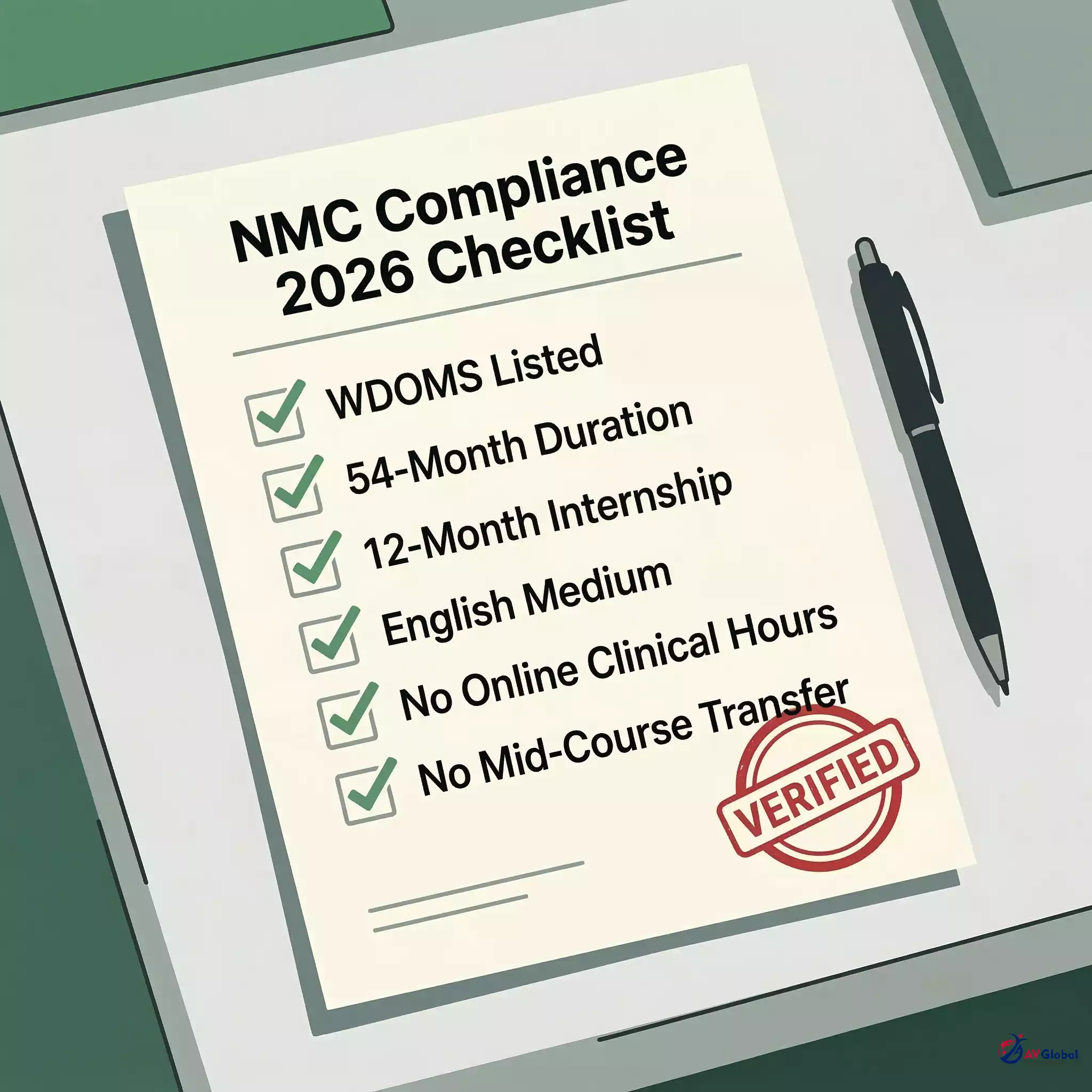
Yes, AMU is listed in WDOMS and recognized by NMC India. Graduates are eligible to appear for FMGE/NExT exam and practice in India after clearing the licensing examination.
The total 6-year MBBS cost at AMU is approximately ₹$40,850 (approx. Rs.
36. 0 Lakhs).
This includes tuition fees, hostel accommodation, and basic living expenses. AV Global provides transparent fee structure with no hidden charges.
AMU teaches MBBS in English medium. Universities in Kazakhstan do not require IELTS or TOEFL for Indian students.
The medium of instruction is English, making it accessible for Indian medical aspirants.
Indian students need a valid NEET scorecard to apply for MBBS at AMU. The cutoff varies each year based on seat availability.
Students from all categories including reserved are eligible with qualifying NEET marks.
Astana has a growing community of Indian restaurants catering to the increasing number of Indian students in the city. Popular options include Namaste India Restaurant on Kabanbay Batyr Avenue serving authentic North Indian curries, biryanis, and fresh tandoori rotis, Spice of India on Mangilik El Avenue offering vegetarian and non-vegetarian thalis, Bollywood Restaurant near Mega Silk Way mall with dosas and South Indian breakfast options, and Curry House on Turan Avenue known for reasonable prices and home-style cooking.
Several Indian grocery stores stock essential ingredients including basmati rice, atta flour, spices, lentils, pickles, and ready-to-eat products. Students who cook at home spend approximately Rs.
5,000-9,000 per month on groceries, while those eating primarily at restaurants spend Rs. 10,000-18,000 monthly.
Traditional Kazakhstani cuisine offers vegetarian-friendly options like beshbarmak (can be made vegetarian), plov (rice pilaf), lagman noodles with vegetables, manty (steamed dumplings with potato filling), and various dairy products. The university canteen serves affordable meals at Rs.
80-150 per plate with some vegetarian choices, though most Indian students prefer cooking or eating at Indian restaurants for authentic flavors. A small informal Indian mess operates near the university campus run by senior students, offering monthly subscription meals at approximately Rs.
8,000-12,000 per month.
AMU provides well-maintained hostel accommodation for international students. Astana Medical University provides on-campus hostel accommodation within a 5-minute walk from the main academic building, located inside a secure university compound with 24-hour gated entry.
The MBBS program at AMU is 6 years including a 1-year internship. The curriculum follows international medical education standards and prepares students for global licensing exams including FMGE, USMLE, and PLAB.
Yes, graduates from AMU can practice in India after clearing the FMGE/NExT licensing exam conducted by NMC. The university has a 41% (2024 estimate) FMGE pass rate.
The degree is recognized for medical practice in India.
Astana ranks as one of the safest capital cities in Central Asia with a Numbeo crime safety index of approximately 71/100, indicating low crime levels and high safety perception. Violent crime is rare, and crimes against international students are exceptionally uncommon.
Petty theft can occur in crowded markets and public transport, so students are advised to keep belongings secure, but overall street crime is minimal compared to major Indian metropolitan cities. The Astana Medical University campus operates as a gated and guarded compound with 24-hour professional security personnel, biometric access control at hostel entry points, and comprehensive CCTV monitoring covering all academic buildings, hostel blocks, and pathways.
Female students report feeling safe both on campus and in the city, particularly in well-populated neighborhoods like Yesil District where the university is located, Saryarka District with shopping centers and residential complexes, and the central business district around Kabanbay Batyr Avenue. The Indian Embassy in Kazakhstan is located in Almaty at 311A Furmanov Street, Almaty, contact number +7 727 291 3601, with a Consular Section helpline.
An Honorary Consul operates in Astana for emergency assistance. Students can reach emergency services by dialing 112 for police, ambulance, and fire services, with English-speaking operators available in the capital city.
AV Global maintains a 24-hour emergency contact number for students and provides a local representative in Astana whose contact information is shared with all students and parents before departure. This representative conducts monthly welfare check-ins and is available for any urgent assistance needed by students.
After MBBS from AMU, graduates can practice in India via FMGE/NExT, pursue USMLE for USA, PLAB for UK, or practice in Kazakhstan.
Related Articles

Ready to Start Your MBBS Journey?
“AV Global Overseas Education has been guiding students to Astana Medical University for over 9 years, having successfully placed more than 180 Indian students at this institution since 2015. We have witnessed our students' complete journeys from nervous first-year freshers adapting to Astana's harsh winter to confident graduating doctors clearing their licensing examinations and beginning medical careers. Our alumni from Astana Medical University are now practicing medicine in cities across India including Mumbai, Bangalore, Hyderabad, Pune, and Chennai after clearing FMGE/NExT, while others have successfully matched into residency programs in the United States and obtained GMC registration in the United Kingdom. What sets AV Global apart is our honest, parent-focused counseling approach - we openly discuss both the advantages and challenges of studying in Kazakhstan including the severe climate, cultural adjustments, and the importance of self-discipline in a foreign environment. We never oversell or make false promises about guaranteed job placements or unrealistic pass rates. Our value addition includes a dedicated local coordinator in Astana, Mr. Rajesh Kumar, who has lived in Kazakhstan for 12 years, speaks fluent Russian and Hindi, and serves as the emergency contact and support system for our students. He conducts monthly in-person welfare checks, assists with any university-related issues, helps during medical emergencies, and maintains regular communication with parents. We also provide ongoing career counseling, helping students decide their target country for practice, plan their licensing examination timeline, and access our NExT/USMLE/PLAB preparation resources. Our relationship doesn't end at admission - we remain your partners throughout the six-year journey and beyond, because your success as a doctor is the true measure of our counseling quality. For AV Global, you are not just an admission number but a future colleague in the noble medical profession.”