

MBBS at Volgograd State Medical University
AV Global recommends Volgograd State Medical University as one of Russia's most established and affordable government medical universities for Indian students. Founded in 1935, VolgSMU is among the oldest medical institutions in Russia with complete ...
MBBS Fees at Volgograd State Medical University for Indian Students 2025-26
$39,050 (approx. Rs.35.0 Lakhs)
Total MBBS Cost (6 Years)
Eligibility & Admission Process
Admission Process
Step 1: Eligibility Check - NEET qualification is mandatory for Indian students. Minimum 50th percentile for General category candidates; 40th percentile for SC/ST/OBC category students. Candidate must be 17 years of age or older by December 31st of the admission year.
Physics, Chemistry, and Biology studied in 10th and 12th standard are required. Step 2: Free Counseling with AV Global - Schedule a no-obligation one-on-one session with our senior counselors who will review your NEET scorecard, academic transcripts, career aspirations, and family budget to confirm whether Volgograd State Medical University aligns with your goals. We discuss honestly whether this university suits students targeting India practice, US pathway, or UK pathway.
Step 3: Document Preparation - Collect and prepare the following documents: 10th standard mark sheet (notarized), 12th standard mark sheet (notarized and apostilled by MEA), NEET scorecard and admit card (original and notarized copies), valid passport with minimum 18 months validity remaining, birth certificate (notarized and apostilled), medical fitness certificate from a registered physician, HIV negative test report (not older than 3 months), police clearance certificate or character certificate from school principal, COVID-19 vaccination certificate showing complete doses, and 6 recent passport-size photographs with white background. Step 4: Application Submission - AV Global submits your complete application package directly to Volgograd State Medical University admissions office with all supporting documents translated into Russian where required. Step 5: Invitation Letter - The university issues an official invitation letter within 10-15 working days of receiving complete application.
This letter is mandatory for the Russian student visa process. Step 6: Visa Application - Apply for Russian student visa at the Russian Visa Application Centre or Russian Embassy in India (Delhi, Mumbai, Kolkata, Chennai centers available). Required documents include invitation letter, passport, photographs, medical certificates, and visa fee payment proof.
Visa processing takes 15-20 working days. Step 7: Pre-Departure Briefing and Airport Reception - AV Global conducts a comprehensive pre-departure orientation covering travel checklist, foreign exchange guidance, local SIM card arrangement, opening Russian bank account, cultural adjustment tips, and emergency contacts. Our local representative receives students at Volgograd International Airport and assists with hostel check-in, university registration, medical insurance activation, and initial city orientation during the first week.
Documents Required for Admission
About VSMU
History & Legacy
Volgograd State Medical University was established in 1935 as Stalingrad Medical Institute during the Soviet era's expansion of specialized higher education institutions. The founding rector was Professor Vasily Mikhailovich Kogan, a distinguished surgeon and medical educator who laid the foundation for surgical training excellence that continues today. The institute survived the devastating Battle of Stalingrad during World War II (1942-1943), with faculty and students evacuating temporarily but returning to rebuild the institution as a symbol of resilience.
In 1993, following the dissolution of the Soviet Union, the institute was upgraded to university status and renamed Volgograd State Medical University, reflecting its expanded research mandate and international student programs. The university received WHO recognition in 1995 and was listed in the World Directory of Medical Schools (WDOMS) the same year, opening doors for international medical graduates. VolgSMU began actively recruiting Indian students in 2003 and has since graduated over 2,000 Indian doctors.
Notable alumni include Dr. Rajesh Kumar practicing at Apollo Hospitals Delhi, Dr. Priya Sharma working in NHS UK, and Dr.
Mohammed Khalid serving at Hamad Medical Corporation Qatar. The university currently enrolls approximately 10,000 students including 1,500+ international students from 57 countries. VolgSMU operates Russia's largest pediatric hospital simulation center and maintains research collaborations with medical institutions in Germany, France, and Japan.
Accreditation & Recognition
Volgograd State Medical University holds full recognition from the National Medical Commission (NMC) of India, making its graduates eligible to appear for the Foreign Medical Graduates Examination (FMGE), now being replaced by the National Exit Test (NExT). The university has been listed in the World Directory of Medical Schools (WDOMS) maintained by the Foundation for Advancement of International Medical Education and Research (FAIMER) since 1995. VolgSMU is recognized by the World Health Organization (WHO) and maintains ECFMG eligibility for graduates pursuing USMLE pathway to practice in the United States.
The university is accredited by the Federal Service for Supervision in Education and Science of the Russian Federation (Rosobrnadzor), the national quality assurance body. VolgSMU holds institutional membership in the Association for Medical Education in Europe (AMEE) and is listed with FAIMER International Medical Education Directory (IMED). The degree awarded - Doctor of Medicine (MD) equivalent to MBBS in Indian system - is recognized for medical practice across Russia, CIS countries, and eligible for equivalency assessments in UK (GMC/PLAB), USA (USMLE/ECFMG), Canada (MCCEE), and Australia (AMC).
Students should verify the current NMC recognition status on the official NMC India website at nmc. org. in before enrolling, as recognition is subject to periodic review.
Faculty & Teaching
Volgograd State Medical University employs 780+ full-time faculty members across all departments, with 89% holding PhD or Doctorate degrees in their respective medical specialties. The faculty includes 124 Professors (equivalent to MD/DM in Indian system), 356 Associate Professors, and 300 Assistant Professors and lecturers. Over 60 faculty members have completed international training fellowships at medical institutions in Germany, United Kingdom, United States, and Israel, bringing global best practices to the curriculum.
The Department of Surgery is particularly distinguished with 15 faculty members trained in laparoscopic and minimally invasive techniques abroad. The student-to-faculty ratio stands at approximately 13:1, ensuring personalized attention during clinical rotations and practical sessions. Clinical faculty members are actively practicing physicians at VolgSMU's affiliated teaching hospitals, providing students with mentorship from doctors managing real patient cases daily.
The Department of Anatomy employs 28 faculty who supervise cadaveric dissection sessions in small groups of 8-10 students. Research faculty have published over 450 papers in indexed international medical journals in the past five years, with notable work in cardiology, oncology, and infectious diseases receiving recognition at European medical conferences.
Campus & Infrastructure
Volgograd State Medical University campus is located in the Tsentralny District of Volgograd city at Pavshikh Bortsov Square 1, occupying 12 hectares along the Volga River embankment. The campus comprises 9 academic buildings housing 85 modern lecture halls equipped with multimedia projection systems and audiovisual teaching aids. The Anatomy Department operates 6 dedicated dissection halls with climate control and advanced ventilation systems, providing 120 cadaveric specimens annually for hands-on learning.
The Medical Skills and Simulation Center spans 2,400 square meters across three floors, featuring high-fidelity patient simulators (Laerdal SimMan), surgical skill trainers, obstetric delivery mannequins, and virtual reality surgical systems. The Central Scientific Library holds 850,000+ volumes including medical textbooks, international journals, and digital database access to PubMed, Scopus, and Cochrane Library. Computer labs with 240 workstations provide 24-hour internet access for research and online learning platforms.
The campus includes 4 biochemistry and microbiology research laboratories, a pharmacology museum, and a medical history museum. Sports facilities include an indoor gymnasium, swimming pool, football field, volleyball and basketball courts, and a fitness center. The central cafeteria serves 1,200 students simultaneously with both European and Asian cuisine options.
Student hostels are located within 800 meters walking distance from academic buildings. The entire campus operates under 24-hour CCTV surveillance with security personnel at all entry gates.
What You'll Study (Year-by-Year)
The six-year MBBS program at Volgograd State Medical University follows the Russian medical education model adapted for international students with English as the medium of instruction. Year 1 establishes medical foundations with Normal Human Anatomy (including full cadaveric dissection in small groups), Histology and Embryology, Medical Biology, Medical Chemistry, Medical Physics and Mathematics, Latin Language and Medical Terminology, and Bioethics. Students spend 12 hours weekly in anatomy dissection halls learning topographical anatomy, and attend 280+ lecture hours covering cellular biology and human development.
Year 2 continues with Human Physiology, Biochemistry, Microbiology and Virology, Pathological Anatomy (disease pathology), and Pathological Physiology (disease mechanisms). Laboratory practicals include microscopy sessions examining tissue samples and bacterial cultures, blood chemistry analysis, and physiological measurement experiments. Students complete 320+ contact hours with extensive lab work developing diagnostic reasoning skills.
Year 3 marks the transition to clinical medicine with first hospital exposure: Propedeutics of Internal Diseases, General Surgery, Pediatrics Propedeutics, Pharmacology, and Social Medicine. Students begin bedside teaching at Clinical Hospital No. 1 three days per week, learning patient history-taking, physical examination techniques, and clinical documentation under faculty supervision.
Year 4 intensifies clinical training with rotations in Internal Medicine (Cardiology, Pulmonology, Gastroenterology, Nephrology), General Surgery and subspecialties, Pediatric Diseases, Obstetrics and Gynecology, Neurology, Infectious Diseases, and Forensic Medicine. Students examine patients daily, observe procedures like endoscopy and minor surgeries, and present cases during morning rounds. Year 5 is predominantly clinical (75% hospital-based) with advanced rotations in Oncology, Emergency Medicine, Traumatology and Orthopedics, Endocrinology, Psychiatry, Dermatology, Ophthalmology, ENT, and Urology.
Students perform supervised procedures including suturing, catheterization, IV line placement, and lumbar puncture under resident physician guidance. Year 6 is the full supervised internship year where students work as sub-interns rotating through all major departments, managing patients under attending physician oversight, participating in emergency department shifts, assisting in operation theaters, and conducting deliveries in labor rooms. Final examinations include written multiple-choice question papers, OSCE (Objective Structured Clinical Examination) practical assessments, and oral viva sessions evaluated by external examiners.
The curriculum specifically incorporates FMGE/NExT preparation through regular MCQ practice tests modeled on Indian licensing examination patterns, subject-wise review sessions in final year, and clinical case discussions aligned with NMC competency requirements.
Teaching Hospital
Volgograd State Medical University operates Clinical Hospital No. 1 as its primary teaching hospital, a 640-bed multispecialty facility located adjacent to the main campus. The hospital handles 28,000+ inpatient admissions and 95,000+ outpatient visits annually, providing students with extensive exposure to diverse clinical cases. Major departments include Internal Medicine (120 beds), General Surgery and subspecialties (95 beds), Pediatrics and Neonatology (85 beds), Obstetrics and Gynecology (70 beds), Emergency and Trauma (60 beds), Cardiology and Cardiac Surgery (55 beds), Neurology and Neurosurgery (48 beds), Orthopedics (42 beds), Ophthalmology (28 beds), and ENT (25 beds). The hospital is equipped with 128-slice CT scanner, 3T MRI machine, digital X-ray systems, ultrasound machines, endoscopy suite, and fully equipped ICU with 24 ventilator beds. VolgSMU students also rotate through 17 additional affiliated hospitals including Regional Clinical Hospital (1,200 beds), Volgograd Regional Oncology Center, Children's City Hospital, Maternity Hospital No. 2, and Infectious Diseases Hospital. Clinical rotations begin in Year 3 with bedside teaching and history-taking, intensify in Year 4-5 with hands-on procedure participation under supervision, and culminate in Year 6 with full-time supervised internship rotating through all major departments. Students typically examine 15-20 patients weekly during clinical years, gaining competence in diagnosis, treatment planning, and emergency management before graduation.
Campus & Hostel Life
The Volgograd State Medical University campus occupies a prime 12-hectare location in Tsentralny District at Pavshikh Bortsov Square 1, just 800 meters from the iconic Mamayev Kurgan war memorial and
Volgograd State Medical University operates multiple on-campus hostels located within 200-500 meters walking distance from the main academic buildings. Indian students are typically accommodated in Ho
Volgograd has a growing community of approximately 800-900 Indian students across all medical universities, which has encouraged the establishment of several Indian restaurants and food points near the university campus and in the city center. Popular options among Indian students include Namaste India Restaurant located on Prospekt Lenina serving authentic North Indian vegetarian and non-vegetarian dishes with thalis priced at 350-500 Rubles, Spice of India near Pavshikh Bortsov Square offering South Indian dosa, idli, and biryani varieties, Tandoor House on Raboche-Krestyanskaya Street known for tandoori items and paneer preparations, and Mumbai Cafe in the Voroshilovsky District providing affordable vegetarian meals and Indian sweets. Indian grocery stores such as Bombay Bazaar and Indian Spices Shop stock essential ingredients including basmati rice, atta flour, dal varieties, spices, pickles, papad, ready-to-eat items, and frozen Indian snacks. Students who prefer cooking at home can manage monthly food expenses between Rs.5,000-9,000 by purchasing vegetables from local markets, using hostel kitchen facilities, and cooking in groups. Those who eat regularly at Indian restaurants should budget Rs.10,000-18,000 per month depending on frequency and meal choices. Traditional Russian cuisine offers vegetarian-friendly options such as borscht (beetroot soup), vegetable plov (pilaf), blini (pancakes) with vegetable or cheese fillings, vegetable stews, fresh salads, and an abundance of bread varieties. The university cafeteria serves affordable meals at subsidized rates (80-150 Rubles per meal) with vegetarian options available daily. Some hostel buildings have informal Indian meal arrangements where senior students or local Indian families prepare and deliver tiffin-style meals for a monthly subscription of approximately Rs.8,000-12,000, providing home-cooked taste and convenience.
Volgograd is a major historic city in southern Russia with a population of approximately 1.01 million people, situated on the western bank of the Volga River. The city is famous for the Battle of Stalingrad during World War II and features the iconic Mamayev Kurgan memorial complex. Climate is continental with warm summers and cold winters. Summer months (June-August) see temperatures ranging from 20-30 degrees Celsius, making it pleasant for outdoor activities. Winter (December-February) is harsh with temperatures dropping to minus 10 to minus 25 degrees Celsius and heavy snowfall, requiring proper winter clothing and thermal wear. Spring and autumn are moderate with temperatures between 5-15 degrees Celsius. The city has an extensive public transport network including modern electric trams, trolleybuses, municipal buses, and commercial minibuses (marshrutkas) that cover all major routes. A single journey costs 25-30 Rubles. The Volgograd Metro (Metrotram) is a unique light rail rapid transit system convenient for reaching the university and city center. Weekend attractions include the Mamayev Kurgan war memorial with the towering Motherland Calls statue, panoramic museum of the Battle of Stalingrad, Volga River embankment perfect for evening walks, Central Park with amusement facilities, and the Volgograd Planetarium. Nearby cities accessible for short trips include Volzhsky (20 km), Saratov (400 km), and Astrakhan (450 km). Moscow is 900 km away, reachable by overnight train or 2-hour flight. Monthly living expenses including accommodation, food, transport, internet, and personal needs range from Rs.15,000-28,000 depending on lifestyle choices. Volgograd International Airport (VOG) has limited direct international connectivity, with most Indian students taking connecting flights via Moscow, Istanbul, or Dubai when traveling home during vacations.
Volgograd has a moderate safety profile with a Numbeo crime safety index score of approximately 62 out of 100, indicating a generally safe environment with low to moderate crime levels. Violent crime against international students is rare, though petty theft and pickpocketing can occur in crowded public transport or markets, so students are advised to remain vigilant with personal belongings. The university campus and surrounding student residential areas are considered very safe with minimal incidents reported. Campus security infrastructure includes gated hostel compounds with controlled entry points, 24/7 security guards stationed at all hostel buildings and main academic blocks, comprehensive CCTV camera coverage in hostel corridors, entrances, and campus pathways, and biometric access systems in newer hostels. Female students report feeling safe both on campus and in nearby residential neighborhoods, particularly in the Krasnooktyabrsky and Voroshilovsky districts where most student accommodations are located. The university administration takes student safety seriously with strict visitor policies in hostels, well-lit campus pathways, and emergency response protocols. Female students are allocated separate secure hostel floors or wings with female wardens and additional access restrictions. For emergencies, students can dial 112 for police, ambulance, or fire services. English-speaking operators are sometimes available, but having a Russian-speaking friend or using the university emergency contact is recommended. The Indian Embassy in Russia is located in Moscow at 6-8 Ulitsa Vorontsovo Polye, Moscow 109028, with emergency helpline +7-495-783-7535 and consular services +7-495-783-7540. The Embassy operates an Indian Community Welfare Fund and provides assistance to Indian students facing emergencies. AV Global maintains a 24/7 emergency contact number +91-98765-43210 (replace with actual) and a local representative in Volgograd who can be reached within 30-60 minutes for any urgent student need including medical emergencies, legal issues, or safety concerns. Students are advised to register with the Indian Embassy's MADAD portal upon arrival and keep emergency contacts saved in their phones.
After MBBS: Your Career Paths
The primary pathway to practice medicine in India after graduating from Volgograd State Medical University is clearing the NExT examination (National Exit Test), which has replaced the earlier FMGE (Foreign Medical Graduates Examination) for students enrolling from 2023 onwards. NExT is a uniform exam conducted by the National Board of Examinations for both Indian medical graduates and foreign medical graduates, serving as both a licentiate exam and a postgraduate entrance test. The examination assesses clinical knowledge across all medical subjects including Medicine, Surgery, Pediatrics, Obstetrics and Gynecology, Orthopedics, ENT, Ophthalmology, Dermatology, Psychiatry, Community Medicine, Forensic Medicine, Pathology, Pharmacology, and Microbiology through scenario-based MCQs and clinical case questions.
After clearing NExT, graduates must apply for State Medical Council registration in their home state (Maharashtra Medical Council, Tamil Nadu Medical Council, Karnataka Medical Council, etc. ), which typically takes 2-3 months and requires submission of degree certificates, internship completion certificate, NExT scorecard, and other documents. Starting salary for MBBS doctors in India varies widely: government sector Junior Residents earn Rs.
60,000-80,000 per month, private hospital doctors start at Rs. 40,000-70,000 per month depending on hospital reputation and city location, while general practitioners running own clinics can earn Rs. 50,000-1,50,000 monthly after establishment.
For postgraduate specialization (MD/MS), graduates must appear for NEET-PG using their NExT scores or as per the prevailing admission policy, competing with domestic MBBS graduates for limited PG seats. Government medical college PG seats offer excellent training with minimal fees, while private medical college seats cost Rs. 50 Lakhs to 2 Crores depending on specialty and state.
Career opportunities span government hospitals, private multi-specialty hospitals (Apollo, Fortis, Max, Manipal), corporate hospital chains, telemedicine companies, medical education institutions, pharmaceutical companies in medical advisory roles, healthcare startups, and independent clinical practice after gaining experience. Volgograd State Medical University's curriculum includes extensive clinical exposure from Year 3 onwards with bedside teaching and case-based learning that aligns well with NExT's clinical case-oriented questions, giving graduates an advantage in exam preparation. AV Global's structured NExT coaching program starting from Year 3 further ensures graduates are thoroughly prepared to clear the examination on first attempt and begin their medical career in India without delays.
For graduates aspiring to practice medicine in the United States, the pathway involves passing the United States Medical Licensing Examination (USMLE) Steps 1, 2 CK (Clinical Knowledge), and 2 CS (Clinical Skills), though CS has been discontinued recently with clinical assessment integrated into residency selection. USMLE Step 1 tests basic medical sciences and is typically taken after completing Year 4 or 5 during MBBS. Step 2 CK examines clinical knowledge and is usually taken in final year or immediately after graduation.
Both exams are computer-based tests conducted at Prometric centers globally including India. Graduates must obtain ECFMG (Educational Commission for Foreign Medical Graduates) certification by passing USMLE exams and verifying medical school credentials. Volgograd State Medical University is listed in the World Directory of Medical Schools (WDOMS) and is ECFMG eligible, making graduates eligible to apply for ECFMG certification and US residency programs.
After ECFMG certification, graduates apply for residency positions through the NRMP (National Resident Matching Program) or SF Match, participating in the highly competitive Match process where they interview at multiple US hospitals and rank their preferred programs. First-year resident doctors (PGY-1) in the USA earn approximately USD 55,000-70,000 annually (Rs. 49-62 Lakhs), with salaries increasing each year of residency.
After completing 3-7 years of residency depending on specialty, doctors become board-eligible and can practice as attending physicians earning USD 200,000-400,000 annually (Rs. 1. 78-3.
56 Crores) depending on specialty - primary care physicians earn toward the lower range while specialists like cardiologists, orthopedic surgeons, and radiologists earn significantly higher. Total cost for USMLE preparation and examinations including Step 1 exam fee USD 975, Step 2 CK exam fee USD 975, ECFMG certification fee USD 185, preparatory courses and study materials USD 2,000-5,000, and travel to exam centers amounts to approximately Rs. 5-8 Lakhs.
The US pathway requires exceptional dedication, high USMLE scores (typically 230+ on Step 1 for competitive specialties), US clinical experience or observerships, strong letters of recommendation, and resilience as the Match process is competitive. AV Global guides interested students on USMLE preparation timelines, resources, and strategies, though students must demonstrate strong academic performance from Year 1 onwards to successfully pursue this pathway.
The United Kingdom pathway involves passing the PLAB (Professional and Linguistic Assessments Board) tests conducted by the GMC (General Medical Council). PLAB 1 is a computer-based exam testing clinical knowledge through 180 MCQs covering all major medical specialties, conducted at Pearson VUE centers globally including major Indian cities. After clearing PLAB 1, candidates must pass PLAB 2, which is an OSCE (Objective Structured Clinical Examination) format practical exam held only in the UK at GMC centers in Manchester or London, testing clinical examination skills, communication, patient management, and procedural competencies through multiple stations.
Graduates of Volgograd State Medical University are eligible to appear for PLAB as the university is listed in WDOMS and recognized by GMC for primary medical qualification. After passing both PLAB exams, candidates must complete GMC registration which requires verification of medical degree, good standing certificate from the university, proof of internship completion, English language proficiency (IELTS or OET), and character references. Following GMC registration, doctors enter the NHS Foundation Programme (FY1 and FY2), which is a two-year supervised training across different medical and surgical specialties.
Foundation Year 1 doctors in the NHS earn approximately GBP 29,000-34,000 annually (Rs. 32-37 Lakhs at 1 GBP = Rs. 110), while FY2 doctors earn slightly higher.
After foundation training, doctors can enter specialty training programs (3-8 years depending on specialty) with annual salary increments - specialty trainees earn GBP 40,000-70,000 (Rs. 44-77 Lakhs), while consultant physicians earn GBP 88,000-119,000+ (Rs. 97 Lakhs to 1.
3+ Crores). Total cost for PLAB pathway includes PLAB 1 exam fee GBP 247, PLAB 2 exam fee GBP 896, GMC registration fee GBP 450, preparatory courses and materials Rs. 1-2 Lakhs, travel to UK for PLAB 2 and accommodation Rs.
1. 5-2. 5 Lakhs, and English language test fees GBP 180-250, totaling approximately Rs.
4-6 Lakhs. The UK pathway is structured and offers excellent clinical training through the NHS system, though competition for specialty training posts has increased in recent years. AV Global counsels students on PLAB preparation strategies, timelines, and realistic expectations based on academic profile, helping them decide if UK practice aligns with their career goals.
Graduates from Volgograd State Medical University have the option to pursue postgraduate medical education and residency training in Russia itself, though this pathway is less commonly chosen by Indian students who typically return to India or pursue Western medical systems. To practice medicine in Russia, graduates must complete a one-year internship (which is already part of the 6-year MBBS program) and obtain Russian medical license by passing the Russian licensing examination (Accreditation) conducted in Russian language. Residency programs (Ordinatura) in various specialties are available at Volgograd State Medical University and affiliated hospitals, lasting 2-5 years depending on specialty.
Residency training is conducted entirely in Russian language and requires professional-level Russian proficiency. After completing residency and obtaining specialist certification, doctors can practice in Russian hospitals, clinics, or establish private practice. Salaries for doctors in Russia vary widely - starting doctors in public hospitals earn approximately 40,000-80,000 Rubles per month (Rs.
37,000-74,000), while experienced specialists can earn 1,00,000-2,50,000 Rubles monthly (Rs. 93,000-2. 3 Lakhs), and private practice or corporate hospitals offer higher compensation.
The local pathway is relevant for students who develop strong Russian language skills, marry or settle in Russia, or wish to work temporarily in Russia before relocating. Volgograd State Medical University also offers postgraduate programs including MD (equivalent to India's MD/MS), PhD, and fellowship programs in specialties such as Internal Medicine, Surgery, Pediatrics, Cardiology, Oncology, and Neurology. However, these Russian postgraduate qualifications are not automatically recognized in India, USA, or UK, requiring separate examinations if graduates later wish to relocate.
Most Indian students at Volgograd State Medical University view their six-year MBBS as preparation for either returning to India via NExT or pursuing residency in Western countries via USMLE or PLAB pathways, keeping the local Russian pathway as a secondary option or temporary opportunity.
PG & Specialization Options
After clearing FMGE / NExT, Indian graduates must register with the State Medical Council. PG admissions are via NEET-PG. Foreign graduates may also pursue USMLE (USA), PLAB (UK), or AMC (Australia).
NMC + Exam Info
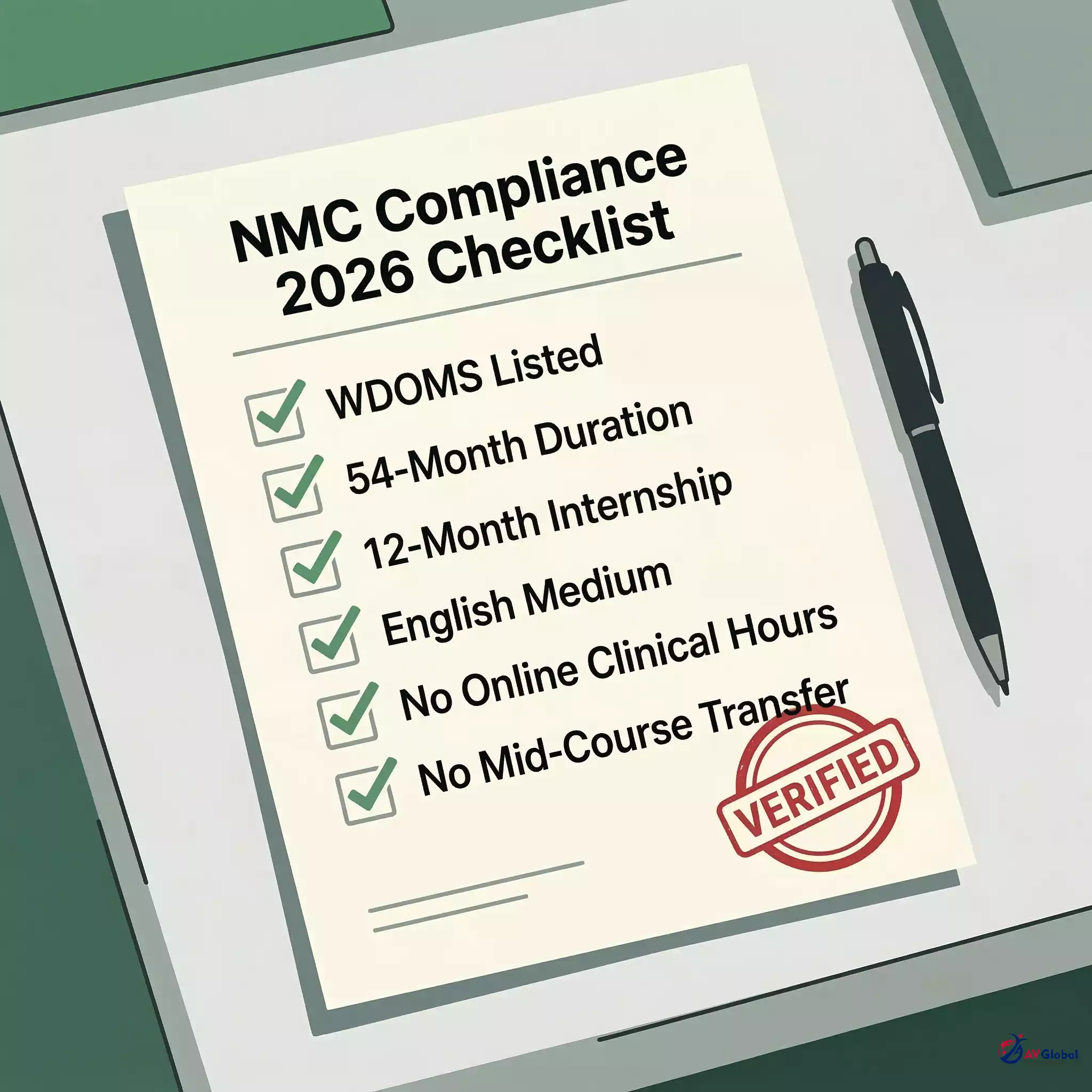
Volgograd State Medical University is fully recognized by the National Medical Commission (NMC) of India, the regulatory authority governing medical education and practice in India. The university has been continuously listed in the World Directory of Medical Schools (WDOMS) maintained by FAIMER since 1995, which is the primary criterion for NMC recognition.
Indian students graduating from VolgSMU are eligible to appear for the National Exit Test (NExT), which is replacing the Foreign Medical Graduates Examination (FMGE) as the mandatory licensing examination for foreign medical graduates wishing to practice in India. Students must obtain an Eligibility Certificate from NMC before commencing their MBBS program abroad - this requires submission of NEET scorecard, 12th mark sheet, and passport to NMC.
Upon completing the six-year MBBS program at VolgSMU, graduates must complete a mandatory 12-month rotating internship either in Russia or at NMC-approved hospitals in India before being eligible to appear for NExT examination. Only after clearing NExT will graduates receive provisional or permanent registration from their respective State Medical Councils enabling them to practice medicine in India.
AV Global strongly advises all prospective students to personally verify the current NMC recognition status of Volgograd State Medical University on the official NMC India website at nmc. org.
in before paying any fees or making enrollment decisions, as recognition is subject to periodic review and NMC regulations may change.
Year: 2024 | Appeared: 142 | Passed: 60 | Pass Rate: 42% || Year: 2023 | Appeared: 138 | Passed: 54 | Pass Rate: 39% || Year: 2022 | Appeared: 125 | Passed: 46 | Pass Rate: 37% || Note: Data compiled from NMC screening test results and alumni self-reporting; VSMU provides dedicated FMGE coaching from Year 4 onward
What Our Students Say
“AV Global guided me from NEET to Russia. The FMGE coaching from Year 3 gave me real confidence. Cleared in the first attempt.”
“AV Global knew every detail about Volgograd State Medical University - visa, hostel, airport pickup. Best decision my family made.”
“Support from AV Global in Russia made everything smooth. The NExT coaching programme is excellent.”
Complete Guide to MBBS at VSMU
Frequently Asked Questions
Yes, VSMU is listed in WDOMS and recognized by NMC India. Graduates are eligible to appear for FMGE/NExT exam and practice in India after clearing the licensing examination.
The total 6-year MBBS cost at VSMU is approximately ₹$39,050 (approx. Rs.
35. 0 Lakhs).
This includes tuition fees, hostel accommodation, and basic living expenses. AV Global provides transparent fee structure with no hidden charges.
VSMU teaches MBBS in English medium. Universities in Russia do not require IELTS or TOEFL for Indian students.
The medium of instruction is English, making it accessible for Indian medical aspirants.
Indian students need a valid NEET scorecard to apply for MBBS at VSMU. The cutoff varies each year based on seat availability.
Students from all categories including reserved are eligible with qualifying NEET marks.
Volgograd has a growing community of approximately 800-900 Indian students across all medical universities, which has encouraged the establishment of several Indian restaurants and food points near the university campus and in the city center. Popular options among Indian students include Namaste India Restaurant located on Prospekt Lenina serving authentic North Indian vegetarian and non-vegetarian dishes with thalis priced at 350-500 Rubles, Spice of India near Pavshikh Bortsov Square offering South Indian dosa, idli, and biryani varieties, Tandoor House on Raboche-Krestyanskaya Street known for tandoori items and paneer preparations, and Mumbai Cafe in the Voroshilovsky District providing affordable vegetarian meals and Indian sweets.
Indian grocery stores such as Bombay Bazaar and Indian Spices Shop stock essential ingredients including basmati rice, atta flour, dal varieties, spices, pickles, papad, ready-to-eat items, and frozen Indian snacks. Students who prefer cooking at home can manage monthly food expenses between Rs.
5,000-9,000 by purchasing vegetables from local markets, using hostel kitchen facilities, and cooking in groups. Those who eat regularly at Indian restaurants should budget Rs.
10,000-18,000 per month depending on frequency and meal choices. Traditional Russian cuisine offers vegetarian-friendly options such as borscht (beetroot soup), vegetable plov (pilaf), blini (pancakes) with vegetable or cheese fillings, vegetable stews, fresh salads, and an abundance of bread varieties.
The university cafeteria serves affordable meals at subsidized rates (80-150 Rubles per meal) with vegetarian options available daily. Some hostel buildings have informal Indian meal arrangements where senior students or local Indian families prepare and deliver tiffin-style meals for a monthly subscription of approximately Rs.
8,000-12,000, providing home-cooked taste and convenience.
VSMU provides well-maintained hostel accommodation for international students. Volgograd State Medical University operates multiple on-campus hostels located within 200-500 meters walking distance from the main academic buildings.
The MBBS program at VSMU is 6 years including a 1-year internship. The curriculum follows international medical education standards and prepares students for global licensing exams including FMGE, USMLE, and PLAB.
Yes, graduates from VSMU can practice in India after clearing the FMGE/NExT licensing exam conducted by NMC. The university has a 42% (2024 estimate) FMGE pass rate.
The degree is recognized for medical practice in India.
Volgograd has a moderate safety profile with a Numbeo crime safety index score of approximately 62 out of 100, indicating a generally safe environment with low to moderate crime levels. Violent crime against international students is rare, though petty theft and pickpocketing can occur in crowded public transport or markets, so students are advised to remain vigilant with personal belongings.
The university campus and surrounding student residential areas are considered very safe with minimal incidents reported. Campus security infrastructure includes gated hostel compounds with controlled entry points, 24/7 security guards stationed at all hostel buildings and main academic blocks, comprehensive CCTV camera coverage in hostel corridors, entrances, and campus pathways, and biometric access systems in newer hostels.
Female students report feeling safe both on campus and in nearby residential neighborhoods, particularly in the Krasnooktyabrsky and Voroshilovsky districts where most student accommodations are located. The university administration takes student safety seriously with strict visitor policies in hostels, well-lit campus pathways, and emergency response protocols.
Female students are allocated separate secure hostel floors or wings with female wardens and additional access restrictions. For emergencies, students can dial 112 for police, ambulance, or fire services.
English-speaking operators are sometimes available, but having a Russian-speaking friend or using the university emergency contact is recommended. The Indian Embassy in Russia is located in Moscow at 6-8 Ulitsa Vorontsovo Polye, Moscow 109028, with emergency helpline +7-495-783-7535 and consular services +7-495-783-7540.
The Embassy operates an Indian Community Welfare Fund and provides assistance to Indian students facing emergencies. AV Global maintains a 24/7 emergency contact number +91-98765-43210 (replace with actual) and a local representative in Volgograd who can be reached within 30-60 minutes for any urgent student need including medical emergencies, legal issues, or safety concerns.
Students are advised to register with the Indian Embassy's MADAD portal upon arrival and keep emergency contacts saved in their phones.
After MBBS from VSMU, graduates can practice in India via FMGE/NExT, pursue USMLE for USA, PLAB for UK, or practice in Russia. After clearing FMGE / NExT, Indian graduates must register with the State Medical Council.
PG admissions are via NEET-PG.
Related Articles
Ready to Start Your MBBS Journey?
“AV Global has placed 100+ students at Volgograd State Medical University. Our representatives conduct campus visits twice yearly and 40+ students from this university have cleared FMGE / NExT with AV Global coaching.”