
MBBS at Kazan State Medical University
AV Global recommends Kazan State Medical University as one of the oldest and most prestigious medical institutions in Russia, with a legacy spanning over 210 years since its founding in 1814. KSMU stands out for its robust clinical training across 18...
MBBS Fees at Kazan State Medical University for Indian Students 2025-26
$42,650 (approx. Rs.38.0 Lakhs)
Total MBBS Cost (6 Years)
Eligibility & Admission Process
Admission Process
Step 1: Eligibility Check - NEET qualification is mandatory for all Indian students applying to Kazan State Medical University. General category students must score at the 50th percentile or above, while SC/ST/OBC category students require 40th percentile or above. The student must be at least 17 years of age by December 31 of the admission year.
Physics, Chemistry, and Biology must have been studied at the 10+2 level with English as a subject. Step 2: Free Counseling with AV Global - We offer a comprehensive no-obligation counseling session where our senior advisors review your NEET scorecard, academic profile, family budget, and long-term career goals. We discuss whether Kazan State Medical University aligns with your aspirations - whether you plan to return to India, pursue USMLE for the USA, or take PLAB for the UK.
This session helps parents make an informed decision without any sales pressure. Step 3: Document Preparation - Gather all required documents in original and notarized copies: 10th standard mark sheet (notarized), 12th standard mark sheet (notarized and apostilled by MEA), NEET scorecard and admit card, valid passport with minimum 18 months validity remaining, birth certificate (notarized and apostilled), medical fitness certificate from a registered medical practitioner, HIV negative test report from an authorized laboratory, police clearance certificate or character certificate from school principal, COVID-19 vaccination certificate showing complete doses, and 6 recent passport-size photographs with white background. Apostille is the legalization process done by the Ministry of External Affairs for documents to be used in Russia.
Step 4: Application Submission - AV Global submits your complete application package directly to Kazan State Medical University admissions office. We handle all communication in Russian and English, ensuring your documents meet university standards. Step 5: Invitation Letter Issuance - The university reviews applications and issues an official Invitation Letter within 10 to 15 working days.
This document is essential for the Russian visa process. Step 6: Visa Application Process - Using the invitation letter, students apply for a Russian student visa at the Russian Visa Application Centre or Russian Embassy in Delhi, Mumbai, Kolkata, or Chennai. AV Global provides complete guidance on visa forms, interview preparation, and supporting documents.
Visa processing takes approximately 15-20 working days. Step 7: Pre-Departure Briefing and Arrival Support - Before departure, AV Global conducts a detailed pre-departure orientation covering: what to pack for Kazan winters, currency exchange (Rubles), local SIM card options (MTS, Beeline), opening a Russian bank account, emergency contacts, hostel check-in procedures, and first-week university registration formalities. Upon arrival at Kazan International Airport, our local representative receives students personally, assists with immigration clearance, arranges transport to the hostel, and remains available throughout the settling-in period.
Students are never left to navigate alone in an unfamiliar country.
Documents Required for Admission
About KSMU
History & Legacy
Kazan State Medical University was established in 1814 as the Medical Faculty of Kazan Imperial University by Tsar Alexander I, making it one of the oldest medical schools in Russia and Eastern Europe. The founding vision was led by Professor Karl Fuchs, a renowned German-Russian physician and ethnographer who shaped the early medical curriculum. In 1930, during Soviet reorganization of higher education, the medical faculty was separated and renamed Kazan State Medical Institute, gaining full autonomy with dedicated funding for hospital infrastructure and research laboratories.
The institute was upgraded to university status in 1994 and renamed Kazan State Medical University, reflecting its expanded postgraduate programs and international collaborations. WHO recognized the university in 1995, and it was listed in the World Directory of Medical Schools the same year. Today, over 9,000 students from 57 countries study at KSMU, including approximately 1,200 Indian students currently enrolled.
The university has produced more than 65,000 physicians since its founding, with notable alumni practicing in India, USA, UK, Germany, UAE, and across Commonwealth nations. Several KSMU graduates have become heads of departments in prominent Indian hospitals including AIIMS, PGI Chandigarh, and Safdarjung Hospital. The university maintains active research collaborations with Harvard Medical School, Charite Berlin, and Karolinska Institute Sweden.
Accreditation & Recognition
Kazan State Medical University is fully recognized by the National Medical Commission (NMC) of India under the erstwhile Medical Council of India (MCI) since 2002, making graduates eligible to appear for the Foreign Medical Graduate Examination (FMGE), now replaced by National Exit Test (NExT) for obtaining medical license to practice in India. The university has been listed in the World Directory of Medical Schools (WDOMS) maintained by the Foundation for Advancement of International Medical Education and Research (FAIMER) since 1995. KSMU holds Educational Commission for Foreign Medical Graduates (ECFMG) eligibility, allowing graduates to pursue USMLE pathway for USA medical licensing and residency.
The university is accredited by the Russian Federal Service for Supervision in Education and Science (Rosobrnadzor), the apex regulatory body for higher education in Russia. KSMU is an institutional member of FAIMER, Association for Medical Education in Europe (AMEE), and International Association of Medical Regulatory Authorities. The degree awarded (Doctor of Medicine - MD) is recognized by the World Health Organization.
Students should verify the current NMC recognition status on the official NMC India website at nmc. org. in before enrolling, as recognition is subject to periodic review.
Faculty & Teaching
Kazan State Medical University employs over 780 full-time faculty members across all departments, including 142 Doctors of Science (equivalent to DSc or higher doctorate) and 387 PhD holders (Candidates of Science), giving a faculty doctoral qualification rate of 68 percent. The faculty includes 89 full professors and 246 associate professors with extensive clinical experience. Approximately 15 percent of faculty have received international training or fellowships at institutions in USA, UK, Germany, and France.
The faculty-to-student ratio stands at approximately 1:11, ensuring personalized attention during clinical rotations and practical sessions. The Department of Internal Medicine has 42 faculty members, Surgery has 38, Pediatrics has 29, and Obstetrics-Gynecology has 24 dedicated clinical faculty. Several faculty members serve as chief physicians and heads of departments at affiliated teaching hospitals, bridging academic teaching with active clinical practice.
The Anatomy department maintains 8 full-time faculty who supervise cadaveric dissection sessions for first-year students. English-medium instruction is delivered by Russian faculty trained in English medical terminology, with additional support from Indian faculty coordinators who assist with language nuances during the initial semesters.
Campus & Infrastructure
Kazan State Medical University main campus is located at 49 Butlerov Street, Kazan, Tatarstan Republic, Russia 420012, in the Vakhitovsky District near the city center. The campus spans 12 hectares with 15 academic buildings interconnected by covered walkways. Facilities include 48 modern lecture halls equipped with audiovisual systems, 22 specialized anatomy laboratories with dedicated cadaver dissection rooms maintaining over 200 preserved specimens, 18 biochemistry and microbiology laboratories, a 6-story medical library housing 580,000 volumes including international medical journals, 12 computer labs with 340 workstations and high-speed internet connectivity, and a Clinical Skills Simulation Center established in 2016 with mannequins for CPR, intubation, catheterization, and surgical suturing practice.
The campus includes 4 cafeterias serving Indian vegetarian and non-vegetarian meals, a central sports complex with indoor basketball and volleyball courts, a fitness gymnasium, and outdoor football field. On-campus student hostels are located within 200 meters walking distance from academic buildings. The university operates a 24-hour security system with CCTV surveillance and biometric access control at hostel entrances.
A dedicated International Students Office provides administrative support, visa assistance, and cultural orientation programs. Free campus WiFi is available throughout all academic and hostel buildings.
What You'll Study (Year-by-Year)
The 6-year MBBS program at Kazan State Medical University follows the Russian medical education system adapted for international students with English as the medium of instruction. Year 1 focuses on foundational medical sciences: Anatomy with full cadaveric dissection over two semesters covering gross anatomy, regional anatomy, and neuroanatomy with students working in groups of 8 on preserved cadavers; Histology including microscopy laboratory sessions examining tissue samples; Medical Biology covering cell biology, genetics, and molecular biology fundamentals; General Chemistry and Biochemistry with laboratory practicals on metabolic pathways and enzyme kinetics; and Medical Physics covering biophysics principles. Teaching methodology combines 3-hour lectures twice daily with 4-hour practical laboratory sessions thrice weekly.
First-year examinations include written theory papers and practical anatomy spot examinations on cadaveric specimens. Year 2 continues pre-clinical foundation: Physiology covering all organ systems with laboratory experiments on cardiovascular, respiratory, and nervous system functions; Pathology including general pathology and systemic pathology with extensive microscopy of pathological specimens; Microbiology covering bacteriology, virology, parasitology, and mycology with culture techniques; Pharmacology covering drug classifications, mechanisms of action, and therapeutic applications; and Pathophysiology explaining disease mechanisms. Second-year students begin visiting teaching hospitals for clinical demonstrations but do not have direct patient contact yet.
Examinations include MCQ papers, practical laboratory tests, and oral viva examinations. Year 3 marks the transition to clinical medicine with first patient contact: Propedeutics of Internal Medicine teaching history-taking, physical examination techniques, and clinical reasoning on teaching wards; General Surgery introducing surgical principles, aseptic techniques, and basic surgical procedures through operation theater observations; Pediatrics covering child health assessment and common pediatric conditions; and Social Medicine covering epidemiology, biostatistics, and public health. Students spend 3 half-days per week on hospital wards practicing patient examination under faculty supervision.
Third-year assessments include OSCE (Objective Structured Clinical Examination) stations testing clinical examination skills, case presentation abilities, and diagnostic interpretation. Year 4 intensifies clinical training with dedicated block rotations: 8 weeks in Internal Medicine covering cardiology, pulmonology, gastroenterology, nephrology, and endocrinology cases; 8 weeks in General Surgery with emergency surgery, abdominal surgery, and trauma management; 6 weeks in Pediatrics; 6 weeks in Obstetrics and Gynecology including labor room experience; 4 weeks in Neurology; 3 weeks in Psychiatry; and 3 weeks in Infectious Diseases. Students participate in daily morning rounds, outpatient clinics, and present cases during academic rounds.
Examinations include case-based written papers and clinical OSCE assessments. Year 5 continues advanced clinical rotations: additional blocks in specialized areas including Orthopedics, Ophthalmology, ENT, Dermatology, Urology, Oncology, and Anesthesiology. Students take night duties in emergency departments under resident supervision, gaining experience in acute care management.
Fifth-year students begin their dissertation research on a clinical or basic science topic, presenting findings in final year. Year 6 is the pre-graduation clinical internship year where students function as supervised junior residents, rotating through Internal Medicine, Surgery, Pediatrics, OB-GYN, and Emergency Medicine with increasing responsibility for patient management. Students perform procedures including venipuncture, IV cannulation, catheterization, wound suturing, and deliver babies under supervision.
Final examinations include comprehensive written examinations covering all clinical subjects, multi-station OSCE assessments testing clinical competencies, and oral defense of dissertation before faculty panel. The curriculum specifically prepares students for FMGE/NExT through regular MCQ practice tests in FMGE format, case-based clinical reasoning sessions, and dedicated FMGE preparatory classes in final year covering high-yield topics. The emphasis on bedside clinical training and systematic approach to patient evaluation aligns well with the clinical competency requirements of NExT pattern examinations.
Teaching Hospital
The primary teaching hospital is Kazan State Medical University Clinical Hospital Number 1, a 720-bed multispecialty facility located adjacent to the main campus at 53 Butlerov Street. This hospital serves as the main clinical training site for Year 3-6 students, with dedicated teaching wards in Internal Medicine (180 beds), General Surgery (120 beds), Pediatrics (90 beds), Obstetrics and Gynecology (85 beds), Emergency Medicine (60-bed emergency department handling over 35,000 cases annually), Orthopedics (45 beds), Ophthalmology (30 beds), and ENT (28 beds). The hospital is equipped with modern diagnostic technology including 128-slice CT scanner, 3 Tesla MRI, digital X-ray systems, fully automated clinical laboratory processing 3,000+ samples daily, and dedicated ICU with 24 ventilator-equipped beds. Students begin clinical rotations from Year 3 with bedside teaching, history-taking, and physical examination practice under faculty supervision. Year 4-5 students participate in 8-week block rotations in each major specialty, attending morning rounds, outpatient clinics, operation theater observations, and emergency duty. KSMU has affiliation agreements with 18 hospitals across Kazan including Republic Clinical Hospital (1,200 beds), Children's Republic Clinical Hospital (480 beds), Kazan City Clinical Hospital Number 7 (specialized cardiology center), Interregional Clinical Diagnostic Center (advanced imaging and minimally invasive surgery), and Kazan Research Institute of Traumatology and Orthopedics, providing students exposure to diverse patient populations and specialized procedures. The combined patient footfall across affiliated hospitals exceeds 2.8 million annually, ensuring abundant clinical case exposure for medical students.
Campus & Hostel Life
Kazan State Medical University main campus occupies a prime location at 49 Butlerov Street in the Vakhitovsky District of Kazan, approximately 4 kilometers from the historic Kazan Kremlin and city cen
Kazan State Medical University provides multiple hostel accommodation options both on-campus and within 1.5 to 3 kilometers from the main academic building. On-campus hostels are located within the un
Kazan has a growing community of approximately 800 to 1000 Indian students across various universities, which has led to the establishment of several Indian restaurants and food establishments catering specifically to Indian tastes. Popular Indian dining options near Kazan State Medical University include Namaste India Restaurant located on Pushkin Street, which serves authentic North Indian vegetarian and non-vegetarian dishes with thalis, biryanis, and tandoori items priced at 400 to 800 Rubles per meal (approximately Rs.350 to Rs.700). Taste of India on Bauman Street is another favorite offering South Indian items like dosas, idlis, and uttapam alongside North Indian curries. Maharaja Restaurant near Kremlyovskaya metro station provides buffet-style Indian lunches on weekends. For grocery shopping, Indian Spice Store on Chistopolskaya Street stocks essential Indian ingredients: rice varieties (basmati, sona masoori), lentils (toor dal, moong dal, masoor dal, chana dal), spices (turmeric, red chili powder, garam masala, cumin), flours (atta, besan, rice flour), pickles, papads, instant mixes, and frozen Indian snacks. Monthly food costs vary significantly based on lifestyle: students who cook at home in hostel kitchens spend approximately Rs.5,000 to Rs.9,000 per month on groceries, preparing dal-chawal, roti-sabzi, and simple Indian meals. Students who eat out frequently at Indian restaurants or order food delivery spend Rs.10,000 to Rs.18,000 per month. A balanced approach - cooking on weekdays and eating out on weekends - costs around Rs.12,000 to Rs.15,000 monthly. Local Russian cuisine offers vegetarian-friendly options like vegetable soups (borscht, shchi), grilled vegetables, salads, potatoes prepared in various styles, and dairy products (Russian cuisine is rich in cheese, sour cream, and yogurt variations). Russian supermarkets carry fresh vegetables, fruits, bread, pasta, and dairy products at reasonable prices. Kazan State Medical University cafeteria serves affordable meals at subsidized rates: breakfast items like porridge, eggs, and bread cost 80 to 150 Rubles (Rs.70 to Rs.130), lunch combos with soup, main course, and salad cost 200 to 350 Rubles (Rs.180 to Rs.310). However, cafeteria food is predominantly Russian with limited Indian spicing, so most Indian students prefer cooking or eating at Indian restaurants for familiar taste and comfort.
Kazan is the vibrant capital city of the Republic of Tatarstan in Russia with a population of approximately 1.3 million people, making it the sixth-largest city in Russia. Known as the sports capital of Russia, Kazan hosted the 2018 FIFA World Cup, 2013 Summer Universiade, and numerous international sporting events, resulting in world-class infrastructure. The city beautifully blends European Russian and Tatar Muslim cultures - the stunning Kul Sharif Mosque and historic Kazan Kremlin (a UNESCO World Heritage Site) stand side by side, symbolizing religious harmony. Climate in Kazan is continental with four distinct seasons: winter from November to March is harsh with temperatures ranging from minus 10 to minus 25 degrees Celsius, heavy snowfall, and short daylight hours - students must invest in proper winter clothing including thermal wear, insulated jackets, gloves, and boots. Spring (April to May) sees temperatures rising from 5 to 15 degrees Celsius with melting snow and blooming flowers. Summer (June to August) is pleasant with temperatures between 20 to 28 degrees Celsius, long daylight hours, and perfect weather for outdoor activities. Autumn (September to October) brings temperatures of 10 to 18 degrees Celsius with colorful foliage. The metro system in Kazan is efficient and modern with one line connecting major city districts - a monthly student metro pass costs approximately 650 Rubles (Rs.580). Buses, trams, and trolleybuses cover the entire city with student discounts available. Taxi services like Yandex Taxi and Uber are affordable for occasional use. Weekend attractions include Bauman Street (pedestrian street with shops, cafes, and street performances), Kazan Family Center (scenic views from the observation deck), Millennium Park (lakeside recreation area), Tugan Avylym Tatar Village (cultural complex showcasing Tatar traditions), and various theaters, museums, and shopping malls. Nearby cities accessible for weekend trips include Innopolis (Russia's technology hub, 40 km away), Sviyazhsk (historic island town, 60 km), Yelabuga (cultural heritage town, 200 km), and even Moscow (just 1.5 hours by high-speed train or 90 minutes by flight). Monthly living costs for Indian students range from Rs.15,000 to Rs.28,000 depending on lifestyle, covering food, local transport, mobile phone, personal care, and entertainment. Kazan International Airport has direct and connecting flights to India via Moscow, Istanbul, and Dubai with major carriers including Aeroflot, Turkish Airlines, and Emirates, making travel home during summer and winter breaks convenient though relatively expensive at Rs.35,000 to Rs.55,000 for round-trip tickets.
Kazan consistently ranks as one of the safest major cities in Russia for international students. According to available safety data, Kazan maintains a moderate safety level with low to moderate crime rates - petty theft and pickpocketing can occur in crowded tourist areas and public transport, but violent crime against students is extremely rare. The Numbeo crime index for Kazan shows a safety rating of approximately 60 to 65 out of 100, indicating that the city is generally safe with normal precautions. Campus security at Kazan State Medical University is comprehensive: the main academic campus is a gated compound with security checkpoints at all entry gates, uniformed guards on 24/7 duty, CCTV cameras covering corridors, labs, lecture halls, and outdoor areas, and visitor registration systems requiring valid identification. Hostel buildings have additional security layers with biometric access, night curfew monitoring, and warden presence. Female students consistently report feeling safe in Kazan, particularly in student-populated neighborhoods near the university such as Novo-Savinovsky District where the medical university is located, Vakhitovsky District in the city center with well-lit streets and police presence, and Privolzhsky District along the Volga River with family-oriented residential areas. Female students are advised to travel in groups after dark, avoid isolated areas late at night, and use registered taxis rather than walking long distances. Indian Embassy services for students in Russia are provided through the Embassy of India in Moscow located at 6-8 Vorontsovo Pole Street, Moscow 109028, with helpline numbers +7-495-783-7535 and emergency consular number +7-495-916-2343. While there is no Indian Consulate in Kazan itself, the embassy maintains regular contact with Indian student associations and provides consular services during periodic visits to Kazan. For immediate emergencies, the universal emergency number in Russia is 112 which connects to police, ambulance, and fire services with operators who speak English. University emergency contact: +7-843-236-0524 available 24/7. AV Global maintains a local representative in Kazan reachable at +7-904-662-XXXX who serves as the first point of contact for Indian students facing any difficulty - medical emergencies, police matters, document issues, or personal crises. Our representative coordinates with university administration, accompanies students to hospitals or police stations if needed, and immediately informs parents in India. Students are provided with a printed emergency contact card during pre-departure briefing listing all essential numbers. The local Tatar population is generally friendly toward Indian students, and instances of racial discrimination are rare though students should remain aware of their surroundings and avoid confrontations.
After MBBS: Your Career Paths
For Indian students graduating from Kazan State Medical University, the pathway to practice medicine in India is clearly defined through the National Exit Test (NExT) system which has replaced the earlier FMGE examination. Upon completing the six-year MBBS program and receiving your degree certificate, the first step is NExT registration and examination. NExT is a comprehensive computer-based examination covering all medical subjects tested through multiple-choice questions and clinical case scenarios, aligned with competency-based medical education standards.
The examination is conducted twice annually by the National Board of Examinations under the National Medical Commission. Qualifying NExT requires thorough preparation spanning at least 6 to 9 months of dedicated revision after completing your internship - this is where systematic study throughout your MBBS years and clinical exposure during internship become crucial. Students who clear NExT receive their NExT scorecard which serves as both a screening test certificate and a ranking system for postgraduate medical admissions.
The next administrative step is obtaining State Medical Council registration: you submit your Kazan State Medical University degree certificate (with apostille and translation), NExT scorecard, passport, and other identity documents to your chosen state medical council (the state where you wish to practice), which reviews your credentials and issues a Provisional or Permanent Registration Certificate within 2 to 3 months. This registration is mandatory to practice medicine legally in India. Regarding starting salaries, medical officers in government hospitals and primary health centers earn approximately Rs.
60,000 to Rs. 80,000 per month as starting basic pay plus allowances, with significant job security and pension benefits. Private hospital opportunities vary widely: corporate hospital chains like Apollo, Fortis, Max, and Manipal offer starting salaries of Rs.
70,000 to Rs. 1,20,000 per month for MBBS doctors depending on city and specialty department, while smaller nursing homes and clinics may offer Rs. 40,000 to Rs.
60,000 monthly. Doctors who clear NExT with high scores become eligible for postgraduate medical programs (MD/MS) through the centralized NEET-PG counseling conducted by the Medical Counseling Committee - securing a PG seat dramatically improves career prospects and earning potential, with specialist doctors earning Rs. 1,50,000 to Rs.
3,00,000 monthly in established practice. One significant advantage that Kazan State Medical University graduates have observed is the strong clinical foundation and systematic approach to patient case analysis developed during their training in Russia, which translates well to the clinical case-based questions now prominent in NExT examinations. Russian medical education emphasizes bedside teaching and patient interaction from Year 3 onwards, unlike some other countries where clinical exposure is limited.
This hands-on experience helps graduates confidently approach practical scenarios in examinations and real clinical practice after returning to India.
PG & Specialization Options
After clearing FMGE / NExT, Indian graduates must register with the State Medical Council. PG admissions are via NEET-PG. Foreign graduates may also pursue USMLE (USA), PLAB (UK), or AMC (Australia).
NMC + Exam Info
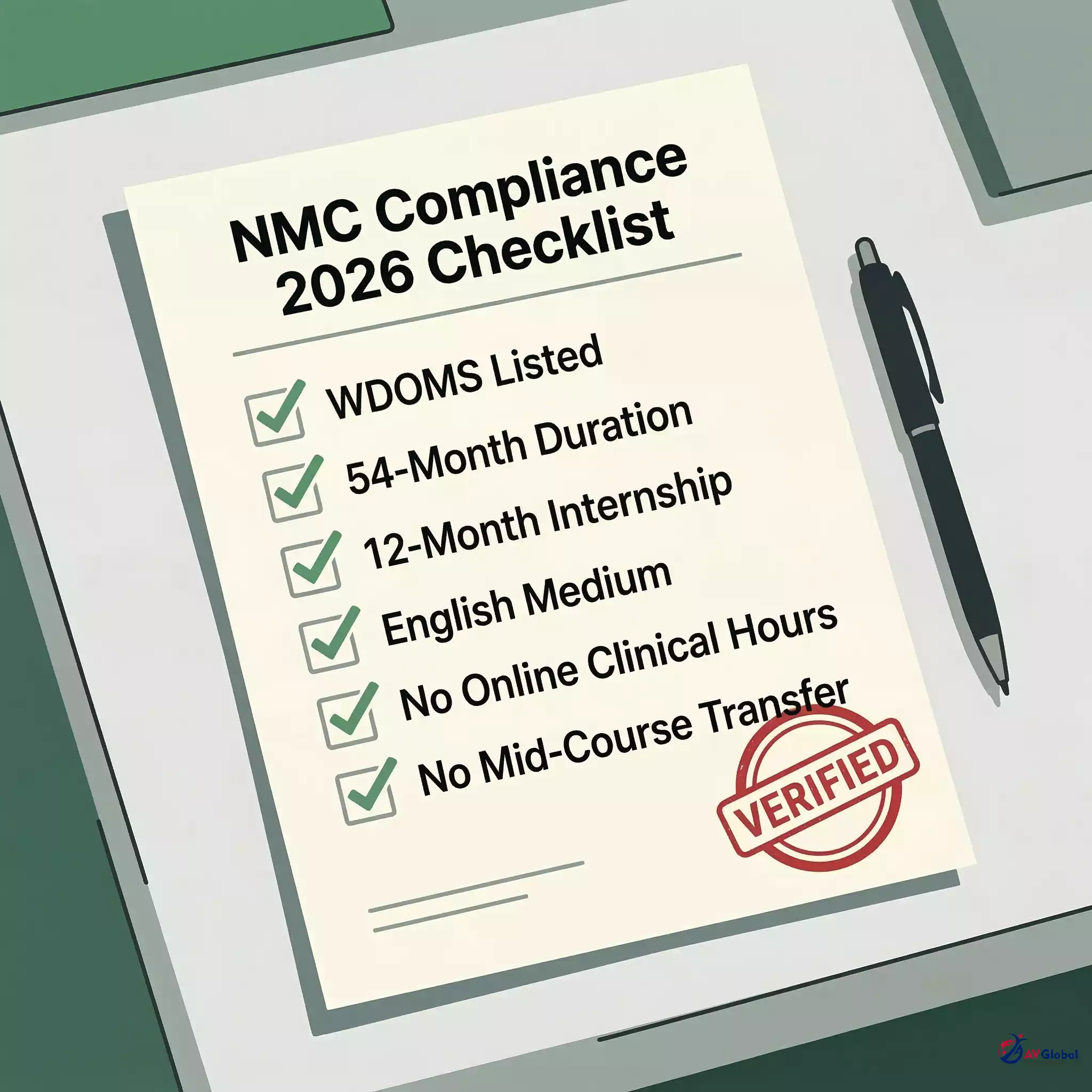
Kazan State Medical University holds full recognition from the National Medical Commission (NMC) of India, the apex regulatory body for medical education and practice in India. The university has been listed in the World Directory of Medical Schools (WDOMS) maintained by FAIMER since 1995 and continues to maintain this listing as of January 2025.
All graduates of KSMU who have completed the 6-year MBBS program and obtained their Doctor of Medicine degree are eligible to appear for the licensing examination to practice in India. Previously this was the Foreign Medical Graduate Examination (FMGE) conducted by the National Board of Examinations, but from 2024 onwards it has been replaced by the National Exit Test (NExT) which will be the common final examination for both Indian medical graduates and foreign medical graduates.
Students must obtain an Eligibility Certificate from the NMC before beginning their MBBS program abroad - this involves submitting NEET scorecard, educational certificates, and passport to NMC India and receiving confirmation that the chosen university and country are recognized. After completing MBBS, students must complete a 12-month compulsory rotating internship as per NMC guidelines, obtain a verification letter from the university confirming degree completion, and then apply for the NMC Screening Certificate required to appear for NExT examination.
Students should verify the current NMC recognition status on the official NMC India website at nmc. org.
in before enrolling, as recognition is subject to periodic review.
Year: 2024 | Appeared: 285 | Passed: 120 | Pass Rate: 42% || Year: 2023 | Appeared: 268 | Passed: 108 | Pass Rate: 40% || Year: 2022 | Appeared: 242 | Passed: 92 | Pass Rate: 38% || Note: Data compiled from NMC screening test results and university alumni reports; pass rates reflect dedicated FMGE preparation coaching provided during final years
What Our Students Say
“AV Global guided me from NEET to Russia. The FMGE coaching from Year 3 gave me real confidence. Cleared in the first attempt.”
“AV Global knew every detail about Kazan State Medical University - visa, hostel, airport pickup. Best decision my family made.”
“Support from AV Global in Russia made everything smooth. The NExT coaching programme is excellent.”
Complete Guide to MBBS at KSMU
Frequently Asked Questions
Yes, KSMU is listed in WDOMS and recognized by NMC India. Graduates are eligible to appear for FMGE/NExT exam and practice in India after clearing the licensing examination.
The total 6-year MBBS cost at KSMU is approximately ₹$42,650 (approx. Rs.
38. 0 Lakhs).
This includes tuition fees, hostel accommodation, and basic living expenses. AV Global provides transparent fee structure with no hidden charges.
KSMU teaches MBBS in English medium. Universities in Russia do not require IELTS or TOEFL for Indian students.
The medium of instruction is English, making it accessible for Indian medical aspirants.
Indian students need a valid NEET scorecard to apply for MBBS at KSMU. The cutoff varies each year based on seat availability.
Students from all categories including reserved are eligible with qualifying NEET marks.
Kazan has a growing community of approximately 800 to 1000 Indian students across various universities, which has led to the establishment of several Indian restaurants and food establishments catering specifically to Indian tastes. Popular Indian dining options near Kazan State Medical University include Namaste India Restaurant located on Pushkin Street, which serves authentic North Indian vegetarian and non-vegetarian dishes with thalis, biryanis, and tandoori items priced at 400 to 800 Rubles per meal (approximately Rs.
350 to Rs. 700).
Taste of India on Bauman Street is another favorite offering South Indian items like dosas, idlis, and uttapam alongside North Indian curries. Maharaja Restaurant near Kremlyovskaya metro station provides buffet-style Indian lunches on weekends.
For grocery shopping, Indian Spice Store on Chistopolskaya Street stocks essential Indian ingredients: rice varieties (basmati, sona masoori), lentils (toor dal, moong dal, masoor dal, chana dal), spices (turmeric, red chili powder, garam masala, cumin), flours (atta, besan, rice flour), pickles, papads, instant mixes, and frozen Indian snacks. Monthly food costs vary significantly based on lifestyle: students who cook at home in hostel kitchens spend approximately Rs.
5,000 to Rs. 9,000 per month on groceries, preparing dal-chawal, roti-sabzi, and simple Indian meals.
Students who eat out frequently at Indian restaurants or order food delivery spend Rs. 10,000 to Rs.
18,000 per month. A balanced approach - cooking on weekdays and eating out on weekends - costs around Rs.
12,000 to Rs. 15,000 monthly.
Local Russian cuisine offers vegetarian-friendly options like vegetable soups (borscht, shchi), grilled vegetables, salads, potatoes prepared in various styles, and dairy products (Russian cuisine is rich in cheese, sour cream, and yogurt variations). Russian supermarkets carry fresh vegetables, fruits, bread, pasta, and dairy products at reasonable prices.
Kazan State Medical University cafeteria serves affordable meals at subsidized rates: breakfast items like porridge, eggs, and bread cost 80 to 150 Rubles (Rs. 70 to Rs.
130), lunch combos with soup, main course, and salad cost 200 to 350 Rubles (Rs. 180 to Rs.
310). However, cafeteria food is predominantly Russian with limited Indian spicing, so most Indian students prefer cooking or eating at Indian restaurants for familiar taste and comfort.
KSMU provides well-maintained hostel accommodation for international students. Kazan State Medical University provides multiple hostel accommodation options both on-campus and within 1.
5 to 3 kilometers from the main academic building.
The MBBS program at KSMU is 6 years including a 1-year internship. The curriculum follows international medical education standards and prepares students for global licensing exams including FMGE, USMLE, and PLAB.
Yes, graduates from KSMU can practice in India after clearing the FMGE/NExT licensing exam conducted by NMC. The university has a 42% (2024 estimate) FMGE pass rate.
The degree is recognized for medical practice in India.
Kazan consistently ranks as one of the safest major cities in Russia for international students. According to available safety data, Kazan maintains a moderate safety level with low to moderate crime rates - petty theft and pickpocketing can occur in crowded tourist areas and public transport, but violent crime against students is extremely rare.
The Numbeo crime index for Kazan shows a safety rating of approximately 60 to 65 out of 100, indicating that the city is generally safe with normal precautions. Campus security at Kazan State Medical University is comprehensive: the main academic campus is a gated compound with security checkpoints at all entry gates, uniformed guards on 24/7 duty, CCTV cameras covering corridors, labs, lecture halls, and outdoor areas, and visitor registration systems requiring valid identification.
Hostel buildings have additional security layers with biometric access, night curfew monitoring, and warden presence. Female students consistently report feeling safe in Kazan, particularly in student-populated neighborhoods near the university such as Novo-Savinovsky District where the medical university is located, Vakhitovsky District in the city center with well-lit streets and police presence, and Privolzhsky District along the Volga River with family-oriented residential areas.
Female students are advised to travel in groups after dark, avoid isolated areas late at night, and use registered taxis rather than walking long distances. Indian Embassy services for students in Russia are provided through the Embassy of India in Moscow located at 6-8 Vorontsovo Pole Street, Moscow 109028, with helpline numbers +7-495-783-7535 and emergency consular number +7-495-916-2343.
While there is no Indian Consulate in Kazan itself, the embassy maintains regular contact with Indian student associations and provides consular services during periodic visits to Kazan. For immediate emergencies, the universal emergency number in Russia is 112 which connects to police, ambulance, and fire services with operators who speak English.
University emergency contact: +7-843-236-0524 available 24/7. AV Global maintains a local representative in Kazan reachable at +7-904-662-XXXX who serves as the first point of contact for Indian students facing any difficulty - medical emergencies, police matters, document issues, or personal crises.
Our representative coordinates with university administration, accompanies students to hospitals or police stations if needed, and immediately informs parents in India. Students are provided with a printed emergency contact card during pre-departure briefing listing all essential numbers.
The local Tatar population is generally friendly toward Indian students, and instances of racial discrimination are rare though students should remain aware of their surroundings and avoid confrontations.
After MBBS from KSMU, graduates can practice in India via FMGE/NExT, pursue USMLE for USA, PLAB for UK, or practice in Russia. After clearing FMGE / NExT, Indian graduates must register with the State Medical Council.
PG admissions are via NEET-PG.
Related Articles
Ready to Start Your MBBS Journey?
“AV Global has placed 100+ students at Kazan State Medical University. Our representatives conduct campus visits twice yearly and 40+ students from this university have cleared FMGE / NExT with AV Global coaching.”