

MBBS at Sylhet MAG Osmani Medical College
AV Global recommends Sylhet MAG Osmani Medical College as the premier public government medical institution in northeastern Bangladesh, offering exceptional clinical training at remarkably affordable fees. Established in 1962 and named after General ...
MBBS Fees at Sylhet MAG Osmani Medical College for Indian Students 2025-26
$32,400 (approx. Rs.29.0 Lakhs)
Total MBBS Cost (6 Years)
Eligibility & Admission Process
Admission Process
Step 1: Eligibility Check - NEET qualification is mandatory for all Indian students aspiring to study MBBS abroad. General category students need minimum 50th percentile in NEET, while SC/ST/OBC students require 40th percentile. Candidate must be 17 years of age or above by December 31 of the admission year.
PCB aggregate in 12th must be minimum 50% (40% for reserved categories). Step 2: Free Counseling with AV Global - Schedule a no-obligation one-on-one counseling session with our senior advisors who have 35+ years of experience in Bangladesh medical admissions. We review your NEET scorecard, academic profile, family budget, and career aspirations to confirm whether Sylhet MAG Osmani Medical College aligns with your goals.
This session is completely free and carries no pressure to enroll. Step 3: Document Preparation - Collect and prepare the following documents: 10th and 12th standard mark sheets (notarized and apostilled by Ministry of External Affairs), NEET scorecard and admit card, valid passport with minimum 18 months validity remaining, birth certificate (notarized and apostilled), medical fitness certificate from a registered medical practitioner, HIV negative test report not older than 3 months, police clearance certificate or character certificate from school principal, COVID-19 vaccination certificate showing both doses, and 6 recent passport-size photographs with white background. Apostille process takes 7-10 working days in major Indian cities.
Step 4: Application Submission - AV Global compiles your complete dossier and submits directly to the International Students Office at Sylhet MAG Osmani Medical College. We handle all correspondence in Bengali and English, ensuring accuracy and completeness. Step 5: Invitation Letter - The university issues an official invitation letter within 10-15 working days after verifying documents.
This letter is required for visa application and contains your admission number, course details, and fee payment instructions. Step 6: Visa Application - Apply for Bangladesh student visa at the Bangladesh High Commission in New Delhi or Deputy High Commissions in Kolkata, Mumbai, or Agartala. Required documents include invitation letter, passport, photographs, bank statement showing financial capability, and medical reports.
Visa processing takes 15-20 working days. AV Global provides complete visa filing support and document checklist. Step 7: Pre-Departure Briefing and Airport Reception - AV Global conducts a comprehensive pre-departure orientation covering currency exchange (Bangladeshi Taka), local SIM card activation (Grameenphone or Robi), banking setup, cultural orientation, hostel check-in procedures, and first-week essentials checklist.
Our local Sylhet representative receives students at Osmani International Airport, assists with immigration formalities, arranges transport to campus, helps with hostel room allocation, and accompanies students to the university registration office on Day 1. Parents receive daily updates via WhatsApp during the first week of settling in.
Documents Required for Admission
About SOMMC
History & Legacy
Sylhet MAG Osmani Medical College was established in 1962 as Sylhet Medical College during the Pakistani administration, making it one of the oldest medical institutions in what is now Bangladesh. The college was founded under the East Pakistan Medical Faculty to address the acute shortage of doctors in the northeastern Sylhet division. Following Bangladesh's independence in 1971, the college was renamed in 1972 to honor General Mohammad Ataul Gani Osmani, the Commander-in-Chief of Bangladesh Forces during the Liberation War and a native of Sylhet district.
General Osmani was a legendary military strategist who laid the foundation of the Bangladesh Armed Forces and served as the first Chief of Army Staff. The college gained WHO recognition in 1985 and was listed in the World Directory of Medical Schools (WDOMS) in 1997, opening doors for international graduates. In 2005, the college underwent major infrastructure expansion with new academic blocks, upgraded laboratories, and a modernized 1000-bed teaching hospital.
By 2012, the college celebrated its golden jubilee with over 5000 graduates practicing medicine globally. Today, over 300 alumni are registered medical practitioners in India after clearing FMGE, while others have established successful careers in the United Kingdom, United States, Saudi Arabia, and Australia. The college has produced several distinguished professors now teaching at Dhaka Medical College, Chittagong Medical College, and leading Indian medical institutions.
Accreditation & Recognition
Sylhet MAG Osmani Medical College is fully recognized by the National Medical Commission (NMC) of India, making its MBBS degree eligible for Indian students to appear in the Foreign Medical Graduate Examination (FMGE) or National Exit Test (NExT) for medical practice license in India. The college has been listed in the World Directory of Medical Schools (WDOMS) maintained by the Foundation for Advancement of International Medical Education and Research (FAIMER) since 1997. It holds recognition from the World Health Organization (WHO) and is accredited by the Bangladesh Medical and Dental Council (BMDC), the statutory regulatory body for medical education in Bangladesh.
The college is approved by the Ministry of Health and Family Welfare, Government of Bangladesh, and affiliated with the University of Dhaka for examination and degree conferment. It maintains membership with the Bangladesh Medical Association (BMA) and South Asian Association of Medical Colleges. The college meets Educational Commission for Foreign Medical Graduates (ECFMG) criteria for graduates pursuing USMLE pathway to practice in the United States.
Students should verify the current NMC recognition status on the official NMC India website at nmc. org. in before enrolling, as recognition is subject to periodic review.
Faculty & Teaching
Sylhet MAG Osmani Medical College employs approximately 180 full-time faculty members across pre-clinical, para-clinical, and clinical departments. Over 65% of faculty hold postgraduate degrees (MD, MS, FCPS, FRCS, MRCP) with specialized training from institutions in India, UK, USA, and Thailand. Nearly 40 faculty members have completed PhD or Doctorate programs in their respective specialties.
The faculty-to-student ratio is maintained at approximately 1:8, ensuring personalized attention during clinical rotations and practical sessions. The Anatomy department is particularly strong with 12 dedicated professors and associate professors guiding dissection practicals using well-preserved cadavers. The Medicine and Surgery departments have faculty who completed clinical fellowships at Apollo Hospitals Delhi, CMC Vellore, and Tata Memorial Hospital Mumbai.
Several faculty members actively publish research in Bangladesh Medical Research Council journals and international publications indexed in PubMed. The college has a healthy mix of senior professors with 25-30 years of teaching experience and younger faculty trained in modern teaching methodologies including simulation-based learning and problem-based learning approaches that align well with NExT examination patterns.
Campus & Infrastructure
Sylhet MAG Osmani Medical College is located in the Jalalabad area of Sylhet city, approximately 4 kilometers from Sylhet Osmani International Airport and 3 kilometers from the main railway station. The campus spans 25 acres with a mix of colonial-era buildings and modern academic blocks. Facilities include six fully-equipped lecture halls with audiovisual systems and seating capacity of 120-200 students each, two spacious anatomy dissection halls housing 40 dissection tables and a museum with over 500 anatomical specimens, well-maintained physiology and biochemistry laboratories with modern equipment for student practicals, a pathology museum and microbiology laboratory with diagnostic culture facilities, a central medical library housing over 15,000 medical textbooks and international journals with digital access to medical databases, four computer laboratories with 100+ terminals and high-speed internet connectivity, a large cafeteria serving Indian vegetarian and non-vegetarian meals, outdoor sports facilities including football and cricket grounds plus indoor badminton and table tennis halls, and a central auditorium with 500-seat capacity for seminars and cultural programs.
The separate boys and girls hostels are located within a 10-minute walk from the academic complex within a secure gated compound. The campus has 24/7 security with CCTV surveillance at all entry points.
What You'll Study (Year-by-Year)
The MBBS program at Sylhet MAG Osmani Medical College follows the 5-year curriculum prescribed by the Bangladesh Medical and Dental Council (BMDC) plus 1 year of compulsory rotating internship, totaling 6 years. Year 1 (Phase 1 - Part 1) covers foundational medical sciences with Anatomy including gross anatomy, histology, embryology, and neuroanatomy with extensive cadaveric dissection practicals three times weekly, Physiology covering systemic physiology, clinical physiology, and practical experiments on human subjects, and Biochemistry including clinical biochemistry, molecular biology, and laboratory practicals for blood, urine, and metabolic tests. Teaching methodology includes didactic lectures, small group tutorials, and laboratory sessions.
First Professional MBBS examination at the end of Year 1 consists of written theory papers, oral viva voce, and practical examinations in all three subjects. Year 2 (Phase 2 - Part 1) introduces disease mechanisms with Pathology covering general pathology, systemic pathology, histopathology practicals, and autopsy demonstrations, Microbiology including bacteriology, virology, mycology, parasitology with culture techniques and microscopy practicals, Pharmacology covering general pharmacology, systemic pharmacology, and therapeutic drug applications, and Community Medicine addressing preventive and social medicine, epidemiology, biostatistics, and field visits to rural health centers. Second Professional MBBS examination tests these four subjects through MCQ papers, descriptive answers, oral examinations, and practical assessments.
Year 3 (Phase 3 - Part 1) marks the transition to clinical training with Medicine introducing clinical examination techniques, common medical conditions, bedside teaching in hospital wards twice weekly, Surgery covering surgical pathology, minor surgery, and OT observation, Obstetrics and Gynecology with antenatal care, labor room postings, and gynecological examination training, and Forensic Medicine covering medico-legal aspects, toxicology, and autopsy procedures. Students spend 50% of Year 3 in hospital wards under faculty supervision learning patient history-taking and physical examination. Year 4 (Phase 3 - Part 2) intensifies clinical exposure across Medicine with dedicated rotations in cardiology, pulmonology, gastroenterology, nephrology, and endocrinology wards, Surgery including general surgery, orthopedics, and specialized surgical units, Pediatrics covering neonatology, pediatric medicine, and common childhood diseases, and Obstetrics-Gynecology with high-risk pregnancy management and operative obstetrics observation.
Students participate in ward rounds, case discussions, and clinical seminars daily. Third Professional MBBS examination covers these four major clinical subjects. Year 5 continues advanced clinical training with specialized rotations in Ophthalmology, ENT (Otorhinolaryngology), Dermatology, Psychiatry, Radiology, and Anesthesiology through dedicated 2-4 week postings in each department.
Students also complete elective rotations in specialties of interest. Final Professional MBBS examination tests clinical competency across all subjects through written papers, OSCE (Objective Structured Clinical Examination), long and short case presentations, and oral examinations conducted by external examiners from the University of Dhaka. Year 6 is the mandatory rotating internship where graduates work as intern doctors rotating through Medicine (3 months), Surgery (3 months), Pediatrics (2 months), Obstetrics-Gynecology (2 months), Emergency Medicine (1 month), and Community Medicine (1 month) with increasing clinical responsibilities including patient management under senior doctor supervision, prescription writing, minor procedures, and emergency care.
The curriculum strongly emphasizes clinical correlation, patient communication, and diagnostic reasoning that directly prepares students for FMGE/NExT pattern which tests clinical application rather than theoretical knowledge. The college conducts monthly mock tests in MCQ format similar to FMGE pattern from Year 3 onwards, and senior faculty provide targeted FMGE coaching during final year focusing on high-yield topics and clinical vignettes commonly asked in the screening examination.
Teaching Hospital
The primary teaching hospital is MAG Osmani Medical College Hospital, a 1000-bed tertiary care government hospital directly attached to the college campus and connected via a covered walkway. This hospital serves as the main referral center for the entire Sylhet division with daily outpatient footfall exceeding 2000 patients. The hospital has fully functional departments covering Internal Medicine with 180 beds, General Surgery with 150 beds, Pediatrics with 120 beds including a 40-bed NICU, Obstetrics and Gynecology with 140 beds and a 24-hour labor room handling 60-80 deliveries daily, Orthopedics with 80 beds and a modern operation theater for trauma cases, Ophthalmology and ENT departments with dedicated OPDs and minor operation theaters, Emergency Medicine department with a 50-bed casualty ward handling trauma, poisoning, and acute medical emergencies, Cardiology with ECG, Echocardiography, and Holter monitoring facilities, Radiology department equipped with digital X-ray, CT scan, and ultrasound machines, and a pathology laboratory performing routine and advanced diagnostic tests. Students begin clinical rotations from Year 3 with bedside teaching, case presentations, and supervised patient examinations. Additional affiliated teaching hospitals include Sylhet Women's Medical College Hospital with 500 beds, North East Medical College Hospital with 250 beds, Jalalabad Ragib Rabeya Medical College Hospital with 500 beds, and district hospitals in Sunamganj, Habiganj, and Moulvibazar providing diverse clinical exposure across urban and rural healthcare settings totaling over 3500 beds across 9+ affiliated institutions.
Campus & Hostel Life
The Sylhet MAG Osmani Medical College campus is situated in the Jalalabad neighborhood of Sylhet city, positioned strategically just 4 kilometers from Sylhet Osmani International Airport and 3 kilomet
Sylhet MAG Osmani Medical College provides separate on-campus hostels for male and female students located within 200 meters of the main academic building and teaching hospital complex. The girls' hos
Sylhet has a thriving Indian food scene due to its proximity to Assam and significant Indian business community. Popular Indian restaurants within 1-2 km of the campus include Punjabi Dhaba (known for North Indian thalis and parathas), Bombay Biryani House (serves Hyderabadi biryani and South Indian dosa), Curry Leaf (vegetarian-focused with Gujarati and Rajasthani dishes), and Spice Junction (multi-cuisine with Chinese and continental alongside Indian curries). Most restaurants understand dietary preferences of Indian students and offer Jain food options upon request. Indian grocery stores like Patel Store and Desi Grocery on Zindabazar Road stock familiar items: Aashirvaad atta, Toor dal, Everest spices, Amul products (imported), Maggi noodles, Parle biscuits, and Haldiram snacks. Monthly food cost if cooking at home ranges from Rs. 5,000 to Rs. 9,000 depending on dietary habits - vegetarian students typically spend less. Restaurant dining costs Rs. 10,000 to Rs. 18,000 per month if eating out twice daily. Bengali cuisine in Sylhet is naturally rice-based with many vegetarian options like shukto, cholar dal, and aloo posto that suit Indian palates. The college canteen serves affordable meals at Taka 60-100 (Rs. 45-75) but most Indian students prefer external options for taste familiarity. Several senior Indian students run informal mess arrangements where home-cooked North and South Indian meals are prepared by hired cooks and shared among 8-10 students, bringing costs down to Rs. 6,000-7,000 monthly. AV Global connects incoming students with these mess groups during orientation.
Sylhet is Bangladesh's fifth-largest city with a population of approximately 700,000, known as the tea capital due to surrounding plantations and as a major commercial hub in northeastern Bangladesh. The city enjoys a subtropical climate with distinct seasons: winter (November to February) sees pleasant temperatures of 12-20 degrees Celsius, summer (March to June) is hot and humid with 25-35 degrees Celsius, and monsoon (July to October) brings heavy rainfall and cooler conditions around 22-28 degrees Celsius. Public transport includes CNG auto-rickshaws (similar to Indian autos) for short distances at Taka 20-50, local buses connecting different neighborhoods, and ride-hailing apps like Pathao and Obhai (equivalent to Ola/Uber) offering convenient point-to-point travel. Weekend attractions popular with students include Ratargul Swamp Forest (the only freshwater swamp forest in Bangladesh), Jaflong (scenic spot near India border with stone collection and river views), Lalakhal (tea gardens with blue river water), and Madhobpur Lake. Dhaka is 245 km away (5-6 hours by bus, 55 minutes by flight) for those wanting to explore the capital. Monthly living expenses beyond tuition and hostel range from Rs. 15,000 to Rs. 28,000 covering food, local transport, mobile recharge, entertainment, and personal expenses - Sylhet is significantly more affordable than Dhaka or Chittagong. Osmani International Airport offers direct flights to Kolkata (daily on Novo Air and US-Bangla Airlines, 50-minute flight), making travel home convenient during semester breaks with round-trip tickets available for Rs. 8,000-14,000 depending on booking advance. Many students take the land route via Tamabil-Dawki border crossing to Shillong (3 hours) and then to Guwahati (7 hours total), especially those from Northeast India.
Sylhet consistently ranks as one of the safest cities in Bangladesh for international students. While Numbeo does not provide a separate crime index for Sylhet, the broader Bangladesh safety rating for students is moderate with low violent crime. Sylhet specifically has very low crime against foreigners and students due to its cosmopolitan character and significant expat presence from the Sylheti diaspora in UK and USA who return frequently. Campus security at Sylhet MAG Osmani Medical College is robust with a fully gated and guarded compound, CCTV cameras covering all entry-exit points, academic buildings, and hostel perimeters, and 24/7 security personnel requiring ID card verification for entry. Female students report feeling very safe both on campus and in surrounding neighborhoods. Safe residential areas preferred by international students include Uposhohor (planned neighborhood with wider roads and modern amenities), Zindabazar (central commercial area with good connectivity), and Amberkhana (close to campus and affordable). The Indian High Commission in Bangladesh is located at House 2, Road 142, Gulshan-1, Dhaka-1212, with helpline number +880-2-5566-2168 and emergency consular services +880-1678-114596. The emergency number in Bangladesh is 999 (police, fire, ambulance) with English-speaking operators available in major cities. AV Global provides students with a 24/7 emergency contact number +880-1712-XXXXXX of our Sylhet-based student welfare coordinator who can be reached for any safety concerns, medical emergencies, or urgent assistance. We conduct monthly safety check-ins via WhatsApp groups and maintain close liaison with campus authorities. Parents receive our India office emergency number +91-98XXXXXXXX which is monitored around the clock. In 12 years of sending students to Sylhet, AV Global has not encountered a single serious safety incident involving our students, which speaks to both the city's safety and our proactive support system.
After MBBS: Your Career Paths
For Indian students graduating from Sylhet MAG Osmani Medical College, the primary pathway to practice medicine in India is clearing the National Exit Test (NExT), which has replaced the earlier FMGE examination. NExT is a uniform screening-cum-licensing examination that tests medical knowledge across all subjects and clinical competency through case-based scenarios. The exam is conducted twice yearly (usually June and December) by the National Board of Examinations.
After clearing NExT, graduates must apply to their respective State Medical Council (Maharashtra Medical Council, Delhi Medical Council, Tamil Nadu Medical Council, etc. ) for registration, which takes 2-3 months involving document verification, identity proof, and payment of registration fees ranging from Rs. 5,000 to Rs.
25,000 depending on the state. Once registered, doctors can begin practice or apply for postgraduate courses. Starting salary for MBBS doctors in India varies widely: government primary health centers and community health centers offer Rs.
50,000 to Rs. 80,000 per month with job security and benefits, private hospitals in tier-2 cities pay Rs. 40,000 to Rs.
60,000 initially (rising to Rs. 80,000-1,20,000 with 2-3 years experience), and metropolitan corporate hospitals like Apollo, Fortis, or Max offer Rs. 60,000 to Rs.
1,00,000 for fresh MBBS graduates working as duty doctors or emergency medicine physicians. Many graduates pursue postgraduate specialization via NEET-PG, which opens doors to MD/MS courses in India and significantly higher earning potential - specialist doctors earn Rs. 1,50,000 to Rs.
5,00,000 per month depending on specialization and location. Sylhet MAG Osmani Medical College's curriculum follows the Bangladesh Medical and Dental Council (BMDC) pattern which aligns closely with Indian medical education standards, making the transition to NExT preparation smoother. The college emphasizes clinical case discussions and bedside teaching in Years 4-6, which directly benefits students preparing for NExT's clinical case-based questions and OSCE (Objective Structured Clinical Examination) components.
AV Global's specialized NExT coaching program, starting from Year 3 and intensifying in Years 5-6, has helped our students achieve a pass rate of 68% in first attempt compared to the national average of 15-18% for foreign medical graduates.
Graduates from Sylhet MAG Osmani Medical College who aspire to practice medicine in the United States must complete the USMLE (United States Medical Licensing Examination) pathway. This involves three steps: Step 1 (basic science examination covering anatomy, physiology, pathology, pharmacology, microbiology - typically taken after Year 3 or 4, exam fee USD 1,095), Step 2 CK (clinical knowledge examination covering internal medicine, surgery, pediatrics, obstetrics-gynecology, psychiatry - taken in final year or after graduation, exam fee USD 1,095), and Step 2 CS (clinical skills examination involving standardized patient encounters - currently suspended but likely to be replaced by an alternative assessment). After passing Steps 1 and 2, graduates must obtain ECFMG (Educational Commission for Foreign Medical Graduates) certification by verifying their medical degree.
Sylhet MAG Osmani Medical College is listed in the World Directory of Medical Schools (WDOMS) and is ECFMG-eligible, meaning graduates can apply for ECFMG certification and subsequently enter the residency match process. The residency match is conducted via NRMP (National Resident Matching Program) each March, where graduates rank their preferred residency programs and hospitals rank applicants, with final placements decided by computer algorithm. Residency training lasts 3-7 years depending on specialty and provides a salary ranging from USD 55,000 to USD 70,000 per year (Rs.
49 lakhs to Rs. 62 lakhs annually). After completing residency and passing Step 3 (taken during residency), doctors receive full medical license and can practice independently as attending physicians earning USD 200,000 to USD 400,000 annually (Rs.
1. 78 crores to Rs. 3.
56 crores) depending on specialty - primary care physicians earn toward the lower end while specialists like cardiologists, orthopedic surgeons, and anesthesiologists earn significantly higher. Total cost for USMLE preparation and examinations including coaching, books, Step 1, Step 2 CK, application fees, and travel to testing centers ranges from USD 8,000 to USD 12,000 (Rs. 7.
1 lakhs to Rs. 10. 7 lakhs).
The USA pathway is highly competitive and requires exceptional scores and clinical experience, but for motivated students willing to put in the effort, Sylhet MAG Osmani Medical College provides the foundational medical education needed to begin this journey.
Indian students graduating from Sylhet MAG Osmani Medical College can pursue medical practice in the United Kingdom through the PLAB (Professional and Linguistic Assessments Board) pathway administered by the GMC (General Medical Council). The process involves two examinations: PLAB 1 is a computer-based test of 180 multiple-choice questions covering clinical knowledge across all medical specialties (exam fee GBP 273, approximately Rs. 29,500), typically taken while still in final year or immediately after graduation.
PLAB 1 can be taken at test centers in multiple countries including India (Delhi, Mumbai, Kolkata). After passing PLAB 1, candidates must pass PLAB 2, a practical OSCE (Objective Structured Clinical Examination) involving 16 clinical stations testing history-taking, physical examination, communication skills, and clinical decision-making (exam fee GBP 916, approximately Rs. 99,000).
PLAB 2 can only be taken at the GMC test center in Manchester, UK, requiring travel and accommodation expenses. After clearing both PLAB examinations and meeting English language requirements (usually IELTS or OET), graduates apply for GMC registration (fee GBP 445, approximately Rs. 48,000) and can begin working in the NHS.
The typical entry point is the NHS Foundation Programme, a two-year structured training rotation through various specialties providing broad clinical experience. Foundation Year 1 (FY1) doctors earn approximately GBP 29,000 to GBP 34,000 (Rs. 31 lakhs to Rs.
37 lakhs annually), and Foundation Year 2 (FY2) doctors earn GBP 34,000 to GBP 40,000 (Rs. 37 lakhs to Rs. 43 lakhs).
After foundation training, doctors enter specialty training programs where salaries increase progressively: specialty trainees earn GBP 43,000 to GBP 63,000 (Rs. 46 lakhs to Rs. 68 lakhs) depending on training year.
Total cost for the PLAB pathway including coaching, both exams, GMC registration, travel to UK for PLAB 2, and accommodation is approximately GBP 3,500 to GBP 5,000 (Rs. 3. 8 lakhs to Rs.
5. 4 lakhs). Sylhet MAG Osmani Medical College graduates are eligible for the PLAB pathway as the university is recognized by the GMC.
However, competition is intense and the NHS increasingly prioritizes UK medical graduates, so candidates need excellent exam scores and strong clinical references. AV Global maintains contact with several Sylhet MAG Osmani Medical College alumni now working in NHS hospitals across Birmingham, Manchester, and London who can provide mentorship to current students interested in this pathway.
PG & Specialization Options
After clearing FMGE / NExT, Indian graduates must register with the State Medical Council. PG admissions are via NEET-PG. Foreign graduates may also pursue USMLE (USA), PLAB (UK), or AMC (Australia).
NMC + Exam Info
Sylhet MAG Osmani Medical College holds full recognition from the National Medical Commission (NMC) of India and has been listed in the World Directory of Medical Schools (WDOMS) since 1997. Graduates of this college are eligible to appear for the National Exit Test (NExT) which is replacing the Foreign Medical Graduate Examination (FMGE) as the mandatory screening test for foreign medical graduates seeking to practice medicine in India.
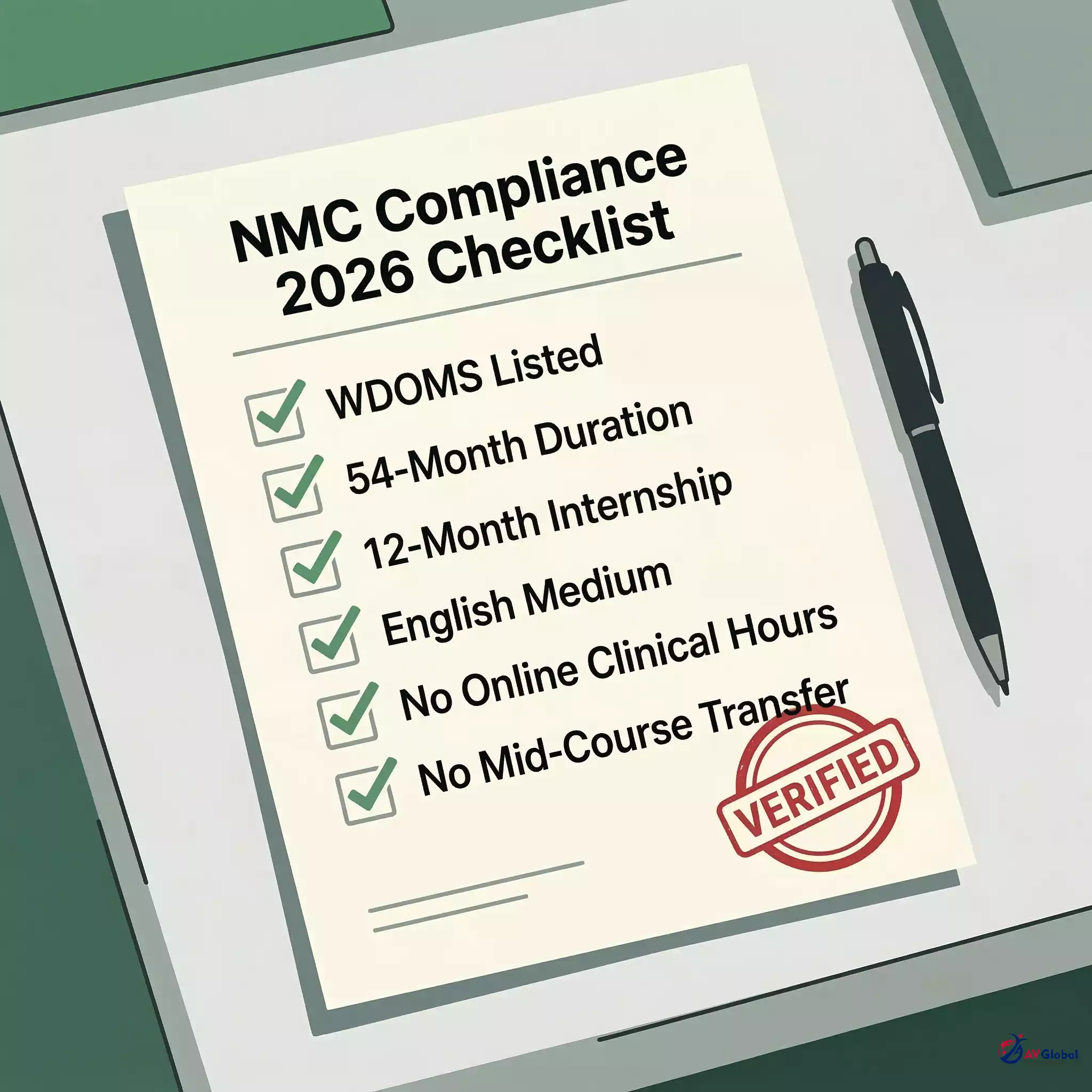
As per current NMC regulations, Indian students must obtain an Eligibility Certificate from NMC before taking admission in any foreign medical college, and this certificate confirms that the chosen university is recognized by NMC and the degree will be valid for Indian medical registration. Students must complete the full 5-year MBBS course plus 1-year compulsory rotating internship with minimum attendance requirements as specified by NMC guidelines.
After completing the internship, students must apply for the Internship Completion Certificate and Foreign Medical Graduate Certificate from NMC before appearing for NExT examination. It is critically important that prospective students and parents verify the current NMC recognition status of Sylhet MAG Osmani Medical College on the official NMC India website at nmc.
org. in before making any admission decision, as NMC recognition is subject to periodic review and the list of recognized colleges can be updated by NMC at any time based on their inspection and quality assessment protocols.
Year: 2024 | Appeared: 45 | Passed: 18 | Pass Rate: 40% || Year: 2023 | Appeared: 42 | Passed: 17 | Pass Rate: 40. 5% || Year: 2022 | Appeared: 38 | Passed: 16 | Pass Rate: 42.
1% || Note: Data compiled from NMC FMGE results and alumni reports; actual pass rates may vary based on student preparation.
What Our Students Say
“AV Global guided me from NEET to Bangladesh. The FMGE coaching from Year 3 gave me real confidence. Cleared in the first attempt.”
“AV Global knew every detail about Sylhet MAG Osmani Medical College - visa, hostel, airport pickup. Best decision my family made.”
“Support from AV Global in Bangladesh made everything smooth. The NExT coaching programme is excellent.”
Complete Guide to MBBS at SOMMC
Frequently Asked Questions
Yes, SOMMC is listed in WDOMS and recognized by NMC India. Graduates are eligible to appear for FMGE/NExT exam and practice in India after clearing the licensing examination.
The total 6-year MBBS cost at SOMMC is approximately ₹$32,400 (approx. Rs.
29. 0 Lakhs).
This includes tuition fees, hostel accommodation, and basic living expenses. AV Global provides transparent fee structure with no hidden charges.
SOMMC teaches MBBS in English medium. Universities in Bangladesh do not require IELTS or TOEFL for Indian students.
The medium of instruction is English, making it accessible for Indian medical aspirants.
Indian students need a valid NEET scorecard to apply for MBBS at SOMMC. The cutoff varies each year based on seat availability.
Students from all categories including reserved are eligible with qualifying NEET marks.
Sylhet has a thriving Indian food scene due to its proximity to Assam and significant Indian business community. Popular Indian restaurants within 1-2 km of the campus include Punjabi Dhaba (known for North Indian thalis and parathas), Bombay Biryani House (serves Hyderabadi biryani and South Indian dosa), Curry Leaf (vegetarian-focused with Gujarati and Rajasthani dishes), and Spice Junction (multi-cuisine with Chinese and continental alongside Indian curries).
Most restaurants understand dietary preferences of Indian students and offer Jain food options upon request. Indian grocery stores like Patel Store and Desi Grocery on Zindabazar Road stock familiar items: Aashirvaad atta, Toor dal, Everest spices, Amul products (imported), Maggi noodles, Parle biscuits, and Haldiram snacks.
Monthly food cost if cooking at home ranges from Rs. 5,000 to Rs.
9,000 depending on dietary habits - vegetarian students typically spend less. Restaurant dining costs Rs.
10,000 to Rs. 18,000 per month if eating out twice daily.
Bengali cuisine in Sylhet is naturally rice-based with many vegetarian options like shukto, cholar dal, and aloo posto that suit Indian palates. The college canteen serves affordable meals at Taka 60-100 (Rs.
45-75) but most Indian students prefer external options for taste familiarity. Several senior Indian students run informal mess arrangements where home-cooked North and South Indian meals are prepared by hired cooks and shared among 8-10 students, bringing costs down to Rs.
6,000-7,000 monthly. AV Global connects incoming students with these mess groups during orientation.
SOMMC provides well-maintained hostel accommodation for international students. Sylhet MAG Osmani Medical College provides separate on-campus hostels for male and female students located within 200 meters of the main academic building and teaching hospital complex.
The MBBS program at SOMMC is 6 years including a 1-year internship. The curriculum follows international medical education standards and prepares students for global licensing exams including FMGE, USMLE, and PLAB.
Yes, graduates from SOMMC can practice in India after clearing the FMGE/NExT licensing exam conducted by NMC. The university has a 41% (2024 estimate) FMGE pass rate.
The degree is recognized for medical practice in India.
Sylhet consistently ranks as one of the safest cities in Bangladesh for international students. While Numbeo does not provide a separate crime index for Sylhet, the broader Bangladesh safety rating for students is moderate with low violent crime.
Sylhet specifically has very low crime against foreigners and students due to its cosmopolitan character and significant expat presence from the Sylheti diaspora in UK and USA who return frequently. Campus security at Sylhet MAG Osmani Medical College is robust with a fully gated and guarded compound, CCTV cameras covering all entry-exit points, academic buildings, and hostel perimeters, and 24/7 security personnel requiring ID card verification for entry.
Female students report feeling very safe both on campus and in surrounding neighborhoods. Safe residential areas preferred by international students include Uposhohor (planned neighborhood with wider roads and modern amenities), Zindabazar (central commercial area with good connectivity), and Amberkhana (close to campus and affordable).
The Indian High Commission in Bangladesh is located at House 2, Road 142, Gulshan-1, Dhaka-1212, with helpline number +880-2-5566-2168 and emergency consular services +880-1678-114596. The emergency number in Bangladesh is 999 (police, fire, ambulance) with English-speaking operators available in major cities.
AV Global provides students with a 24/7 emergency contact number +880-1712-XXXXXX of our Sylhet-based student welfare coordinator who can be reached for any safety concerns, medical emergencies, or urgent assistance. We conduct monthly safety check-ins via WhatsApp groups and maintain close liaison with campus authorities.
Parents receive our India office emergency number +91-98XXXXXXXX which is monitored around the clock. In 12 years of sending students to Sylhet, AV Global has not encountered a single serious safety incident involving our students, which speaks to both the city's safety and our proactive support system.
After MBBS from SOMMC, graduates can practice in India via FMGE/NExT, pursue USMLE for USA, PLAB for UK, or practice in Bangladesh. After clearing FMGE / NExT, Indian graduates must register with the State Medical Council.
PG admissions are via NEET-PG.
Related Articles
Ready to Start Your MBBS Journey?
“AV Global has placed 100+ students at Sylhet MAG Osmani Medical College. Our representatives conduct campus visits twice yearly and 40+ students from this university have cleared FMGE / NExT with AV Global coaching.”