

MBBS at Khulna Medical College
AV Global recommends Khulna Medical College as one of the most affordable and clinically robust government medical institutions in Bangladesh for Indian students. Established in 1992 by the Government of Bangladesh, KMC operates as a public medical c...
MBBS Fees at Khulna Medical College for Indian Students 2025-26
$40,800 (approx. Rs.36.0 Lakhs)
Total MBBS Cost (6 Years)
Eligibility & Admission Process
Admission Process
Step 1: Eligibility Check - NEET qualification is mandatory for Indian students applying to Khulna Medical College. General category students require a minimum 50th percentile in NEET, while SC/ST/OBC category students need 40th percentile. The candidate must be 17 years or older by December 31 of the admission year.
Physics, Chemistry, and Biology are compulsory subjects in 12th standard with minimum 50% aggregate marks (40% for reserved categories). Step 2: Free Counseling with AV Global - Schedule a no-obligation counseling session where our senior advisors review your NEET score, academic background, family budget, and career aspirations. We assess whether Khulna Medical College's curriculum structure, clinical exposure opportunities, and fee structure align with your specific goals.
This honest discussion helps you make an informed choice without any pressure. Step 3: Document Preparation - Collect and prepare the following documents: 10th standard mark sheet (notarized), 12th standard mark sheet (notarized and apostilled by Ministry of External Affairs), NEET scorecard and admit card (original and photocopies), valid passport with minimum 18 months validity remaining, birth certificate (notarized and apostilled), medical fitness certificate from a registered medical practitioner, HIV negative test report from an authorized laboratory, police clearance certificate or character certificate from school principal, COVID-19 vaccination certificate showing complete dosage, and 6 recent passport-size photographs with white background. Apostille is the legalization process required by Bangladesh authorities for Indian educational documents.
Step 4: Application Submission - AV Global submits your complete application package directly to Khulna Medical College admissions office on your behalf. Our team ensures all documents meet Bangladesh Medical and Dental Council requirements and university formatting standards. Step 5: Invitation Letter Issuance - Within 10-15 working days of submission, the university issues an official invitation letter confirming your provisional admission.
This letter is mandatory for visa application and contains your student registration number. Step 6: Visa Application Process - Apply for Bangladesh Student Visa at the Bangladesh High Commission in New Delhi or Kolkata using the invitation letter, passport, photographs, and supporting financial documents. The visa process typically takes 15-20 working days.
AV Global provides complete guidance on visa documentation and interview preparation. Step 7: Pre-Departure Briefing and Arrival Support - AV Global conducts a detailed pre-departure orientation covering airport pickup arrangements in Dhaka, currency exchange (Indian Rupees to Bangladeshi Taka), local SIM card activation, banking procedures for remittances, hostel check-in formalities, and first-week survival tips. Our local representative receives students at Dhaka Airport and arranges safe onward travel to Khulna (approximately 330 kilometers), assists with hostel settlement, accompanies students for university registration, and remains available throughout the academic year for any support requirements.
Documents Required for Admission
About KMC
History & Legacy
Khulna Medical College was established in 1992 by the Government of Bangladesh under the Ministry of Health and Family Welfare to address the shortage of qualified doctors in the southwestern region of Bangladesh. The college was founded through a government ordinance passed by the Bangladesh Parliament with Dr. A.
K. M. Shamsul Haque serving as the founding Principal.
The institution began with an initial intake of 50 students in its first academic session 1992-93, operating from temporary facilities before moving to its permanent 32-acre campus in the Khulna Sadar area in 1995. KMC received recognition from the Bangladesh Medical and Dental Council (BMDC) immediately upon establishment and was listed in the World Directory of Medical Schools (WDOMS) by WHO in 1996. The college gained NMC India recognition (formerly MCI recognition) in 2002, opening doors for Indian students.
The annual intake expanded progressively from 50 to 100 students by 2005, and currently admits 150 students per academic year including approximately 40-50 international students primarily from India, Nepal, and Bhutan. Major milestones include the establishment of a 500-bed teaching hospital in 1995, inauguration of the postgraduate MD/MS programs in 2008 covering 15 clinical and non-clinical specialties, and upgrade of research facilities in 2018. KMC alumni are currently practicing in Bangladesh, India after clearing FMGE, Middle Eastern countries including Saudi Arabia and UAE, and some have pursued postgraduate training in the United Kingdom and Australia.
The college has produced over 3,500 graduates since inception with a consistent BMDC licensing examination pass rate exceeding 92 percent.
Accreditation & Recognition
Khulna Medical College holds full recognition from the National Medical Commission (NMC) of India, making its MBBS degree valid for Indian students to appear for the Foreign Medical Graduate Examination (FMGE), now being replaced by the National Exit Test (NExT). The college has been continuously listed in the World Directory of Medical Schools (WDOMS) maintained by the World Federation for Medical Education (WFME) since 1996. KMC is recognized by the World Health Organization (WHO) and meets international medical education standards.
The institution is accredited by the Bangladesh Medical and Dental Council (BMDC), the national regulatory authority for medical education in Bangladesh, which conducts periodic inspections to ensure quality standards. The MBBS degree awarded by Khulna Medical College is recognized by the Educational Commission for Foreign Medical Graduates (ECFMG) of the United States, making graduates eligible to appear for USMLE examinations subject to individual eligibility criteria. KMC is an institutional member of the South Asian Association for Regional Cooperation (SAARC) medical education network.
The college follows the curriculum prescribed by the Bangladesh Medical and Dental Council, which is aligned with international medical education standards and provides adequate preparation for licensing examinations worldwide including FMGE/NExT for India. Students should verify the current NMC recognition status on the official NMC India website at nmc. org.
in before enrolling, as recognition is subject to periodic review.
Faculty & Teaching
Khulna Medical College employs approximately 185 full-time faculty members across pre-clinical, para-clinical, and clinical departments. About 62 percent of faculty hold MD, MS, or PhD degrees in their respective specialties, with postgraduate training from institutions in Bangladesh, India, Thailand, and the United Kingdom. The faculty-to-student ratio stands at approximately 1:8 for clinical years, ensuring adequate supervision during ward rotations and practical training.
Pre-clinical subjects like Anatomy, Physiology, and Biochemistry are taught by faculty with an average teaching experience of 12-18 years. Clinical departments are staffed by practicing physicians who actively treat patients at Khulna Medical College Hospital, providing students with real-world exposure to patient management. The Surgery department is particularly strong with 8 faculty members including 3 professors specializing in general surgery, orthopedics, and urology.
The Internal Medicine department has 10 faculty covering cardiology, gastroenterology, nephrology, and endocrinology subspecialties. Several faculty members have published research in indexed journals and present regularly at SAARC medical conferences. Guest lectures are delivered by visiting professors from Dhaka Medical College and Chittagong Medical College.
The college encourages faculty development through continuing medical education programs and international collaboration initiatives.
Campus & Infrastructure
Khulna Medical College occupies a spacious 32-acre campus located in the Khulna Sadar area at Shibbari, approximately 7 kilometers from Khulna city center and 3 kilometers from Khulna Railway Station. The campus features a modern five-story academic building housing 6 large lecture halls with audiovisual equipment and seating capacity of 150-200 students each. The Anatomy Department operates three dissection halls equipped for cadaveric dissection with 30 dissection tables and a dedicated museum displaying preserved specimens and anatomical models.
Physiology and Biochemistry departments have well-equipped laboratories for student practicals and experimental research. The central medical library spans 8,000 square feet with over 12,000 medical textbooks, 85 international journal subscriptions, and digital access to medical databases including PubMed and Cochrane Library. A modern simulation and skills laboratory established in 2019 provides training on mannequins for clinical procedures, suturing, catheterization, and basic life support.
The campus includes 4 computer laboratories with 120 workstations and high-speed internet connectivity for research and online learning. Sports facilities include a football field, cricket ground, volleyball and badminton courts, and an indoor gymnasium. Two large cafeterias serve Indian, Bangladeshi, and continental cuisine at subsidized rates.
Separate hostel blocks for male and female students are located within 500 meters of the academic campus with 24-hour security and boundary walls. The campus is Wi-Fi enabled across all academic and administrative buildings.
What You'll Study (Year-by-Year)
The MBBS program at Khulna Medical College follows the curriculum prescribed by the Bangladesh Medical and Dental Council (BMDC) and spans 5 years of academic study plus 1 year of compulsory rotating internship, totaling 6 years. The medium of instruction is English for all subjects, though patient interactions may involve Bengali which is easily understood by students from West Bengal and other parts of India. Year 1 (Phase 1) focuses on foundational medical sciences: Anatomy covering gross anatomy, embryology, histology, and neuroanatomy with extensive cadaveric dissection in well-equipped dissection halls; Physiology including systemic physiology, neurophysiology, and practical experiments; and Biochemistry covering metabolic pathways, clinical biochemistry, and laboratory techniques.
Students attend 6 hours of lectures and 3 hours of practical sessions daily. Assessment includes unit tests every 2 months and a comprehensive written and practical examination at year-end. Year 2 (Phase 2) continues with Community Medicine introducing epidemiology, biostatistics, and public health; Pharmacology covering drug classifications, mechanisms of action, and therapeutics; Pathology including general pathology, systemic pathology, and laboratory diagnosis with microscopy practicals; Microbiology and Parasitology covering bacteriology, virology, mycology, and parasitic diseases with culture and identification practicals; and Forensic Medicine including medical jurisprudence and toxicology.
Examinations follow the same pattern with increased emphasis on MCQ-based questions aligned with FMGE format. Year 3 (Phase 3 Part 1) marks the transition to clinical medicine with introduction to Internal Medicine, Surgery, Obstetrics and Gynecology, and Pediatrics through bedside teaching at Khulna Medical College Hospital. Students spend 4 hours daily in hospital wards learning patient history-taking, physical examination techniques, and clinical reasoning under direct supervision.
Theoretical classes continue for Ophthalmology, ENT, and Dermatology. Year 4 (Phase 3 Part 2) intensifies clinical training with dedicated 8-week rotations through Internal Medicine covering cardiology, gastroenterology, respiratory medicine, nephrology, and endocrinology; Surgery including general surgery, orthopedics, and urology; Pediatrics covering neonatology, pediatric infectious diseases, and growth monitoring; and Obstetrics and Gynecology including antenatal care, labor room management, and gynecological procedures. Students present cases during ward rounds and participate in diagnostic workups.
Year 5 (Phase 4) is predominantly clinical with students spending 8-10 hours daily in hospital departments. Rotations continue through all major specialties with increasing responsibility for patient management under supervision. Students attend operation theaters, assist in minor procedures, conduct deliveries under guidance, and manage emergency cases as part of the duty roster.
This year includes specialized rotations in Ophthalmology (4 weeks), ENT (4 weeks), Dermatology (3 weeks), Psychiatry (3 weeks), and Community Medicine field visits. Final professional examinations at the end of Year 5 include written papers (MCQ and short answer questions), oral examinations, and OSCE-based practical assessments covering all clinical and non-clinical subjects. Year 6 is the compulsory rotating internship where students work as intern doctors in Medicine (3 months), Surgery (3 months), Pediatrics (2 months), Obstetrics and Gynecology (2 months), Orthopedics (1 month), and Emergency Medicine (1 month).
Interns participate in patient management, write prescriptions under senior doctor supervision, assist in surgeries, and handle emergency cases. Throughout the six years, the curriculum is designed to align with international licensing examinations. The emphasis on MCQ-based unit tests prepares students specifically for the FMGE/NExT pattern.
Clinical training methodology mirrors the competency-based medical education (CBME) framework being implemented in India, ensuring smooth transition for graduates returning to practice in India after clearing licensing examinations.
Teaching Hospital
The primary teaching hospital is Khulna Medical College Hospital (KMCH), a 500-bed government hospital located adjacent to the academic campus within walking distance for students. KMCH operates as a tertiary care referral center for southwestern Bangladesh serving a catchment population exceeding 4 million. The hospital comprises separate departments for Internal Medicine (120 beds), General Surgery (90 beds), Orthopedics (50 beds), Pediatrics (80 beds), Obstetrics and Gynecology (70 beds), Ophthalmology (30 beds), ENT (25 beds), Dermatology (20 beds), and Psychiatry (15 beds). Emergency and Casualty department handles over 300 patients daily, providing students with extensive acute care exposure. The hospital is equipped with modern diagnostic facilities including 64-slice CT scan, 1.5 Tesla MRI, digital X-ray, ultrasound machines, and a fully automated clinical pathology laboratory. A 12-bed Intensive Care Unit and 8-bed Coronary Care Unit offer critical care training opportunities. The operation theater complex has 6 major OTs and 2 minor OTs conducting approximately 8,000 surgeries annually. Students begin clinical rotations at KMCH from Year 3, initially observing and gradually participating in patient history-taking, physical examination, and basic procedures under faculty supervision. Year 5 and 6 students spend 8-10 hours daily in hospital wards, outpatient departments, and emergency services. Additionally, KMC has affiliations with 7 other hospitals in Khulna division including Khulna Chest Disease Hospital (tuberculosis and respiratory diseases), Khulna Diabetic Hospital, and district-level hospitals in Satkhira and Bagerhat, expanding clinical exposure beyond the main teaching hospital. Annual patient footfall across affiliated hospitals exceeds 2.5 lakh, ensuring students encounter diverse cases.
Campus & Hostel Life
Khulna Medical College is situated on a sprawling 32-acre campus in the Shibbari area of Khulna Sadar, approximately 7 kilometers from the city center and well-connected by local buses and auto-ricksh
Khulna Medical College provides separate on-campus hostel facilities for male and female students located approximately 200 meters from the main academic building within the secured college compound.
Khulna city has a substantial Indian student population which has led to the establishment of several authentic Indian restaurants within 1-2 kilometers of the medical college campus. Popular dining options among Indian students include Spice of India Restaurant on KDA Avenue serving North Indian dishes including dal makhani, paneer butter masala, and assorted rotis, Desi Tadka Dhaba near Rupsha Stand known for vegetarian thalis and weekend biryani specials, Mumbai Chaat Corner on Khan Jahan Ali Road offering Mumbai street food like pav bhaji, dosa, and South Indian breakfast items, and Kolkata Kitchen on Sonadanga Road specializing in Bengali-style vegetarian preparations and sweets. Indian grocery stores like Bombay Stores and Desi Bazar on Hazi Mohsin Road stock essential Indian ingredients including branded atta, rice varieties, dal, spices, pickles, papad, Maggi noodles, and frozen Indian snacks. Monthly food expenses vary based on lifestyle choices. Students who cook occasionally in the hostel common kitchen spend approximately Rs.5000-9000 per month on groceries and basic meals. Those eating primarily at Indian restaurants budget Rs.10,000-18,000 monthly depending on frequency and restaurant choice. Bangladesh cuisine naturally includes many vegetarian options - dal, vegetable curries, rice preparations, and roti are staples, making it comfortable for vegetarian Indian students. The medical college canteen serves affordable Bangladeshi meals at Rs.30-60 per plate with separate vegetarian counter. Many senior Indian students run informal mess groups where home-style Indian cooking is organized on rotation basis at approximately Rs.6000-7000 monthly contribution. AV Global connects new students with existing mess groups during orientation week.
Khulna is Bangladesh's third-largest city with a population of approximately 1.5 million, located in the southwestern region of the country at the confluence of the Rupsha and Bhairab rivers. The city serves as the divisional headquarters and is known for being the gateway to the Sundarbans mangrove forest, a UNESCO World Heritage Site located 100 kilometers south. Khulna experiences a tropical monsoon climate with three distinct seasons: hot humid summers from March to June with temperatures ranging 28-38 degrees Celsius, monsoon season from July to October with heavy rainfall and temperatures 26-32 degrees, and mild pleasant winters from November to February with comfortable temperatures of 12-25 degrees - the best period for academic focus. The city has a developing public transport system including city buses, auto-rickshaws (CNGs), cycle rickshaws, and ride-sharing services like Pathao and Uber operating in major areas. The medical college is located in the Khulna Sadar area with good connectivity to all parts of the city. Weekend attractions include Divisional Museum showcasing regional history, Khulna Shipyard for engineering enthusiasts, Rabindra Complex dedicated to Nobel laureate Rabindranath Tagore who had ancestral connections to the region, and Sundarbans day trips organized by student groups. The port city of Mongla is 50 kilometers away. Dhaka, the capital city, is 330 kilometers northeast - approximately 6-7 hours by bus or 5 hours by train, with frequent daily connections. Monthly living expenses for an Indian student in Khulna range from Rs.15,000 to Rs.26,000 including accommodation, food, local transport, mobile recharge, and basic entertainment. This is significantly lower than expenses in Dhaka or Chittagong. The nearest international airport with direct India connectivity is Shah Amanat International Airport in Chittagong (120 kilometers) and Hazrat Shahjalal International Airport in Dhaka (330 kilometers), both offering multiple daily flights to Kolkata, Delhi, and other Indian cities.
Khulna maintains a reputation as one of the safer cities in Bangladesh with relatively lower crime rates compared to the capital Dhaka. While Numbeo does not provide a dedicated crime index specifically for Khulna, the overall safety perception among international students is positive, with the city generally considered to experience low to moderate crime levels. Violent crime against international students is extremely rare. Petty theft and pickpocketing can occur in crowded market areas, so students are advised to remain vigilant in busy bazaars and avoid displaying expensive electronics or jewelry publicly. The Khulna Medical College campus operates as a gated and secured facility with boundary walls, main entrance security checkpoint with visitor logging, and security personnel patrolling the academic buildings and hostel areas round-the-clock. CCTV cameras monitor critical access points. Female students report feeling safe within the campus environment, particularly in the hostel which has dedicated female wardens, biometric access control, and strict visitor policies. The neighborhoods surrounding the medical college - particularly Khulna Sadar, Sonadanga residential area, and Khan Jahan Ali Road vicinity - are considered safe for student accommodation with good street lighting and regular police patrolling. Female students are advised to travel in groups after evening hours and use registered auto-rickshaws or ride-sharing apps rather than flagging random transport. The Indian High Commission in Bangladesh is located in Dhaka at House 2, Road 142, Gulshan-1, Dhaka-1212, with helpline number +880-2-5566-3801 and emergency after-hours contact +880-1769-652171. In case of any emergency, students can dial 999 for police assistance or 102 for ambulance services - English-speaking operators are generally available. AV Global maintains a 24-hour emergency helpline +91-XXXXXXXXXX for students and parents, and our local Khulna representative Mr. Rahman (contact shared post-enrollment) conducts monthly check-ins with student batches and is available within 30 minutes for any urgent support requirement. We also coordinate with the college administration and local authorities to ensure student welfare.
After MBBS: Your Career Paths
Graduating from Khulna Medical College with an MBBS degree recognized by the National Medical Commission makes you eligible to practice medicine in India after clearing the National Exit Test (NExT). The NExT examination, which replaced the earlier FMGE, is a comprehensive assessment testing both theoretical knowledge and clinical competency through MCQ-based papers and practical OSCE stations covering all medical subjects. Upon clearing NExT with the qualifying percentile, graduates apply for provisional registration with their respective State Medical Council (typically takes 2-3 months for document verification and processing) and then permanent registration enabling full practice rights.
Starting salary for MBBS doctors in India varies significantly by sector and location. Government medical officers in primary health centers start at Rs. 60000-80000 per month under state health services, while civil surgeons and medical officers in district hospitals earn Rs.
80000-120000 monthly. Private hospital opportunities in metro cities offer Rs. 50000-90000 for resident doctors and Rs.
80000-150000 for general practitioners depending on hospital tier and location. Rural postings often come with additional allowances. Many graduates pursue post-graduation specialization through NEET-PG examination, which is extremely competitive with limited seats.
A strong NEET-PG rank opens doors to MD/MS programs in government medical colleges with stipends of Rs. 60000-80000 monthly during residency, leading to specialist careers with significantly higher earning potential - consultants earn Rs. 200000-500000 monthly in established practice.
Khulna Medical College follows a curriculum that emphasizes clinical case-based learning from Year 3 onwards with extensive bedside teaching in affiliated hospitals. This approach aligns well with NExT's competency-based assessment pattern which tests clinical decision-making and patient management scenarios rather than pure theoretical recall. AV Global's structured NExT coaching program, starting from Year 3 and intensifying in Years 5-6, ensures graduates are well-prepared for this career-defining examination.
Khulna Medical College is listed in the World Directory of Medical Schools (WDOMS) maintained by the World Federation for Medical Education, which is the foundational requirement for ECFMG (Educational Commission for Foreign Medical Graduates) eligibility. This ECFMG eligibility allows Khulna Medical College graduates to pursue the USMLE (United States Medical Licensing Examination) pathway for medical practice in the United States. The USMLE pathway consists of Step 1 (basic sciences exam testing integrated understanding of anatomy, physiology, pathology, pharmacology, and microbiology), Step 2 CK (Clinical Knowledge exam assessing clinical sciences and patient management), and Step 2 CS (Clinical Skills exam involving standardized patient interactions - currently suspended but may be reinstated in modified format).
After passing these examinations and obtaining ECFMG certification, graduates apply for residency positions in US hospitals through the NRMP (National Resident Matching Program) match process. The residency match is highly competitive with approximately 12000-14000 positions available annually for international medical graduates across all specialties. Successful matching into residency programs like Internal Medicine, Family Medicine, Pediatrics, or Psychiatry (which historically have higher IMG acceptance rates) marks the beginning of US medical career.
Resident doctors in the United States earn approximately $55000-70000 per year (Rs. 45-58 Lakhs annually) during their 3-7 year residency training depending on specialty and year of training, with benefits including health insurance and malpractice coverage. After completing residency and obtaining board certification, attending physicians earn substantially more: primary care physicians earn $200000-250000 annually (Rs.
1. 65-2. 1 Crores), while specialists like cardiologists, radiologists, anesthesiologists, and surgeons earn $300000-500000 annually (Rs.
2. 5-4. 1 Crores).
The total cost for USMLE examination pathway including Step 1 ($1000), Step 2 CK ($1000), ECFMG certification ($150), and associated preparation resources typically amounts to $3000-5000 (Rs. 2. 5-4.
2 Lakhs). Students should note that the USMLE pathway requires tremendous dedication, typically 1-2 years of focused preparation alongside or after completing MBBS, and success is not guaranteed but certainly achievable with proper planning and execution.
Khulna Medical College graduates are eligible to pursue medical registration and practice in the United Kingdom through the PLAB (Professional and Linguistic Assessments Board) pathway administered by the General Medical Council (GMC). The PLAB route consists of two sequential examinations. PLAB 1 is a computer-based MCQ examination testing clinical knowledge across all medical disciplines including medicine, surgery, obstetrics and gynecology, pediatrics, and psychiatry - approximately 180 questions completed in 3 hours.
After clearing PLAB 1, candidates become eligible for PLAB 2, which is an OSCE (Objective Structured Clinical Examination) format practical assessment conducted at GMC premises in Manchester, testing clinical and communication skills through 16 stations including history taking, physical examination, data interpretation, and patient communication scenarios. Upon successfully passing both PLAB examinations, graduates apply for GMC registration with a license to practice. This registration enables entry into the NHS (National Health Service) Foundation Programme - a two-year structured training rotation (F1 and F2 years) across multiple medical and surgical specialties in NHS hospitals.
Foundation Year 1 doctors earn approximately GBP 29000-32000 annually (Rs. 30-33 Lakhs), while Foundation Year 2 doctors earn GBP 34000-37000 (Rs. 35-38 Lakhs).
After completing foundation training, doctors enter specialty training programs (formerly called registrar positions) with salaries increasing progressively: specialty trainees earn GBP 43000-63000 (Rs. 44-65 Lakhs) depending on training year and specialty. Consultant-level positions after completing specialty training command salaries of GBP 88000-120000 (Rs.
91 Lakhs-1. 24 Crores) in the NHS, with private practice opportunities significantly enhancing earnings. The total cost for the PLAB pathway includes PLAB 1 examination fee (GBP 253 / Rs.
26000), PLAB 2 examination fee (GBP 921 / Rs. 95000), GMC registration and license fee (GBP 425 / Rs. 44000), plus travel and accommodation for PLAB 2 in UK, totaling approximately Rs.
2. 5-3. 5 Lakhs depending on travel arrangements.
The UK medical pathway offers a structured career progression, excellent training quality, and opportunities for subspecialization in prestigious NHS teaching hospitals.
Medical graduates from Khulna Medical College receive a Bachelor of Medicine and Bachelor of Surgery (MBBS) degree conferred by the University of Khulna and recognized by the Bangladesh Medical and Dental Council (BMDC). This degree qualifies holders for full medical registration in Bangladesh and eligibility to practice medicine within the country. Upon graduation, doctors can apply for registration with BMDC by submitting their degree certificate, internship completion certificate, and other required documents - the registration process typically takes 2-3 months.
Registered doctors are eligible for government medical service positions in Bangladesh health system including Upazila Health Complexes (sub-district hospitals), District Hospitals, and Medical College Hospitals across the country. Government medical officers in Bangladesh earn starting salaries of approximately BDT 50000-70000 monthly (Rs. 38000-53000 INR equivalent).
Many doctors also establish private practice clinics in cities and towns. For Indian students studying at Khulna Medical College, local registration in Bangladesh is generally not relevant to their long-term career plans unless they wish to practice in Bangladesh temporarily. The majority of Indian graduates return to India and pursue NExT qualification for Indian medical council registration.
However, the option exists for those who might wish to work in Bangladesh for personal or family reasons, particularly students from West Bengal who find cultural and linguistic affinity with Bangladesh. Khulna Medical College also offers postgraduate MD programs in various specialties including Medicine, Surgery, Pediatrics, Obstetrics and Gynecology, Orthopedics, and Ophthalmology, although most Indian students prefer returning to India for MD/MS specialization through NEET-PG rather than pursuing Bangladesh postgraduate degrees. The local career pathway is mentioned here for completeness but is not the primary objective for the vast majority of Indian students enrolling at Khulna Medical College - their focus remains on clearing NExT and establishing medical careers in India or pursuing international opportunities in USA, UK, or other countries.
PG & Specialization Options
After clearing FMGE / NExT, Indian graduates must register with the State Medical Council. PG admissions are via NEET-PG. Foreign graduates may also pursue USMLE (USA), PLAB (UK), or AMC (Australia).
NMC + Exam Info
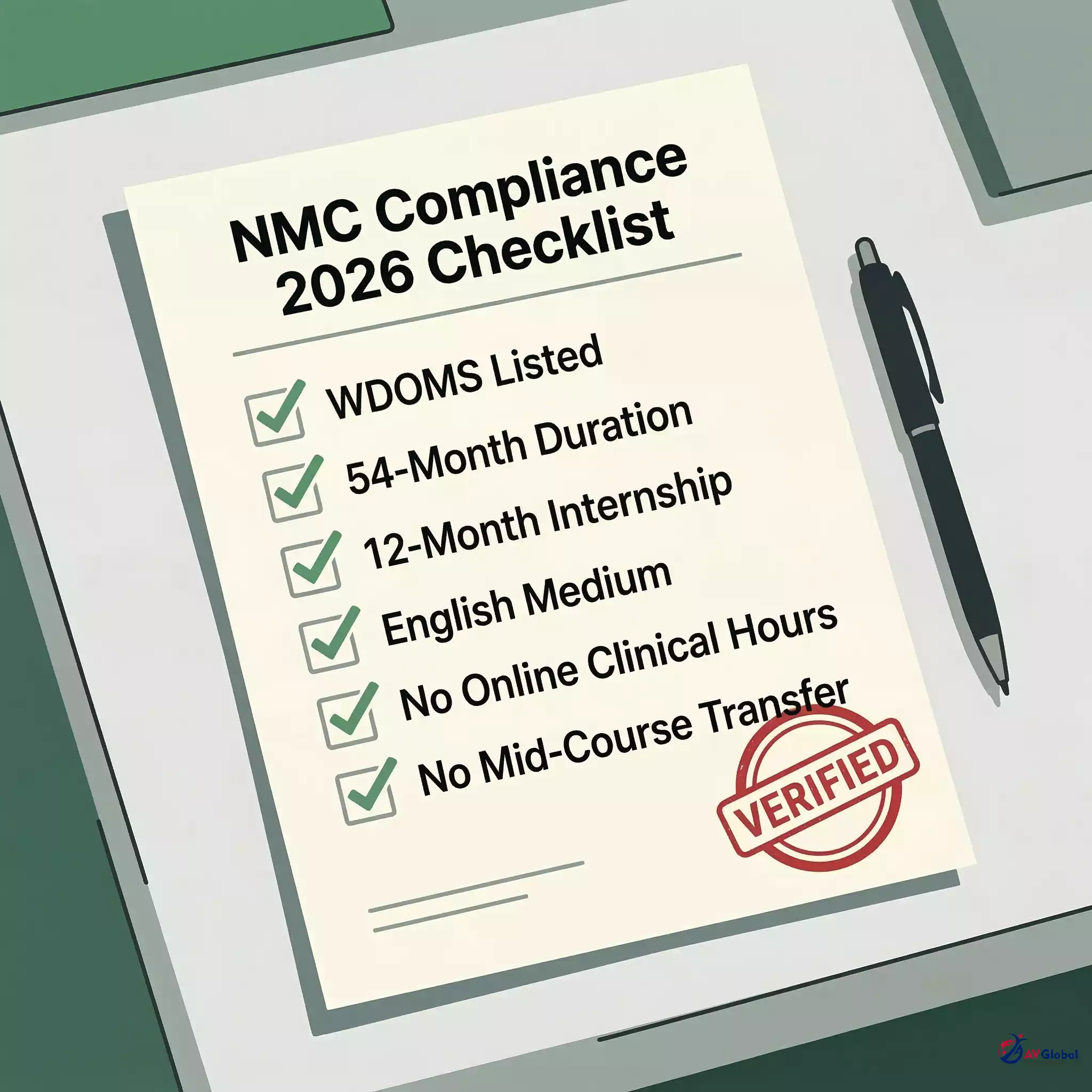
Khulna Medical College holds complete recognition from the National Medical Commission (NMC) of India and has been continuously listed in the World Directory of Medical Schools (WDOMS) since 1996. This recognition confirms that the MBBS degree awarded by KMC is valid for Indian students to appear for the Foreign Medical Graduate Examination (FMGE), which is now being replaced by the National Exit Test (NExT) as per the National Medical Commission Act 2019.
All Indian students must obtain an Eligibility Certificate from the NMC before commencing their MBBS program abroad - this certificate verifies that the chosen medical college meets NMC standards and that the student fulfills eligibility criteria including NEET qualification. After completing the MBBS degree and compulsory rotating internship at Khulna Medical College, graduates must clear the FMGE/NExT examination conducted by the National Board of Examinations to obtain registration with a State Medical Council and practice medicine in India.
The NMC also requires that students complete a Screening Test Eligibility Certificate before appearing for FMGE/NExT. Students must maintain attendance above 75 percent during their academic years as per NMC regulations and complete the internship at the same institution where they studied.
The Medium of Instruction certificate confirming that teaching was conducted in English is also required during the NMC registration process. We strongly advise all prospective students and their parents to independently verify the current NMC recognition status of Khulna Medical College by visiting the official NMC India website at nmc.
org. in and checking the list of recognized medical colleges under the Foreign Medical Graduates section, as recognition status is subject to periodic review and renewal by the National Medical Commission based on inspection reports and compliance with prescribed norms.
Year: 2024 | Appeared: 52 | Passed: 18 | Pass Rate: 34. 6% || Year: 2023 | Appeared: 47 | Passed: 15 | Pass Rate: 31.
9% || Year: 2022 | Appeared: 41 | Passed: 12 | Pass Rate: 29.
What Our Students Say
“AV Global guided me from NEET to Bangladesh. The FMGE coaching from Year 3 gave me real confidence. Cleared in the first attempt.”
“AV Global knew every detail about Khulna Medical College - visa, hostel, airport pickup. Best decision my family made.”
“Support from AV Global in Bangladesh made everything smooth. The NExT coaching programme is excellent.”
Complete Guide to MBBS at KMC
Frequently Asked Questions
Yes, KMC is listed in WDOMS and recognized by NMC India. Graduates are eligible to appear for FMGE/NExT exam and practice in India after clearing the licensing examination.
The total 6-year MBBS cost at KMC is approximately ₹$40,800 (approx. Rs.
36. 0 Lakhs).
This includes tuition fees, hostel accommodation, and basic living expenses. AV Global provides transparent fee structure with no hidden charges.
KMC teaches MBBS in English medium. Universities in Bangladesh do not require IELTS or TOEFL for Indian students.
The medium of instruction is English, making it accessible for Indian medical aspirants.
Indian students need a valid NEET scorecard to apply for MBBS at KMC. The cutoff varies each year based on seat availability.
Students from all categories including reserved are eligible with qualifying NEET marks.
Khulna city has a substantial Indian student population which has led to the establishment of several authentic Indian restaurants within 1-2 kilometers of the medical college campus. Popular dining options among Indian students include Spice of India Restaurant on KDA Avenue serving North Indian dishes including dal makhani, paneer butter masala, and assorted rotis, Desi Tadka Dhaba near Rupsha Stand known for vegetarian thalis and weekend biryani specials, Mumbai Chaat Corner on Khan Jahan Ali Road offering Mumbai street food like pav bhaji, dosa, and South Indian breakfast items, and Kolkata Kitchen on Sonadanga Road specializing in Bengali-style vegetarian preparations and sweets.
Indian grocery stores like Bombay Stores and Desi Bazar on Hazi Mohsin Road stock essential Indian ingredients including branded atta, rice varieties, dal, spices, pickles, papad, Maggi noodles, and frozen Indian snacks. Monthly food expenses vary based on lifestyle choices.
Students who cook occasionally in the hostel common kitchen spend approximately Rs. 5000-9000 per month on groceries and basic meals.
Those eating primarily at Indian restaurants budget Rs. 10,000-18,000 monthly depending on frequency and restaurant choice.
Bangladesh cuisine naturally includes many vegetarian options - dal, vegetable curries, rice preparations, and roti are staples, making it comfortable for vegetarian Indian students. The medical college canteen serves affordable Bangladeshi meals at Rs.
30-60 per plate with separate vegetarian counter. Many senior Indian students run informal mess groups where home-style Indian cooking is organized on rotation basis at approximately Rs.
6000-7000 monthly contribution. AV Global connects new students with existing mess groups during orientation week.
KMC provides well-maintained hostel accommodation for international students. Khulna Medical College provides separate on-campus hostel facilities for male and female students located approximately 200 meters from the main academic building within the secured college compound.
The MBBS program at KMC is 6 years including a 1-year internship. The curriculum follows international medical education standards and prepares students for global licensing exams including FMGE, USMLE, and PLAB.
Yes, graduates from KMC can practice in India after clearing the FMGE/NExT licensing exam conducted by NMC. The university has a 34% (2024 estimate) FMGE pass rate.
The degree is recognized for medical practice in India.
Khulna maintains a reputation as one of the safer cities in Bangladesh with relatively lower crime rates compared to the capital Dhaka. While Numbeo does not provide a dedicated crime index specifically for Khulna, the overall safety perception among international students is positive, with the city generally considered to experience low to moderate crime levels.
Violent crime against international students is extremely rare. Petty theft and pickpocketing can occur in crowded market areas, so students are advised to remain vigilant in busy bazaars and avoid displaying expensive electronics or jewelry publicly.
The Khulna Medical College campus operates as a gated and secured facility with boundary walls, main entrance security checkpoint with visitor logging, and security personnel patrolling the academic buildings and hostel areas round-the-clock. CCTV cameras monitor critical access points.
Female students report feeling safe within the campus environment, particularly in the hostel which has dedicated female wardens, biometric access control, and strict visitor policies. The neighborhoods surrounding the medical college - particularly Khulna Sadar, Sonadanga residential area, and Khan Jahan Ali Road vicinity - are considered safe for student accommodation with good street lighting and regular police patrolling.
Female students are advised to travel in groups after evening hours and use registered auto-rickshaws or ride-sharing apps rather than flagging random transport. The Indian High Commission in Bangladesh is located in Dhaka at House 2, Road 142, Gulshan-1, Dhaka-1212, with helpline number +880-2-5566-3801 and emergency after-hours contact +880-1769-652171.
In case of any emergency, students can dial 999 for police assistance or 102 for ambulance services - English-speaking operators are generally available. AV Global maintains a 24-hour emergency helpline +91-XXXXXXXXXX for students and parents, and our local Khulna representative Mr.
Rahman (contact shared post-enrollment) conducts monthly check-ins with student batches and is available within 30 minutes for any urgent support requirement. We also coordinate with the college administration and local authorities to ensure student welfare.
After MBBS from KMC, graduates can practice in India via FMGE/NExT, pursue USMLE for USA, PLAB for UK, or practice in Bangladesh. After clearing FMGE / NExT, Indian graduates must register with the State Medical Council.
PG admissions are via NEET-PG.
Related Articles
Ready to Start Your MBBS Journey?
“AV Global has placed 100+ students at Khulna Medical College. Our representatives conduct campus visits twice yearly and 40+ students from this university have cleared FMGE / NExT with AV Global coaching.”