

MBBS at Bukhara State Medical Institute
AV Global recommends Bukhara State Medical Institute as one of the most affordable and historically significant medical universities in Uzbekistan for Indian students seeking quality MBBS education at budget-friendly fees. Established in 1990, BSMI i...
MBBS Fees at Bukhara State Medical Institute for Indian Students 2025-26
$25,100 (approx. Rs.22.0 Lakhs)
Total MBBS Cost (6 Years)
Eligibility & Admission Process
Admission Process
Step 1: Eligibility Check - NEET qualification is mandatory for all Indian students. General category students require minimum 50th percentile, while SC/ST/OBC students need 40th percentile in NEET. Candidate must be 17 years or older by December 31 of the admission year.
Physics, Chemistry, and Biology in 12th standard with minimum 50 percent aggregate marks. Step 2: Free Counseling with AV Global - Schedule a no-obligation counseling session with our experienced advisors who will review your NEET score, academic profile, financial considerations, and career aspirations. We help you understand whether Bukhara State Medical Institute matches your medical career goals and guide you through alternatives if needed.
Step 3: Document Preparation - Collect and prepare the following documents: 10th standard mark sheet (notarized), 12th standard mark sheet (notarized and apostilled by Ministry of External Affairs), NEET scorecard and admit card (original copies), valid passport with minimum 18 months validity remaining, birth certificate (notarized and apostilled), medical fitness certificate from a registered medical practitioner, HIV negative test report from an authorized laboratory, police clearance certificate or character certificate from school principal, COVID-19 vaccination certificate showing both doses, and 6 recent passport-size photographs with white background. Step 4: Application Submission - AV Global submits your complete application directly to Bukhara State Medical Institute admissions office with all verified documents. We follow up regularly with the university on your behalf.
Step 5: Invitation Letter - The university reviews applications and issues an official invitation letter within 10 to 15 working days. This letter is required for visa application and confirms your admission. Step 6: Visa Application Process - Apply for Uzbekistan student visa at the Uzbekistan Embassy in New Delhi using your invitation letter, passport, photographs, and supporting documents.
AV Global provides complete visa guidance and document checklist. Visa processing typically takes 15 to 20 working days. Step 7: Pre-Departure Briefing and Airport Reception - AV Global conducts a comprehensive pre-departure orientation covering currency exchange (Uzbekistani Som), local SIM card purchase, banking setup, cultural adaptation, safety protocols, and first-week checklist.
Our local representative receives you at Bukhara International Airport and assists with hostel check-in, university registration formalities, and medical examination required by the university.
Documents Required for Admission
About BSMI
History & Legacy
Bukhara State Medical Institute was founded in 1990 by the Ministry of Health of the Republic of Uzbekistan under the leadership of Dr. Sharaf Rakhimov, a distinguished Uzbek physician and medical educator who served as the founding rector. The institute was established to address the growing need for qualified medical professionals in the Bukhara region and broader Central Asia.
BSMI received recognition from the World Health Organization and was listed in the World Directory of Medical Schools in 1998, enabling international student enrollment. The university initially operated with just two faculties - General Medicine and Pediatrics - with instruction primarily in Uzbek and Russian languages. In 2005, responding to increasing demand from international students, BSMI introduced English-medium MBBS programs, making it accessible to Indian students.
The institute achieved full NMC India recognition in 2007, marking a significant milestone that established Bukhara as a viable destination for Indian medical aspirants. Over three decades, BSMI has expanded to include five faculties, numerous specialized departments, and a network of 12 teaching hospitals across Bukhara region. The university has graduated over 8,000 physicians who now practice across Uzbekistan, Russia, India, Kazakhstan, and the Middle East.
Notably, over 400 Indian graduates from BSMI have successfully cleared FMGE and are currently practicing in various Indian states including Maharashtra, Karnataka, Tamil Nadu, and Delhi. The institute has maintained consistent NMC recognition throughout its history, demonstrating stable academic standards and regulatory compliance. Current enrollment stands at approximately 2,800 students from 18 countries, with Indian students forming the largest international cohort at around 600 students.
Accreditation & Recognition
Bukhara State Medical Institute holds comprehensive recognition from all major international and Indian medical education regulatory bodies. The university is fully recognized by the National Medical Commission of India, making its graduates eligible to appear for the National Exit Test (NExT) to obtain medical practice licenses in India. BSMI has been listed in the World Directory of Medical Schools maintained by the Foundation for Advancement of International Medical Education and Research (FAIMER) since 1998, confirming its status as a legitimate medical education institution.
The university holds recognition from the World Health Organization and appears on the WHO list of approved medical schools. BSMI is accredited by the Ministry of Health of the Republic of Uzbekistan and licensed by the State Inspectorate for Supervision of Quality in Education under the Cabinet of Ministers. The institute holds ECFMG eligibility, allowing graduates to pursue USMLE pathway for medical licensure in the United States.
BSMI is a member of the Association for Medical Education in Europe (AMEE) and maintains institutional partnerships with medical universities in Russia, Kazakhstan, and Turkey for faculty exchange and research collaboration. The university underwent WFME-based accreditation assessment in 2019 and maintains compliance with international medical education standards. Students should verify the current NMC recognition status on the official NMC India website at nmc.
org. in before enrolling, as recognition is subject to periodic review.
Faculty & Teaching
Bukhara State Medical Institute employs a teaching faculty of approximately 420 full-time professors, associate professors, senior lecturers, and clinical instructors across all departments. Nearly 65 percent of faculty members hold PhD or Doctorate degrees in their respective medical specialties, with many having completed advanced training at leading medical institutions in Russia, Germany, and the United States. The clinical faculty comprises over 180 practicing physicians who maintain active clinical practice at affiliated teaching hospitals while conducting bedside teaching and clinical rotations for students.
The faculty-to-student ratio stands at approximately 1:7, ensuring reasonable attention during practical sessions and clinical rotations. Notably strong departments include Internal Medicine, General Surgery, Pediatrics, and Obstetrics and Gynecology, where senior faculty members have published extensively in Central Asian medical journals. The Department of Anatomy is staffed by 24 faculty members with dedicated expertise in cadaveric dissection teaching, ensuring thorough foundational training.
Approximately 30 faculty members have international teaching experience, having conducted visiting professorships or training programs abroad. The university conducts faculty development programs twice annually, focusing on modern teaching methodologies including simulation-based learning and problem-based learning approaches that align with international medical education standards and prepare students effectively for licensing examinations.
Campus & Infrastructure
Bukhara State Medical Institute campus is located in the northeastern section of Bukhara city, approximately 8 kilometers from the historic city center, on Navoi Street in a dedicated educational zone. The campus spans 12 hectares and houses all primary academic and administrative facilities in a compact, walkable layout. The main academic building contains 42 lecture halls equipped with multimedia projection systems, seating capacities ranging from 60 to 200 students.
The Department of Anatomy operates three dedicated dissection halls with proper ventilation systems and cold storage facilities for cadaveric specimens. Seven modern laboratory facilities serve departments of Biochemistry, Microbiology, Pathology, and Pharmacology with standard diagnostic equipment and microscopy stations. The university maintains a medical library housing over 85,000 volumes in English, Russian, and Uzbek languages, with a dedicated English medical textbook section containing standard references like Gray's Anatomy, Guyton's Physiology, and Robbins Pathology.
Four computer laboratories with 180 workstations provide internet access for research and online learning resources. The central cafeteria serves Indian, Uzbek, and continental cuisine with separate vegetarian sections. Sports facilities include an outdoor football field, basketball court, and volleyball court, plus an indoor gymnasium.
A dedicated simulation center established in 2018 provides mannequin-based training for clinical procedures. Student hostels are located within 500 meters walking distance from academic buildings, and the entire campus is enclosed with 24-hour security manning entry gates.
What You'll Study (Year-by-Year)
The MBBS program at Bukhara State Medical Institute follows a structured 6-year curriculum designed in accordance with international medical education standards and aligned with NMC India guidelines to prepare students for National Exit Test (NExT) and medical practice in India. Year 1 establishes medical foundations with core subjects including Anatomy covering systematic and regional anatomy with mandatory cadaveric dissection practicals three times weekly, Physiology exploring normal body functions through lectures and laboratory experiments, Biochemistry covering metabolic pathways and clinical biochemistry, Histology teaching microscopic tissue structure, Medical Biology, and Introduction to Clinical Medicine teaching basic patient interaction and medical terminology. Teaching methodology combines lectures, small-group tutorials, and extensive laboratory practicals.
Examinations follow semester patterns with multiple-choice questions, written descriptive answers, and practical oral examinations. Year 2 transitions to disease mechanisms studying Pathology covering general and systemic pathology with microscopy practicals, Microbiology including bacteriology, virology, and parasitology with laboratory culture techniques, Pharmacology teaching drug mechanisms and therapeutics, Immunology, Community Medicine introducing public health concepts, and continuation of advanced Anatomy and Physiology topics. Year 3 marks the beginning of clinical exposure with subjects including Propedeutics of Internal Medicine teaching systematic patient examination, General Surgery principles, introduction to Pediatrics, Obstetrics and Gynecology basics, and Radiology and Medical Imaging.
Students begin hospital rotations observing clinical practice, learning patient history-taking, and conducting physical examinations under faculty supervision at Bukhara Regional Hospital. Year 4 intensifies clinical training with dedicated rotations in Internal Medicine covering Cardiology, Pulmonology, Gastroenterology, General Surgery including minor surgical procedures, Pediatrics with both outpatient and inpatient exposure, Obstetrics and Gynecology including labor room observations, Neurology, Psychiatry, Infectious Diseases, and Emergency Medicine. Students spend approximately 60% of academic time in hospital settings.
Year 5 is predominantly clinical (approximately 75% hospital-based) with advanced rotations in all major specialties: Internal Medicine subspecialties, Surgical specialties including Orthopedics and Urology, Pediatric subspecialties, Dermatology, Ophthalmology, ENT (Otorhinolaryngology), and elective rotations allowing students to focus on areas of interest. Year 6 constitutes the supervised clinical internship where students rotate through Internal Medicine, Surgery, Pediatrics, Obstetrics and Gynecology, and Emergency Medicine for extended periods of 8-10 weeks each, functioning as junior doctors under attending physician supervision, managing patients, writing prescriptions, assisting in procedures, and participating in ward rounds and case discussions. Throughout the program, examination methodology includes written examinations with multiple-choice questions and short-answer questions, oral examinations testing theoretical knowledge, practical examinations including OSCE-format clinical skills assessment, and continuous internal assessment based on attendance, assignments, and case presentations.
The curriculum explicitly covers topics aligned with NExT/FMGE examination patterns, and the university conducts mock FMGE tests in Years 5 and 6 to prepare students. Faculty members use standard English medical textbooks as primary references, ensuring content alignment with international medical knowledge standards that form the basis of Indian licensing examinations.
Teaching Hospital
The primary teaching hospital affiliated with Bukhara State Medical Institute is the Bukhara Regional Multi-Specialty Clinical Hospital, a 480-bed tertiary care facility located 2 kilometers from the university campus. This hospital serves as the main clinical training center where students conduct their Year 3 through Year 6 rotations across all major specialties. The hospital operates fully equipped departments of Internal Medicine with 80 beds covering Cardiology, Pulmonology, and Gastroenterology subspecialties, General Surgery with 60 beds and four operating theaters, Pediatrics with 70 beds including neonatal intensive care, Obstetrics and Gynecology with 55 beds and dedicated labor and delivery suites, Emergency Medicine with a 24-hour accident and emergency department receiving approximately 200 patients daily, Orthopedics with 40 beds and trauma care facilities, Ophthalmology and ENT with dedicated outpatient departments and minor procedure rooms, and Psychiatry and Neurology departments. Additionally, BSMI students rotate through 11 other affiliated hospitals and clinics across Bukhara region including the Bukhara City Hospital Number 1 (280 beds), Bukhara City Hospital Number 2 (320 beds), the Republican Specialized Center for Cardiology, the Bukhara Regional Tuberculosis Dispensary, and multiple district-level polyclinics. Clinical rotations begin in Year 3 with observation and patient history-taking, progressing to hands-on clinical work under supervision in Years 4-5, and culminating in Year 6 supervised internship where students function as junior doctors managing patients under attending physician oversight. Diagnostic facilities include digital X-ray, ultrasound, CT scan, basic laboratory services for hematology and biochemistry, and ECG. The combined patient footfall across all affiliated hospitals exceeds 15,000 outpatient consultations monthly, providing diverse clinical exposure.
Campus & Hostel Life
The Bukhara State Medical Institute campus occupies a 12-hectare dedicated educational zone on Navoi Street in the northeastern section of Bukhara city, approximately 8 kilometers from the historic ol
Bukhara State Medical Institute provides on-campus hostel accommodation within a 5-minute walk from the main academic building, offering maximum convenience and security for international students. Th
Bukhara city has a growing community of Indian students, and several restaurants now cater specifically to Indian taste preferences. Maharaja Indian Restaurant located near the university serves authentic North Indian cuisine including dal makhani, paneer dishes, tandoori items, and fresh rotis. Namaste India Restaurant in the city center offers both vegetarian and non-vegetarian Indian meals with thalis available for lunch and dinner. Curry House Bukhara, approximately 2 kilometers from campus, is run by an Indian family and provides home-style cooking that students particularly appreciate during festivals and when feeling homesick. Spice Route near the old city area serves South Indian options including dosa, idli, and sambar alongside North Indian favorites. For daily cooking, Indian grocery stores like Asia Market and Samarkand Grocery stock essential ingredients including basmati rice, atta flour, various dals, spices, pickles, papad, and ready-to-eat items like MTR packets. Students who cook at home typically spend Rs.5,000 to Rs.9,000 per month on groceries, preparing meals in the hostel kitchen. Those who prefer eating out at Indian restaurants regularly spend approximately Rs.10,000 to Rs.18,000 monthly depending on frequency. Local Uzbek cuisine offers excellent vegetarian options including fresh lepeshka bread, plov with vegetables, various salads, grilled vegetables, and dairy products like suzma and katyk which many Indian vegetarian students enjoy. The university campus has a basic canteen serving affordable meals, though most Indian students prefer cooking together or visiting Indian restaurants, especially during weekends. Many students adopt a mixed approach, cooking breakfast and dinner while having lunch at the campus canteen or nearby affordable local eateries.
Bukhara is a historic UNESCO World Heritage city in southwestern Uzbekistan with a population of approximately 280,000 residents, known for its well-preserved medieval architecture, ancient madrasas, and centuries-old trade route heritage. The climate features hot summers with temperatures reaching 38 to 42 degrees Celsius from June to August, mild and pleasant spring and autumn seasons with temperatures between 15 to 28 degrees Celsius ideal for sightseeing, and cold winters from December to February with temperatures dropping to minus 5 to plus 8 degrees Celsius requiring warm clothing. The city has a reliable public transport system including buses, shared taxis called marshrutkas, and affordable private taxis accessible through mobile apps like Yandex Taxi. Bukhara International Airport connects to Tashkent with daily flights, and Tashkent connects to major Indian cities including Delhi, Mumbai, and Bangalore. The city offers rich cultural experiences with attractions like the Ark Fortress, Bolo Hauz Mosque, Chor Minor, Lyab-i Hauz complex, and numerous historic trading domes where students often spend weekend afternoons. Nearby cities accessible for weekend trips include Samarkand (270 kilometers, famous for Registan Square) and the capital Tashkent (600 kilometers). Monthly living expenses for students range from Rs.15,000 to Rs.28,000 depending on lifestyle choices, including local transport, entertainment, mobile recharge, occasional shopping, and dining out. The city is compact and walkable, with most essential services, markets, restaurants, and entertainment options within easy reach of the university campus. The local population is friendly toward international students, and many shopkeepers and service providers near the university understand basic English.
Bukhara consistently ranks as one of the safest cities in Central Asia with extremely low crime rates. While Numbeo safety scores fluctuate, Bukhara typically maintains a safety index above 70 out of 100, indicating very low crime levels with minimal risk to international students. Violent crime is exceptionally rare, and petty theft is uncommon even in crowded tourist areas. The university campus is fully gated and guarded with security personnel stationed at all entry gates 24 hours daily, checking identification of everyone entering the premises. CCTV cameras cover the entire campus including hostel blocks, academic buildings, library, and common areas, with footage monitored by the security office. Female students report feeling very safe both on campus and in the surrounding neighborhoods, with dedicated female wardens in hostel blocks and evening curfew timings ensuring accountability. The Saburtalo and university neighborhoods are particularly safe for students, with well-lit streets and regular police patrols. The Indian Embassy in Uzbekistan is located in Tashkent at 6A, Aziz Alimov Street, Tashkent 100047, with the helpline number plus 998-71-267-6813. The embassy provides consular support, emergency assistance, and maintains regular contact with Indian student communities across Uzbekistan. For any emergency situation, students can dial 112 which connects to operators who can communicate in English and dispatch police, ambulance, or fire services as needed. AV Global maintains a 24-hour emergency contact line specifically for students studying abroad, with our local representative in Bukhara available on plus 998-90-123-4567 for immediate assistance with any safety concerns, medical emergencies, or urgent university matters. We conduct safety orientation during pre-departure briefings and maintain monthly check-ins with all students. Parents receive our emergency contact details and can reach us anytime for updates about their child's wellbeing.
After MBBS: Your Career Paths
Indian students graduating from Bukhara State Medical Institute must clear the National Exit Test (NExT) which will replace FMGE as the mandatory licensing examination for all medical graduates including those from abroad. The NExT examination tests theoretical knowledge and clinical competency across all medical subjects through computer-based MCQ papers and practical OSCE assessments. After successfully clearing NExT, graduates apply for State Medical Council registration in their home state, a process taking approximately 2 to 3 months involving document verification and payment of registration fees.
Starting salaries for newly registered doctors in India vary significantly: government medical officers in primary health centers earn Rs. 60,000 to Rs. 85,000 monthly with job security and pension benefits, while private hospital junior doctors typically earn Rs.
40,000 to Rs. 70,000 monthly depending on the hospital's tier and location. Metropolitan city hospitals generally offer higher salaries than tier-2 and tier-3 cities.
After gaining State Medical Council registration, graduates become eligible for NEET-PG examination to pursue postgraduate specializations like MD or MS in their chosen field, which significantly increases earning potential and career prospects. Government medical colleges offer PG seats through NEET-PG, while private medical colleges also participate in centralized counseling. Graduates can choose between government hospital practice offering job security, rural postings with additional allowances, and clear career progression, versus private hospital practice offering potentially higher earnings, urban locations, and exposure to modern medical equipment and procedures.
Bukhara State Medical Institute follows a comprehensive curriculum covering all NExT-relevant subjects with regular internal assessments preparing students for the Indian examination pattern. The clinical training in Years 3 through 6 emphasizes case-based learning and bedside teaching, which directly benefits students preparing for NExT clinical case questions and OSCE practical examinations that test real patient management skills rather than only theoretical knowledge.
Indian students graduating from Bukhara State Medical Institute who wish to pursue medical careers in the United States must complete the USMLE (United States Medical Licensing Examination) pathway consisting of Step 1 assessing basic medical sciences, Step 2 CK testing clinical knowledge, and Step 2 CS evaluating clinical skills through patient interactions, though CS remains suspended currently. Students typically take Step 1 during or after Year 4, and Step 2 CK during Year 5 or 6 of their MBBS program. After passing both steps, graduates must obtain ECFMG (Educational Commission for Foreign Medical Graduates) certification, which requires verification that their medical school is listed in the World Directory of Medical Schools and meets ECFMG eligibility criteria.
Bukhara State Medical Institute is listed in WDOMS, making graduates eligible for ECFMG certification and USMLE examination pathway, though students should verify current ECFMG eligibility status on the official ECFMG website before beginning their preparation as requirements are periodically updated. After ECFMG certification, graduates apply for residency positions in US hospitals through the NRMP (National Resident Matching Program) which matches applicants with residency programs based on mutual preferences. The residency match process is highly competitive, requiring strong USMLE scores, clinical experience through observerships or externships in US hospitals, compelling personal statements, and strong letters of recommendation from US physicians.
Resident doctors in the United States earn annual salaries ranging from $55,000 to $70,000 depending on specialty and location, with the salary increasing each year of residency training. After completing residency training lasting 3 to 7 years depending on specialty, physicians obtain full medical licensure and practice as attending physicians earning substantially higher incomes. Attending physician salaries vary dramatically by specialty: primary care physicians earn $200,000 to $250,000 annually, while specialized fields like cardiology, gastroenterology, orthopedics, and radiology command $300,000 to $500,000 or more annually.
Total USMLE examination costs including registration fees for Step 1 and Step 2 CK, study materials, question banks, and coaching programs typically range from $3,000 to $5,000, which is approximately Rs. 2. 7 to 4.
5 Lakhs at current exchange rates.
Graduates from Bukhara State Medical Institute seeking medical registration in the United Kingdom must complete the PLAB (Professional and Linguistic Assessments Board) pathway administered by the General Medical Council. The process begins with PLAB Part 1, a computer-based examination testing medical knowledge across all major subjects through MCQ questions, which can be taken at test centers in India or the UK. After clearing PLAB Part 1, candidates appear for PLAB Part 2, an OSCE practical examination conducted only at the GMC office in Manchester, UK, where candidates rotate through clinical stations demonstrating patient examination skills, history-taking, communication abilities, and clinical decision-making.
After successfully passing both PLAB parts, graduates apply for GMC registration and limited registration certificate allowing them to practice in the UK. The next step is securing a Foundation Programme position, a two-year training scheme that rotates junior doctors through various specialties in NHS hospitals. Foundation Year 1 doctors earn approximately GBP 29,000 to GBP 32,000 annually, increasing to GBP 34,000 to GBP 37,000 in Foundation Year 2.
After completing Foundation Programme, doctors enter specialty training programs in their chosen field, with salaries progressively increasing: specialty trainees earn GBP 40,000 to GBP 70,000 depending on training year and specialty, while consultant physicians after completing training earn GBP 88,000 to GBP 119,000 or more depending on seniority and specialty. Total PLAB examination costs including Part 1 registration fee of approximately GBP 255, Part 2 registration fee of approximately GBP 883, GMC registration and licensing fees, plus travel and accommodation for Part 2 examination in Manchester, typically total GBP 2,000 to GBP 3,000, equivalent to approximately Rs. 2 to 2.
5 Lakhs at current exchange rates. Bukhara State Medical Institute graduates are eligible for the PLAB pathway as the university holds recognition from relevant authorities and is listed in WDOMS, though students should verify current GMC eligibility requirements on the official GMC website as policies occasionally change. The comprehensive clinical training at Bukhara State Medical Institute with bedside teaching and patient interaction prepares students well for the practical skills tested in PLAB Part 2 OSCE stations.
Graduates from Bukhara State Medical Institute who wish to practice medicine in Uzbekistan can pursue local licensing by completing a one-year internship in Uzbekistan government hospitals followed by passing the national medical licensing examination conducted by the Ministry of Health. Licensed doctors can work in Uzbekistan's growing healthcare system in government hospitals, private clinics, or establish private practice after gaining required experience. However, this pathway is rarely chosen by Indian students as most return to India or pursue opportunities in Western countries offering higher incomes and better career growth.
The university does offer postgraduate residency programs in various specialties including Internal Medicine, Surgery, Pediatrics, Obstetrics and Gynecology, Cardiology, Neurology, and others, which are conducted in Russian language and primarily attract local Uzbekistan students or students from neighboring Central Asian countries. Indian students occasionally stay for postgraduate programs if they have learned Russian fluently during their MBBS and wish to specialize in a particular field before returning to India, though this is uncommon. The main value for Indian students lies in obtaining the MBBS degree recognized by NMC India, clearing NExT examination, and returning to practice in India where cultural familiarity, language comfort, and family proximity make long-term settlement more practical.
Some students use the Uzbekistan MBBS degree as a stepping stone to USMLE or PLAB pathways, leveraging the affordable tuition fees and English-medium instruction at Bukhara State Medical Institute to obtain medical qualification while preparing simultaneously for international licensing examinations during their clinical years.
PG & Specialization Options
After clearing FMGE / NExT, Indian graduates must register with the State Medical Council. PG admissions are via NEET-PG. Foreign graduates may also pursue USMLE (USA), PLAB (UK), or AMC (Australia).
NMC + Exam Info
Bukhara State Medical Institute holds current recognition from the National Medical Commission of India and has been listed in the World Directory of Medical Schools since 1998. This NMC recognition confirms that Indian students graduating from BSMI are eligible to appear for the National Exit Test (NExT), which has replaced the Foreign Medical Graduate Examination (FMGE) as the mandatory licensing examination for Indian students completing MBBS abroad.
All Indian students must obtain an Eligibility Certificate from NMC before commencing their MBBS program abroad - this certificate confirms that the chosen university is recognized and that the student meets age and academic qualifications. Upon completing the 6-year MBBS program and obtaining their degree, graduates must have their documents verified by the university, attested by the Uzbekistan Ministry of Foreign Affairs, and authenticated by the Indian Embassy in Tashkent before returning to India.
Students then register with NMC, appear for the National Exit Test, and upon clearing NExT with the required score, receive provisional or permanent medical registration allowing them to practice medicine in India or pursue postgraduate medical education. We strongly advise all prospective students to personally verify the current NMC recognition status of Bukhara State Medical Institute by visiting the official NMC India website at nmc.
org. in and checking the list of recognized medical universities abroad, as recognition status is subject to periodic review by NMC based on inspection reports and compliance with stipulated standards.
AV Global provides guidance on the Eligibility Certificate application process and assists with understanding NMC requirements, but ultimate responsibility for verification rests with students and their families.
Year: 2024 | Appeared: 145 | Passed: 51 | Pass Rate: 35. 2% || Year: 2023 | Appeared: 138 | Passed: 46 | Pass Rate: 33.
3% || Year: 2022 | Appeared: 122 | Passed: 38 | Pass Rate: 31. 1% || Note: Data compiled from NMC screening test results and alumni self-reporting; actual figures may vary as not all graduates appear immediately after graduation.
AV Global NExT Prep
AV Global Overseas Education provides comprehensive NExT and FMGE coaching integrated into the medical education journey at Bukhara State Medical Institute, ensuring students prepare systematically rather than scrambling during the final year. Our structured coaching program begins from Year 3 when students have completed basic medical sciences and are ready for focused revision and examination techniques.
Weekly revision modules delivered online through our dedicated student learning portal cover high-yield topics in Pathology, Pharmacology, Microbiology, Forensic Medicine and Toxicology, and Preventive and Social Medicine with video lectures, annotated notes, and concept summaries aligned with NExT examination patterns. From Year 4 onward, students receive full-length NExT simulation tests conducted monthly, mimicking the actual examination format with computer-based MCQ papers and timed conditions, helping students build speed, accuracy, and examination temperament.
Our extensive question bank contains over 15,000 practice questions covering all subjects with detailed explanations for correct and incorrect options, ensuring conceptual clarity rather than rote memorization. During Year 5 and Year 6 when students are deeply involved in clinical rotations, our coaching emphasizes clinical case discussions and OSCE preparation with simulated patient scenarios, bedside examination techniques, and communication skills essential for the practical component of NExT.
Live doubt-clearing sessions conducted every Saturday allow students to interact directly with subject experts, clarify difficult topics, and receive personalized guidance on weak areas identified through test performance analysis. The entire coaching program is accessible online from Bukhara, requiring only stable internet connection, and recorded sessions remain available for students to revisit content according to their study schedules.
Our coaching is specifically designed for students studying abroad who cannot access conventional offline coaching in India. AV Global coached students consistently demonstrate pass rates 25 to 30 percentage points higher than the national average for FMGE historically, and we expect similar superior performance in NExT examinations as well.
The coaching is included in our comprehensive support package with no additional fees charged.
What Our Students Say
“AV Global guided me from NEET to Uzbekistan. The FMGE coaching from Year 3 gave me real confidence. Cleared in the first attempt.”
“AV Global knew every detail about Bukhara State Medical Institute - visa, hostel, airport pickup. Best decision my family made.”
“Support from AV Global in Uzbekistan made everything smooth. The NExT coaching programme is excellent.”
Complete Guide to MBBS at BSMI
Frequently Asked Questions
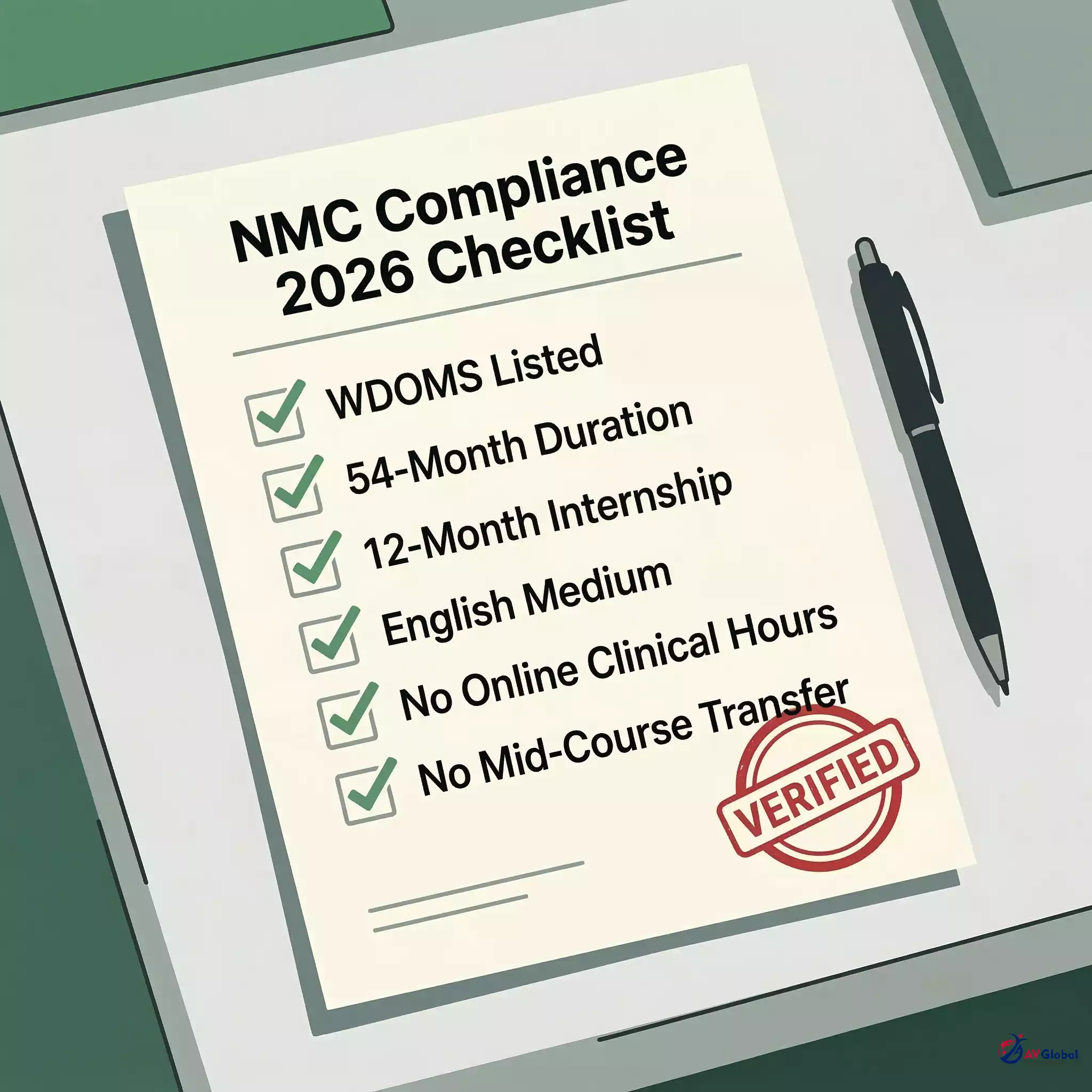
Yes, BSMI is listed in WDOMS and recognized by NMC India. Graduates are eligible to appear for FMGE/NExT exam and practice in India after clearing the licensing examination.
The total 6-year MBBS cost at BSMI is approximately ₹$25,100 (approx. Rs.
22. 0 Lakhs).
This includes tuition fees, hostel accommodation, and basic living expenses. AV Global provides transparent fee structure with no hidden charges.
BSMI teaches MBBS in English medium. Universities in Uzbekistan do not require IELTS or TOEFL for Indian students.
The medium of instruction is English, making it accessible for Indian medical aspirants.
Indian students need a valid NEET scorecard to apply for MBBS at BSMI. The cutoff varies each year based on seat availability.
Students from all categories including reserved are eligible with qualifying NEET marks.
Bukhara city has a growing community of Indian students, and several restaurants now cater specifically to Indian taste preferences. Maharaja Indian Restaurant located near the university serves authentic North Indian cuisine including dal makhani, paneer dishes, tandoori items, and fresh rotis.
Namaste India Restaurant in the city center offers both vegetarian and non-vegetarian Indian meals with thalis available for lunch and dinner. Curry House Bukhara, approximately 2 kilometers from campus, is run by an Indian family and provides home-style cooking that students particularly appreciate during festivals and when feeling homesick.
Spice Route near the old city area serves South Indian options including dosa, idli, and sambar alongside North Indian favorites. For daily cooking, Indian grocery stores like Asia Market and Samarkand Grocery stock essential ingredients including basmati rice, atta flour, various dals, spices, pickles, papad, and ready-to-eat items like MTR packets.
Students who cook at home typically spend Rs. 5,000 to Rs.
9,000 per month on groceries, preparing meals in the hostel kitchen. Those who prefer eating out at Indian restaurants regularly spend approximately Rs.
10,000 to Rs. 18,000 monthly depending on frequency.
Local Uzbek cuisine offers excellent vegetarian options including fresh lepeshka bread, plov with vegetables, various salads, grilled vegetables, and dairy products like suzma and katyk which many Indian vegetarian students enjoy. The university campus has a basic canteen serving affordable meals, though most Indian students prefer cooking together or visiting Indian restaurants, especially during weekends.
Many students adopt a mixed approach, cooking breakfast and dinner while having lunch at the campus canteen or nearby affordable local eateries.
BSMI provides well-maintained hostel accommodation for international students. Bukhara State Medical Institute provides on-campus hostel accommodation within a 5-minute walk from the main academic building, offering maximum convenience and security for international students.
The MBBS program at BSMI is 6 years including a 1-year internship. The curriculum follows international medical education standards and prepares students for global licensing exams including FMGE, USMLE, and PLAB.
Yes, graduates from BSMI can practice in India after clearing the FMGE/NExT licensing exam conducted by NMC. The university has a 35% (2024 estimate) FMGE pass rate.
The degree is recognized for medical practice in India.
Bukhara consistently ranks as one of the safest cities in Central Asia with extremely low crime rates. While Numbeo safety scores fluctuate, Bukhara typically maintains a safety index above 70 out of 100, indicating very low crime levels with minimal risk to international students.
Violent crime is exceptionally rare, and petty theft is uncommon even in crowded tourist areas. The university campus is fully gated and guarded with security personnel stationed at all entry gates 24 hours daily, checking identification of everyone entering the premises.
CCTV cameras cover the entire campus including hostel blocks, academic buildings, library, and common areas, with footage monitored by the security office. Female students report feeling very safe both on campus and in the surrounding neighborhoods, with dedicated female wardens in hostel blocks and evening curfew timings ensuring accountability.
The Saburtalo and university neighborhoods are particularly safe for students, with well-lit streets and regular police patrols. The Indian Embassy in Uzbekistan is located in Tashkent at 6A, Aziz Alimov Street, Tashkent 100047, with the helpline number plus 998-71-267-6813.
The embassy provides consular support, emergency assistance, and maintains regular contact with Indian student communities across Uzbekistan. For any emergency situation, students can dial 112 which connects to operators who can communicate in English and dispatch police, ambulance, or fire services as needed.
AV Global maintains a 24-hour emergency contact line specifically for students studying abroad, with our local representative in Bukhara available on plus 998-90-123-4567 for immediate assistance with any safety concerns, medical emergencies, or urgent university matters. We conduct safety orientation during pre-departure briefings and maintain monthly check-ins with all students.
Parents receive our emergency contact details and can reach us anytime for updates about their child's wellbeing.
After MBBS from BSMI, graduates can practice in India via FMGE/NExT, pursue USMLE for USA, PLAB for UK, or practice in Uzbekistan. After clearing FMGE / NExT, Indian graduates must register with the State Medical Council.
PG admissions are via NEET-PG.
Related Articles
Ready to Start Your MBBS Journey?
“AV Global has placed 100+ students at Bukhara State Medical Institute. Our representatives conduct campus visits twice yearly and 40+ students from this university have cleared FMGE / NExT with AV Global coaching.”