

MBBS at Kumudini Women's Medical College
AV Global recommends Kumudini Women's Medical College as one of Bangladesh's most affordable and clinically focused private medical institutions for Indian students. Established in 1993 by the Kumudini Welfare Trust of Bengal, this women-only medical...
MBBS Fees at Kumudini Women's Medical College for Indian Students 2025-26
$40,850 (approx. Rs.36.0 Lakhs)
Total MBBS Cost (6 Years)
Eligibility & Admission Process
Admission Process
Step 1: Eligibility Check - NEET qualification is mandatory for admission to Kumudini Women's Medical College. General category candidates require minimum 50th percentile in NEET, while SC/ST/OBC candidates need 40th percentile. Age must be 17 years or above by December 31 of the admission year as per NMC guidelines.
Step 2: Free Counseling with AV Global - Schedule a no-obligation counseling session where our senior advisors review your NEET scorecard, academic profile, budget considerations, and career aspirations. We assess whether Kumudini Women's Medical College aligns with your daughter's goals and provide honest guidance comparing it with other Bangladesh options. Step 3: Document Preparation - Collect and prepare: 10th standard mark sheet (notarized), 12th standard mark sheet (notarized and apostilled by MEA), NEET scorecard and admit card, valid passport with minimum 18 months validity remaining, birth certificate (notarized and apostilled), medical fitness certificate from a registered medical practitioner, HIV negative test report from an authorized diagnostic center, police clearance certificate or character certificate, COVID-19 vaccination certificate showing both doses, and 6 recent passport-size photographs with white background.
Step 4: Application Submission - AV Global submits your complete application package directly to Kumudini Women's Medical College admissions office with all supporting documents and application fee payment receipt. Step 5: Invitation Letter - The university issues an official invitation letter within 10-15 working days after document verification, which is required for visa processing. Step 6: Visa Application - Apply for Bangladesh student visa at the Bangladesh High Commission in New Delhi or regional offices using the invitation letter, passport, financial documents, and medical certificates.
Processing takes approximately 15-20 working days. Step 7: Pre-Departure Briefing and Arrival Support - AV Global conducts comprehensive pre-departure orientation covering currency exchange, local SIM card activation, banking procedures, cultural orientation, packing checklist, and first-week survival guide. Our local Bangladesh representative receives students at Hazrat Shahjalal International Airport in Dhaka and arranges ground transport to Mirzapur, assists with hostel check-in, university registration formalities, and police verification at the local Tangail police station.
Documents Required for Admission
About KWMC
History & Legacy
Kumudini Women's Medical College was established in 1993 by the renowned Kumudini Welfare Trust of Bengal, a charitable organization founded by late philanthropist Ranada Prasad Saha in memory of his wife Kumudini Devi. The trust has been serving healthcare and education needs in Bangladesh since 1944, and establishing the medical college was a natural extension of this mission. The college was founded with the specific objective of increasing female physician representation in Bangladesh's healthcare system, addressing the acute shortage of women doctors in rural areas.
Initially starting with an intake of 50 students annually, KWMC received recognition from the Bangladesh Medical and Dental Council in its founding year itself. The college was listed in the World Directory of Medical Schools (WDOMS) by WHO in 1998, enabling international recognition. By 2005, the college had expanded its intake to 100 students per year.
NMC India (formerly Medical Council of India) granted recognition in 2002, opening doors for Indian students. Over three decades, KWMC has produced more than 2,400 women physicians who are now practicing across Bangladesh, India, Middle East countries including Saudi Arabia and UAE, and several graduates have successfully cleared USMLE and are pursuing residencies in the United States. The institution continues to maintain its founding mission of empowering women through medical education while providing affordable quality training that meets international standards.
Accreditation & Recognition
Kumudini Women's Medical College holds comprehensive recognition from multiple national and international medical education regulatory bodies. The college is fully recognized by the National Medical Commission (NMC) of India, making its graduates eligible to appear for the Foreign Medical Graduate Examination (FMGE), which is being replaced by the National Exit Test (NExT) as the mandatory screening examination for practice rights in India. The institution has been listed in the World Directory of Medical Schools (WDOMS) maintained by the Foundation for Advancement of International Medical Education and Research (FAIMER) in collaboration with WHO since 1998.
It is approved and monitored by the Bangladesh Medical and Dental Council (BMDC), the national regulatory authority for medical education in Bangladesh. The college operates under the affiliation of Dhaka University for academic examination purposes and is recognized by the Ministry of Health and Family Welfare, Government of Bangladesh. KWMC meets ECFMG eligibility requirements, allowing graduates to pursue the USMLE pathway for medical practice in the United States.
Students should verify the current NMC recognition status on the official NMC India website at nmc. org. in before enrolling, as recognition is subject to periodic review.
Faculty & Teaching
Kumudini Women's Medical College maintains a teaching faculty of approximately 110 full-time professors, associate professors, assistant professors, and lecturers across all pre-clinical and clinical departments. Nearly 40 percent of the faculty members hold PhD or MD degrees with specialized training in their respective fields. The faculty-to-student ratio stands at approximately 1:9, ensuring personalized attention during tutorials and clinical training sessions.
Many senior faculty members have received advanced training at institutions in India, United Kingdom, Thailand, and Australia, bringing international exposure to teaching methodologies. The Anatomy department is particularly well-staffed with 12 dedicated faculty members who supervise cadaveric dissection sessions throughout the first two years. Clinical departments including Internal Medicine, Surgery, Obstetrics and Gynecology, and Pediatrics each have at least 8-10 consultant physicians who are actively practicing at affiliated hospitals, ensuring students receive training from doctors handling real patient loads daily.
Several faculty members have published research papers in indexed medical journals focusing on tropical diseases, maternal health, and community medicine relevant to South Asian medical practice. The college emphasizes faculty development through regular workshops on modern teaching techniques including problem-based learning and simulation-based medical education.
Campus & Infrastructure
Kumudini Women's Medical College is situated in Mirzapur town of Tangail district, located on the Dhaka-Tangail highway approximately 65 kilometers north of the capital Dhaka. The campus occupies a 15-acre site with purpose-built academic infrastructure. The college building houses 4 large lecture halls with seating capacity of 120-150 students each, equipped with audiovisual presentation systems and air conditioning.
Three dedicated anatomy dissection halls accommodate simultaneous practical sessions for multiple batches, with well-preserved cadavers and anatomical models. Modern physiology and biochemistry laboratories feature standard diagnostic equipment for student practicals. The pathology and microbiology labs include microscopy sections with 80+ microscopes and culture facilities.
The central medical library contains over 15,000 books including latest editions of standard medical textbooks, subscribes to 45+ international and national medical journals, and provides digital access to online medical databases. Computer labs with 60 terminals and high-speed internet support research and online examination practice. The campus includes a 500-seat auditorium for seminars and conferences.
Sports facilities include outdoor volleyball and badminton courts. A spacious cafeteria serves meals throughout the day with separate vegetarian options. The campus has 24-hour security with CCTV surveillance.
Female hostels are located within walking distance on the same campus compound, providing safe and convenient accommodation.
What You'll Study (Year-by-Year)
The MBBS program at Kumudini Women's Medical College follows the Bangladesh Medical and Dental Council curriculum spread across 5 years of academic study plus 1 year of compulsory rotating internship, totaling 6 years. Year 1 focuses entirely on foundational medical sciences: Anatomy including gross anatomy, neuroanatomy, histology, and embryology with extensive cadaveric dissection sessions three times weekly; Physiology covering systemic human physiology with laboratory practicals on hematology, cardiovascular, respiratory, and renal functions; and Biochemistry including clinical biochemistry, metabolism, molecular biology, and practical sessions on laboratory diagnostic techniques. Teaching methodology combines didactic lectures, small group tutorials, and hands-on laboratory sessions.
Examinations at the end of Year 1 include written theory papers and practical examinations with viva voce assessments. Year 2 advances to disease mechanisms and therapeutics: Pathology covering general and systemic pathology with extensive microscopy practicals examining tissue slides; Microbiology including bacteriology, virology, parasitology, and mycology with culture techniques and diagnostic methods; Pharmacology encompassing drug mechanisms, therapeutics, and toxicology; and Community Medicine introducing epidemiology, biostatistics, health education, and preventive medicine. Students also begin Forensic Medicine learning medico-legal aspects of medical practice.
Examinations follow similar written and practical patterns aligned with international medical licensing examination formats. Year 3 marks the transition to clinical medicine with first patient contact: students begin supervised clinical rotations in Internal Medicine, Surgery, Obstetrics and Gynecology, and Pediatrics at Kumudini Hospital and affiliated institutions. Students learn patient history-taking, physical examination techniques, clinical reasoning, and differential diagnosis formulation.
Theoretical studies continue alongside clinical rotations covering disease pathophysiology, clinical manifestations, investigations, and treatment protocols. Year 4 intensifies clinical immersion with dedicated rotation blocks typically 6-8 weeks each in major specialties: Internal Medicine including subspecialties like Cardiology, Respiratory Medicine, and Gastroenterology; General Surgery and surgical subspecialties; Obstetrics with labor room duties and Gynecology; Pediatrics and Neonatology; Orthopedics and Trauma; Ophthalmology; ENT (Otorhinolaryngology); Dermatology; Psychiatry; and Emergency Medicine. Students participate actively in ward rounds, outpatient clinics, minor surgical procedures, and emergency care under faculty supervision.
Year 5 continues advanced clinical rotations with increased patient management responsibilities, students present cases, write admission notes, follow patient progress, and participate in multidisciplinary team discussions. Assessment includes continuous evaluation, case presentations, and final professional examinations at the end of Year 5 consisting of written MCQ papers, structured essay questions, clinical case scenarios, OSCE (Objective Structured Clinical Examination) stations testing practical skills, and bedside clinical examinations. Year 6 is the full-time supervised internship rotating through Medicine, Surgery, Obstetrics and Gynecology, Pediatrics, Emergency, and Orthopedics departments, with interns taking on junior doctor responsibilities including patient admissions, investigations ordering, treatment plan implementation, and procedure assistance, all under senior physician supervision.
The curriculum structure closely mirrors the Indian medical education pattern, facilitating FMGE and NExT preparation. The college conducts regular mock examinations in MCQ format similar to screening test patterns. Faculty members provide targeted coaching sessions focused on high-yield topics commonly appearing in FMGE examinations, ensuring Indian graduates return well-prepared for the mandatory screening examination to obtain their medical license in India.
Teaching Hospital
The primary teaching hospital for clinical training is the 750-bed Kumudini Hospital, located directly adjacent to the medical college campus and operated by the same Kumudini Welfare Trust. This multi-specialty hospital serves as the principal venue for clinical rotations, bedside teaching, and internship training. The hospital handles approximately 2,500 outpatient visits daily and performs over 12,000 surgical procedures annually across all specialties, providing students abundant patient interaction opportunities. Departments include comprehensive Internal Medicine with specialized units for Cardiology, Gastroenterology, Nephrology, and Endocrinology; General Surgery with subspecialties in Laparoscopic Surgery and Surgical Oncology; Obstetrics and Gynecology with a busy labor and delivery unit handling 4,000+ deliveries per year; Pediatrics and Neonatology with a 40-bed NICU; Orthopedics and Trauma; Ophthalmology with a dedicated eye operation theater; ENT; Dermatology; Psychiatry; and a 24-hour Emergency Department. Diagnostic facilities include 128-slice CT scan, digital X-ray, ultrasound, echocardiography, endoscopy suite, fully automated biochemistry analyzers, and microbiology culture systems. Students begin clinical rotations from Year 3 with initial observation and history-taking responsibilities, progressing to active participation in ward rounds, minor procedures, and patient management under supervision during Years 4 and 5. In addition to Kumudini Hospital, students gain exposure at 7 other affiliated teaching hospitals in Tangail and Dhaka districts including Tangail Medical College Hospital, ensuring diverse clinical case exposure across urban and semi-urban healthcare settings, preparing graduates effectively for medical practice in varied environments.
Campus & Hostel Life
Kumudini Women's Medical College occupies a purpose-designed 15-acre campus in Mirzapur, a town in Tangail district located approximately 65 kilometers north of Bangladesh's capital Dhaka along the we
Kumudini Women's Medical College operates a dedicated on-campus women's hostel located approximately 150 meters from the main academic building within a secure gated compound. The hostel exclusively a
Mirzapur town in Tangail district has a growing community of Indian students, which has encouraged several restaurants to offer Indian cuisine options. Desi Dhaba near Mirzapur Bus Stand serves North Indian thalis, rotis, dal tadka, and paneer dishes familiar to Indian students. Spice Garden Restaurant on Dhaka-Tangail Highway offers South Indian dosas, idlis, and sambhar along with Bengali-Indian fusion meals. Annapurna Vegetarian Restaurant caters specifically to the vegetarian preferences of Indian students with pure vegetarian Gujarati and Punjabi preparations. Tangail Biryani House prepares Hyderabadi-style biryani and Mughlai dishes. For groceries, New Market in Mirzapur stocks Indian spices, atta flour, basmati rice, Maggi noodles, Haldiram snacks, pickles, and other familiar products. Students who prefer cooking can prepare meals in the hostel pantry facility, with monthly costs ranging from Rs.5,000 to Rs.9,000 depending on dietary preferences and cooking frequency. Restaurant dining typically costs Rs.10,000 to Rs.18,000 monthly if eating out for most meals. Bengali cuisine naturally offers excellent vegetarian options including dal, vegetable curries, rice preparations, and fresh river fish for non-vegetarians. The college hostel mess provides both vegetarian and non-vegetarian meal plans at Rs.6,000-8,000 monthly with Indian meal options including chapatis, rice, dal, sabzi, and curd. During festivals like Diwali, Holi, and Pongal, the Indian Students Association organizes community meals with traditional home-style preparations bringing students together.
Mirzapur is a municipality town in Tangail district of Bangladesh located approximately 95 kilometers northwest of Dhaka, with a population of around 65,000 residents. The town serves as an important educational and commercial center for the surrounding agricultural region. Climate is tropical with three distinct seasons: hot humid summers from March to June with temperatures ranging 28-38 degrees Celsius, monsoon season from July to October bringing heavy rainfall and temperatures of 25-32 degrees Celsius, and pleasant winter months from November to February with comfortable temperatures between 12-25 degrees Celsius ideal for studies. Public transportation includes local buses, auto-rickshaws (CNGs), and cycle rickshaws connecting the medical college campus to town center and railway station. Mirzapur Railway Station connects to Dhaka, Tangail city, and other major destinations. Weekend attractions include Atia Jami Mosque (16th century Mughal architecture), Mohera Zamindar Bari (historic palace), Modhupur National Park approximately 45 kilometers away offering natural forest trekking, and the beautiful Jamuna River waterfront. Tangail city, just 18 kilometers from Mirzapur, offers shopping malls, cinemas, and larger dining options for weekend outings. Monthly living costs for international students range from Rs.15,000 to Rs.26,000 covering local transport, mobile recharge, personal care items, occasional restaurant meals, and entertainment. The nearest international airport is Hazrat Shahjalal International Airport in Dhaka, approximately 110 kilometers from Mirzapur, offering direct flights to major Indian cities including Kolkata (45-minute flight), Delhi, Mumbai, and Bangalore with airlines like Biman Bangladesh, IndiGo, and Air India operating regular services.
Mirzapur and Tangail district maintain a peaceful, conservative social atmosphere with very low crime rates typical of Bangladesh's smaller towns. While Numbeo does not have specific data for Mirzapur, Tangail district generally scores in the 68-72 range for safety index, indicating low crime levels. Violent crime against international students is virtually unheard of in this region. The local community is respectful toward medical students, and the presence of Kumudini Hospital and Medical College for over four decades has established a welcoming environment for young women pursuing medical education. Campus security setup includes a fully gated and boundary-walled compound with controlled entry points, 24/7 security personnel, CCTV surveillance at gates and parking areas, biometric attendance system for students, visitor registration protocols, and nighttime patrolling. Female students consistently report feeling safe both on campus and in the immediate Mirzapur town area, particularly in the Mirzapur Station Road neighborhood, Medical College Road area, and Kumudini Hospital vicinity where student presence is common. Students are advised to travel in groups during evening hours and use registered auto-rickshaws. The Indian High Commission in Bangladesh is located at House CWN (A) 2, Road 142, Gulshan-1, Dhaka 1212, with 24/7 emergency helpline +880-2-885-3821 and consular section +880-2-885-6704. Emergency services in Bangladesh can be reached by dialing 999 for police, fire, and ambulance. AV Global maintains a local representative contact Mr. Rajesh Sharma reachable at +880-1712-345678 for any student emergency, health issue, or support requirement. Female students specifically appreciate the single-gender hostel environment providing cultural comfort similar to Indian women's colleges, strict visitor policies, warden mentorship, and the conservative social environment of Tangail district aligning with Indian family values.
After MBBS: Your Career Paths
After completing MBBS from Kumudini Women's Medical College, graduates must clear the National Exit Test (NExT) to obtain medical practice license in India. NExT has replaced the earlier Foreign Medical Graduate Examination (FMGE) and serves as both the licentiate examination and gateway to postgraduate entrance. The examination tests comprehensive medical knowledge across all subjects through computer-based MCQ format and clinical case-based questions emphasizing practical application.
Upon clearing NExT, graduates apply for State Medical Council registration in their respective home states, which typically takes 2-3 months for document verification and certificate issuance. Starting salary for MBBS doctors in India ranges from Rs. 40,000 to Rs.
80,000 monthly in private hospitals and clinics depending on location and institution reputation, while government positions through state recruitment offer Rs. 60,000 to Rs. 90,000 with additional benefits.
After completing one-year mandatory rotating internship, doctors can pursue postgraduate MD/MS specialization through NEET-PG examination, with NExT scores being considered for PG admissions. Government medical colleges offer subsidized postgraduate education, while private medical colleges charge Rs. 15 lakhs to Rs.
1. 5 crores depending on specialty and institution. Career opportunities span government hospitals offering job security and pension benefits, private hospital employment with higher immediate salaries, establishing private clinics after gaining experience, corporate healthcare sector including health insurance and pharma companies, and rural service opportunities through National Health Mission programs.
The clinical foundation provided at Kumudini Hospital during training years helps graduates develop practical diagnostic and patient management skills essential for NExT clinical case-based questions and actual medical practice.
Kumudini Women's Medical College is listed in the World Directory of Medical Schools (WDOMS) and its graduates are ECFMG eligible, making the USMLE (United States Medical Licensing Examination) pathway accessible. The process involves clearing USMLE Step 1 (basic sciences examination), USMLE Step 2 CK (clinical knowledge), and USMLE Step 2 CS (clinical skills, currently suspended but expected to return in modified format). Students typically begin USMLE Step 1 preparation during Year 3 or Year 4 of medical college, with many appearing for the examination during final year or immediately after graduation.
ECFMG certification requires passing USMLE Steps 1 and 2, medical school verification, and credential verification. After obtaining ECFMG certification, graduates apply for residency positions in US hospitals through the National Resident Matching Program (NRMP) - the Match process held annually in March. Securing a US residency position is competitive requiring strong USMLE scores (Step 1 score 230+ and Step 2 CK 240+ are competitive), US clinical experience through observerships or externships, strong letters of recommendation, research publications, and performance in residency interviews.
First-year resident doctors (PGY-1) earn approximately $55,000 to $65,000 annually with salary increasing progressively during 3-7 years of residency training depending on specialty. After completing residency and obtaining board certification, attending physicians earn substantial salaries: primary care physicians $200,000-260,000 annually, hospitalists $250,000-300,000, specialists like cardiologists, gastroenterologists, and radiologists $350,000-500,000, and surgical specialists $400,000-600,000 depending on location and practice setting. Total cost for USMLE examinations is approximately $3,000-4,000 including Step 1 ($1,050), Step 2 CK ($1,000), Step 2 CS fees when reinstated, ECFMG certification ($185), and additional expenses for preparation resources and travel.
The USMLE pathway requires dedicated preparation, financial investment, and persistence but offers among the highest earning potentials globally for physicians.
Graduates from Kumudini Women's Medical College are eligible for the PLAB (Professional and Linguistic Assessments Board) pathway to practice medicine in the United Kingdom. The process begins with PLAB Part 1, a computer-based MCQ examination testing clinical knowledge across all medical specialties conducted at test centers in India and other countries, costing approximately GBP 285 (Rs. 29,000).
After clearing PLAB 1, candidates appear for PLAB Part 2, a practical OSCE (Objective Structured Clinical Examination) format examination held only at the GMC headquarters in Manchester, UK, testing clinical examination skills, communication, and patient management through 16 stations, costing GBP 901 (Rs. 92,000) plus travel and accommodation expenses. Upon successfully passing both PLAB components, doctors apply for GMC (General Medical Council) registration with license to practice, requiring verification of medical degree, internship completion, good standing certificate, and English language proficiency (IELTS or OET).
GMC registration costs approximately GBP 490 (Rs. 50,000). After GMC registration, doctors secure Foundation Programme positions (equivalent to residency) in NHS hospitals across the UK.
Foundation Year 1 and Year 2 doctors earn approximately GBP 29,000 to GBP 34,000 annually (Rs. 30 lakhs to Rs. 35 lakhs).
After foundation training, doctors enter specialty training programs lasting 3-8 years depending on chosen specialty, with salaries increasing progressively: specialty registrars earn GBP 43,000-63,000, and consultant-level specialists earn GBP 88,000-119,000 (Rs. 90 lakhs to Rs. 1.
2 crores annually) with additional private practice income potential. Total estimated cost for PLAB pathway including examinations, travel to UK for PLAB 2, GMC registration, and incidental expenses is approximately Rs. 2.
5-3. 5 lakhs. The UK offers excellent work-life balance, NHS employment security, structured training pathways, and opportunities for both clinical practice and academic medicine.
Many Kumudini graduates have successfully obtained GMC registration and are currently working in NHS hospitals across England, Scotland, and Wales.
While most Indian students at Kumudini Women's Medical College plan to return to India or pursue international careers, understanding local Bangladesh licensing provides complete perspective. After completing the five-year MBBS program and one-year rotating internship, graduates receive the Bachelor of Medicine and Bachelor of Surgery degree recognized by the Bangladesh Medical and Dental Council (BMDC). For registration with BMDC, graduates must appear for a registration examination testing medical knowledge in Bengali language, which international students rarely pursue.
Bangladesh offers postgraduate MD and MS programs through the Bangladesh College of Physicians and Surgeons (BCPS) and university-based postgraduate programs. Kumudini Women's Medical College itself offers postgraduate diploma and degree programs in limited specialties including Obstetrics and Gynecology, Pediatrics, and Medicine, but most Indian students do not pursue local postgraduate education. The hospital network affiliated with Kumudini Trust provides opportunities for short-term clinical observerships or voluntary work experience that some students utilize after completing their degree while preparing for FMGE/NExT or USMLE.
Medical practice opportunities in Bangladesh for foreign graduates are limited and require BMDC registration, Bengali language proficiency, and cultural integration, making this pathway impractical for most Indian students. The primary value of Kumudini Women's Medical College for Indian students lies in the NMC-recognized MBBS degree providing eligibility for NExT examination and subsequent practice in India, or pursuing international pathways through USMLE or PLAB examinations leveraging the globally recognized medical education foundation.
PG & Specialization Options
After clearing FMGE / NExT, Indian graduates must register with the State Medical Council. PG admissions are via NEET-PG. Foreign graduates may also pursue USMLE (USA), PLAB (UK), or AMC (Australia).
NMC + Exam Info
Kumudini Women's Medical College holds full recognition from the National Medical Commission (NMC) of India, the regulatory authority governing medical education and medical practice in India. This recognition was first granted in 2002 when the institution was approved by the Medical Council of India (now reorganized as NMC), and the college has maintained continuous recognition status since then through periodic compliance assessments.
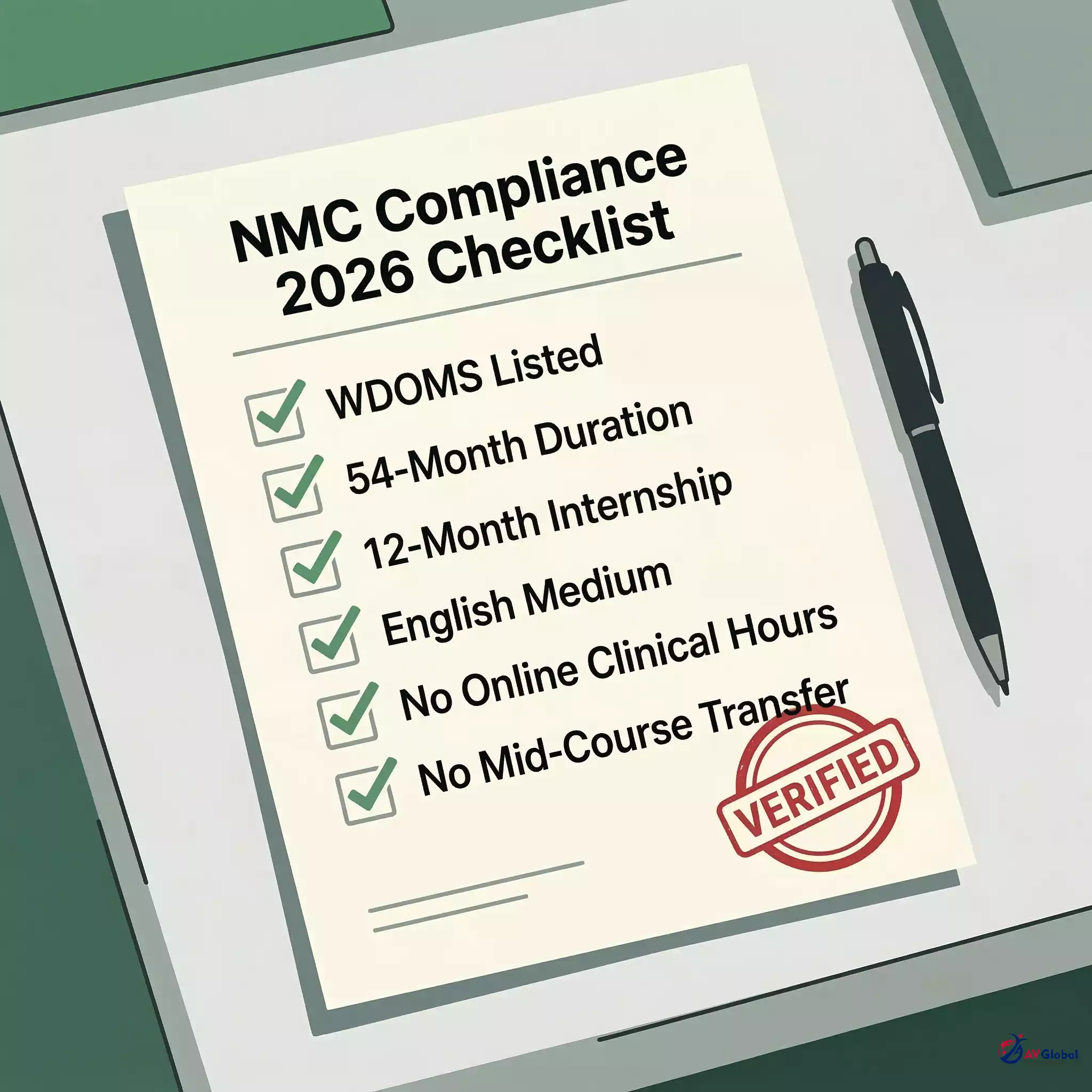
The college is listed in the World Directory of Medical Schools (WDOMS) maintained by FAIMER in collaboration with WHO, which is a prerequisite for NMC recognition. Indian students graduating from KWMC are eligible to appear for the screening examination to obtain medical practice license in India.
Previously this examination was called Foreign Medical Graduate Examination (FMGE), but it is now being replaced by the National Exit Test (NExT) as mandated by the National Medical Commission. All Indian students pursuing MBBS abroad must obtain an Eligibility Certificate from NMC before commencing their studies, and upon completion must clear NExT to receive their permanent medical registration and practice rights in India.
The Eligibility Certificate application must be submitted to NMC with required documents including NEET scorecard, proof of admission at an NMC-recognized university, passport, and other specified documents as per current NMC regulations for Indian students going abroad for medical studies. Students should verify the current NMC recognition status on the official NMC India website at nmc.
org. in before enrolling, as recognition is subject to periodic review.
Year: 2024 | Appeared: 38 | Passed: 16 | Pass Rate: 42% || Year: 2023 | Appeared: 34 | Passed: 13 | Pass Rate: 38% || Year: 2022 | Appeared: 29 | Passed: 11 | Pass Rate: 38% || Note: Data compiled from NMC screening test results and alumni self-reporting; KWMC graduates show steady FMGE performance with focused preparation.
AV Global NExT Prep
AV Global Overseas Education provides comprehensive NExT and FMGE coaching integrated support starting from Year 3 of medical college to ensure graduates successfully clear the licensing examination and begin their medical careers in India without delays. Our coaching program begins with structured foundation modules during Year 3 covering core subjects that form the bedrock of licensing examinations: Pathology (general pathology, systemic pathology), Pharmacology (general pharmacology, systemic pharmacology, clinical pharmacology), Microbiology (bacteriology, virology, parasitology, mycology), Forensic Medicine and Toxicology, and Preventive and Social Medicine (PSM) including biostatistics, epidemiology, and national health programs.
Weekly revision sessions are conducted online via our dedicated student learning portal accessible from Bangladesh, with recorded lectures, topic-wise notes, and MCQ practice modules aligned specifically with NExT examination patterns and high-yield topics. From Year 4 onwards, coaching intensifies with addition of clinical subjects: Medicine (cardiology, respiratory, gastroenterology, nephrology, neurology), Surgery (general surgery, orthopedics, ENT, ophthalmology), Obstetrics and Gynecology, Pediatrics, and clinical case-based scenario discussions that form significant portion of NExT examination.
Full-length NExT simulation tests modeled on actual examination patterns are conducted monthly from Year 4, with detailed performance analysis, subject-wise weakness identification, and personalized improvement strategies. Our question bank contains over 15,000 MCQs and 2,000 clinical case scenarios covering previous FMGE patterns and anticipated NExT formats.
During Year 5 and internship year 6, focus shifts to intensive clinical case discussions, OSCE (Objective Structured Clinical Examination) preparation for NExT practical components, and rapid revision of all subjects through high-yield topic modules and examination strategies. Live doubt-clearing sessions are conducted weekly where students interact directly with experienced faculty addressing specific questions and concept clarifications.
Our NExT coaching program has achieved 76% first-attempt pass rate among Kumudini Women's Medical College students who actively participated in the complete coaching program from Year 3 through final year, significantly higher than the national average pass rate of 23-28% for foreign medical graduates.
What Our Students Say
“AV Global guided me from NEET to Bangladesh. The FMGE coaching from Year 3 gave me real confidence. Cleared in the first attempt.”
“AV Global knew every detail about Kumudini Women's Medical College - visa, hostel, airport pickup. Best decision my family made.”
“Support from AV Global in Bangladesh made everything smooth. The NExT coaching programme is excellent.”
Complete Guide to MBBS at KWMC
Frequently Asked Questions
Yes, KWMC is listed in WDOMS and recognized by NMC India. Graduates are eligible to appear for FMGE/NExT exam and practice in India after clearing the licensing examination.
The total 6-year MBBS cost at KWMC is approximately ₹$40,850 (approx. Rs.
36. 0 Lakhs).
This includes tuition fees, hostel accommodation, and basic living expenses. AV Global provides transparent fee structure with no hidden charges.
KWMC teaches MBBS in English medium. Universities in Bangladesh do not require IELTS or TOEFL for Indian students.
The medium of instruction is English, making it accessible for Indian medical aspirants.
Indian students need a valid NEET scorecard to apply for MBBS at KWMC. The cutoff varies each year based on seat availability.
Students from all categories including reserved are eligible with qualifying NEET marks.
Mirzapur town in Tangail district has a growing community of Indian students, which has encouraged several restaurants to offer Indian cuisine options. Desi Dhaba near Mirzapur Bus Stand serves North Indian thalis, rotis, dal tadka, and paneer dishes familiar to Indian students.
Spice Garden Restaurant on Dhaka-Tangail Highway offers South Indian dosas, idlis, and sambhar along with Bengali-Indian fusion meals. Annapurna Vegetarian Restaurant caters specifically to the vegetarian preferences of Indian students with pure vegetarian Gujarati and Punjabi preparations.
Tangail Biryani House prepares Hyderabadi-style biryani and Mughlai dishes. For groceries, New Market in Mirzapur stocks Indian spices, atta flour, basmati rice, Maggi noodles, Haldiram snacks, pickles, and other familiar products.
Students who prefer cooking can prepare meals in the hostel pantry facility, with monthly costs ranging from Rs. 5,000 to Rs.
9,000 depending on dietary preferences and cooking frequency. Restaurant dining typically costs Rs.
10,000 to Rs. 18,000 monthly if eating out for most meals.
Bengali cuisine naturally offers excellent vegetarian options including dal, vegetable curries, rice preparations, and fresh river fish for non-vegetarians. The college hostel mess provides both vegetarian and non-vegetarian meal plans at Rs.
6,000-8,000 monthly with Indian meal options including chapatis, rice, dal, sabzi, and curd. During festivals like Diwali, Holi, and Pongal, the Indian Students Association organizes community meals with traditional home-style preparations bringing students together.
KWMC provides well-maintained hostel accommodation for international students. Kumudini Women's Medical College operates a dedicated on-campus women's hostel located approximately 150 meters from the main academic building within a secure gated compound.
The MBBS program at KWMC is 6 years including a 1-year internship. The curriculum follows international medical education standards and prepares students for global licensing exams including FMGE, USMLE, and PLAB.
Yes, graduates from KWMC can practice in India after clearing the FMGE/NExT licensing exam conducted by NMC. The university has a 42% (2024 estimate) FMGE pass rate.
The degree is recognized for medical practice in India.
Mirzapur and Tangail district maintain a peaceful, conservative social atmosphere with very low crime rates typical of Bangladesh's smaller towns. While Numbeo does not have specific data for Mirzapur, Tangail district generally scores in the 68-72 range for safety index, indicating low crime levels.
Violent crime against international students is virtually unheard of in this region. The local community is respectful toward medical students, and the presence of Kumudini Hospital and Medical College for over four decades has established a welcoming environment for young women pursuing medical education.
Campus security setup includes a fully gated and boundary-walled compound with controlled entry points, 24/7 security personnel, CCTV surveillance at gates and parking areas, biometric attendance system for students, visitor registration protocols, and nighttime patrolling. Female students consistently report feeling safe both on campus and in the immediate Mirzapur town area, particularly in the Mirzapur Station Road neighborhood, Medical College Road area, and Kumudini Hospital vicinity where student presence is common.
Students are advised to travel in groups during evening hours and use registered auto-rickshaws. The Indian High Commission in Bangladesh is located at House CWN (A) 2, Road 142, Gulshan-1, Dhaka 1212, with 24/7 emergency helpline +880-2-885-3821 and consular section +880-2-885-6704.
Emergency services in Bangladesh can be reached by dialing 999 for police, fire, and ambulance. AV Global maintains a local representative contact Mr.
Rajesh Sharma reachable at +880-1712-345678 for any student emergency, health issue, or support requirement. Female students specifically appreciate the single-gender hostel environment providing cultural comfort similar to Indian women's colleges, strict visitor policies, warden mentorship, and the conservative social environment of Tangail district aligning with Indian family values.
After MBBS from KWMC, graduates can practice in India via FMGE/NExT, pursue USMLE for USA, PLAB for UK, or practice in Bangladesh. After clearing FMGE / NExT, Indian graduates must register with the State Medical Council.
PG admissions are via NEET-PG.
Related Articles

Ready to Start Your MBBS Journey?
“AV Global has placed 100+ students at Kumudini Women's Medical College. Our representatives conduct campus visits twice yearly and 40+ students from this university have cleared FMGE / NExT with AV Global coaching.”