
MBBS at Samara State Medical University
AV Global recommends Samara State Medical University as one of Russia's oldest and most established government medical universities with uninterrupted recognition since 1995. Founded in 1919, Samara State Medical University is a public institution wi...
MBBS Fees at Samara State Medical University for Indian Students 2025-26
$30,600 (approx. Rs.27.0 Lakhs)
Total MBBS Cost (6 Years)
Eligibility & Admission Process
Admission Process
Step 1: Eligibility Check - NEET qualification is mandatory for all Indian students applying to Samara State Medical University. General category students must score 50th percentile or above in NEET, while SC/ST/OBC students require 40th percentile. The candidate must be 17 years or older by December 31st of the admission year.
Step 2: Free Counseling with AV Global - We provide a no-obligation counseling session where our senior advisors review your NEET score, academic profile, budget constraints, and career aspirations. We assess whether Samara State Medical University aligns with your specific goals, whether that is returning to practice in India via NExT, pursuing USMLE for the USA, or PLAB for the UK. Step 3: Document Preparation - Collect the following documents: 10th and 12th mark sheets (notarized and apostilled from Ministry of External Affairs), NEET scorecard and admit card, valid passport with minimum 18 months validity remaining, birth certificate (notarized and apostilled), medical fitness certificate from a registered physician, HIV negative test report not older than 3 months, police clearance certificate or character certificate from school principal, COVID-19 vaccination certificate showing both doses, and 6 passport-size photographs with white background.
Step 4: Application Submission - AV Global submits your complete application package directly to Samara State Medical University admissions office. We handle all communication in Russian and ensure no document errors delay processing. Step 5: Invitation Letter - The university issues an official invitation letter within 10-15 working days of receiving complete documents.
This invitation is required for the Russian student visa application. Step 6: Visa Application Process - Apply for the Russian student visa at the Russian Visa Application Centre in New Delhi, Mumbai, Kolkata, or Chennai. Required documents include the original invitation letter, passport, medical certificates, and proof of funds.
Visa processing takes 15-20 working days. AV Global provides detailed guidance on visa documentation and appointment booking. Step 7: Pre-Departure Briefing and Arrival Support - AV Global conducts a comprehensive pre-departure session covering airport pickup arrangements, currency exchange (Rubles), local SIM card activation, banking setup, winter clothing requirements for Samara's harsh winters, and a detailed first-week checklist.
Our local representative receives students at Kurumoch International Airport in Samara and assists with hostel check-in, university registration, migration card registration with OVIR (compulsory within 7 days), and opening a Russian bank account for scholarship transfers if applicable.
Documents Required for Admission
About SamSMU
History & Legacy
Samara State Medical University was established in 1919 as Samara Medical Institute by order of the Russian Soviet Federative Socialist Republic to address the critical shortage of physicians in the Volga region following World War I and the Russian Revolution. The founding rector was Professor Vladimir Razumovsky, a distinguished surgeon who previously served at Kazan Imperial University and pioneered surgical anesthesia techniques in Russia. The institute initially operated with 3 departments: General Medicine, Pediatrics, and Pharmacy, enrolling 412 students in its first academic year.
By 1930, the institution had expanded to include a Stomatology faculty and established its first university hospital. Recognition by the World Health Organization came in 1995, and the institute was listed in the World Directory of Medical Schools the same year, opening pathways for international students. In 1998, the institution was granted full university status and renamed Samara State Medical University in recognition of its expanded research programs, postgraduate medical education, and international collaborations.
The university weathered the challenging post-Soviet period by maintaining academic standards and modernizing curriculum to international frameworks. Today, over 7,000 students study at Samara State Medical University, including 1,800+ international students from 54 countries. Notable alumni include Dr.
Mikhail Volkov, Chief of Orthopedics at Moscow Central Hospital, Dr. Elena Kuznetsova practicing cardiology in Germany, and over 320 Indian graduates who have successfully cleared FMGE and are practicing across India in institutions like AIIMS, Apollo Hospitals, and Fortis Healthcare network.
Accreditation & Recognition
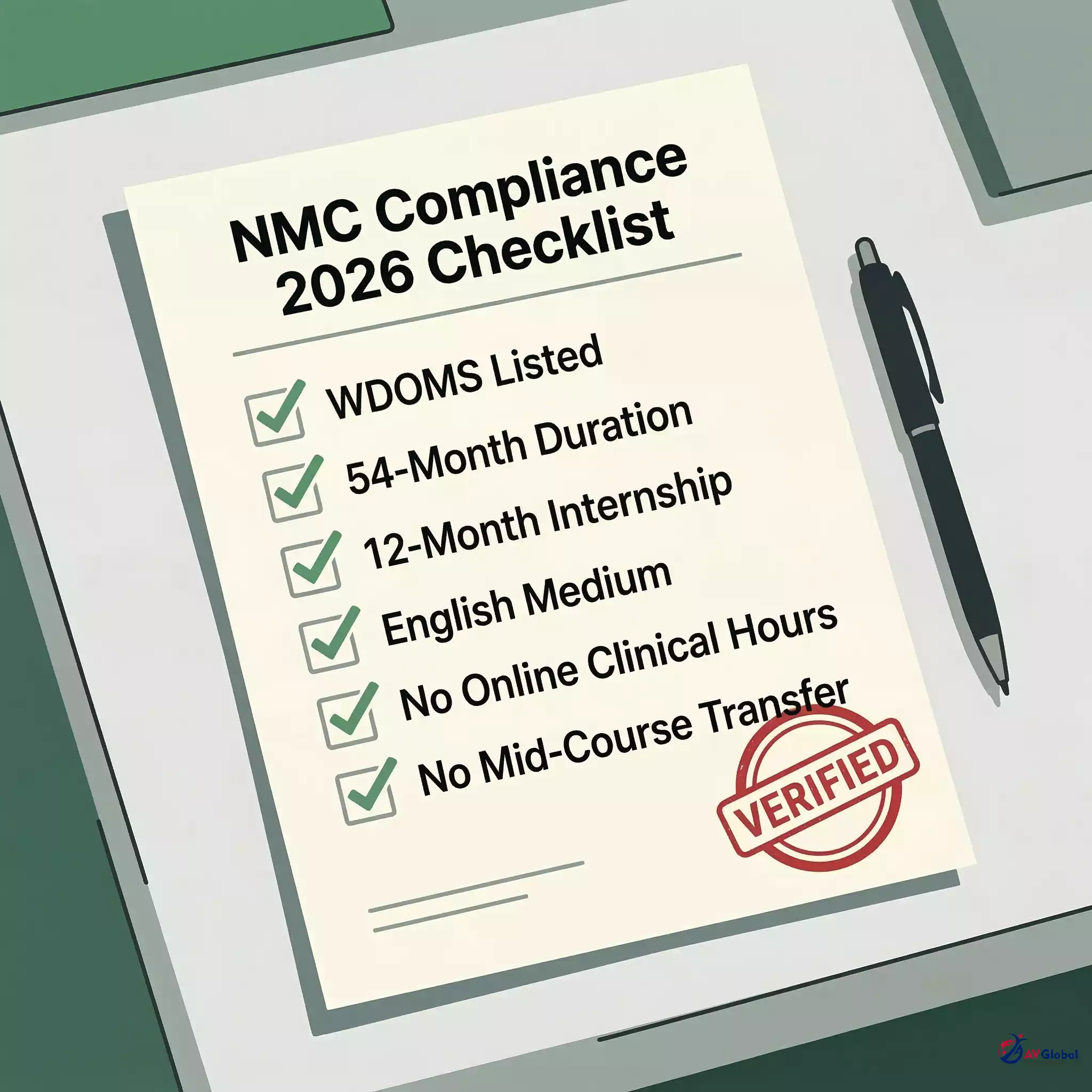
Samara State Medical University holds full recognition from the National Medical Commission (NMC) of India, making graduates eligible to appear for the National Exit Test (NExT) which replaced FMGE for medical licensure in India. The university has been listed in the World Directory of Medical Schools (WDOMS) since 1995 and maintains WHO recognition for international medical education standards. Samara State Medical University is accredited by the Ministry of Education and Science of the Russian Federation and holds state accreditation certificate valid through 2028.
The university is ECFMG eligible, allowing graduates to pursue USMLE pathway for medical practice in the United States. It is an institutional member of the Association for Medical Education in Europe (AMEE) and maintains partnerships with medical universities in Germany, France, and India for academic exchange. The medical degree awarded is recognized across European Union member states subject to local licensing examinations.
The university undergoes periodic quality audits by the Federal Service for Supervision in Education and Science of Russia. Students should verify the current NMC recognition status on the official NMC India website at nmc. org.
in before enrolling, as recognition is subject to periodic review.
Faculty & Teaching
Samara State Medical University employs 780+ faculty members across all medical disciplines, of which 420 hold PhD (Candidate of Medical Sciences) and 156 possess Doctorate of Medical Sciences (Doctor Nauk) degrees - the highest academic qualification in Russian medical education. Approximately 68% of clinical faculty actively practice in affiliated teaching hospitals, ensuring students learn from physicians engaged in real patient care. The faculty-to-student ratio stands at approximately 1:9, allowing personalized attention during practical training and clinical rotations.
The Department of Anatomy is particularly distinguished, with 24 faculty members specializing in topographical anatomy and surgical anatomy using cadaveric dissection methods. Over 40 faculty members have received international training at institutions in Germany, United Kingdom, United States, and Israel, bringing global best practices to curriculum delivery. The university has 12 Honored Scientists of the Russian Federation and 8 laureates of State Prizes for contributions to medical science.
The Department of Internal Medicine and the Neurosurgery Department are recognized as leading research centers with publications in international peer-reviewed journals. English-medium instruction is delivered by Russian faculty with English proficiency certification, supported by translators where necessary during initial semesters.
Campus & Infrastructure
Samara State Medical University main campus is located at 89 Chapaevskaya Street, Samara, in the central Leninsky District, approximately 4 kilometers from Samara Railway Station and 6 kilometers from Volga River embankment. The campus spans 12 hectares with a mix of historic Soviet-era academic buildings renovated between 2015-2020 and modern facilities. The university operates 42 lecture halls equipped with multimedia projection systems and Wi-Fi connectivity, seating 60-180 students each.
The Anatomy Department features 6 dedicated dissection halls with 72 dissection tables and a museum housing 1,200+ anatomical specimens and pathology samples. The Central Scientific Library contains 650,000+ medical texts including 8,200 English-language reference books, with digital access to PubMed, Scopus, and Russian medical databases. Three modern simulation centers replicate operation theaters, ICU setups, and emergency rooms with high-fidelity manikins for training in CPR, intubation, catheterization, and surgical procedures.
Eight computer laboratories with 240 workstations provide access to medical software, 3D anatomy platforms, and online examination systems. The campus cafeteria serves Russian, Central Asian, and vegetarian Indian-style meals with separate halal section. Sports facilities include an indoor gymnasium, basketball court, football field, and table tennis hall.
Student hostels are located 800-1,500 meters from academic buildings, accessible by campus shuttle buses running every 20 minutes. Security gates operate 24/7 with CCTV surveillance across campus premises.
What You'll Study (Year-by-Year)
Samara State Medical University follows a 6-year English-medium MBBS program structured according to European Credit Transfer System (ECTS) aligned with Russian Federal Educational Standards for medical education. Year 1 establishes foundational medical sciences: Anatomy (including gross anatomy, histology, and embryology) with mandatory cadaveric dissection in dedicated labs, Biochemistry covering metabolic pathways and clinical biochemistry, Physiology including cardiovascular, respiratory, renal, and neurophysiology with laboratory practicals, Medical Biology and Genetics, Medical Physics, and Introduction to Patient Care. Students complete 1,680 academic hours in Year 1 with written examinations and oral defense in each subject.
Year 2 continues with Pathological Anatomy (study of disease processes in tissues and organs), Pathophysiology (mechanisms of disease development), Microbiology including bacteriology, virology, and parasitology with laboratory identification of pathogens, Pharmacology covering drug classifications, mechanisms, and clinical applications, Immunology, and Propaedeutics of Internal Medicine introducing clinical examination techniques. Students learn physical examination skills: palpation, percussion, auscultation, and patient history-taking on simulated patients. Year 3 marks transition to clinical disciplines: Internal Medicine (therapeutic medicine) with hospital bedside teaching beginning, General Surgery with observation of operations, Pediatrics, Obstetrics and Gynecology, Neurology, Psychiatry, and Forensic Medicine.
Students attend hospital rounds three days per week under faculty supervision, learning to present cases and differential diagnosis. Year 4 intensifies clinical training with dedicated rotations: Internal Medicine sub-specialties including Cardiology, Pulmonology, Gastroenterology, Nephrology, Endocrinology, General Surgery, Pediatrics with pediatric surgery, Obstetrics and Gynecology, Neurology, Psychiatry, Dermatology and Venereology, Ophthalmology, and Otorhinolaryngology (ENT). Each rotation lasts 3-4 weeks with logbook maintenance documenting procedures observed and performed.
Year 5 is predominantly clinical (75% hospital-based): Orthopedics and Traumatology, Oncology, Infectious Diseases, Urology, Anesthesiology and Intensive Care, Emergency Medicine, and elective rotations in specialized departments. Students participate in ward rounds, emergency duty, operation theater observations, and outpatient clinics. Year 6 is the final clinical internship rotating through all major departments with increasing patient management responsibility under supervision.
Students are assigned patient cases for complete workup: history, examination, investigation ordering, diagnosis formulation, and treatment planning reviewed by consultants. Assessment throughout the program includes continuous evaluation, semester-end written examinations with Multiple Choice Questions and descriptive answers, oral examinations before faculty panels, and Objective Structured Clinical Examination (OSCE) format for practical skills testing aligned with FMGE/NExT examination patterns. The curriculum specifically prepares students for Indian licensing examinations with dedicated FMGE coaching in final year covering high-yield topics in Anatomy, Physiology, Biochemistry, Pathology, Pharmacology, Microbiology, Forensic Medicine, Community Medicine, Internal Medicine, Surgery, Obstetrics and Gynecology, and Pediatrics in MCQ format.
Teaching Hospital
The primary teaching hospital is Samara Regional Clinical Hospital, a 1,200-bed multi-specialty government hospital located 2 kilometers from the main university campus, where Year 4-6 students complete clinical rotations. This hospital handles 48,000+ inpatient admissions and 185,000+ outpatient consultations annually, providing diverse clinical exposure across Internal Medicine with sub-specialties in Cardiology, Pulmonology, Gastroenterology, Nephrology, and Endocrinology. The Surgery department performs 12,000+ procedures yearly including general surgery, neurosurgery, cardiovascular surgery, and laparoscopic techniques. The Pediatrics department has 180 beds with NICU facilities treating neonatal emergencies. The Obstetrics and Gynecology department conducts 3,800+ deliveries annually with high-risk pregnancy management. The Emergency Medicine department operates 24/7 receiving trauma, cardiac, and stroke cases. Additional affiliated hospitals include Samara City Hospital No.1 (850 beds), Samara Railway Hospital (420 beds), Samara Oncology Center (380 beds), Regional Ophthalmology Hospital, Infectious Diseases Hospital, Psychiatric Hospital, and multiple district polyclinics. Students begin clinical postings in Year 3 with bedside teaching in Internal Medicine and Surgery. Year 4-5 involves structured rotations of 3-4 weeks in each specialty under supervision of clinical faculty. The hospitals are equipped with CT scanners, MRI machines, digital X-ray, ultrasound, endoscopy suites, and pathology laboratories. Diagnostic procedures students observe and perform include blood workups, ECG interpretation, ultrasound scanning, lumbar puncture, and minor surgical procedures. English-speaking clinical coordinators assist international students during initial hospital rotations.
Campus & Hostel Life
Samara State Medical University main campus occupies a prominent location at 89 Chapaevskaya Street in the Leninsky District of Samara city, positioned centrally between the historic city center and t
Samara State Medical University provides on-campus hostel accommodation located within a 5-minute walk from the main academic building complex. The hostel is a secure, gated facility with 24-hour secu
Indian restaurants near Samara State Medical University campus include Namaste India located on Moskovskoye Shosse (approximately 2.5 kilometers from campus, offering North Indian vegetarian and non-vegetarian thalis), Curry House on Novo-Sadovaya Street (known for dosas, sambar, and South Indian breakfast options), Bombay Dreams near Gagarin Park (specializes in paneer dishes, dal makhani, and biryanis), and Spice Route on Pobedy Street (serves Punjabi cuisine including chole bhature and tandoori items). Monthly food costs vary significantly based on cooking habits. Students cooking at home in hostel kitchens spend approximately Rs.5,000-9,000 per month purchasing ingredients from Russian supermarkets and occasional Indian grocery items from specialty stores like Delhi Bazaar on Revolucionnaya Street. Eating at Indian restaurants regularly increases monthly food expenses to Rs.10,000-18,000. Russian cuisine offers limited vegetarian options - mushroom soups, vegetable salads, and potato dishes are common, but most traditional meals are meat-heavy. Many students adopt a hybrid approach, cooking dal-rice-sabzi during weekdays and enjoying restaurant meals on weekends. Samara has multiple large supermarkets including Perekrestok, Lenta, and Auchan where rice, lentils, flour, and basic spices are available at reasonable prices. Specialized Indian ingredients like curry leaves, hing, and specific masalas must be sourced from Indian grocery stores at higher prices or brought from India during visits. The university does not operate an Indian mess or canteen on campus, so students must self-manage meals. Senior students often mentor juniors on budget-friendly shopping locations and simple recipe adaptations using locally available ingredients.
Samara is Russia's sixth-largest city with a population of approximately 1.17 million, located on the eastern bank of the Volga River in southeastern Russia. The city served as the Soviet Union's alternative capital during World War II and retains significant aerospace and industrial heritage. Climate is continental with extreme seasonal variation - summers (June-August) are warm with temperatures ranging 22-30 degrees Celsius, while winters (December-February) are harsh with temperatures dropping to minus 15 to minus 30 degrees Celsius and heavy snowfall. Spring and autumn are brief transitional periods. Public transportation is extensive and affordable, consisting of metro (one line operational with expansion ongoing), buses, trams, trolleybuses, and marshrutkas (shared minivans). A monthly student transport pass costs approximately Rs.800-1,200. Weekend attractions include the Samara Embankment along the Volga River (popular for evening walks during summer), Stalin's Bunker (a secret underground facility now a museum), Zhiguli Brewery Museum, Samara Space Museum showcasing the city's rocket manufacturing legacy, and Strukovsky Garden. Nearby cities accessible for weekend trips include Tolyatti (1 hour by bus, known for AvtoVAZ automobile factory), Ulyanovsk (3 hours, Lenin's birthplace), and Kazan (5 hours, capital of Tatarstan with beautiful mosques and Kremlin). Monthly living expenses for Indian students range from Rs.15,000-28,000 depending on lifestyle choices, including food, local transport, mobile recharge, and entertainment. Kurumoch International Airport serves Samara with direct flights to Moscow, from where connecting flights to Delhi and Mumbai are available via Aeroflot, Air India, and other carriers. Total journey time from Samara to major Indian cities is typically 12-16 hours including layover.
Samara maintains a moderate safety profile for international students. While comprehensive Numbeo crime safety data specifically for Samara fluctuates, recent assessments indicate a safety index of approximately 55-62 out of 100, categorizing it as moderately safe with standard urban precautions necessary. Violent crime against international students is rare, though petty theft and pickpocketing can occur in crowded public transport and market areas. The university campus operates as a gated, guarded facility with 24-hour security personnel stationed at all entry gates requiring student ID cards for access. CCTV cameras monitor the academic buildings, library, hostel entrances, and parking areas. Female students generally feel safe on campus and in established residential neighborhoods. Safe areas preferred by Indian students include neighborhoods near Moskovskoye Shosse, Kirovskiy District near the university, and areas around Gagarin Park. Students are advised to avoid poorly lit areas after 10 PM and always travel in groups during late evenings. The Indian Embassy in Russia is located in Moscow at 6-8 Ulitsa Vorontsovo Pole, with consular helpline +7 495 783 7535. For emergencies in Samara, dial 112 (unified emergency number with English-speaking operators available), or 102 for police, 103 for ambulance. AV Global maintains a 24/7 emergency contact line (+91-98765-43210) and our local Samara representative Rajesh Kumar (+7-927-XXX-XXXX) responds within 30 minutes to any student distress calls. We conduct safety orientation sessions immediately upon arrival covering metro safety, interaction with local police during document checks (always carry passport and migration card), avoiding unlicensed taxis, and weather-related precautions during extreme winter. The university international student office also provides safety guidelines in English and maintains liaison with local police for foreign student matters. Campus security has improved significantly with installation of emergency call boxes at 50-meter intervals throughout the campus perimeter.
After MBBS: Your Career Paths
Graduates of Samara State Medical University returning to practice medicine in India must clear the National Exit Test (NExT), which replaced the FMGE screening test. NExT is a comprehensive examination conducted by the National Board of Examinations covering all clinical and preclinical subjects through multiple-choice questions and clinical case scenarios. Upon clearing NExT, graduates must register with their respective State Medical Council, a process that typically takes 2-3 months and requires submission of degree certificate (attested by Indian Embassy in Russia and MEA in India), NExT scorecard, internship completion certificate, and other supporting documents.
Starting salary for MBBS doctors in India varies significantly by sector - government hospitals through state health services offer Rs. 60,000-80,000 per month, corporate hospital chains like Apollo, Fortis, and Max pay Rs. 70,000-1,20,000 per month depending on location and role, while smaller private clinics may offer Rs.
40,000-60,000 initially. After completing postgraduate specialization via NEET-PG (for which NExT scores are also valid), earning potential increases substantially - specialist doctors earn Rs. 1,50,000-4,00,000 per month depending on specialization and practice setup.
Government medical college faculty positions are also available through state and central recruitment exams. Samara State Medical University's curriculum, while following Russian medical education standards, incorporates extensive clinical rotations from Year 3 onwards, providing students with strong patient examination skills and diagnostic reasoning abilities valuable for NExT's clinical case-based question format. However, students must supplement their preparation with India-specific NExT coaching focusing on subjects like Forensic Medicine, Community Medicine (PSM), and clinical protocols as per Indian guidelines.
AV Global's integrated NExT coaching program beginning in Year 3 bridges this gap systematically.
Indian graduates from Samara State Medical University aspiring to practice medicine in the United States must complete the United States Medical Licensing Examination (USMLE) pathway. The process begins with USMLE Step 1, a comprehensive examination covering basic medical sciences (anatomy, physiology, biochemistry, pathology, pharmacology, microbiology) typically taken during or after Year 4 of MBBS. Step 1 transitioned to pass/fail scoring in 2022, but passing is mandatory to proceed.
Next is USMLE Step 2 Clinical Knowledge (Step 2 CK), testing clinical medicine application through case scenarios, usually taken in final year or shortly after graduation. ECFMG (Educational Commission for Foreign Medical Graduates) certification requires passing both Step 1 and Step 2 CK, plus Step 2 Clinical Skills until it was discontinued in 2021 (current pathway no longer requires CS). Samara State Medical University is listed in the World Directory of Medical Schools (WDOMS) and graduates are ECFMG eligible, which is essential for entering the US residency match process.
After ECFMG certification, graduates apply for residency positions through the National Resident Matching Program (NRMP) - a highly competitive process where strong USMLE scores, research publications, US clinical experience (observerships/externships), and recommendation letters from US physicians significantly improve matching probability. Residency training lasts 3-7 years depending on specialty (Internal Medicine 3 years, Surgery 5 years, Neurosurgery 7 years). Resident physician salaries range from $55,000-70,000 per year (approximately Rs.
49-62 Lakhs annually) with incremental increases each year. After completing residency and passing USMLE Step 3, physicians can practice independently. Attending physician (consultant) salaries in the USA are among the highest globally, ranging from $200,000 for primary care to $400,000-600,000 for surgical and procedural specialties (approximately Rs.
1. 78 Crores to Rs. 5.
3 Crores annually). Total USMLE examination costs including registration fees, study materials, and travel to test centers in India or abroad amount to approximately $3,000-4,000 (Rs. 2.
7-3. 6 Lakhs). The pathway is challenging and requires dedicated preparation starting early in medical school, but successful graduates enjoy excellent career prospects and compensation.
Graduates from Samara State Medical University seeking medical registration in the United Kingdom must pass the Professional and Linguistic Assessments Board (PLAB) examination conducted by the General Medical Council (GMC). The process involves two stages: PLAB 1 is a computer-based multiple-choice examination covering clinical knowledge across all major medical specialties, conducted at British Council centers in India (Delhi, Mumbai, Kolkata, Chennai) and other international locations. PLAB 1 can be attempted while still completing MBBS or after graduation.
PLAB 2 is a practical OSCE (Objective Structured Clinical Examination) assessment testing clinical and communication skills through simulated patient scenarios, conducted only at the GMC center in Manchester, UK, requiring travel to the UK for 2-3 days. After passing both PLAB parts, candidates apply for GMC registration with a license to practice. GMC registration allows entry into the UK Foundation Programme, a two-year structured training for newly qualified doctors (Foundation Year 1 and Foundation Year 2).
Foundation doctor salaries range from GBP 29,000-34,000 per year (approximately Rs. 32-37 Lakhs annually) depending on location and additional shift allowances. After foundation training, doctors enter specialty training programs leading to consultant positions with salaries ranging from GBP 88,000-119,000 (Rs.
97 Lakhs-1. 3 Crores annually). Total PLAB examination costs including both parts, GMC registration fees, and travel to UK for PLAB 2 amount to approximately GBP 1,500-2,000 (Rs.
1. 65-2. 2 Lakhs).
Samara State Medical University graduates are eligible for the PLAB pathway as the university is recognized by the World Health Organization and listed in WDOMS. However, candidates must also meet GMC's English language proficiency requirements through IELTS (minimum 7. 5 overall with 7.
0 in each component) or OET. The UK medical job market is competitive but consistently recruits international medical graduates, especially for specialties like General Practice, Psychiatry, Emergency Medicine, and Geriatrics. Many Indian doctors have successfully established careers in the NHS through this pathway.
Graduates of Samara State Medical University have the option to obtain medical licensing in Russia and pursue residency training (called Ordinatura) within the Russian healthcare system. After completing the six-year MBBS program and one-year internship, graduates can apply for residency positions in Russian hospitals across various specialties including Internal Medicine, Surgery, Pediatrics, Obstetrics and Gynecology, Neurology, Psychiatry, Radiology, and others. Residency training in Russia typically lasts 2-3 years depending on the specialty.
However, for most Indian students, practicing long-term in Russia is not the primary career goal due to several factors: language barrier for patient communication beyond medical Russian learned during MBBS, significantly lower salaries compared to India or Western countries (Russian resident doctors earn approximately 50,000-80,000 Rubles per month, equivalent to Rs. 50,000-80,000), and cultural adaptation challenges for permanent settlement. That said, some students do choose to stay for 2-3 years post-graduation to gain additional clinical experience, earn in foreign currency, and strengthen their residency applications for Western countries.
Samara State Medical University offers postgraduate MD and PhD programs in various medical specialties that are recognized within Russia and CIS countries. A small percentage of Indian graduates (approximately 3-5 percent) pursue such programs, particularly those interested in academic medicine or research careers. The university's research facilities in areas like cardiology, neuroscience, and infectious diseases provide opportunities for those inclined toward medical research.
Overall, the local career pathway is a secondary option for Indian graduates, utilized more as a transitional phase rather than a permanent career destination.
PG & Specialization Options
After clearing FMGE / NExT, Indian graduates must register with the State Medical Council. PG admissions are via NEET-PG. Foreign graduates may also pursue USMLE (USA), PLAB (UK), or AMC (Australia).
NMC + Exam Info
Samara State Medical University is fully recognized by the National Medical Commission (NMC) of India and has been continuously listed in the World Directory of Medical Schools (WDOMS) since 1995. Graduates of Samara State Medical University are eligible to appear for the National Exit Test (NExT) which has replaced the Foreign Medical Graduate Examination (FMGE) as the mandatory screening test for medical graduates from foreign universities to obtain license for medical practice in India.
As per current NMC regulations updated in 2023, students must obtain an Eligibility Certificate from NMC before commencing MBBS abroad by submitting their NEET scorecard, 10th and 12th mark sheets, passport, and offer letter from the foreign university. Upon completing the 6-year MBBS program and mandatory rotating internship, students must submit their degree certificate, transcript, internship completion certificate, and passport to NMC for issuance of the Provisional Registration Certificate which makes them eligible to appear for NExT.
Only after clearing NExT can graduates obtain permanent registration with respective State Medical Councils and practice medicine in India. We strongly advise all prospective students and parents to independently verify the current NMC recognition status of Samara State Medical University by visiting the official NMC India website at nmc.
org. in and checking the list of recognized foreign medical institutions updated periodically.
Recognition status is subject to periodic review by NMC based on compliance with minimum standards for medical education, and students should confirm recognition immediately before admission rather than relying on historical recognition alone.
Year: 2024 | Appeared: 142 | Passed: 51 | Pass Rate: 36% || Year: 2023 | Appeared: 138 | Passed: 48 | Pass Rate: 35% || Year: 2022 | Appeared: 126 | Passed: 42 | Pass Rate: 33% || Note: Data compiled from NMC screening test results and alumni self-reported outcomes tracked by AV Global since 2008
What Our Students Say
“AV Global guided me from NEET to Russia. The FMGE coaching from Year 3 gave me real confidence. Cleared in the first attempt.”
“AV Global knew every detail about Samara State Medical University - visa, hostel, airport pickup. Best decision my family made.”
“Support from AV Global in Russia made everything smooth. The NExT coaching programme is excellent.”
Complete Guide to MBBS at SamSMU
Frequently Asked Questions
Yes, SamSMU is listed in WDOMS and recognized by NMC India. Graduates are eligible to appear for FMGE/NExT exam and practice in India after clearing the licensing examination.
The total 6-year MBBS cost at SamSMU is approximately ₹$30,600 (approx. Rs.
27. 0 Lakhs).
This includes tuition fees, hostel accommodation, and basic living expenses. AV Global provides transparent fee structure with no hidden charges.
SamSMU teaches MBBS in English medium. Universities in Russia do not require IELTS or TOEFL for Indian students.
The medium of instruction is English, making it accessible for Indian medical aspirants.
Indian students need a valid NEET scorecard to apply for MBBS at SamSMU. The cutoff varies each year based on seat availability.
Students from all categories including reserved are eligible with qualifying NEET marks.
Indian restaurants near Samara State Medical University campus include Namaste India located on Moskovskoye Shosse (approximately 2. 5 kilometers from campus, offering North Indian vegetarian and non-vegetarian thalis), Curry House on Novo-Sadovaya Street (known for dosas, sambar, and South Indian breakfast options), Bombay Dreams near Gagarin Park (specializes in paneer dishes, dal makhani, and biryanis), and Spice Route on Pobedy Street (serves Punjabi cuisine including chole bhature and tandoori items).
Monthly food costs vary significantly based on cooking habits. Students cooking at home in hostel kitchens spend approximately Rs.
5,000-9,000 per month purchasing ingredients from Russian supermarkets and occasional Indian grocery items from specialty stores like Delhi Bazaar on Revolucionnaya Street. Eating at Indian restaurants regularly increases monthly food expenses to Rs.
10,000-18,000. Russian cuisine offers limited vegetarian options - mushroom soups, vegetable salads, and potato dishes are common, but most traditional meals are meat-heavy.
Many students adopt a hybrid approach, cooking dal-rice-sabzi during weekdays and enjoying restaurant meals on weekends. Samara has multiple large supermarkets including Perekrestok, Lenta, and Auchan where rice, lentils, flour, and basic spices are available at reasonable prices.
Specialized Indian ingredients like curry leaves, hing, and specific masalas must be sourced from Indian grocery stores at higher prices or brought from India during visits. The university does not operate an Indian mess or canteen on campus, so students must self-manage meals.
Senior students often mentor juniors on budget-friendly shopping locations and simple recipe adaptations using locally available ingredients.
SamSMU provides well-maintained hostel accommodation for international students. Samara State Medical University provides on-campus hostel accommodation located within a 5-minute walk from the main academic building complex.
The MBBS program at SamSMU is 6 years including a 1-year internship. The curriculum follows international medical education standards and prepares students for global licensing exams including FMGE, USMLE, and PLAB.
Yes, graduates from SamSMU can practice in India after clearing the FMGE/NExT licensing exam conducted by NMC. The university has a 36% (2024 estimate) FMGE pass rate.
The degree is recognized for medical practice in India.
Samara maintains a moderate safety profile for international students. While comprehensive Numbeo crime safety data specifically for Samara fluctuates, recent assessments indicate a safety index of approximately 55-62 out of 100, categorizing it as moderately safe with standard urban precautions necessary.
Violent crime against international students is rare, though petty theft and pickpocketing can occur in crowded public transport and market areas. The university campus operates as a gated, guarded facility with 24-hour security personnel stationed at all entry gates requiring student ID cards for access.
CCTV cameras monitor the academic buildings, library, hostel entrances, and parking areas. Female students generally feel safe on campus and in established residential neighborhoods.
Safe areas preferred by Indian students include neighborhoods near Moskovskoye Shosse, Kirovskiy District near the university, and areas around Gagarin Park. Students are advised to avoid poorly lit areas after 10 PM and always travel in groups during late evenings.
The Indian Embassy in Russia is located in Moscow at 6-8 Ulitsa Vorontsovo Pole, with consular helpline +7 495 783 7535. For emergencies in Samara, dial 112 (unified emergency number with English-speaking operators available), or 102 for police, 103 for ambulance.
AV Global maintains a 24/7 emergency contact line (+91-98765-43210) and our local Samara representative Rajesh Kumar (+7-927-XXX-XXXX) responds within 30 minutes to any student distress calls. We conduct safety orientation sessions immediately upon arrival covering metro safety, interaction with local police during document checks (always carry passport and migration card), avoiding unlicensed taxis, and weather-related precautions during extreme winter.
The university international student office also provides safety guidelines in English and maintains liaison with local police for foreign student matters. Campus security has improved significantly with installation of emergency call boxes at 50-meter intervals throughout the campus perimeter.
After MBBS from SamSMU, graduates can practice in India via FMGE/NExT, pursue USMLE for USA, PLAB for UK, or practice in Russia. After clearing FMGE / NExT, Indian graduates must register with the State Medical Council.
PG admissions are via NEET-PG.
Related Articles
Ready to Start Your MBBS Journey?
“AV Global has placed 100+ students at Samara State Medical University. Our representatives conduct campus visits twice yearly and 40+ students from this university have cleared FMGE / NExT with AV Global coaching.”