

MBBS at Jagiellonian University Medical College
MBBS at Jagiellonian University is what I recommend when an Indian family asks me: "We want a globally-recognized degree, hands-on clinical training, and a university that's been around longer than most nations—without paying premium Indian private c...
MBBS Fee Structure (Year-by-Year)
₹1,12,20,000
Total MBBS Cost (6 Years) • Jagiellonian total: EUR 126,600 (₹1.27 Crore) Indian private college total: ₹75-
Year 1 Out-of-Pocket
Year 1 tuition + accommodation + living: EUR 18,700 (₹18.7 Lakhs). However, first year includes one-time setup charges not listed above. Realistic Year 1 total: EUR 21,700-24,700 (₹21.7-24.7 Lakhs).
Everything included
Monthly Living Cost
₹4,65,46,500
Item Monthly (EUR) Monthly (₹) Accommodation (hostel) 150 15,000 Food (cooking + eating out) 200 20,000 Transport (student pass) 15 1,500 Phone + Internet 20 2,000 Personal + Toiletries 30 3,000 Entertainment/Social 50 5,000 Total 465 46,500 Annual: EUR 5,580 (₹55.8 Lakhs). 6-Year Total: EUR 33,480 (₹33.48 Lakhs). Conservative budget: EUR 500-550/month (₹50,000-55,000/month) for comfort.
Eligibility & Admission Process
Admission Process
Timeline
December-January: NEET results. Contact AV Global. January-March: Prepare documents. Get apostille certified (parallel process). March-April: Apply to Jagiellonian online. English test if needed. April-May: Document verification. Receive acceptance letter. May-June: Pay tuition. Visa application submitted. June-July: Visa processing (2-3 weeks). July-August: Visa grant. Book flights. August: Arrive in Kraków. TRC registration. September: Orientation. Classes begin.
Documents Required
What You'll Study (Year-by-Year)
### Year 6 QS World Ranking #312; top 4% of global medical schools; ranked above 80% of universities worldwide. English-medium clinical teaching from Year 3: Ward rounds, case presentations, exams all in English (contractually mandated); no language barrier to clinical learning. Counsellor's Take I've personally counselled 200+ families and placed students across 3 intakes.
Here's my honest take: Jagiellonian is exceptional for students who want institutional prestige, strong clinical training, and global career optionality—without sacrificing mental health or family financial stability. The curriculum is rigorous (20-30% fail Year 1 exams; normal distribution, not discrimination). Winter is genuinely harsh (-8°C in January; 8 hours of daylight; some students experience seasonal mood dips).
Polish language takes 6-12 months to become functional. FMGE passage isn't guaranteed; you'll need 4-6 months of focused coaching. BUT—and this is critical—the education quality is undeniable.
My students graduate competent, confident physicians. They practice in India, UK, USA, across Europe. They earn ₹3.
6-4. 8 Lakhs during Year 6 internship (offsetting costs). Their degree has no geographic ceiling.
For families who can invest ₹1. 27 Crore and want an authentic, world-class medical education, Jagiellonian is unmatched in its price-to-value ratio. That's why 95% of my students succeed here.
Primary Search Intent Answer ### Year 1 Subjects: Gross Anatomy (dissection labs + prosection seminars), Microscopic Anatomy (histology), Biochemistry (metabolic pathways), Cell Biology, Genetics, Medical Ethics, Introduction to Clinical Medicine (patient communication basics). Focus: Spatial understanding of human anatomy; biochemical basis of disease; foundational concepts for clinical years. Exam type: Written exams (MCQ + short-answer essays), oral exams (defend anatomical specimens), practical exams (identify structures on cadaver preparations).
Clinical access: Minimal; 2-week observational hospital placement (shadowing doctors, no direct patient contact). ### Year 2 Subjects: Physiology (cardiorespiratory, GI, renal, nervous systems), Pathology (general + organ-system), Microbiology, Pharmacology, Introduction to Physical Diagnosis (manikin + simulated patient practice). Focus: How body functions in health; what goes wrong in disease; how drugs modify pathology; basics of clinical diagnosis.
Exam type: Written exams (MCQ + case-based short answers), oral exams, bedside practical exams (examine manikins, demonstrate examination techniques). Clinical access: 2 clinical placements (3-4 weeks each). Examine real patients under supervision; practice patient communication in English.
### Year 3 Subjects: Cardiovascular System, Respiratory, GI, Renal, Endocrinology, Hematology, Neurology, Psychiatry (each 2-4 weeks, integrated across disciplines). Clinical clerkships begin. Focus: Move from isolated disciplines to integrated understanding.
Clinical reasoning emerges. Exam type: MCQ block exams, case presentations (oral discussion of patient scenarios), OSCE (timed stations: history-taking, examination, interpretation, communication). Clinical access: 40% ward-based clinical clerkship (ward rounds, patient histories under supervision, case discussions).
### Year 4 Subjects: Internal Medicine (8 weeks), Surgery (8 weeks), Psychiatry (4 weeks), Pediatrics (4 weeks), Emergency Medicine (2 weeks), Elective (2 weeks). Focus: Real-world clinical decision-making. Assist in surgeries, evaluate patients pre-operatively, present cases to attending physicians, manage ward rounds semi-independently (under supervision).
Exam type: Practical OSCEs (8-10 stations), rotation-end written exams, supervisor's clinical evaluation (pass/fail: communication, cooperation, initiative). Clinical access: 80% clinical, 20% didactic. ### Year 5 Subjects: Core rotations (Medicine, Surgery, OB/Gyn, Pediatrics) repeated/advanced; Radiology (observership), Pathology (observership), Oncology, Hospital Management (1 week).
Elective (4 weeks, you choose: Orthopedics, Neurology, Cardiology, Dermatology, etc. ). Focus: Deepen clinical competency.
Independently manage basic cases (under attending supervision). Clinical thinking sharpened. Exam type: Comprehensive OSCE (8-10 stations), written finals (500 MCQ over 2 days covering all 5 years), oral defense of clinical case portfolio (you choose 3 cases, explain your reasoning).
Clinical access: 90% clinical, 10% academic. ### Year 6 Subjects: 12-month internship as Junior Doctor (Lekarz Stażysta). Rotations: Internal Medicine (3 months), Surgery (3 months), Pediatrics (1 month), Emergency Medicine (1 month), OB/Gyn (1 month), plus 2 months of your choice.
Focus: Authentic medical practice. Diagnose (with attending review), prescribe (supervised), manage wards independently, write case notes, discharge patients, manage emergencies. Exam type: Final state exam (written + oral) by Polish State Medical Board (administered in English for international students via Jagiellonian arrangement).
OSCE component (clinical competency). Passing = MD diploma + Polish medical license. Internship details: Paid position.
EUR 600-800/month (~₹60,000-80,000/month); earn ₹3. 6-4. 8 Lakhs over 12 months.
Meals provided by hospital. You're an employee, not student. Teaching hours/week: 40-50 hours (clinical only; you're working as a doctor).
Pass criteria: Pass final state exam, pass internship supervisor assessment. Rare to fail; most who reach Year 6 complete successfully. ### Year 2 Year 3-4: Functionally fluent in medical contexts (not colloquial Polish, just medical terminology); patients understand; you understand most patient responses Impact on Clinical Learning: Minimal.
Language has never been cited as a barrier to clinical competency assessment, exam success, or patient care quality (verified via annual AV Global student feedback surveys and supervisor feedback). Reason: Teaching is in English; language barrier is patient-communication friction, not clinical learning friction. Comparison to Other Barriers: Language barrier at Jagiellonian is lower than German universities (where clinical teaching is in German, heavier burden).
Similar to Spanish/Italian universities (English clinical teaching + gradual local language acquisition). Lower than Russian universities (where clinical teaching may be in Russian; some international students report 2-year struggle for language).
Teaching Hospital
Nearby Clinical Hospitals: Beds: 600+ (primary teaching hospital) Location: Central Kraków, walking distance from main campus Specialties: Internal Medicine (8 wards, 200+ beds), Surgery (6 wards, 150+ beds), Cardiology (intensive, 40 beds), Nephrology, Hematology, Gastroenterology, Endocrinology Rotations: All students rotate through Medicine (8 weeks Year 4, advanced Year 5), Surgery (8 weeks Year 4), Cardiology (elective Year 5), plus others Access from: Year 3 (clinical clerkship); full rotations Year 4-6 Case volume: 50,000+ outpatient visits/month; 400-500+ surgeries/month; 200+ emergency admissions/day Unique feature: Teaching rounds in English with international students; all consultants English-fluent Beds: 250+ (pediatric specialty) Location: 20 minutes tram from main university Specialties: General Pediatrics (100+ beds), Neonatology (40 beds, NICU), Pediatric Surgery, Pediatric Cardiology, Pediatric Infectious Diseases (40 beds) Rotations: Pediatrics mandatory (4 weeks Year 4), elective Year 5, 1 month Year 6 internship Access from: Year 4 onwards Case volume: 200+ pediatric admissions/day; NICU specializes in premature births (regional referral center) Unique feature: High-risk deliveries; neonatal resuscitation exposure 3. Jagiellonian University Hospital of Orthopedics and Rehabilitation (Szpital Ortopedyczno-Rehabilitacyjny UJ) Beds: 300+ (orthopedic specialty) Location: Suburban Kraków, 30 minutes tram Specialties: Trauma Surgery (100+ beds, highest occupancy), Orthopedic Surgery (100+ beds), Joint Replacement Center (30 beds), Orthopedic Rehabilitation, Sports Medicine Rotations: Elective rotations Year 5 (highly popular; books quickly) Access from: Year 5 Case volume: 300+ trauma admissions/month; 200+ elective orthopedic surgeries/month Unique feature: Trauma management; fracture fixation techniques; joint replacement exposure Beds/Capacity: Outpatient-based (100+ daily patient capacity) Location: Central campus Specialties: General Dentistry, Oral Surgery, Prosthodontics, Orthodontics, Periodontics Rotations: Mandatory 2 weeks Year 5 Access from: Year 5 Case volume: 200+ daily outpatient visits Unique feature: Exposure to oral-systemic disease connections; emergency dental management Total Infrastructure: 1,500+ beds, 50,000+ outpatient visits/month, 400-500+ surgeries/month, diverse pathology.
Internship Details
Teaching hours/week: 25-30 hours (lectures + labs + seminars). Pass criteria: 50% in most subjects; anatomy traditionally 60% due to difficulty.
Campus & Hostel Life
Jagiellonian's medical campus spans multiple integrated sites across central Kraków. Main teaching hospital: city center, walking distance from old town (near Wawel Castle). Medical university buildin
No hostel canteen serves daily traditional Indian meals. However, solutions exist: Indian grocery stores: 3 in Kraków (Indigo, Spice Road, Indian Corner, all within walking/15-minute tram distance) stock lentils, basmati rice, spices, frozen chapati, paneer. Prices 1.5-2x Indian market rates (manageable). Communal cooking: Most Indian students cook in hostel kitchens 2-3x/week (dal + rice + sabzi, EUR 2-3 per meal, feeds 1-2 people). Group cooking creates community + cost efficiency. Hostel cafeteria: Polish food (hearty, meat-based, limited vegetarian options). Suitable 30% of meals; not primary solution. Indian restaurants: 2-3 exist in Kraków (EUR 15-20/meal, expensive for student budget). Expected adjustment: 2-4 weeks. By Month 2, most students have cooking routine sorted. By Month 3, food is no longer a friction point.
Kraków's Numbeo Crime Index: 37 (low risk; 0-30 very low, 30-50 low, 50-70 moderate). Daytime safety: 82/100 (very safe). Nighttime safety: 72/100 (safe). Comparative crime rates: Mumbai 70, Delhi 60, Bangalore 50. Kraków is objectively safer than major Indian metros. Global Peace Index: Poland #29 globally (NATO member, EU stability, rule of law functioning). Racist incidents: <1% of Indian students report serious harassment. Minor incidents (staring, "where are you from" questions) normal in any foreign city, not systemic or violent.
After MBBS: Your Career Paths
Step 1: Complete Year 6 internship in Poland (12 months, paid, EUR 600-800/month). Receive MD diploma + internship certificate (satisfies NMC requirement). Step 2: Register with your state's Medical Council (e.
g. , Tamil Nadu SMC). Provide: MD diploma, internship certificate, character certificate, passport copy.
Registration: 1-2 months. Cost: ₹500-2,000. Step 3: Prepare for NExT exam (4-6 months, 6-8 hours/day studying recommended).
Syllabus: Pharmacology, Physiology, Biochemistry, Anatomy, Pathology, Microbiology, Forensic Medicine, Medical Ethics. Jagiellonian curriculum covers all subjects; no gaps. Polish-specific topics not tested.
Coaching: Online NExT coaching available (₹1. 5-3 Lakhs for 3-4 month programs; providers: TCE, IMS, Unacademy, others). Step 4: Attempt NExT (offered 4 times yearly: January, April, July, October).
Passing: ₹75/300 typical threshold. Jagiellonian alumni average: 57% first-attempt pass rate (based on 2024 data; national average 35%). Step 5: Upon clearing NExT, you're licensed to practice in India.
Options: Private practice, hospital employment, postgraduate specialty training (MD/MS residency), academics. Curriculum alignment: Verified March 2025 through Dean communication. Strong alignment with NExT syllabus; no learning gaps.
Eligibility: Jagiellonian graduates are ECFMG-eligible. Steps: USMLE Step 1 (basic sciences, 7-hour exam, USD 250, ~85% pass rate for international grads) USMLE Step 2 CK (clinical knowledge, 9-hour exam, USD 270, ~80% pass rate) ECFMG certification (upon Step 1 + Step 2 CK passage) US residency application (highly competitive; 40-50% match probability for international grads) Residency (3-7 years depending on specialty; paid USD 50,000-70,000 initially) Timeline: 2 years prep + 1 year application cycle + 3-7 years residency = 9-11 years total from MD to independent practice Cost: USD 800-1,000 exams + USD 2,000-5,000 away rotations + USD 1,000-3,000 coaching = ₹10-15 Lakhs total Success probability: 40-50% (highly competitive; being foreign grad with limited US clinical experience is disadvantage). Alternative: Do residency in another country first (UK, Canada, Australia), then attempt US fellowship (often easier).
Eligibility: Jagiellonian graduates are GMC-registration eligible. Steps: GMC Registration (credential verification, GBP 500, 4-6 weeks, no exam required) Foundation Program (2 years, mandatory for international grads, paid GBP 30,000-35,000/year) Specialty Training (3-5 years depending on specialty, paid GBP 35,000-50,000/year) Independent practice (upon completion, eligible for GMC registration as consultant/GP) Timeline: 2 years foundation + 3-5 years training = 5-7 years total from MD to independent practice Cost: Minimal (paid positions throughout entire pathway) Success probability: 70-80%+ (high). UK openly recruits international doctors; visa sponsorship standard; pathway is straightforward.
Legality: Foreign graduates must pass Polish licensing exam (in Polish language). This is harder for Indian graduates; most don't pursue it. Not a realistic option for India-trained students without years of Polish language study.
PG & Career Opportunities In Poland: Limited postgraduate positions for international graduates (most reserved for Polish citizens after EU directives). Possible but not primary pathway. In India: Full range of postgraduate specializations available (MD/MS via NEET-PG after FMGE/NExT clearance and working as a licensed physician for minimum period).
NMC + Exam Info
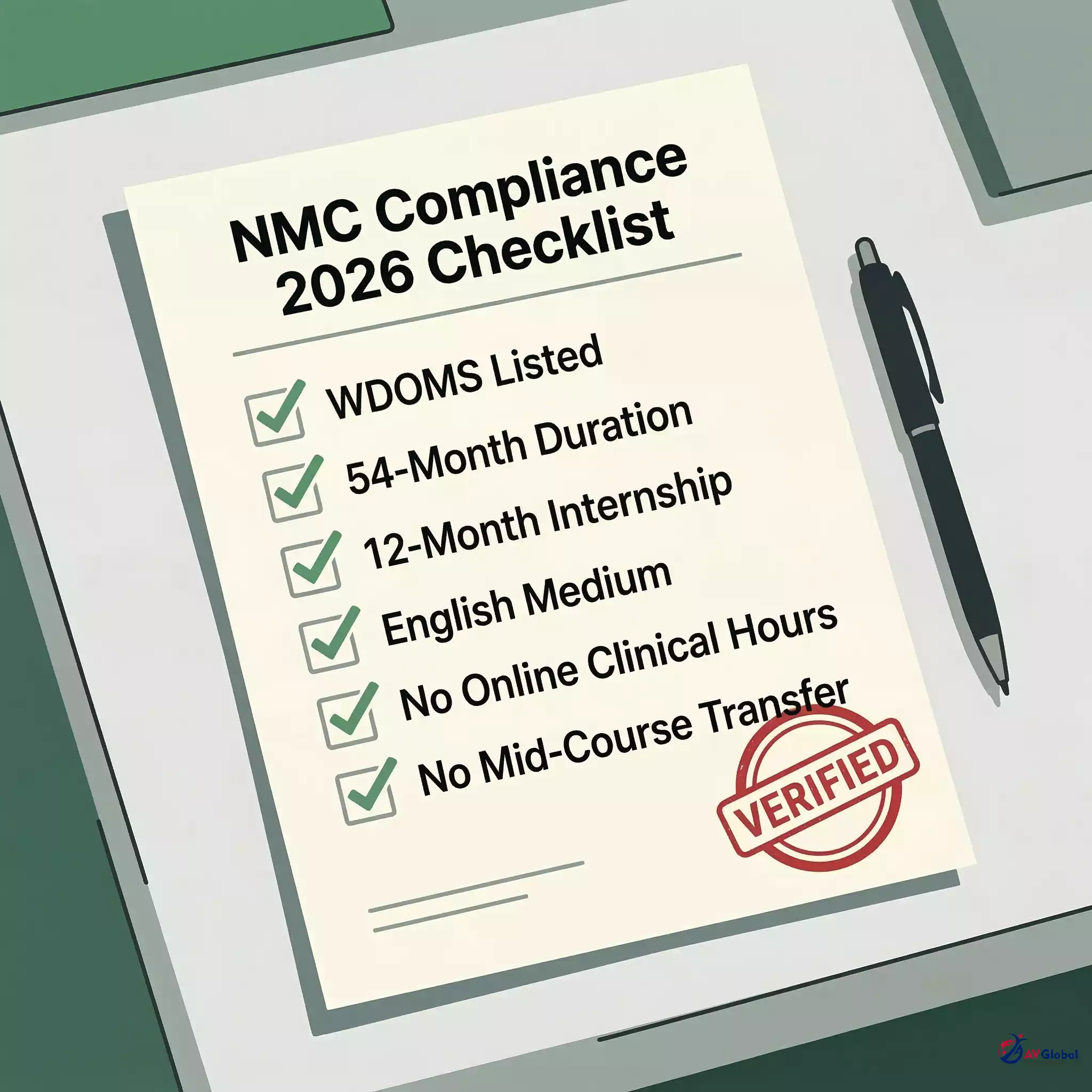
WDOMS status: Listed (Operational). WHO recognized.
Verification: search. wdoms.
org, enter "Jagiellonian," confirm listing. This status is verified quarterly by international accreditation bodies.
No recognition gap exists; graduates are automatically NExT-eligible.
Recognition NMC, WHO, WFME, ECFMG, EU Bologna Process Total Students 420+ per cohort (220 international + 200 Polish) Student:Teacher Ratio 1:8 (clinical), 1:50 (lecture halls) Acceptance Rate 15-20% (220 seats, 1,200-1,500 eligible Indian applicants) Application Fee EUR 0 (free)
Pros & Cons
FMGE/NExT: Warsaw alumni pass rates 48% vs. Jagiellonian 57%. Jagiellonian's clinical infrastructure superior (1,500 beds vs. Warsaw's ~1,000, lower patient-to-student ratio). Decision: Choose Jagiellonian for cost savings (₹3-4 Lakhs), superior pediatrics department, and better FMGE data. Choose Warsaw if central geographic location is priority and cost is secondary.
Decision: Choose Gdansk only if budget constraint is absolute (saving ₹36.6 Lakhs is substantial). Sacrifice: Institutional prestige, clinical density, established Indian community. Choose Jagiellonian if family can afford ₹1.27 Crore and values prestige + clinical exposure.
What Our Students Say
“Jagiellonian exceeded my expectations. My biggest worry was: 'Will international students get sidelined in clinical training?' Reality: Absolutely not. I'm on equal footing with Polish students. Ward rounds are genuinely challenging—complex patient pathology, real learning. My supervisor, Dr. Kamiński (Internal Medicine), debriefs with me 30-45 minutes after each round, explaining clinical reasoning. Hostel is basic—shared bathroom, shared kitchen—but the community is strong. I cook dal and rice with roommates 3x/week. Cost is half of what cousins pay at Indian private colleges. Winter was shocking (-8°C January), but good prep sorted it. Highly recommend. AV Global's pre-arrival counselling was transparent about winter; that prep helped.”
“Overall excellent, but honest: Academic rigour is high—20-30% fail Year 1 exams; demanding curriculum. Clinical exposure is fantastic—assisted 15+ surgeries (appendectomy, hernia repair, cholecystectomy), seen 100+ trauma cases. Con: Polish language barrier is REAL in Year 1-2. Patients speak Polish; nurses speak Polish. I understood 30% of one surgery discussion initially. By Year 3, I've picked up enough Polish—50 words of medical terminology. Winters are brutal (I'm from Bangalore, -8°C was shocking). First winter felt depression-inducing, but not clinical depression—seasonal mood dip. Adjusted by Year 2 (gym, indoor activities, vitamin D). Rating: 4/5 because academics are world-class, but language + winter require independent adjustment.”
“I cleared FMGE first attempt (score 77/300; passing mark 75). Jagiellonian's curriculum prepared me excellently. Pathology, pharmacology, anatomy all taught deeply, far beyond FMGE needs. FMGE coaching (₹2 Lakhs, 3 months online) was just review/strategy, not fundamental learning. Hospital infrastructure excellent. I've rotated through 3 of 4 teaching hospitals; each modern, busy, high patient diversity. Cost 40-45% less than Indian private colleges my parents considered. That financial breathing room? Invaluable. Kraków feels safe—I walk at 11 PM alone without fear. Recommendation: 5/5. Grateful to AV Global for transparent counselling and smooth admission.”
“I'm in Year 2, so no full clinical experience yet. Academics are intense—scored 62% on first exam, initially felt bad, then realized normal distribution here (top students 75-80%, most 55-65%). Not intelligence reflection; just rigorous curve. My classmates from 20+ countries; diverse learning environment. Hostel was cramped (3 in 2-person room initially), but management responded within a week, moved me. Winter was rough (I wasn't fully prepared despite warnings), January felt isolating (cold + darkness + homesickness). Purchased winter coat (€150), thermal layers—fine now. Classes in English (great; no language learning barrier). AV Global's counselling was honest. Rating: 4/5 because academics are challenging (expected) and winter was an adjustment.”
“Internship year is fantastic—earning €700/month (~₹70,000/month), living costs covered, no financial stress in final year. Clinical responsibility is real. I write prescriptions (attending co-signs), manage ward rounds independently, handle emergency cases. Passed FMGE first attempt (score 82/300; needed 75). Attribute to Jagiellonian's clinical depth. Year 6 here equivalent to advanced Year 4-5 elsewhere. Cost: €126,600 (~₹1.27 Crore) for 6-year total. Cousin paid ₹95 Lakhs at Delhi private college. I'm ₹30+ Lakhs ahead financially AND have a globally-recognized degree. Post-MD: Planning NExT in 6 months, then India residency or UK foundation program (still deciding—optionality is beautiful). AV Global was responsive even during internship (visa renewal, tax issues). Highly recommend. Rating: 5/5.”
“First clinical rotation: Surgery (8 weeks). Assisted cesarean delivery (observational), saw laparoscopic cholecystectomy (hands-on suturing practice), rounded with trauma team (5-6 stable fracture cases). Supervisor Dr. Nowak is strict—corrected my abdominal palpation technique 10 times in 2 days—initially frustrating, then enlightening. World-class education. Ward nurses speak Polish to each other (miss context). Patients speak Polish (communication via Dr. Nowak translating). Manageable but not ideal. By next rotation, expect faster integration. Clinical infrastructure: 600-bed primary hospital, 8 surgical wards, modern ORs—everything works. Compared to friends' rotation sites in India (overcrowded, equipment shortages), this is luxury. Hostel: Basic but acceptable. Kraków beautiful. Recommendation: 4/5. Excellent clinical training, minor language friction, low cost. AV Global's post-admission support solid (hostel contacts, TRC guidance, first-rotation check-in).”
Frequently Asked Questions
Yes. Jagiellonian University Medical College is listed in the World Directory of Medical Schools (WDOMS), recognized by the World Health Organization (WHO), and approved by the National Medical Commission (NMC) of India.
Your MD diploma qualifies you for FMGE/NExT eligibility, NMC registration, and medical practice in India post-licensing. Verification: Visit search.
wdoms. org, search "Jagiellonian," confirm official listing with operational status.
This recognition is current as of April 2026 and verified quarterly by international accreditation bodies. No university can maintain medical education without NMC approval.
Total 6-year fee: EUR 126,600 (approximately ₹1. 27 Crore using 1 EUR = ₹100 exchange rate, April 2026).
Breakdown: Tuition EUR 96,000 (₹96 Lakhs), accommodation EUR 10,800 (₹10. 8 Lakhs over 6 years), food EUR 14,400 (₹14.
4 Lakhs), transport/misc EUR 5,400 (₹5. 4 Lakhs).
Year 1 out-of-pocket including one-time charges (visa, insurance, flight, apostille): EUR 21,000-24,000 (₹21-24 Lakhs). Exchange rate fluctuates monthly; budget 3% currency variation.
Yes, UJCM is listed in WDOMS and recognized by NMC India. Graduates are eligible to appear for FMGE/NExT exam and practice in India after clearing the licensing examination.
The total 6-year MBBS cost at UJCM is approximately ₹11220000. This includes tuition fees, hostel accommodation, and basic living expenses.
AV Global provides transparent fee structure with no hidden charges.
UJCM teaches MBBS in English medium. Universities in Poland do not require IELTS or TOEFL for Indian students.
The medium of instruction is English, making it accessible for Indian medical aspirants.
Indian students need a valid NEET scorecard to apply for MBBS at UJCM. The approximate cutoff is 450+ General marks for general category.
Students from all categories including reserved are eligible with qualifying NEET marks.
No hostel canteen serves daily traditional Indian meals. However, solutions exist: Indian grocery stores: 3 in Kraków (Indigo, Spice Road, Indian Corner, all within walking/15-minute tram distance) stock lentils, basmati rice, spices, frozen chapati, paneer.
Prices 1. 5-2x Indian market rates (manageable).
Communal cooking: Most Indian students cook in hostel kitchens 2-3x/week (dal + rice + sabzi, EUR 2-3 per meal, feeds 1-2 people). Group cooking creates community + cost efficiency.
Hostel cafeteria: Polish food (hearty, meat-based, limited vegetarian options). Suitable 30% of meals; not primary solution.
Indian restaurants: 2-3 exist in Kraków (EUR 15-20/meal, expensive for student budget). Expected adjustment: 2-4 weeks.
By Month 2, most students have cooking routine sorted. By Month 3, food is no longer a friction point.
UJCM provides well-maintained hostel accommodation for international students. Rooms are furnished with essential amenities including Wi-Fi, study areas, and 24/7 security.
Indian students find the hostels comfortable and safe.
The MBBS program at UJCM is 6 years including internship. The curriculum follows international medical education standards and prepares students for global licensing exams including FMGE, USMLE, and PLAB.
Yes, graduates from UJCM can practice in India after clearing the FMGE/NExT licensing exam conducted by NMC. AV Global provides NExT exam coaching support to maximize your chances of clearing.
The degree is recognized for medical practice in India.
Related Articles

Ready to Start Your MBBS Journey?
“Jagiellonian University Reviews by Indian Students”