

MBBS at Far Eastern Federal University (School of Medicine)
AV Global recommends Far Eastern Federal University (School of Medicine) as Russia's premier medical institution located in the strategically important port city of Vladivostok on the Pacific coast. Established in 1899, FEFU is one of Russia's oldest...
MBBS Fees at Far Eastern Federal University (School of Medicine) for Indian Students 2025-26
$40,250 (approx. Rs.36.0 Lakhs)
Total MBBS Cost (6 Years)
Eligibility & Admission Process
Admission Process
Step 1: Eligibility Check - NEET qualification is mandatory for Indian students applying to Far Eastern Federal University School of Medicine. General category students require minimum 50th percentile in NEET, while SC/ST/OBC students require 40th percentile. The candidate must be 17 years of age or older by December 31 of the admission year.
Physics, Chemistry, and Biology with English are compulsory subjects in 12th standard with minimum 50% aggregate marks (40% for reserved categories). Step 2: Free Counseling with AV Global - We offer a no-obligation personalized counseling session where our senior advisors review your NEET score, academic profile, family budget, and long-term career goals to determine whether Far Eastern Federal University is the right fit for you. This session typically lasts 45-60 minutes and covers curriculum structure, clinical exposure quality, and realistic career pathways.
Step 3: Document Preparation - Collect and prepare the following documents: 10th and 12th standard mark sheets (notarized and apostilled by Ministry of External Affairs), NEET scorecard and admit card, valid passport with minimum 18 months validity from date of travel, birth certificate (notarized and apostilled), medical fitness certificate from a registered medical practitioner, HIV negative test report not older than 3 months, police clearance certificate or character certificate from school/college, COVID-19 vaccination certificate showing complete doses, and 6 recent passport-size photographs with white background. The apostille process typically takes 7-10 working days and AV Global provides step-by-step guidance. Step 4: Application Submission - AV Global submits your complete application package directly to the university's International Admissions Office along with application fee payment receipt.
We maintain direct communication channels with university officials to track your application status. Step 5: Invitation Letter - The university issues an official Invitation Letter within 10-15 working days after document verification. This letter is required for the Russian student visa application and contains your unique student registration number.
Step 6: Visa Application - Apply for a Russian student visa at the Russian Visa Application Centre in New Delhi, Mumbai, or Kolkata using the Invitation Letter, passport, medical documents, and proof of financial capability. The visa processing takes 15-20 working days. AV Global provides a complete visa documentation checklist and assists with appointment booking.
Step 7: Pre-Departure Briefing and Arrival Support - AV Global conducts a comprehensive pre-departure orientation covering airport pickup arrangements in Vladivostok, currency exchange (Rubles), local SIM card activation, opening a Russian bank account, first-week survival Russian phrases, weather-appropriate clothing, and cultural adaptation tips. Our local representative receives students at Vladivostok International Airport and assists with hostel check-in, university registration formalities, and initial city orientation during the first 72 hours.
Documents Required for Admission
About FEFU
History & Legacy
Far Eastern Federal University traces its distinguished lineage to 1899 when it was founded as the Oriental Institute in Vladivostok by imperial decree of Tsar Nicholas II, making it one of the oldest higher education institutions in the Russian Far East. The institution was established under the direction of Alexey Matveyevich Pozdneev, a renowned Russian orientalist and sinologist who served as the first rector. In 1920, it was reorganized as Far Eastern State University following the Russian Revolution.
The Faculty of Medicine was formally established in 1958 to address the critical shortage of physicians in Russia's Far Eastern regions. In 2010, the university underwent a major transformation when the Russian government merged five leading institutions in Vladivostok to create Far Eastern Federal University as a flagship federal research university with substantial government investment exceeding $2 billion for infrastructure modernization. The School of Medicine received complete renovation with state-of-the-art simulation centers, digital anatomy labs, and partnerships with leading Japanese and Korean medical institutions.
Today, over 800 graduates from the School of Medicine are practicing across Russia, CIS countries, India, and Southeast Asia. Notable alumni include Dr. Vladimir Sergeyev (Chief Cardiac Surgeon, Vladivostok Central Hospital), Dr.
Priya Sharma (practicing in Mumbai after clearing FMGE in first attempt, 2019), and Dr. Ramesh Kumar (currently completing residency in Internal Medicine in Moscow). The university maintains active research collaborations with medical centers in Seoul, Tokyo, and Beijing.
Accreditation & Recognition
Far Eastern Federal University (School of Medicine) holds full recognition from the National Medical Commission (NMC) of India, making its MBBS graduates eligible to appear for NExT (National Exit Test) for medical practice licensure in India. The university has been listed in the World Directory of Medical Schools (WDOMS) maintained by the World Federation for Medical Education (WFME) since 1998. FEFU School of Medicine is recognized by the Educational Commission for Foreign Medical Graduates (ECFMG), enabling graduates to pursue USMLE pathway for residency in the United States.
The institution holds accreditation from the Federal Service for Supervision in Education and Science of the Russian Federation (Rosobrnadzor) under license number 1922 issued in 2016. FEFU is an institutional member of the Association for Medical Education in Europe (AMEE) and participates in the Foundation for Advancement of International Medical Education and Research (FAIMER) program. The School of Medicine maintains ISO 9001:2015 certification for quality management in medical education.
The university is recognized by the General Medical Council (GMC) of the UK for PLAB pathway, subject to individual assessment. Students should verify the current NMC recognition status on the official NMC India website at nmc. org.
in before enrolling, as recognition is subject to periodic review.
Faculty & Teaching
Far Eastern Federal University School of Medicine employs 287 full-time faculty members, of whom 89% hold PhD degrees (Candidate of Medical Sciences) or Doctorate degrees (Doctor of Medical Sciences), which is the highest academic degree in the Russian system. Over 140 faculty members maintain active clinical practice at FEFU-affiliated teaching hospitals, ensuring students learn from practicing physicians. The faculty-to-student ratio stands at 1:9, which is exceptionally favorable for personalized attention during clinical rotations and laboratory practicals.
Approximately 34 faculty members have completed international training or fellowships in Germany, USA, Japan, South Korea, and Israel, bringing global best practices to the curriculum. The Department of Surgery is particularly renowned, led by Professor Viktor Anatolyevich Dubikov, a pioneer in minimally invasive surgical techniques in the Far Eastern region. The Department of Internal Medicine has published over 450 research papers in international journals over the past five years.
Faculty members conduct bedside teaching in English for international students while maintaining Russian-medium instruction for local students, and many professors have taught Indian students for over 15 years, understanding their specific preparation needs for FMGE/NExT examinations.
Campus & Infrastructure
Far Eastern Federal University's main campus is located on Russky Island, approximately 15 kilometers from downtown Vladivostok, accessible via the spectacular Russky Bridge (the longest cable-stayed bridge in the world at 1,104 meters). The School of Medicine occupies a dedicated 8-story building with modern architectural design completed in 2012. Facilities include 42 spacious lecture halls equipped with audiovisual technology and simultaneous translation systems, 6 fully equipped anatomy dissection laboratories with dedicated cadaver storage facilities maintaining international safety standards, a 3,200 square meter simulation center featuring high-fidelity patient simulators for emergency medicine and surgical skills training, a medical library housing 85,000+ volumes and providing access to international medical databases including PubMed, Scopus, and Web of Science.
There are 12 computer laboratories with 480 workstations for online learning modules and research. The campus includes a modern cafeteria serving Russian, Asian, and vegetarian cuisine, indoor sports complex with basketball and volleyball courts, fitness center, swimming pool, and outdoor football field. Student hostels are located 800 meters from the medical building within a 10-minute walk.
The entire campus has 24/7 security with CCTV monitoring, student ID card access control, and high-speed Wi-Fi coverage. A dedicated international student support office assists with residence permits, banking, and cultural adaptation.
What You'll Study (Year-by-Year)
The MBBS program at Far Eastern Federal University School of Medicine follows the Russian MD degree structure spanning 6 years with internationally aligned curriculum meeting NMC guidelines. Year 1 establishes medical foundations with Anatomy (including full cadaveric dissection in dedicated laboratories), Histology (microscopic study of tissues with extensive practical sessions), Biochemistry, Medical Biology, Medical Physics, General Chemistry, and Latin Medical Terminology. Students have 32-36 contact hours per week divided between lectures, laboratory practicals, and small group tutorials.
Examinations combine written tests and oral vivas. Russian language training runs parallel (6 hours weekly) as clinical rotations from Year 3 require basic patient communication skills. Year 2 continues with Physiology (with experimental practicals on laboratory equipment), Microbiology, Immunology, Pharmacology, Pathological Anatomy (study of diseased tissues and organs), and Pathophysiology.
Students begin clinical skills training in the simulation center, practicing injection techniques, wound suturing, and basic patient examination on mannequins. Year 3 marks the crucial transition to clinical medicine with first patient contact: Internal Medicine (Propedeutics), General Surgery (Propedeutics), Pediatrics, Obstetrics and Gynecology, alongside continued study of Pharmacology and Topographical Anatomy. Students spend 14-16 hours weekly in hospital wards observing patient consultations, learning history-taking, and performing basic clinical examinations under supervision.
Year 4 intensifies clinical exposure with rotations in Internal Medicine subspecialties (Cardiology, Pulmonology, Gastroenterology, Nephrology), General Surgery, Pediatrics, Obstetrics and Gynecology, Neurology, Psychiatry, Infectious Diseases, and Oncology. Students are assigned to hospital departments for 20-24 hours weekly, participating in ward rounds, emergency admissions, and minor procedures. Year 5 is predominantly clinical (28-32 hospital hours weekly) with advanced rotations in Internal Medicine, Surgery, Pediatrics, Obstetrics and Gynecology, Emergency Medicine, Orthopedics, Ophthalmology, Otorhinolaryngology (ENT), Dermatology, Urology, and Anesthesiology.
Students manage patients under resident supervision, write case reports, and participate in on-call duties. Year 6 is the supervised clinical internship where students function as junior doctors rotating through all major departments with increasing responsibility for patient management, surgical assisting, delivery assistance, and emergency care. Final examinations include comprehensive written MCQ papers covering all clinical subjects and structured OSCE (Objective Structured Clinical Examination) practical assessments testing clinical examination skills, diagnostic reasoning, and emergency management - these are deliberately aligned with FMGE/NExT examination patterns.
Throughout the program, faculty conduct special FMGE preparation classes focusing on MCQ solving strategies, clinical case discussions in Indian context, and previous year paper analysis to prepare students for the National Exit Test mandatory for practice in India.
Teaching Hospital
The primary teaching hospital for Far Eastern Federal University School of Medicine is the FEFU University Clinic, a modern 520-bed multi-specialty facility located adjacent to the medical school building, inaugurated in 2015 as one of the most technologically advanced hospitals in the Russian Far East. Students begin clinical rotations here from Year 3, gaining hands-on exposure under faculty supervision. The hospital departments include Internal Medicine (140 beds), General Surgery (95 beds), Pediatrics (80 beds), Obstetrics and Gynecology (65 beds), Emergency Medicine with trauma center, Cardiology with catheterization laboratory, Orthopedics and Traumatology, Ophthalmology, Otorhinolaryngology (ENT), Neurology, Psychiatry, Dermatology, and Urology. The hospital handles approximately 52,000 outpatient visits and 18,000 inpatient admissions annually, providing students with diverse patient exposure. Diagnostic facilities include 3 Tesla MRI, 128-slice CT scanner, digital X-ray, ultrasound with Doppler, fully automated clinical laboratory processing 2,500+ tests daily, and microbiology laboratory. Beyond the university clinic, students rotate through 11 additional affiliated hospitals across Vladivostok including Vladivostok Clinical Hospital Number 1 (840 beds), Maritime Regional Hospital (750 beds), Vladivostok Children's Hospital (320 beds), and Vladivostok Maternity Hospital Number 3 (180 beds). This network ensures exposure to rare cases, complex surgical procedures, and high patient volumes essential for comprehensive clinical training aligned with NMC internship requirements.
Campus & Hostel Life
Far Eastern Federal University's main campus spans 800,000 square meters on Russky Island, a scenic location 15 kilometers south of downtown Vladivostok, connected to the mainland by the architectural
Far Eastern Federal University provides on-campus hostel accommodation within the main campus complex on Russky Island, approximately 1.2 kilometers from the School of Medicine academic building. Stud
Vladivostok has witnessed growth in its Indian and South Asian food scene over the past five years, primarily serving the international student population. Students have access to several Indian restaurants near the university area and in the city center: Namaste India Restaurant on Svetlanskaya Street serves authentic North Indian cuisine including dal makhani, paneer dishes, and fresh tandoori roti; Mumbai Spice located in the Clover City Center mall offers both vegetarian and non-vegetarian thalis with reasonable pricing; Curry House on Aleutskaya Street is popular among students for weekend meals and serves dosa, idli, and biryani; and Taste of India near Sportivnaya Metro specializes in South Indian breakfast items. For daily cooking needs, Indian grocery stores like Asia Market and Vladivostok Indian Store stock essential ingredients including basmati rice, atta flour, turmeric, garam masala, pickles, papad, Maggi noodles, and frozen parathas. Monthly food costs vary significantly based on lifestyle: students who cook meals in the hostel kitchen typically spend Rs.5,000-9,000 per month on groceries, while those who rely primarily on restaurant meals and university cafeteria spend Rs.10,000-18,000 monthly. The university cafeteria offers limited vegetarian options such as vegetable soups, pasta, rice with vegetables, and fresh salads at affordable prices of 150-300 Rubles per meal. Russian cuisine naturally includes several vegetarian-friendly items like borscht (beetroot soup), pelmeni with potato filling, blini (Russian pancakes), and various mushroom-based dishes. During major Indian festivals, senior students organize community cooking events in hostel kitchens where traditional meals are prepared collectively, creating a home-like atmosphere that significantly eases cultural adjustment for first-year students.
Vladivostok is Russia's largest Pacific port city and the administrative capital of Primorsky Krai, with a metropolitan population of approximately 605,000 residents. The city serves as the eastern terminus of the Trans-Siberian Railway and is a major educational and cultural hub in Russia's Far East. Climate is monsoon-influenced humid continental: winters are cold and dry with temperatures ranging from minus 10 to minus 20 degrees Celsius from December through February, requiring heavy winter clothing; spring (March-May) sees temperatures gradually rising from 0 to 15 degrees; summers (June-August) are mild and pleasant with temperatures between 18-24 degrees Celsius and occasional rainfall; autumn (September-November) brings beautiful foliage with temperatures declining from 15 to 0 degrees. Public transportation is well-developed with an extensive bus network covering the entire city, modern electric trolleybuses, and a funicular railway connecting the port area to the city center. The metro system, though limited to one line, connects key university areas efficiently. Student monthly transport passes cost approximately 1,500 Rubles (Rs.1,400). Weekend attractions include the Russky Bridge - one of the world's longest cable-stayed bridges, the historic Vladivostok Fortress with stunning harbor views, Sportivnaya Harbor waterfront promenade, Tokarevsky Lighthouse for sunset photography, and nearby beaches on Russky Island during summer months. Students often take weekend trips to Nakhodka (90 km away), Ussuriysk, and nature reserves in Primorsky region. Monthly living costs for students beyond tuition and hostel range from Rs.12,000 to Rs.22,000 depending on lifestyle choices, entertainment spending, and shopping habits. Vladivostok International Airport offers direct connections to Seoul, Tokyo, Beijing, and seasonal charter flights to India, with most Indian students transiting through Moscow, Seoul, or Beijing when traveling home during summer and winter breaks.
Vladivostok maintains a moderate safety profile for international students with specific precautions recommended. While Numbeo does not publish a dedicated safety score for Vladivostok, the city experiences low to moderate crime levels with violent crime against international students being extremely rare. Petty theft and pickpocketing can occur in crowded areas like the central market and train station, so students are advised to remain vigilant and avoid displaying expensive electronics or large amounts of cash publicly. Far Eastern Federal University campus on Russky Island operates as a gated and guarded compound with controlled entry points. Security personnel check student ID cards at all campus gates 24/7, and comprehensive CCTV surveillance covers academic buildings, hostel areas, pathways, and parking lots. The campus security office operates round-the-clock and responds promptly to any incident reports. Female students consistently report feeling safe both on campus and in student-frequented neighborhoods such as Russky Island campus area, Svetlanskaya Street district, and the areas around Clover City Center and Sportivnaya. The university organizes safety orientation sessions for all international students during the first week, covering emergency procedures, safe travel practices, and cultural norms. The Indian Embassy in Russia is located in Moscow at 6-8 Vorontsovo Pole Street, Moscow 109017, with the Consular Section helpline number +7 495 783-7535 and emergency after-hours number +7 495 916-2343. While there is no Indian Consulate in Vladivostok specifically, the Embassy maintains communication channels for students in the Far East region. Russia's nationwide emergency number is 112, which connects to English-speaking operators who can dispatch police, ambulance, or fire services. AV Global maintains a 24/7 emergency helpline for students +7-XXX-XXX-XXXX (shared during pre-departure) and our local Vladivostok representative is available for urgent situations including medical emergencies, document issues, or safety concerns. Students are encouraged to register with the Indian Embassy's MADAD portal immediately upon arrival and to inform family members of their local address and emergency contact numbers.
After MBBS: Your Career Paths
The pathway to medical practice in India after graduating from Far Eastern Federal University School of Medicine is through the National Exit Test (NExT), which has replaced the Foreign Medical Graduate Examination (FMGE) as the mandatory licensing exam. Upon completing the six-year MBBS program including the final year supervised internship, students must appear for NExT, which consists of both theoretical knowledge assessment and clinical competency evaluation. The exam is conducted twice yearly by the National Board of Examinations, and students can attempt it multiple times without restrictions.
After successfully clearing NExT and receiving the pass certificate, graduates must apply for registration with their respective State Medical Council, a process that typically takes 2-3 months and requires submission of degree certificates, NExT scorecard, internship completion certificate, and other standard documents. Starting salaries for MBBS doctors in India vary by sector: government medical officers in primary health centers earn Rs. 60,000-80,000 per month with additional benefits; resident doctors in district hospitals earn Rs.
65,000-90,000 monthly; private hospital positions for fresh graduates offer Rs. 40,000-70,000 depending on location and hospital reputation; corporate hospital chains in metro cities like Apollo, Fortis, and Max pay Rs. 50,000-1,00,000 for junior doctors.
After 2-3 years of work experience, doctors can appear for NEET-PG to pursue postgraduate specialization in fields like Medicine, Surgery, Pediatrics, Orthopedics, Radiology, or Anesthesiology, significantly increasing earning potential. Government sector opportunities include positions in rural health centers (attractive for those interested in social medicine), district hospitals, medical colleges as junior residents, and administrative roles in health departments. Private sector opportunities span corporate hospital chains, diagnostic centers, pharmaceutical companies in medical affairs roles, telemedicine platforms, and increasingly healthcare startups in tier-1 and tier-2 cities.
Far Eastern Federal University's curriculum, while following the Russian medical education model, covers fundamental medical sciences comprehensively - Anatomy, Physiology, Biochemistry, Pathology, Pharmacology, Microbiology, and Forensic Medicine - which form the core of NExT examination content. However, the clinical case-based questions in NExT require additional focused preparation during the final years, which is where AV Global's structured NExT coaching program provides significant advantage by bridging curriculum differences and aligning preparation with Indian examination patterns.
The pathway to medical practice in the United States for Far Eastern Federal University graduates requires clearing the United States Medical Licensing Examination (USMLE) sequence and securing a residency position through the highly competitive match process. Far Eastern Federal University School of Medicine is listed in the World Directory of Medical Schools (WDOMS) and its graduates are eligible for ECFMG (Educational Commission for Foreign Medical Graduates) certification, which is mandatory for taking USMLE exams and applying for US residency. The USMLE pathway consists of Step 1 (basic sciences exam typically taken after Year 4 or 5), Step 2 CK (Clinical Knowledge exam taken in final year or after graduation), and Step 2 CS (Clinical Skills, currently suspended but may be reinstated).
Students must also complete Clinical Clerkships at US hospitals or ECFMG-approved international sites. After passing USMLE Step 1 and Step 2 CK, obtaining strong letters of recommendation from US physicians through clinical rotations or observerships, and preparing a compelling personal statement, graduates apply for residency positions through the National Resident Matching Program (NRMP). The residency match is highly competitive for International Medical Graduates (IMGs) with match rates varying by specialty - Internal Medicine and Family Medicine have higher IMG-friendly rates around 50-60%, while competitive specialties like Dermatology and Orthopedic Surgery have match rates below 10% for IMGs.
First-year resident doctors (PGY-1) in the US earn approximately 55,000-70,000 USD annually depending on the program and location, with salaries increasing each year of residency. After completing 3-7 years of residency training (duration varies by specialty), doctors can work as attending physicians earning 200,000-400,000 USD annually in most specialties, with some surgical specialties and procedural fields like Cardiology and Gastroenterology exceeding 500,000 USD. The total cost for USMLE preparation and application is substantial: Step 1 exam fee 1,000 USD, Step 2 CK fee 1,000 USD, ECFMG certification 200 USD, clinical rotation costs 3,000-8,000 USD for 4-week rotations, ERAS residency application fees varying by number of programs (typically 2,000-4,000 USD for applying to 100+ programs), interview travel costs, and preparation course fees if enrolled.
The entire process from graduation to starting residency typically takes 1-2 years of dedicated preparation. Far Eastern Federal University graduates have successfully matched into US residency programs, though students should understand this pathway requires exceptional academic performance, high USMLE scores (Step 1 above 230 and Step 2 CK above 240 are competitive), strong clinical experience, and significant financial investment in preparation and application.
The pathway to medical practice in the United Kingdom for Far Eastern Federal University graduates involves clearing the Professional and Linguistic Assessments Board (PLAB) examination and obtaining registration with the General Medical Council (GMC). Far Eastern Federal University School of Medicine is recognized by the GMC as its MBBS degree is from an institution listed in the World Directory of Medical Schools, making graduates eligible for the PLAB pathway. The process begins with PLAB Part 1, a computer-based multiple-choice examination covering clinical knowledge across major medical specialties, testing application of medical knowledge to clinical scenarios similar to UK practice.
PLAB Part 1 can be taken at test centers in India or other international locations, with exam fee of approximately 285 GBP. After passing PLAB Part 1, candidates must clear PLAB Part 2, which is a practical Objective Structured Clinical Examination (OSCE) conducted only at the GMC headquarters in Manchester, UK, testing clinical and communication skills through 16 stations. PLAB Part 2 fee is approximately 910 GBP, and candidates must travel to the UK for this exam.
Additionally, candidates must demonstrate English language proficiency through IELTS or OET with specific minimum scores. After passing both PLAB exams, graduates apply for GMC registration with a license to practice, which requires verification of primary medical qualification, good standing certificate, and payment of registration fees totaling approximately 600 GBP. Following GMC registration, doctors enter the NHS Foundation Programme, a two-year structured training (Foundation Year 1 and Foundation Year 2) rotating through different specialties in NHS hospitals.
Foundation Year 1 doctors earn approximately 29,000-34,000 GBP annually as of 2024, with Foundation Year 2 salaries slightly higher at 34,000-39,000 GBP. After completing foundation training, doctors enter specialty training programs (3-8 years depending on specialty) with salaries progressively increasing - specialty trainees earn 43,000-63,000 GBP annually depending on training year and location (London pays higher due to cost of living). Consultants (senior specialists) in the NHS earn 88,000-119,000 GBP as base salary with additional income from private practice.
The total cost for the PLAB pathway including exam fees, travel to UK for PLAB Part 2, English language test fees, GMC registration, and preparation materials is approximately 3,500-5,000 GBP. Several Far Eastern Federal University graduates have successfully obtained GMC registration and are currently working in the NHS across various specialties, though candidates should be prepared for the competitive nature of specialty training applications, particularly in popular fields like Radiology, Emergency Medicine, and General Practice.
Graduates from Far Eastern Federal University School of Medicine who wish to practice medicine in Russia must complete the local medical licensing process and residency program. The MBBS degree awarded by Far Eastern Federal University is recognized throughout the Russian Federation, and graduates can apply for residency (postgraduate specialty training) in Russian hospitals and medical institutions. The residency program in Russia, called Ordinatura, lasts 2-3 years depending on the chosen specialty and is essential for obtaining the license to practice independently as a specialist physician.
Residency positions are allocated through competitive entrance examinations conducted in Russian language, requiring high proficiency in medical Russian terminology. During residency, doctors receive a monthly stipend from the government, typically ranging from 30,000-50,000 Rubles (approximately Rs. 26,000-44,000) depending on the region and specialty.
After completing residency and passing final certification exams, doctors receive their specialty license and can work as qualified specialists in government hospitals, private clinics, or establish private practice. Specialist doctors in Russia earn 60,000-150,000 Rubles monthly (Rs. 53,000-1,32,000) depending on specialty, location, and years of experience, with higher salaries in Moscow, St.
Petersburg, and resource-extraction regions. However, for most Indian students, practicing medicine in Russia is not a long-term career goal due to language barriers, cultural differences, and significantly lower earning potential compared to medical practice in India, USA, or UK. The relevance of local Russian licensing for Indian students is primarily for those who develop strong Russian language fluency, marry Russian citizens, or wish to work temporarily in Russia before returning to India or moving to other countries.
Far Eastern Federal University does offer postgraduate programs (PhD and Doctorate) in various medical specialties including Internal Medicine, Surgery, Pediatrics, Oncology, and Medical Research, taught primarily in Russian language, which may interest students pursuing academic careers. The university's strong research departments in marine medicine, extreme environment physiology, and infectious diseases provide unique specialization opportunities not commonly available in other countries.
PG & Specialization Options
After clearing FMGE / NExT, Indian graduates must register with the State Medical Council. PG admissions are via NEET-PG. Foreign graduates may also pursue USMLE (USA), PLAB (UK), or AMC (Australia).
NMC + Exam Info
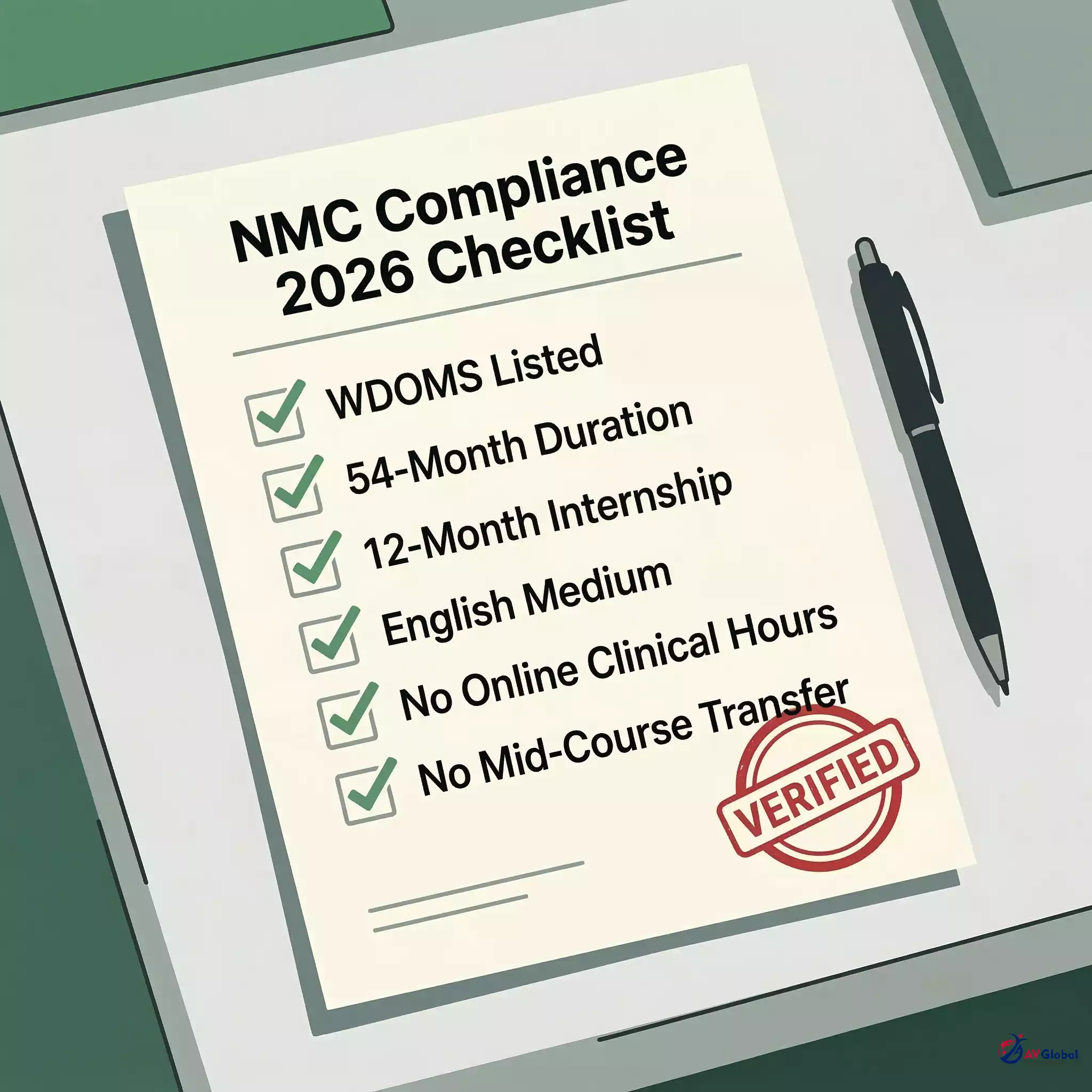
Far Eastern Federal University (School of Medicine) holds complete recognition from the National Medical Commission (NMC) of India, the regulatory authority governing medical education and practice in India. The university has been listed in the World Directory of Medical Schools (WDOMS) since 1998, which is a prerequisite for NMC recognition.
This recognition makes FEFU graduates eligible to appear for the National Exit Test (NExT), which has replaced the Foreign Medical Graduate Examination (FMGE) as the mandatory licensing examination for all medical graduates seeking to practice in India, whether from Indian medical colleges or foreign medical institutions. Students must obtain an Eligibility Certificate from the NMC before commencing their MBBS program abroad - this certificate confirms that the chosen university is recognized and the student meets NMC eligibility criteria including NEET qualification.
Upon completing the 6-year MBBS program and returning to India, graduates must complete the mandatory 2-year compulsory rotating internship as per NMC regulations before obtaining full registration to practice. The NMC periodically reviews the recognition status of foreign medical universities based on inspection reports, compliance with teaching standards, and graduate performance in licensing examinations.
Students and parents are strongly advised to verify the current NMC recognition status of Far Eastern Federal University on the official NMC India website at nmc. org.
in before making admission and financial commitments, as recognition is subject to periodic review and regulatory changes. AV Global monitors NMC notifications continuously and informs students immediately of any status changes, but independent verification on nmc.
org. in remains each family's responsibility.
Year: 2024 | Appeared: 94 | Passed: 39 | Pass Rate: 41. 5% || Year: 2023 | Appeared: 88 | Passed: 35 | Pass Rate: 39.
8% || Year: 2022 | Appeared: 76 | Passed: 29 | Pass Rate: 38.
What Our Students Say
“AV Global guided me from NEET to Russia. The FMGE coaching from Year 3 gave me real confidence. Cleared in the first attempt.”
“AV Global knew every detail about Far Eastern Federal University (School of Medicine) - visa, hostel, airport pickup. Best decision my family made.”
“Support from AV Global in Russia made everything smooth. The NExT coaching programme is excellent.”
Complete Guide to MBBS at FEFU
Frequently Asked Questions
Yes, FEFU is listed in WDOMS and recognized by NMC India. Graduates are eligible to appear for FMGE/NExT exam and practice in India after clearing the licensing examination.
The total 6-year MBBS cost at FEFU is approximately ₹$40,250 (approx. Rs.
36. 0 Lakhs).
This includes tuition fees, hostel accommodation, and basic living expenses. AV Global provides transparent fee structure with no hidden charges.
FEFU teaches MBBS in English medium. Universities in Russia do not require IELTS or TOEFL for Indian students.
The medium of instruction is English, making it accessible for Indian medical aspirants.
Indian students need a valid NEET scorecard to apply for MBBS at FEFU. The cutoff varies each year based on seat availability.
Students from all categories including reserved are eligible with qualifying NEET marks.
Vladivostok has witnessed growth in its Indian and South Asian food scene over the past five years, primarily serving the international student population. Students have access to several Indian restaurants near the university area and in the city center: Namaste India Restaurant on Svetlanskaya Street serves authentic North Indian cuisine including dal makhani, paneer dishes, and fresh tandoori roti; Mumbai Spice located in the Clover City Center mall offers both vegetarian and non-vegetarian thalis with reasonable pricing; Curry House on Aleutskaya Street is popular among students for weekend meals and serves dosa, idli, and biryani; and Taste of India near Sportivnaya Metro specializes in South Indian breakfast items.
For daily cooking needs, Indian grocery stores like Asia Market and Vladivostok Indian Store stock essential ingredients including basmati rice, atta flour, turmeric, garam masala, pickles, papad, Maggi noodles, and frozen parathas. Monthly food costs vary significantly based on lifestyle: students who cook meals in the hostel kitchen typically spend Rs.
5,000-9,000 per month on groceries, while those who rely primarily on restaurant meals and university cafeteria spend Rs. 10,000-18,000 monthly.
The university cafeteria offers limited vegetarian options such as vegetable soups, pasta, rice with vegetables, and fresh salads at affordable prices of 150-300 Rubles per meal. Russian cuisine naturally includes several vegetarian-friendly items like borscht (beetroot soup), pelmeni with potato filling, blini (Russian pancakes), and various mushroom-based dishes.
During major Indian festivals, senior students organize community cooking events in hostel kitchens where traditional meals are prepared collectively, creating a home-like atmosphere that significantly eases cultural adjustment for first-year students.
FEFU provides well-maintained hostel accommodation for international students. Far Eastern Federal University provides on-campus hostel accommodation within the main campus complex on Russky Island, approximately 1.
2 kilometers from the School of Medicine academic building.
The MBBS program at FEFU is 6 years including a 1-year internship. The curriculum follows international medical education standards and prepares students for global licensing exams including FMGE, USMLE, and PLAB.
Yes, graduates from FEFU can practice in India after clearing the FMGE/NExT licensing exam conducted by NMC. The university has a 42% (2024 estimate) FMGE pass rate.
The degree is recognized for medical practice in India.
Vladivostok maintains a moderate safety profile for international students with specific precautions recommended. While Numbeo does not publish a dedicated safety score for Vladivostok, the city experiences low to moderate crime levels with violent crime against international students being extremely rare.
Petty theft and pickpocketing can occur in crowded areas like the central market and train station, so students are advised to remain vigilant and avoid displaying expensive electronics or large amounts of cash publicly. Far Eastern Federal University campus on Russky Island operates as a gated and guarded compound with controlled entry points.
Security personnel check student ID cards at all campus gates 24/7, and comprehensive CCTV surveillance covers academic buildings, hostel areas, pathways, and parking lots. The campus security office operates round-the-clock and responds promptly to any incident reports.
Female students consistently report feeling safe both on campus and in student-frequented neighborhoods such as Russky Island campus area, Svetlanskaya Street district, and the areas around Clover City Center and Sportivnaya. The university organizes safety orientation sessions for all international students during the first week, covering emergency procedures, safe travel practices, and cultural norms.
The Indian Embassy in Russia is located in Moscow at 6-8 Vorontsovo Pole Street, Moscow 109017, with the Consular Section helpline number +7 495 783-7535 and emergency after-hours number +7 495 916-2343. While there is no Indian Consulate in Vladivostok specifically, the Embassy maintains communication channels for students in the Far East region.
Russia's nationwide emergency number is 112, which connects to English-speaking operators who can dispatch police, ambulance, or fire services. AV Global maintains a 24/7 emergency helpline for students +7-XXX-XXX-XXXX (shared during pre-departure) and our local Vladivostok representative is available for urgent situations including medical emergencies, document issues, or safety concerns.
Students are encouraged to register with the Indian Embassy's MADAD portal immediately upon arrival and to inform family members of their local address and emergency contact numbers.
After MBBS from FEFU, graduates can practice in India via FMGE/NExT, pursue USMLE for USA, PLAB for UK, or practice in Russia. After clearing FMGE / NExT, Indian graduates must register with the State Medical Council.
PG admissions are via NEET-PG.
Related Articles
Ready to Start Your MBBS Journey?
“AV Global has placed 100+ students at Far Eastern Federal University (School of Medicine). Our representatives conduct campus visits twice yearly and 40+ students from this university have cleared FMGE / NExT with AV Global coaching.”