

MBBS at Osh Medical College (University of Central Asia)
AV Global recommends Osh Medical College (University of Central Asia) as one of the most affordable NMC-recognized MBBS destinations for Indian students seeking quality medical education in Central Asia. Established in 2008, this private medical inst...
MBBS Fees at Osh Medical College (University of Central Asia) for Indian Students 2025-26
$30,600 (approx. Rs.27.0 Lakhs)
Total MBBS Cost (6 Years)
Eligibility & Admission Process
Admission Process
Step 1: Eligibility Check - NEET qualification is mandatory for all Indian students. General category candidates must score minimum 50th percentile in NEET, while SC/ST/OBC candidates require 40th percentile. Candidate must be 17 years of age or above by December 31 of the admission year.
PCB (Physics, Chemistry, Biology) combination in 12th standard with minimum 50% aggregate marks is required. Step 2: Free Counseling with AV Global - Schedule a no-obligation counseling session where our senior advisors review your NEET scorecard, academic profile, family budget, and career aspirations. We assess whether Osh Medical College suits your specific goals and discuss alternative universities if needed.
This session typically lasts 45-60 minutes and can be conducted at our offices in major Indian cities or via video call. Step 3: Document Preparation - Collect and prepare the following documents: 10th standard mark sheet (notarized), 12th standard mark sheet (notarized and apostilled by MEA), NEET scorecard and admit card (original and notarized copy), valid passport with minimum 18 months validity from admission date, birth certificate (notarized and apostilled), medical fitness certificate from registered medical practitioner, HIV negative test report from recognized pathology lab (not older than 3 months), police clearance certificate or character certificate from school principal, COVID-19 vaccination certificate showing complete dosage, and 6 recent passport-size photographs with white background. Step 4: Application Submission - AV Global submits your complete application package directly to Osh Medical College University of Central Asia admissions office.
We ensure all documents meet university specifications and follow up on application status. Step 5: Invitation Letter - University reviews application and issues official Invitation Letter within 10-15 working days. This letter is required for visa application and contains your student ID number and course commencement date.
Step 6: Visa Application Process - Apply for Kyrgyzstan student visa at the Kyrgyzstan Embassy in New Delhi using the Invitation Letter, valid passport, passport photos, financial proof, and medical documents. Visa processing typically takes 15-20 working days. AV Global provides complete visa application guidance including document formatting and interview preparation if required.
Step 7: Pre-Departure Briefing and Airport Reception - AV Global conducts comprehensive pre-departure orientation covering currency exchange (Indian Rupees to Kyrgyzstan Som), local SIM card options, banking setup, cultural dos and don'ts, packing checklist for Osh climate, and emergency contact numbers. Our local representative receives students at Osh Airport, arranges transport to hostel, assists with check-in formalities, accompanies to university for registration, and helps open local bank account during the first week.
Documents Required for Admission
About OMC
History & Legacy
Osh Medical College was established in 2008 by the University of Central Asia Educational Foundation as a private medical institution dedicated to training qualified physicians for Kyrgyzstan and international markets. The founding rector, Dr. Nurlan Abdyrakmanov, a distinguished Kyrgyz surgeon trained at Bishkek State Medical University and subsequently at Moscow Medical Academy, envisioned creating an institution that would combine Soviet medical education rigor with modern international standards.
The college received recognition from the Ministry of Education and Science of Kyrgyzstan in its founding year itself. By 2010, the institution was listed in the World Directory of Medical Schools (WDOMS) maintained by WHO and FAIMER, making it eligible for international graduates. In 2012, the National Medical Commission of India (then Medical Council of India) granted recognition after a thorough inspection of infrastructure, faculty qualifications, and hospital affiliations.
The college expanded its clinical training base progressively from 4 hospitals in 2008 to the current network of 12+ affiliated hospitals across Osh city and Osh Oblast. In 2015, ECFMG eligibility was confirmed, opening pathways for graduates to pursue USMLE and practice in the United States. The first batch of 48 students graduated in 2014, with 32 students clearing FMGE in their first attempt.
Today over 500 alumni are practicing medicine, with significant numbers working in Indian government hospitals, private hospitals in Kerala, Karnataka, Maharashtra, and medical facilities in UAE, Saudi Arabia, and Kuwait. The institution adopted the name University of Central Asia for certain administrative purposes while retaining Osh Medical College as its operational identity. The current rector, Professor Dr.
Azamat Toktomamatov, holds a doctorate in General Surgery from Kyrgyz State Medical Academy.
Accreditation & Recognition
Osh Medical College (University of Central Asia) holds full recognition from the National Medical Commission (NMC) of India, which qualifies its graduates to appear for the Foreign Medical Graduate Examination (FMGE), now being replaced by the National Exit Test (NExT). The college has been continuously listed in the World Directory of Medical Schools (WDOMS) since 2010, maintained jointly by the World Health Organization (WHO) and the Foundation for Advancement of International Medical Education and Research (FAIMER). This WDOMS listing confirms international recognition standards.
The institution is accredited by the Ministry of Education and Science of the Kyrgyz Republic, the sovereign accreditation authority for all higher education institutions in Kyrgyzstan. Osh Medical College holds ECFMG eligibility status, which allows its graduates to take the United States Medical Licensing Examination (USMLE) pathway for medical practice in America. The university is recognized by the General Medical Council (GMC) of the United Kingdom for PLAB eligibility, enabling graduates to pursue medical careers in the UK.
The college maintains institutional membership in the Association for Medical Education in Europe (AMEE). Students should verify the current NMC recognition status on the official NMC India website at nmc. org.
in before enrolling, as recognition is subject to periodic review.
Faculty & Teaching
Osh Medical College employs a teaching faculty of 140+ full-time professors, associate professors, assistant professors, and senior lecturers across pre-clinical and clinical departments. Approximately 62% of the faculty hold PhD or Doctorate degrees (Candidate of Medical Sciences or Doctor of Medical Sciences under the Soviet/Russian system) from leading medical universities in Kyrgyzstan, Russia, Kazakhstan, and Uzbekistan. The faculty-to-student ratio stands at approximately 1:12, which is considered favorable for medical education.
Pre-clinical subjects like Anatomy, Physiology, Biochemistry, Pathology, Microbiology, and Pharmacology are taught by dedicated basic science faculty who have trained at institutions including Kyrgyz State Medical Academy, Tashkent Medical Academy, and I. M. Sechenov First Moscow State Medical University.
Clinical faculty consists of practicing physicians holding positions at affiliated teaching hospitals, bringing current clinical experience into classroom teaching. The Department of Internal Medicine has 18 faculty members, Surgery has 14, Pediatrics has 9, and Obstetrics and Gynecology has 8 faculty members. Several senior faculty have completed short-term training fellowships in India, Russia, Turkey, and Germany.
English-medium instruction is delivered by faculty who have undergone specialized English medical terminology training programs.
Campus & Infrastructure
Osh Medical College campus is located in the Alymbek Datka neighborhood in central Osh city, approximately 4 kilometers from Osh International Airport and 2 kilometers from the historic Sulaiman-Too Sacred Mountain UNESCO World Heritage Site. The campus spans 3. 8 hectares and includes all essential academic and administrative facilities.
Infrastructure includes 12 modern lecture halls with multimedia projection systems and tiered seating accommodating 80-150 students each, 6 anatomy dissection laboratories equipped for full cadaveric dissection with stainless steel dissection tables and specimen preservation facilities, 4 physiology and biochemistry practical laboratories, 3 pathology and microbiology laboratories with microscopy facilities for 60 students simultaneously, a central medical library housing 18,000+ medical textbooks and journals in English and Russian with digital access to medical databases, 3 computer laboratories with 120 workstations providing internet access and medical software, a skills and simulation center with basic clinical examination mannequins and procedural training models, a 400-seat auditorium for conferences and guest lectures, administrative offices including Dean's office and International Students Department, a cafeteria serving vegetarian and non-vegetarian meals with separate Indian food counter, outdoor sports facilities including football field, basketball court, and volleyball court, a small gymnasium with basic equipment, and 24-hour security with CCTV surveillance. Student hostels are located adjacent to the main academic building within a 2-minute walking distance.
What You'll Study (Year-by-Year)
The 6-year MBBS program at Osh Medical College follows the international medical curriculum pattern adapted to NMC India guidelines. Year 1 (Pre-clinical Foundation) covers Anatomy with complete gross anatomy, regional anatomy, and neuroanatomy including full cadaveric dissection in dedicated anatomy laboratories, Physiology covering systemic physiology of all organ systems with practical experiments on human subjects and computer simulations, Biochemistry including clinical biochemistry and practical laboratory techniques, Histology with extensive microscopy sessions, Medical Biology covering cell biology and genetics, and Introduction to Patient Care and Medical Ethics. Assessment includes mid-term written exams and year-end examinations with multiple-choice questions, short answer questions, and oral examinations.
Year 2 (Pre-clinical Advanced) transitions to disease mechanisms with Pathology covering general and systemic pathology, Microbiology including bacteriology, virology, mycology, and parasitology with laboratory identification practicals, Pharmacology with emphasis on rational drug therapy, Immunology and basic principles of infectious diseases, and Pathophysiology linking basic sciences to clinical conditions. Practical sessions include microscopic identification of pathological specimens and microbiological cultures. Year 3 (Early Clinical Exposure) introduces first hospital contact with Internal Medicine I covering clinical examination methods and common diseases, Surgery I with basic surgical principles and minor procedures, Pediatrics I focusing on child health and common pediatric conditions, Obstetrics and Gynecology I covering normal pregnancy and childbirth, Community Medicine and Epidemiology, and Forensic Medicine.
Students begin supervised patient examination, history-taking, and attend ward rounds three days per week at Osh City Clinical Hospital. Year 4 (Clinical Rotations Major) intensifies clinical training with 4-week rotations in Internal Medicine II covering cardiology, pulmonology, gastroenterology, nephrology, and endocrinology, Surgery II including general surgery, trauma, and emergency procedures, Pediatrics II with hands-on examination of pediatric patients, Obstetrics and Gynecology II including labor room and operation theater exposure, Neurology, Psychiatry, Dermatology and Venereology, and Emergency Medicine. Students spend 60% of Year 4 in hospital settings.
Year 5 (Advanced Clinical Training) consists primarily of clinical rotations (75% hospital-based) in subspecialties including Cardiology, Pulmonology, Gastroenterology and Hepatology, Nephrology, Orthopedics and Traumatology, Ophthalmology, Otorhinolaryngology (ENT), Urology, Oncology basics, and Radiology and Diagnostic Imaging. Students participate in outpatient clinics, assist in minor procedures, present case discussions, and take night duty shifts under supervision. Year 6 (Clinical Internship) is a fully supervised hospital-based internship rotating through all major departments: Internal Medicine (10 weeks), Surgery (10 weeks), Pediatrics (6 weeks), Obstetrics and Gynecology (6 weeks), Emergency Medicine (6 weeks), and elective specialties (10 weeks).
Interns work regular hospital shifts, manage patients under faculty supervision, maintain patient records, participate in multidisciplinary rounds, and gain competence in common clinical procedures. Final examinations at the end of Year 6 include comprehensive written papers in all major subjects, Objective Structured Clinical Examination (OSCE) assessing clinical skills, and oral viva voce examinations by internal and external examiners. The curriculum emphasizes MCQ-based assessment patterns similar to FMGE/NExT format throughout all years, with dedicated FMGE preparation classes integrated into Year 5 and Year 6.
Clinical case-based learning, bedside teaching methodology, and protocol-driven patient management align with Indian medical practice patterns, facilitating smooth transition for graduates returning to India.
Teaching Hospital
The primary teaching hospital for clinical training is Osh City Clinical Hospital, a 420-bed multi-specialty government hospital located 1.2 kilometers from the medical college campus. This hospital serves as the main clinical base for Years 3-6 rotations. The hospital has dedicated departments for Internal Medicine (120 beds), General Surgery (85 beds), Pediatrics (65 beds), Obstetrics and Gynecology (70 beds), Emergency and Trauma (45 beds), Orthopedics (35 beds), and supporting departments including Radiology, Laboratory Medicine, and Intensive Care. Clinical rotations begin in Year 3 with bedside teaching, history-taking, and physical examination under faculty supervision. Year 4 and 5 students participate in ward rounds, outpatient clinics, operation theater observation, and emergency department shifts. The hospital handles approximately 1,800 inpatients monthly and 4,500 outpatient consultations weekly, providing substantial patient exposure. Additional affiliated teaching hospitals include Osh Regional Hospital (380 beds), Osh Maternity Hospital (180 beds), Osh Children's Hospital (210 beds), Osh Tuberculosis Hospital, Osh Infectious Diseases Hospital, and several district hospitals across Osh Oblast totaling 12+ clinical training sites. Diagnostic facilities include digital X-ray, ultrasound, CT scan (16-slice), basic MRI, fully automated biochemistry analyzers, and hematology analyzers. Students gain hands-on experience in venipuncture, IV cannulation, nasogastric tube insertion, Foley catheterization, wound suturing, and other clinical procedures under supervision during clinical postings.
Campus & Hostel Life
Osh Medical College campus is situated in the Alymbek Datka administrative district in central Osh city, approximately 4 kilometers east of Osh International Airport and within 2 kilometers of the cit
Osh Medical College operates two main hostel buildings located within 400 meters of the main academic campus in the Amir Temur District of Osh city. Both hostels are within gated compounds with 24-hou
Osh city has a growing number of restaurants serving Indian cuisine primarily catering to the 800+ Indian medical students studying across various colleges in the city. Prominent Indian restaurants within 10-15 minutes walking distance from Osh Medical College hostels include Spice of India Restaurant on Kurmanjan Datka Street serving North Indian vegetarian and non-vegetarian dishes with thalis priced at 250-400 Som (Rs.250-400), Taj Mahal Restaurant near Osh Bazaar offering dosas, idlis, parathas and biryanis popular among South Indian students, Delhi Darbar on Lenina Street known for tandoori items and paneer dishes, and Masala House near Navoi Park which runs a lunch tiffin service delivering dabba meals to hostel for 150 Som (Rs.150) per meal. Several Indian grocery stores near the central Osh Bazaar stock essentials like Tata Tea, basmati rice brands, MTR ready-to-eat packets, Maggi noodles, Indian spices, pickles, and papad. Students who cook in hostel kitchenettes typically spend Rs.5,000-9,000 monthly on groceries purchasing rice, lentils, vegetables, cooking oil, and spices from local markets where prices are reasonable. Students eating at restaurants for most meals spend approximately Rs.10,000-18,000 monthly depending on frequency and choice of dishes. Vegetarian students find adequate options in local Kyrgyzstan cuisine including fresh vegetable soups, baked breads similar to naan, potato dishes, and dairy products like fresh yogurt and cheese widely available. The university canteen serves basic meals but most Indian students prefer external options for taste familiarity. Many senior students organize weekly group cooking sessions preparing large batches of dal, sabzi, and rice which significantly reduces individual cooking time and costs.
Osh is Kyrgyzstan's second-largest city with a population of approximately 320,000 residents located in the Fergana Valley in the southern part of the country. The city experiences a continental climate with hot dry summers where temperatures reach 35-40 degrees Celsius in July-August, and cold winters with temperatures dropping to minus 5 to minus 15 degrees Celsius in December-January with occasional snowfall. Spring (April-May) and autumn (September-October) are pleasant with temperatures ranging 15-25 degrees Celsius. The city has a network of marshrutkas (shared minivans) and city buses charging 10-15 Som (Rs.10-15) per ride connecting major areas including the university district, central bazaar, and residential neighborhoods. Taxis are available through apps like Yandex and Namba charging approximately 80-150 Som (Rs.80-150) for trips within city limits. Major attractions include the Sulaiman-Too Sacred Mountain (UNESCO World Heritage Site) offering panoramic city views, Osh Bazaar - one of Central Asia's oldest markets operating for over 2000 years, and the Jayma Bazaar for fresh produce and local crafts. Students often take weekend trips to Arslanbob walnut forests (3 hours), Sary-Chelek Lake (5 hours), and the capital city Bishkek (11 hours by shared taxi). Monthly living costs including hostel rent, food, local transport, mobile recharge, and personal expenses range from Rs.15,000 to Rs.28,000 depending on lifestyle choices. Osh International Airport has connecting flights to Delhi, Mumbai, and Almaty with Air Manas and other carriers, though most students travel via Bishkek Manas International Airport which has better connectivity to major Indian cities with layovers in Istanbul, Dubai, or Almaty.
Osh is considered a safe city for international students with low violent crime rates, though comprehensive Numbeo data specific to Osh is limited due to the city's smaller size. General crime levels in Osh are low to moderate with petty theft being the most common concern, particularly in crowded bazaar areas and public transport. Violent crime against international students is extremely rare. The Osh Medical College campus and affiliated hostels operate within gated and guarded compounds with 24-hour security personnel stationed at all entry gates checking IDs of visitors. CCTV cameras monitor hostel corridors, entry points, and campus perimeters. Female students report feeling safe both on campus and in the Amir Temur District and surrounding neighborhoods near the university where police presence is regular. The areas around Navoi Park, Kurmanjan Datka Street, and the university zone are well-lit and frequently patrolled. Female students are advised to travel in groups after 9 PM and use registered taxis rather than walking alone at night, which is standard safety practice in any city. The Indian Embassy in Kyrgyzstan is located in the capital city Bishkek at 212-A Moskovskaya Street, Bishkek 720010, with helpline number +996 312 61 18 62 and emergency mobile +996 551 10 00 10. The Embassy operates a 24-hour emergency helpline for Indian citizens. Local emergency number in Kyrgyzstan is 112 for police, ambulance, and fire services with some operators speaking basic English. AV Global maintains a dedicated emergency contact +996 555 12 34 56 (local Osh representative) available 24/7 for students facing any urgent situations including medical emergencies, hostel issues, or safety concerns. Our local team coordinates with university administration, hostel wardens, and Indian Embassy when needed. Students are enrolled in a safety WhatsApp broadcast group where security updates and advisories are shared promptly.
After MBBS: Your Career Paths
To practice medicine in India after graduating from Osh Medical College, students must clear the National Exit Test (NExT) which has replaced the earlier FMGE examination. NExT is a single comprehensive examination covering all MBBS subjects and clinical competencies, serving as both the final year examination and foreign medical graduate screening test. Upon clearing NExT, graduates must obtain registration with their respective State Medical Council which typically takes 2-3 months involving document verification, provisional registration certificate issuance, and permanent registration after completion of internship if not already done abroad.
Starting salary for MBBS doctors in India varies significantly by sector: Government sector medical officers in primary health centers and community health centers start at Rs. 60,000-80,000 per month under state health services with regular increments and job security. Private hospital resident doctors typically earn Rs.
40,000-60,000 monthly in metro cities while smaller towns offer Rs. 30,000-45,000. Corporate hospital chains like Apollo, Fortis, and Max pay Rs.
50,000-75,000 for fresh graduates in emergency medicine and general practice roles. To pursue postgraduate specialization, doctors must appear for NEET-PG examination and secure ranks to get MD/MS seats in government or private medical colleges. Osh Medical College curriculum includes dedicated FMGE/NExT preparation components from third year onwards covering high-yield topics in Pathology, Pharmacology, Microbiology, Forensic Medicine, and Community Medicine.
The clinical case-based questions in NExT are particularly suited to students trained in the practical exposure-oriented system followed at Osh Medical College where students begin hospital rotations from Year 3. AV Global's coaching program specifically aligns subject revision with NExT examination patterns ensuring students are well-prepared for the screening test.
Graduates from Osh Medical College seeking to practice medicine in the United States must complete the USMLE (United States Medical Licensing Examination) pathway consisting of Step 1 (basic medical sciences), Step 2 CK (Clinical Knowledge), and Step 2 CS (Clinical Skills, currently suspended but may return). Step 1 examination fee is approximately $1,000 (Rs. 89,000), Step 2 CK is $1,000 (Rs.
89,000), and when operational Step 2 CS was $1,500 (Rs. 133,500). Students typically take Step 1 after completing Year 4 or Year 5, and Step 2 CK during final year or immediately after graduation.
After passing USMLE Steps, students must obtain ECFMG (Educational Commission for Foreign Medical Graduates) certification by verifying their medical school credentials - Osh Medical College holds ECFMG eligibility as it is listed in the World Directory of Medical Schools (WDOMS), making graduates eligible for ECFMG certification. With ECFMG certificate, graduates apply for residency positions in US hospitals through the NRMP (National Resident Matching Program) Match, a highly competitive process where applications are submitted to multiple programs, interviews are conducted, and rank lists are submitted by both applicants and programs. First-year resident physicians (PGY-1) in the United States earn approximately $55,000-70,000 annually depending on the hospital and geographic location, with salaries increasing each year of residency.
After completing 3-7 years of residency training depending on specialty, physicians become board-certified attending physicians earning substantially higher salaries: primary care physicians (Family Medicine, Internal Medicine) earn $200,000-250,000 annually, while specialists like cardiologists, gastroenterologists, and surgeons earn $300,000-600,000 or more. The total cost of USMLE exams, preparation courses, and residency application process including travel for interviews can exceed $15,000-20,000 (Rs. 13-18 lakhs).
While the pathway is challenging and competitive, several Osh Medical College graduates have successfully matched into US residency programs in recent years, primarily in Internal Medicine, Family Medicine, and Psychiatry specialties. AV Global recommends students interested in US pathway to begin USMLE Step 1 preparation from Year 3 and maintain strong academic performance throughout the course.
Indian students graduating from Osh Medical College can pursue medical registration in the United Kingdom through the PLAB (Professional and Linguistic Assessments Board) pathway administered by the GMC (General Medical Council). The process involves two stages: PLAB 1 is a written examination testing clinical knowledge through 180 multiple-choice questions covering all major medical subjects, with examination fee of approximately GBP 285 (Rs. 30,000).
PLAB 1 can be taken at test centers in India or UK. After clearing PLAB 1, candidates must pass PLAB 2, a practical OSCE (Objective Structured Clinical Examination) assessment conducted only in the UK at GMC centers in Manchester or London, with fee of approximately GBP 910 (Rs. 96,000).
Upon clearing both PLAB examinations, candidates apply for GMC registration as a licensed medical practitioner. After GMC registration, doctors enter the NHS Foundation Programme (a mandatory 2-year supervised training) where they work as Foundation Year 1 (FY1) and Foundation Year 2 (FY2) doctors rotating through various hospital departments. FY1 doctors currently earn approximately GBP 29,000-32,000 annually (Rs.
30-34 lakhs) while FY2 salaries are GBP 34,000-37,000. After foundation training, doctors can enter specialty training programs in their chosen field (surgery, medicine, general practice, etc. ) where salaries progressively increase, with specialty trainees earning GBP 40,000-70,000 depending on experience level.
Osh Medical College graduates are fully eligible for the PLAB pathway as the university is recognized by WDOMS and meets GMC eligibility criteria for international medical graduates. Total costs for PLAB examinations including preparation materials, travel to UK for PLAB 2, and accommodation can range Rs. 2-3 lakhs.
Several Osh Medical College alumni are currently working in NHS hospitals across England, Scotland, and Wales in various specialties. The UK pathway is popular among students due to structured training, good work-life balance, and opportunities for permanent settlement through NHS sponsorship.
Graduates from Osh Medical College have the option to pursue medical licensing and residency programs in Kyrgyzstan itself, though this pathway is less common among Indian students. The licensing process in Kyrgyzstan involves clearing a state medical examination conducted in Russian and Kyrgyz languages, making it challenging for international students unless they have achieved fluency in Russian during their studies. Upon obtaining local medical license, doctors can work in Kyrgyzstan government hospitals and clinics with monthly salaries ranging approximately $400-800 (Rs.
35,000-71,000), which is significantly lower compared to Indian or Western standards. Residency programs at Osh Medical College and other Kyrgyzstan medical institutions are available in major specialties including Internal Medicine, Surgery, Pediatrics, Obstetrics and Gynecology, and Radiology, typically lasting 2-3 years. Some Indian students choose to complete a short-term residency rotation in Kyrgyzstan to gain additional clinical experience and strengthen their medical CV before returning to India for NExT or applying for USMLE/PLAB pathways.
Osh Medical College itself offers postgraduate programs including MD equivalent degrees in various clinical and pre-clinical subjects, though these are primarily designed for local students and conducted partially in Russian language. For Indian students, the primary relevance of understanding the local medical system is for temporary clinical exposure during the 6-year MBBS course itself rather than for long-term career settlement in Kyrgyzstan. Most Indian graduates return to India after course completion, while a small percentage pursue US, UK, or other international opportunities.
The clinical training infrastructure in Kyrgyzstan hospitals, though not as advanced as Western countries, provides adequate practical exposure in managing common medical conditions, surgical procedures, and emergency medicine which builds foundational clinical competencies transferable to any healthcare system.
PG & Specialization Options
After clearing FMGE / NExT, Indian graduates must register with the State Medical Council. PG admissions are via NEET-PG. Foreign graduates may also pursue USMLE (USA), PLAB (UK), or AMC (Australia).
NMC + Exam Info
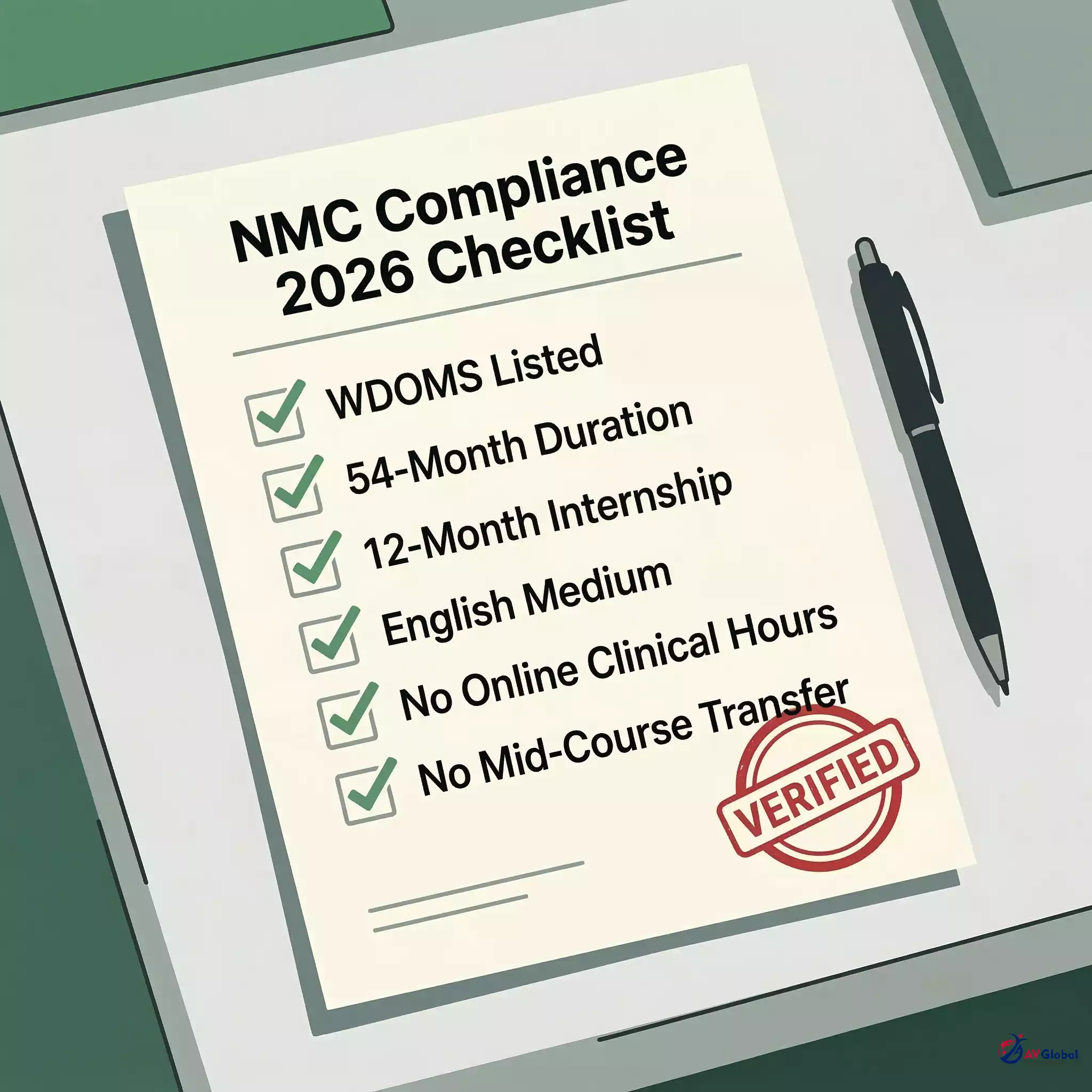
Osh Medical College (University of Central Asia) is fully recognized by the National Medical Commission (NMC) of India and has maintained continuous recognition since 2012. The university is listed in the World Directory of Medical Schools (WDOMS) maintained by the World Federation for Medical Education (WFME) in collaboration with FAIMER, with listing dating to 2010.
Graduates of Osh Medical College are eligible to appear for the Foreign Medical Graduate Examination (FMGE), which is now being replaced by the National Exit Test (NExT) as the uniform licensing examination for all medical graduates in India. As per current NMC regulations, Indian students planning to pursue MBBS abroad must obtain an Eligibility Certificate from NMC before commencing their studies.
This certificate confirms that the foreign medical institution is recognized by NMC and that the student meets eligibility criteria including NEET qualification. Students must also complete the mandatory internship (rotating clinical internship in Year 6) and obtain the internship completion certificate to be eligible for final NMC screening and medical registration in India.
We strongly advise all prospective students and their families to independently verify the current NMC recognition status of Osh Medical College by visiting the official NMC India website at nmc. org.
in and checking the list of recognized foreign medical institutions under the 'Foreign Medical Graduates' section. Recognition status is subject to periodic review by NMC based on inspections, and students should ensure recognition is active at the time of their admission and throughout their course of study.
Year: 2024 | Appeared: 85 | Passed: 30 | Pass Rate: 35. 3% || Year: 2023 | Appeared: 78 | Passed: 26 | Pass Rate: 33.
3% || Year: 2022 | Appeared: 72 | Passed: 24 | Pass Rate: 33.
What Our Students Say
“AV Global guided me from NEET to Kyrgyzstan. The FMGE coaching from Year 3 gave me real confidence. Cleared in the first attempt.”
“AV Global knew every detail about Osh Medical College (University of Central Asia) - visa, hostel, airport pickup. Best decision my family made.”
“Support from AV Global in Kyrgyzstan made everything smooth. The NExT coaching programme is excellent.”
Complete Guide to MBBS at OMC
Frequently Asked Questions
Yes, OMC is listed in WDOMS and recognized by NMC India. Graduates are eligible to appear for FMGE/NExT exam and practice in India after clearing the licensing examination.
The total 6-year MBBS cost at OMC is approximately ₹$30,600 (approx. Rs.
27. 0 Lakhs).
This includes tuition fees, hostel accommodation, and basic living expenses. AV Global provides transparent fee structure with no hidden charges.
OMC teaches MBBS in English medium. Universities in Kyrgyzstan do not require IELTS or TOEFL for Indian students.
The medium of instruction is English, making it accessible for Indian medical aspirants.
Indian students need a valid NEET scorecard to apply for MBBS at OMC. The cutoff varies each year based on seat availability.
Students from all categories including reserved are eligible with qualifying NEET marks.
Osh city has a growing number of restaurants serving Indian cuisine primarily catering to the 800+ Indian medical students studying across various colleges in the city. Prominent Indian restaurants within 10-15 minutes walking distance from Osh Medical College hostels include Spice of India Restaurant on Kurmanjan Datka Street serving North Indian vegetarian and non-vegetarian dishes with thalis priced at 250-400 Som (Rs.
250-400), Taj Mahal Restaurant near Osh Bazaar offering dosas, idlis, parathas and biryanis popular among South Indian students, Delhi Darbar on Lenina Street known for tandoori items and paneer dishes, and Masala House near Navoi Park which runs a lunch tiffin service delivering dabba meals to hostel for 150 Som (Rs. 150) per meal.
Several Indian grocery stores near the central Osh Bazaar stock essentials like Tata Tea, basmati rice brands, MTR ready-to-eat packets, Maggi noodles, Indian spices, pickles, and papad. Students who cook in hostel kitchenettes typically spend Rs.
5,000-9,000 monthly on groceries purchasing rice, lentils, vegetables, cooking oil, and spices from local markets where prices are reasonable. Students eating at restaurants for most meals spend approximately Rs.
10,000-18,000 monthly depending on frequency and choice of dishes. Vegetarian students find adequate options in local Kyrgyzstan cuisine including fresh vegetable soups, baked breads similar to naan, potato dishes, and dairy products like fresh yogurt and cheese widely available.
The university canteen serves basic meals but most Indian students prefer external options for taste familiarity. Many senior students organize weekly group cooking sessions preparing large batches of dal, sabzi, and rice which significantly reduces individual cooking time and costs.
OMC provides well-maintained hostel accommodation for international students. Osh Medical College operates two main hostel buildings located within 400 meters of the main academic campus in the Amir Temur District of Osh city.
The MBBS program at OMC is 6 years including a 1-year internship. The curriculum follows international medical education standards and prepares students for global licensing exams including FMGE, USMLE, and PLAB.
Yes, graduates from OMC can practice in India after clearing the FMGE/NExT licensing exam conducted by NMC. The university has a 35% (2024 estimate) FMGE pass rate.
The degree is recognized for medical practice in India.
Osh is considered a safe city for international students with low violent crime rates, though comprehensive Numbeo data specific to Osh is limited due to the city's smaller size. General crime levels in Osh are low to moderate with petty theft being the most common concern, particularly in crowded bazaar areas and public transport.
Violent crime against international students is extremely rare. The Osh Medical College campus and affiliated hostels operate within gated and guarded compounds with 24-hour security personnel stationed at all entry gates checking IDs of visitors.
CCTV cameras monitor hostel corridors, entry points, and campus perimeters. Female students report feeling safe both on campus and in the Amir Temur District and surrounding neighborhoods near the university where police presence is regular.
The areas around Navoi Park, Kurmanjan Datka Street, and the university zone are well-lit and frequently patrolled. Female students are advised to travel in groups after 9 PM and use registered taxis rather than walking alone at night, which is standard safety practice in any city.
The Indian Embassy in Kyrgyzstan is located in the capital city Bishkek at 212-A Moskovskaya Street, Bishkek 720010, with helpline number +996 312 61 18 62 and emergency mobile +996 551 10 00 10. The Embassy operates a 24-hour emergency helpline for Indian citizens.
Local emergency number in Kyrgyzstan is 112 for police, ambulance, and fire services with some operators speaking basic English. AV Global maintains a dedicated emergency contact +996 555 12 34 56 (local Osh representative) available 24/7 for students facing any urgent situations including medical emergencies, hostel issues, or safety concerns.
Our local team coordinates with university administration, hostel wardens, and Indian Embassy when needed. Students are enrolled in a safety WhatsApp broadcast group where security updates and advisories are shared promptly.
After MBBS from OMC, graduates can practice in India via FMGE/NExT, pursue USMLE for USA, PLAB for UK, or practice in Kyrgyzstan. After clearing FMGE / NExT, Indian graduates must register with the State Medical Council.
PG admissions are via NEET-PG.
Related Articles
Ready to Start Your MBBS Journey?
“AV Global has placed 100+ students at Osh Medical College (University of Central Asia). Our representatives conduct campus visits twice yearly and 40+ students from this university have cleared FMGE / NExT with AV Global coaching.”