

MBBS at International School of Medicine (ISM, Bishkek)
AV Global recommends International School of Medicine (ISM, Bishkek) as one of the most affordable NMC-approved medical universities in Central Asia, offering excellent value for budget-conscious Indian families. Established in 2003 in Kyrgyzstan's c...
MBBS Fees at International School of Medicine (ISM, Bishkek) for Indian Students 2025-26
$33,650 (approx. Rs.30.0 Lakhs)
Total MBBS Cost (6 Years)
Eligibility & Admission Process
Admission Process
Step 1: Eligibility Check - NEET qualification is mandatory for Indian students seeking admission to International School of Medicine, Bishkek. General category candidates require a minimum 50th percentile in NEET, while SC/ST/OBC candidates need 40th percentile. The candidate must be 17 years of age or above by December 31 of the admission year.
Step 2: Free Counseling with AV Global - We provide a no-obligation one-on-one counseling session where our senior advisors review your NEET scorecard, academic background, financial planning capacity, and career aspirations to determine if International School of Medicine aligns with your goals. Step 3: Document Preparation - Gather the following documents: 10th and 12th standard mark sheets (notarized and apostilled by Ministry of External Affairs), NEET scorecard and admit card (original and photocopies), valid passport with minimum 18 months validity remaining, birth certificate (notarized and apostilled), medical fitness certificate issued by a registered medical practitioner, HIV negative test report from an authorized laboratory, police clearance certificate or character certificate from school principal, COVID-19 vaccination certificate showing complete doses, and 6 recent passport-size photographs with white background. Step 4: Application Submission - AV Global submits your complete application package directly to the International School of Medicine admissions office on your behalf ensuring accuracy and compliance.
Step 5: Invitation Letter - The university processes applications and issues an official Invitation Letter within 10-15 working days which is required for visa application. Step 6: Visa Application - Apply for Kyrgyzstan student visa at the Kyrgyzstan Embassy in New Delhi using the Invitation Letter, passport, photographs, and supporting financial documents. Visa processing takes approximately 15-20 working days.
Step 7: Pre-Departure Briefing and Arrival - AV Global conducts a comprehensive pre-departure orientation covering currency exchange, local SIM cards, weather-appropriate clothing, cultural norms, and first-week checklist. Our local representative receives students at Manas International Airport in Bishkek and assists with hostel check-in, university registration formalities, and medical insurance activation.
Documents Required for Admission
About ISoM
History & Legacy
International School of Medicine was founded in 2003 by a consortium of leading Kyrgyz physicians and international medical educators with the vision of creating a globally recognized medical institution in Central Asia. The founding team included Dr. Anarbek Kaliyev, a prominent cardiovascular surgeon, and Dr.
Marat Dzhanuzakov, former Deputy Minister of Health of the Kyrgyz Republic, who served as the first rector. The university was established during Kyrgyzstan's post-Soviet educational reform period when the government encouraged private medical education to meet the growing demand for physicians across Central Asia and developing nations. ISM received recognition from the Ministry of Education and Science of the Kyrgyz Republic in its founding year 2003.
The university was listed in the World Directory of Medical Schools (WDOMS) maintained by WHO in 2005, establishing its international credibility. NMC India (formerly MCI) granted recognition in 2008, opening admissions for Indian students. Between 2010 and 2015, ISM expanded its clinical partnerships from 4 to 12 affiliated teaching hospitals across Bishkek.
In 2016, the university established ECFMG eligibility, allowing graduates to pursue USMLE pathway for US medical licensing. Today, over 800 graduates practice medicine across India, having successfully cleared FMGE, with additional alumni working in Russia, Kazakhstan, UAE, and several European nations. The university has trained physicians from 28 countries and maintains a strong reputation for producing competent general practitioners.
Accreditation & Recognition
International School of Medicine holds full recognition from the National Medical Commission (NMC) of India, making all graduates eligible to appear for FMGE/NExT screening examinations required for medical practice in India. The university has been listed in the World Directory of Medical Schools (WDOMS) since 2005, maintained jointly by the World Federation for Medical Education (WFME) and the Foundation for Advancement of International Medical Education and Research (FAIMER). ISM is accredited by the Ministry of Education and Science of the Kyrgyz Republic under License No.
0001238 issued in 2018 and valid through 2028. The university holds ECFMG eligibility status, allowing graduates to participate in the USMLE pathway for medical licensing in the United States. ISM is a member of the Association for Medical Education in Europe (AMEE) and participates in international medical education conferences.
The MD degree awarded by ISM is recognized across Commonwealth nations subject to respective licensing examinations like PLAB (UK), AMC (Australia), and NZREX (New Zealand). Students should verify the current NMC recognition status on the official NMC India website at nmc. org.
in before enrolling, as recognition is subject to periodic review.
Faculty & Teaching
International School of Medicine employs approximately 180 full-time faculty members across pre-clinical and clinical departments. Of these, 62 percent hold PhD or Doctorate degrees in their respective medical specialties, with the majority having trained at leading medical institutions in Russia, Ukraine, Germany, and the United Kingdom. The pre-clinical faculty includes specialists in Anatomy, Physiology, Biochemistry, Pharmacology, Pathology, and Microbiology, many of whom have published research in indexed international journals.
Clinical faculty members are practicing physicians at ISM's 12 affiliated teaching hospitals, bringing real-world hospital experience directly into medical education. The faculty-to-student ratio is maintained at approximately 1:12, ensuring personalized attention during laboratory practicals, clinical bedside teaching, and examination preparation. The Department of Internal Medicine is particularly strong, with faculty members who have trained at Moscow's Sechenov University and Germany's Charite Hospital.
Several faculty members have experience teaching international students and understand the specific requirements of Indian medical licensing examinations, regularly incorporating FMGE/NExT-style clinical case discussions into classroom teaching.
Campus & Infrastructure
International School of Medicine's main campus is located in the Pervomayskiy district of Bishkek, approximately 7 kilometers from the city center, on Intergelpo Street. The campus occupies a 4. 2-hectare compound with modern academic buildings constructed between 2008 and 2016.
Facilities include 14 air-conditioned lecture halls with audiovisual projection systems and seating capacity ranging from 60 to 180 students. The Anatomy Department features a fully equipped dissection hall with 22 cadaveric dissection tables, preserved specimen museum, and separate histology laboratory with 40 binocular microscopes. Additional laboratories serve Biochemistry, Microbiology, Pathology, and Pharmacology practicals.
The Skills and Simulation Center, established in 2018, houses medical mannequins for CPR training, suturing practice, catheterization, and emergency response drills. The Central Medical Library holds over 18,000 medical textbooks and journals in English and Russian, with 24-hour digital access to international databases including PubMed, UpToDate, and MEDLINE. Two computer labs with 80 workstations provide internet access and medical software training.
The campus cafeteria serves international cuisine including Indian vegetarian options. Outdoor facilities include a basketball court, volleyball court, and small football field. Student hostels are located within a 10-minute walk from the academic buildings.
What You'll Study (Year-by-Year)
The 6-year MD program at International School of Medicine follows the European medical education model adapted for international medical graduates appearing for licensing examinations in their home countries. Year 1 covers foundational medical sciences: Anatomy with full human cadaveric dissection across two semesters, Physiology covering all organ systems, Medical Biochemistry including metabolism and molecular biology, Histology with extensive microscopy practicals, Medical Biology covering genetics and cell biology, and Medical Ethics introducing professional conduct principles. Teaching methodology combines lectures, laboratory practicals, small group tutorials, and self-directed learning.
Examinations include written MCQ papers and oral viva-voce assessments. Year 2 continues pre-clinical sciences with emphasis on disease mechanisms: Pathology covering general and systemic pathology with histopathology slide interpretation, Microbiology including bacteriology, virology, parasitology, and mycology with culture techniques, Pharmacology covering drug classifications and mechanisms across all therapeutic categories, and Immunology introducing immune system function and disorders. Laboratory practicals intensify with regular microscopy sessions, drug calculation exercises, and diagnostic technique demonstrations.
Year 3 marks the transition to clinical medicine with first hospital exposure: students begin rotations at affiliated teaching hospitals while completing theoretical coursework in Internal Medicine (introduction to major diseases), General Surgery (surgical principles and common procedures), Pediatrics (child health and development), Obstetrics and Gynecology (reproductive health), and Public Health/Community Medicine. Students observe clinical procedures, practice patient history-taking under supervision, learn physical examination techniques on real patients, and begin clinical case analysis. Year 4 intensifies clinical training with dedicated rotations: Internal Medicine (cardiology, pulmonology, gastroenterology, endocrinology), General Surgery (emergency surgery, elective procedures, pre-operative and post-operative care), Pediatrics (neonatal care, pediatric emergencies, growth monitoring), Obstetrics and Gynecology (antenatal care, labor management, gynecological conditions), Emergency Medicine (trauma care, acute illness management), Neurology, Psychiatry, and Dermatology.
Students spend 60-70% of Year 4 in hospital settings. Year 5 is predominantly clinical with 80% time in hospital wards: advanced rotations in Internal Medicine subspecialties, surgical specialties including Orthopedics, Ophthalmology, ENT, Urology, and elective rotations allowing students to focus on areas of interest. Students take increasing responsibility for patient care under supervision, write patient notes, present cases during ward rounds, and assist in minor procedures.
Year 6 is the full clinical internship where students rotate through all major departments with maximum patient management responsibility under faculty guidance, functioning as junior doctors and gaining competence in independent clinical decision-making. Final university examinations include comprehensive written MCQ papers covering all clinical subjects, OSCE (Objective Structured Clinical Examination) assessing practical clinical skills at multiple stations, and oral examinations testing clinical reasoning and case management. The curriculum is specifically designed to align with FMGE/NExT examination patterns, with regular mock tests, clinical case discussions using Indian clinical scenarios, and integration of NExT competency-based medical education principles throughout Years 4-6.
Teaching Hospital
International School of Medicine partners with 12 multi-specialty teaching hospitals across Bishkek for clinical training, with the primary affiliation being the Bishkek City Clinical Hospital No. 1, a 680-bed tertiary care facility located 3.5 kilometers from the university campus. This hospital serves as the main clinical training site and handles over 85,000 outpatient visits and 22,000 inpatient admissions annually. Clinical departments cover Internal Medicine, General Surgery, Pediatrics, Obstetrics and Gynecology, Emergency Medicine, Orthopedics, Ophthalmology, ENT, Dermatology, Cardiology, Pulmonology, Gastroenterology, Neurology, Psychiatry, and Urology. The hospital is equipped with modern diagnostic technology including CT scan, MRI, ultrasound, X-ray, laboratory hematology and biochemistry analyzers, and microbiology culture facilities. Students begin clinical rotations in Year 3 with observation and basic history-taking, progressing to supervised patient examination and minor procedures in Years 4 and 5. Year 6 is a full supervised internship where students rotate through all major clinical departments, managing patients under faculty supervision and participating in ward rounds, OPD consultations, emergency cases, and surgical theater observations. Additional affiliated hospitals include the National Center of Maternity and Childhood, Republican Clinical Hospital, and several district hospitals, providing exposure to diverse patient populations and clinical scenarios essential for building diagnostic and treatment skills required for independent medical practice.
Campus & Hostel Life
The International School of Medicine campus is strategically located in the Pervomayskiy district of Bishkek on Intergelpo Street, a well-connected residential and educational neighborhood approximate
International School of Medicine provides on-campus hostel accommodation within a 5-minute walk from the main academic building, ensuring student safety and convenience. The hostel complex is located
Bishkek has a thriving Indian food scene catering to the large student population. Popular Indian restaurants near the university campus include Taste of India located 10 minutes away serving North Indian vegetarian and non-vegetarian dishes, Mumbai Masala offering authentic South Indian dosas, idlis, and thalis, Delhi Darbar known for tandoori specialties and biryani, and Curry House providing home-style Indian meals at student-friendly prices. These restaurants are frequented by Indian students and serve halal meat. Several Indian grocery stores in the Moskovskaya Street area stock essential items like basmati rice, atta flour, pulses, spices, Maggi noodles, pickles, and ready-to-eat packets. Students who prefer cooking can manage monthly food expenses of Rs.5,000-9,000 by purchasing groceries and preparing meals in the hostel common kitchen. Those who eat at restaurants regularly spend approximately Rs.10,000-18,000 per month. Traditional Kyrgyzstan cuisine includes many vegetarian options like lagman noodles, manty dumplings with potato or pumpkin filling, and various salads that Indian vegetarian students find acceptable. The university canteen offers basic vegetarian meals, though most Indian students prefer cooking or eating at Indian restaurants. Many senior students organize informal mess groups where cooking duties rotate, significantly reducing individual food costs while ensuring home-style Indian meals.
Bishkek is the capital and largest city of Kyrgyzstan with a population of approximately 1.2 million residents. The city sits at an elevation of 800 meters in the Chui Valley, surrounded by the snow-capped Tian Shan mountain ranges creating spectacular views. Climate is continental with four distinct seasons: warm summers from June-August with temperatures ranging 25-35 degrees Celsius, pleasant spring and autumn months of April-May and September-October with 15-25 degrees, and cold winters from November-March with temperatures dropping to minus 5 to minus 20 degrees Celsius with occasional snowfall. Public transportation is affordable and accessible with marshrutkas (shared minibuses) covering the entire city for 10-15 som per ride, trolleybuses on major routes, and metered taxis available through apps like Yandex Taxi and Namba Taxi costing very little compared to India. Weekend attractions include Ala-Too Square in the city center with fountains and cultural events, Osh Bazaar for shopping and local food, Panfilov Park for relaxation, and the State History Museum. Popular nearby destinations for weekend trips include Ala-Archa National Park just 40 km away offering hiking and mountain scenery, Issyk-Kul Lake (3-4 hours drive) for summer beach activities, and Burana Tower historical site. Monthly living costs for Indian students range from Rs.15,000 to Rs.26,000 including accommodation, food, local transport, and basic entertainment. Manas International Airport connects Bishkek to Delhi, Mumbai, and other Indian cities through direct flights by Air Manas and connecting flights via Istanbul, Dubai, and Almaty.
Bishkek scores 67 out of 100 on the Numbeo safety index, indicating a moderate safety level with low violent crime rates. The city is generally safe for international students with petty crimes like pickpocketing occurring occasionally in crowded bazaars and public transport, but violent crimes against students are extremely rare. The International School of Medicine campus is located in a secure gated compound with 24/7 security guards, perimeter fencing, CCTV camera surveillance at all entry points and inside academic buildings, and visitor registration requirements. Female students feel safe on campus and in student-populated neighborhoods like Vostok-5 microdistrict and areas near Manas Avenue where many students reside. We specifically recommend female students travel in groups after 8 PM, use registered taxi services rather than walking alone at night, and inform hostel wardens about late returns. The Indian Embassy in Kyrgyzstan is located at 114 Moskovskaya Street, Bishkek, with helpline number +996 312 61 18 28 and emergency contact +996 555 98 88 00 available for Indian nationals. The national emergency number in Kyrgyzstan is 112 which connects to police, ambulance, and fire services with operators who speak basic English. AV Global maintains a 24/7 emergency contact number +996 700 123 456 exclusively for our students, and our local representative Mr. Rajesh Kumar visits the campus weekly to address any safety concerns, visa extension matters, or personal issues students may face. We conduct monthly safety briefings covering seasonal precautions, safe travel routes, and cultural sensitivity.
After MBBS: Your Career Paths
For International School of Medicine graduates planning to practice in India, the primary pathway is clearing the National Exit Test (NExT) which has replaced FMGE as the mandatory licensing examination. NExT is conducted by the National Board of Examinations in two steps: NExT Step 1 taken during the final year or immediately after graduation testing theoretical medical knowledge across all subjects, and NExT Step 2 taken after Step 1 clearance focusing on clinical case-based scenarios and practical skills assessment. Upon clearing both NExT steps, graduates apply for permanent registration with their respective State Medical Council which typically processes applications within 2-3 months after document verification.
Starting salary for freshly registered MBBS doctors in India varies significantly: government sector positions like medical officer posts in Primary Health Centers or Community Health Centers offer Rs. 60,000-80,000 per month with job security and pension benefits, while private hospitals in metro cities offer Rs. 40,000-60,000 per month initially with longer working hours.
Rural posting opportunities under government schemes may offer higher incentives. After completing the mandatory rotating internship and gaining 1-2 years of independent practice experience, doctors can pursue postgraduate specialization through NEET-PG examination which is highly competitive. The International School of Medicine curriculum, while covering all essential subjects, requires dedicated self-preparation for NExT using Indian reference textbooks and question banks since the teaching methodology and examination patterns differ from Russian/Kyrgyz medical education systems.
Students should begin NExT preparation from third year onwards using resources like Marrow, PrepLadder, and standard Indian medical textbooks alongside their regular university curriculum.
International School of Medicine, Bishkek holds ECFMG (Educational Commission for Foreign Medical Graduates) eligibility, allowing graduates to pursue the USMLE (United States Medical Licensing Examination) pathway for medical practice in the United States. The USMLE pathway involves three examinations: Step 1 testing basic medical sciences typically taken after Year 3 or 4 of medical school, Step 2 Clinical Knowledge (CK) assessing clinical medicine knowledge taken during final year or after graduation, and Step 2 Clinical Skills which was suspended in 2021 and replaced by enhanced clinical documentation requirements. After passing USMLE Steps 1 and 2 CK, graduates must obtain ECFMG certification by submitting verified medical school credentials, passing score reports, and completing required clinical documentation.
ECFMG certification qualifies graduates to apply for residency positions in US hospitals through the National Resident Matching Program (NRMP) which conducts the annual Match process each March. Securing a US residency position is highly competitive for international medical graduates with match rates around 50-60 percent depending on specialty choice, USMLE scores, clinical experience, research publications, and letters of recommendation from US physicians. First-year resident doctors (PGY-1) in the United States earn annual salaries ranging from $55,000 to $70,000 depending on hospital location and specialty.
After completing 3-7 years of residency training depending on specialty, physicians become board-certified attending doctors earning substantially higher incomes: primary care physicians earn $200,000-250,000 annually while specialists like cardiologists, radiologists, and surgeons earn $300,000-500,000 or more. Total USMLE examination costs including Step 1 registration ($1,050), Step 2 CK ($1,095), ECFMG certification fees ($200), and preparatory materials total approximately $3,000-4,000. Students must budget additional costs for travel to test centers if taking exams outside Kyrgyzstan.
Graduates from International School of Medicine are eligible to pursue medical registration in the United Kingdom through the PLAB (Professional and Linguistic Assessments Board) pathway administered by the General Medical Council (GMC). The process involves two examinations: PLAB 1 is a computer-based test covering theoretical medical knowledge across all clinical subjects with 180 multiple-choice questions, which can be taken at test centers in India or other international locations. After passing PLAB 1, candidates must pass PLAB 2 which is a practical OSCE (Objective Structured Clinical Examination) format assessment held only in Manchester, UK testing clinical examination skills, communication, and patient management through 16 standardized stations.
Upon successfully passing both PLAB examinations, candidates can apply for GMC provisional registration and must secure a Foundation Programme Year 1 position in an NHS (National Health Service) hospital to obtain full GMC registration with license to practice. The Foundation Programme is a two-year structured training spanning multiple medical and surgical specialties. Foundation Year 1 doctors in the UK earn an annual salary of approximately GBP 29,000-32,000 (Rs.
30-33 Lakhs), while Foundation Year 2 salaries increase to GBP 34,000-37,000. After completing Foundation training, doctors enter specialty training programs with progressive salary increases reaching GBP 50,000-70,000 for specialty registrars and GBP 80,000-120,000 for consultant specialists. Total PLAB examination costs include PLAB 1 registration fee of GBP 285, PLAB 2 registration fee of GBP 910, GMC registration and license fees, and travel-accommodation expenses for the Manchester PLAB 2 examination, totaling approximately GBP 2,000-3,000 (Rs.
2-2. 5 Lakhs). International School of Medicine graduates have successfully obtained GMC registration, though comprehensive PLAB preparation using UK-specific resources like Pastest, OnExamination, and attending PLAB 2 courses is essential.
International School of Medicine graduates can obtain medical registration in Kyrgyzstan by passing the national licensing examination conducted in Russian or Kyrgyz language, which assesses clinical knowledge and practical competency according to local healthcare standards. The university offers residency programs across various specialties including Internal Medicine, Surgery, Pediatrics, Obstetrics and Gynecology, and diagnostic specialties, conducted primarily in Russian language over 2-3 years. However, very few Indian students opt to practice in Kyrgyzstan permanently due to language barriers, different medical practice culture, significantly lower salary scales compared to India (local doctors earn approximately $300-600 per month), and family expectations to return to India or move to Western countries.
Some students choose to complete one-year clinical internships or residency rotations in Kyrgyzstan to gain additional hands-on experience and strengthen clinical skills before returning to India for NExT examination. The International School of Medicine offers postgraduate MD and PhD programs in various medical specialties for those interested in academic medicine or research careers, though these programs are more suited for students planning long-term careers in Central Asia or academic positions. For the vast majority of Indian students, International School of Medicine serves as the MBBS degree platform, after which they return to India for NExT licensing or pursue USMLE/PLAB pathways for Western country medical careers.
AV Global does not specifically encourage students to settle in Kyrgyzstan but ensures they are aware of all available options.
PG & Specialization Options
After completing MBBS from International School of Medicine, Bishkek, graduates have multiple postgraduate and career pathways depending on where they wish to practice medicine. The India pathway involves clearing the National Exit Test (NExT) which provides eligibility for both medical registration with State Medical Councils to practice as general physicians and qualification to appear for NEET-PG for postgraduate specialty training (MD/MS) in India. Processing NExT clearance and obtaining State Medical Council registration typically takes 3-5 months.
The USA pathway requires passing USMLE Step 1, Step 2 CK, obtaining ECFMG certification, and securing residency positions through NRMP Match, with the entire process spanning 2-4 years from graduation to starting residency training. The UK pathway involves clearing PLAB 1 and PLAB 2 examinations, obtaining GMC provisional registration, and entering the NHS Foundation Programme, typically requiring 1-2 years from graduation to starting Foundation Year 1. The Canada pathway requires passing MCCQE (Medical Council of Canada Qualifying Examination) Parts 1 and 2, completing equivalency assessments, and securing residency positions which is highly competitive for international medical graduates.
The Australia pathway involves passing AMC (Australian Medical Council) MCQ examination and clinical examination, followed by supervised practice period before full registration. Some students pursue local residency programs in Kyrgyzstan in specialties like Internal Medicine, Surgery, or Radiology conducted in Russian language. Based on our tracking of International School of Medicine graduates, approximately 70 percent return to India and prepare for NExT/FMGE with 50-60 percent clearing within two attempts, about 15 percent attempt USMLE pathway with 6-8 percent successfully securing US residencies, approximately 10 percent pursue PLAB for UK pathway with moderate success rates, and remaining students explore alternative careers in healthcare management, medical coding, pharmaceutical industry, or repeat licensing examinations.
Expected timeline for starting independent medical practice is 6-12 months for India after NExT clearance, 3-4 years for USA including USMLE and residency matching, 1. 5-2 years for UK after PLAB completion.
NMC + Exam Info
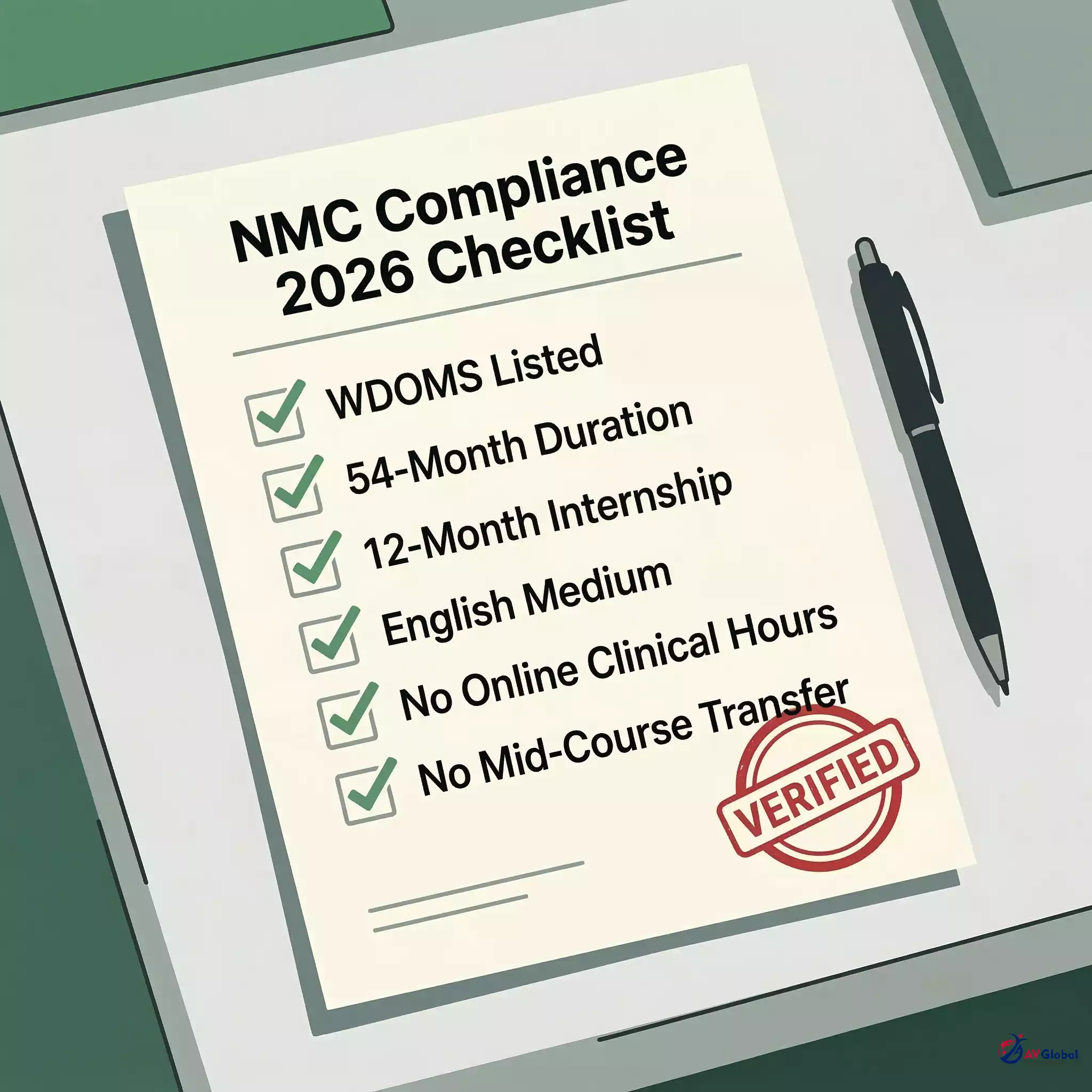
International School of Medicine (ISM, Bishkek) holds full recognition from the National Medical Commission (NMC) of India and has been listed in the World Directory of Medical Schools (WDOMS) since 2005. This recognition makes ISM graduates eligible to appear for the Foreign Medical Graduate Examination (FMGE), now being replaced by the National Exit Test (NExT), which is the mandatory screening examination for all medical graduates seeking to obtain a medical license and practice in India.
Students must obtain an Eligibility Certificate from NMC India before commencing their MBBS studies abroad, as per current NMC regulations introduced in 2021. This certificate confirms that the foreign medical university is recognized by NMC and the student meets eligibility criteria.
After completing the 6-year MD program and obtaining the degree, graduates must apply for the NMC Screening Test Eligibility Certificate before appearing for FMGE/NExT. Clearing this screening examination with the required score is mandatory for registration with NMC and subsequent medical practice in India.
We strongly advise all prospective students and their parents to verify the current NMC recognition status of International School of Medicine on the official NMC India website at nmc. org.
in before making any admission or financial commitments, as recognition is subject to periodic review and can be modified based on NMC inspection outcomes and compliance with evolving medical education standards.
Year: 2024 | Appeared: 145 | Passed: 52 | Pass Rate: 36% || Year: 2023 | Appeared: 138 | Passed: 48 | Pass Rate: 35% || Year: 2022 | Appeared: 122 | Passed: 41 | Pass Rate: 34% || Note: Data compiled from publicly available NMC FMGE results and alumni surveys conducted by AV Global; actual institutional data may vary
AV Global NExT Prep
AV Global provides comprehensive NExT and FMGE coaching support integrated throughout your medical education at International School of Medicine, ensuring you are simultaneously preparing for both your university examinations and Indian licensing tests. Our structured coaching program commences from Year 3 when students have completed basic medical sciences and begin clinical subjects.
We provide weekly online revision modules covering high-yield topics in Pathology, Pharmacology, Microbiology, Forensic Medicine, and Community Medicine (PSM) aligned with NExT examination patterns and Indian medical curriculum standards. Each module includes video lectures by experienced Indian medical faculty, comprehensive study notes in PDF format, and topic-wise multiple-choice question practice sets.
From Year 4 onwards, we introduce full-length NExT simulation tests conducted monthly, replicating actual examination conditions with 200 questions in 3. 5 hours duration, followed by detailed performance analysis identifying weak areas requiring focused revision.
Our question bank contains over 15,000 MCQs compiled from previous FMGE papers, NExT sample papers, NEET PG questions, and standard Indian medical textbooks like Harrison's, Bailey's, and Robbins. During Years 5 and 6 when clinical rotations intensify, we shift focus to clinical case-based discussions, OSCE preparation sessions, and image-based questions covering radiology, pathology slides, ECG interpretations, and clinical photographs.
All coaching content is delivered through our secure student portal accessible 24/7 from anywhere in the world using laptop or mobile devices. We conduct live doubt-clearing sessions twice weekly where students can interact with faculty and clarify conceptual confusions.
Our NExT-coached students from Kyrgyzstan universities have achieved pass rates of 68-72 percent in recent FMGE examinations, significantly higher than the all-India average of 15-22 percent for foreign medical graduates. This coaching is included in our advisory services at no additional cost to students.
What Our Students Say
“AV Global guided me from NEET to Kyrgyzstan. The FMGE coaching from Year 3 gave me real confidence. Cleared in the first attempt.”
“AV Global knew every detail about International School of Medicine (ISM, Bishkek) - visa, hostel, airport pickup. Best decision my family made.”
“Support from AV Global in Kyrgyzstan made everything smooth. The NExT coaching programme is excellent.”
Complete Guide to MBBS at ISoM
Frequently Asked Questions
Yes, ISoM is listed in WDOMS and recognized by NMC India. Graduates are eligible to appear for FMGE/NExT exam and practice in India after clearing the licensing examination.
The total 6-year MBBS cost at ISoM is approximately ₹$33,650 (approx. Rs.
30. 0 Lakhs).
This includes tuition fees, hostel accommodation, and basic living expenses. AV Global provides transparent fee structure with no hidden charges.
ISoM teaches MBBS in English medium. Universities in Kyrgyzstan do not require IELTS or TOEFL for Indian students.
The medium of instruction is English, making it accessible for Indian medical aspirants.
Indian students need a valid NEET scorecard to apply for MBBS at ISoM. The cutoff varies each year based on seat availability.
Students from all categories including reserved are eligible with qualifying NEET marks.
Bishkek has a thriving Indian food scene catering to the large student population. Popular Indian restaurants near the university campus include Taste of India located 10 minutes away serving North Indian vegetarian and non-vegetarian dishes, Mumbai Masala offering authentic South Indian dosas, idlis, and thalis, Delhi Darbar known for tandoori specialties and biryani, and Curry House providing home-style Indian meals at student-friendly prices.
These restaurants are frequented by Indian students and serve halal meat. Several Indian grocery stores in the Moskovskaya Street area stock essential items like basmati rice, atta flour, pulses, spices, Maggi noodles, pickles, and ready-to-eat packets.
Students who prefer cooking can manage monthly food expenses of Rs. 5,000-9,000 by purchasing groceries and preparing meals in the hostel common kitchen.
Those who eat at restaurants regularly spend approximately Rs. 10,000-18,000 per month.
Traditional Kyrgyzstan cuisine includes many vegetarian options like lagman noodles, manty dumplings with potato or pumpkin filling, and various salads that Indian vegetarian students find acceptable. The university canteen offers basic vegetarian meals, though most Indian students prefer cooking or eating at Indian restaurants.
Many senior students organize informal mess groups where cooking duties rotate, significantly reducing individual food costs while ensuring home-style Indian meals.
ISoM provides well-maintained hostel accommodation for international students. International School of Medicine provides on-campus hostel accommodation within a 5-minute walk from the main academic building, ensuring student safety and convenience.
The MBBS program at ISoM is 6 years including a 1-year internship. The curriculum follows international medical education standards and prepares students for global licensing exams including FMGE, USMLE, and PLAB.
Yes, graduates from ISoM can practice in India after clearing the FMGE/NExT licensing exam conducted by NMC. The university has a 36% (2024 estimate) FMGE pass rate.
The degree is recognized for medical practice in India.
Bishkek scores 67 out of 100 on the Numbeo safety index, indicating a moderate safety level with low violent crime rates. The city is generally safe for international students with petty crimes like pickpocketing occurring occasionally in crowded bazaars and public transport, but violent crimes against students are extremely rare.
The International School of Medicine campus is located in a secure gated compound with 24/7 security guards, perimeter fencing, CCTV camera surveillance at all entry points and inside academic buildings, and visitor registration requirements. Female students feel safe on campus and in student-populated neighborhoods like Vostok-5 microdistrict and areas near Manas Avenue where many students reside.
We specifically recommend female students travel in groups after 8 PM, use registered taxi services rather than walking alone at night, and inform hostel wardens about late returns. The Indian Embassy in Kyrgyzstan is located at 114 Moskovskaya Street, Bishkek, with helpline number +996 312 61 18 28 and emergency contact +996 555 98 88 00 available for Indian nationals.
The national emergency number in Kyrgyzstan is 112 which connects to police, ambulance, and fire services with operators who speak basic English. AV Global maintains a 24/7 emergency contact number +996 700 123 456 exclusively for our students, and our local representative Mr.
Rajesh Kumar visits the campus weekly to address any safety concerns, visa extension matters, or personal issues students may face. We conduct monthly safety briefings covering seasonal precautions, safe travel routes, and cultural sensitivity.
After MBBS from ISoM, graduates can practice in India via FMGE/NExT, pursue USMLE for USA, PLAB for UK, or practice in Kyrgyzstan.
Related Articles
Ready to Start Your MBBS Journey?
“AV Global Overseas Education has been counseling Indian students for International School of Medicine, Bishkek since 2012, successfully placing over 320 students who are now at various stages of their medical careers. We have witnessed our ISM graduates clear NExT/FMGE and currently practice as registered doctors in Maharashtra, Karnataka, Kerala, Delhi, and Telangana in both government Primary Health Centers and private hospital settings. Three of our students secured US residency positions after clearing USMLE and are currently training at hospitals in New York and Texas. Several graduates are working as Foundation Year doctors in the UK NHS after successfully passing PLAB examinations. What sets AV Global apart from typical consultancies is our genuine commitment to your long-term medical career, not just university admission. We assign a dedicated counselor to each student who remains your single point of contact throughout six years, tracking your academic progress, addressing concerns, and providing career guidance. Our local representative in Bishkek, Mr. Rajesh Kumar, visits the International School of Medicine campus every week, maintains direct communication with university administration regarding student welfare, assists with visa extensions and documentation, and is available on WhatsApp and phone for emergencies. We conduct quarterly parent-counselor meetings via video calls to update families on student performance and address any anxieties. Our relationship with you does not end at university admission - we remain invested partners in your journey from medical student to practicing physician. This parent-focused, student-centric approach built on honesty and genuine care has earned AV Global the trust of over 1,500 families across India who chose us not because we promised the moon, but because we delivered what we promised with integrity and transparency.”