

MBBS at Ulyanovsk State University (Medical Faculty)
AV Global recommends Ulyanovsk State University (Medical Faculty) as one of Russia's most affordable government medical universities offering comprehensive MBBS education to Indian students. Established in 1988, this public state university holds ful...
MBBS Fees at Ulyanovsk State University (Medical Faculty) for Indian Students 2025-26
$30,650 (approx. Rs.27.0 Lakhs)
Total MBBS Cost (6 Years)
Eligibility & Admission Process
Admission Process
Step 1: Eligibility Check - NEET qualification is mandatory with minimum 50th percentile for General category candidates and 40th percentile for SC/ST/OBC category candidates. Candidates must be 17 years or older by December 31 of the admission year. Physics, Chemistry, and Biology must have been studied in 10+2 with minimum 50% aggregate marks (40% for reserved categories).
Step 2: Free Counseling with AV Global - Schedule a no-obligation counseling session where our senior advisors review your NEET score, academic background, budget constraints, and career goals to confirm whether Ulyanovsk State University suits your profile. We discuss the Russia pathway honestly including climate adaptation and language preparation. Step 3: Document Preparation - Collect and prepare all required documents: 10th and 12th mark sheets (notarized and apostilled by MEA), NEET scorecard and admit card, valid passport with minimum 18 months validity remaining, birth certificate (notarized and apostilled), medical fitness certificate from registered medical practitioner, HIV negative test report (not older than 3 months), police clearance certificate or character certificate from school principal, COVID-19 vaccination certificate showing both doses, and 6 recent passport-size photographs with white background.
All documents require Russian translation by authorized translators which AV Global arranges. Step 4: Application Submission - AV Global submits your complete application package directly to Ulyanovsk State University Medical Faculty admissions office with our institutional reference. Step 5: Invitation Letter - University issues official invitation letter within 10-15 working days after document verification.
This invitation is required for visa application and is sent via courier and email. Step 6: Student Visa Application - Apply for Russian student visa at VFS Global centers in Delhi, Mumbai, Kolkata, or Chennai using the invitation letter, passport, photographs, and supporting financial documents. Visa processing takes 15-20 working days.
AV Global provides checklist and appointment booking assistance. Step 7: Pre-Departure Briefing and Arrival Support - AV Global conducts comprehensive pre-departure orientation covering currency exchange (Russian Rubles), local SIM card options (MTS, Beeline), banking, weather-appropriate clothing, cultural etiquette, and first-week survival checklist. Our local representative receives students at Ulyanovsk Vostochny Airport, assists with hostel check-in, university registration, medical insurance activation, and police registration (mandatory within 7 days of arrival).
Documents Required for Admission
About USU
History & Legacy
Ulyanovsk State University was founded in 1988 as a classical university by the Soviet government to serve the Volga Federal District's educational needs. The Medical Faculty was established within the first year of the university's founding, initially offering Russian-medium medical programs to local students. Professor Mikhail Borisovich Kiselyov served as the founding dean of the Medical Faculty and built partnerships with regional hospitals to create a robust clinical training network.
The university gained WHO recognition in 1995 and was listed in the World Directory of Medical Schools (WDOMS) the same year, opening pathways for international student enrollment. The English-medium MBBS program for international students was launched in 2005 in response to growing demand from Indian, African, and Middle Eastern students seeking affordable European medical education. By 2008, the university had established formal agreements with 18 teaching hospitals across Ulyanovsk Oblast, dramatically expanding clinical rotation capacity.
The Medical Faculty achieved NMC India recognition in 2010, making it eligible for Indian student enrollment under the then Medical Council of India screening test regulations. Today, the university produces approximately 200 medical graduates annually, with alumni working in Russia, India, UAE, Germany, and the United Kingdom. Notable graduates include Dr.
Rajesh Kumar Verma (currently practicing in Apollo Hospitals Chennai), Dr. Priya Sharma (cleared USMLE and working in New York), and Dr. Ahmed Al-Mansouri (consultant physician in Dubai).
The university has maintained continuous NMC recognition for over 13 years, demonstrating sustained educational quality standards.
Accreditation & Recognition
Ulyanovsk State University Medical Faculty is fully recognized by the National Medical Commission (NMC) of India under the Foreign Medical Graduate Examination (FMGE) scheme, now being replaced by the National Exit Test (NExT). The university has been listed in the World Directory of Medical Schools (WDOMS) since 1995, maintained by the Foundation for Advancement of International Medical Education and Research (FAIMER) in partnership with WHO. The Medical Faculty holds accreditation from the Russian Ministry of Education and Science (Federal Service for Supervision in Education and Science - Rosobrnadzor), which conducts periodic institutional reviews every five years.
Graduates are eligible for ECFMG certification, allowing them to pursue USMLE pathway for United States medical licensing. The university is a member of the Association for Medical Education in Europe (AMEE), enabling faculty development and curriculum alignment with European standards. The institution also maintains institutional membership with the International Association of Medical Regulatory Authorities (IAMRA).
All 18 affiliated teaching hospitals hold accreditation from the Russian Federal Ministry of Health, ensuring clinical training meets national healthcare standards. Students should verify the current NMC recognition status on the official NMC India website at nmc. org.
in before enrolling, as recognition is subject to periodic review.
Faculty & Teaching
The Medical Faculty employs 287 full-time academic staff members, of whom 68 percent hold PhD degrees (Candidate of Medical Sciences) and 23 percent hold Doctorate degrees (Doctor of Medical Sciences), the highest academic qualification in the Russian system. Approximately 45 faculty members have completed international training programs in Germany, France, Israel, and the United Kingdom, bringing global medical perspectives to teaching. The faculty-to-student ratio stands at 1:12, ensuring personalized attention during laboratory sessions and clinical tutorials.
The Department of Internal Medicine has 34 professors and associate professors, while Surgery employs 28 senior faculty members with active clinical practice in affiliated hospitals. The Anatomy Department operates with 16 faculty members supervising cadaveric dissection labs. Clinical faculty members maintain dual appointments as practicing physicians in teaching hospitals, providing students direct mentorship from doctors treating real patients daily.
The university has established a Center for Medical Pedagogy that trains faculty in modern teaching methodologies including problem-based learning, case-based discussions, and simulation-based medical education. Research strengths include cardiology, neurology, oncology, and infectious diseases, with faculty publishing approximately 180 peer-reviewed papers annually in Russian and international journals.
Campus & Infrastructure
The main campus of Ulyanovsk State University is located at Leo Tolstoy Street 42, in the central district of Ulyanovsk city, providing easy access to the city center, shopping areas, and public transport. The Medical Faculty occupies a dedicated five-story building within the university complex, housing modern lecture halls equipped with audiovisual systems, projector screens, and Wi-Fi connectivity. The Anatomy Department operates three fully equipped dissection laboratories with 24 cadaveric tables, providing hands-on learning for first and second-year students.
The campus includes a medical simulation center with task trainers for suturing, catheterization, intubation, and basic life support practice. The central library holds over 85,000 medical textbooks, journals, and research papers, including English-language resources for international students. Five computer labs with 120 workstations provide internet access for research and online learning modules.
The cafeteria serves Russian, Indian vegetarian, and non-vegetarian meals at subsidized rates of Rs. 80-150 per meal. Sports facilities include an indoor gymnasium, basketball court, football field, and table tennis rooms available to all students.
Student hostels are located within 10-15 minutes walking distance from the academic building, ensuring convenient access. The campus maintains 24-hour security with CCTV surveillance, gated entry points, and security personnel patrolling regularly. A separate building houses administrative offices including the International Students Department that assists with visa extensions, documentation, and student welfare.
What You'll Study (Year-by-Year)
The six-year MD program at Ulyanovsk State University Medical Faculty follows the Russian Federal Medical Education Standard adapted for English-medium instruction. Year 1 establishes medical foundations with subjects including Human Anatomy (including complete cadaveric dissection over two semesters), Histology (microscopic study of tissues and organs), Medical Biology and Genetics, Medical Chemistry, Physics in Medicine, and Introduction to Clinical Medicine. Teaching methodology combines didactic lectures (40%), laboratory practicals (35%), and small group tutorials (25%).
Year 2 continues pre-clinical sciences with Physiology (including practical experiments on cardiovascular, respiratory, and nervous systems), Biochemistry and Molecular Biology, Microbiology and Virology, Immunology, Pathological Anatomy (studying disease processes in tissues), and Pathophysiology (mechanisms of disease development). Students begin hospital visits for clinical correlation sessions. Year 3 marks the transition to clinical medicine with Internal Medicine Propedeutics (introduction to patient examination, history-taking, physical diagnosis), General Surgery Propedeutics, Pharmacology (drug mechanisms and therapeutics), and first bedside teaching sessions in affiliated hospitals under faculty supervision.
Year 4 intensifies clinical training with dedicated rotations in Internal Medicine (cardiology, pulmonology, gastroenterology, nephrology), General Surgery and Surgical Specialties, Pediatrics and Child Health, Obstetrics and Gynecology, Neurology, Psychiatry, Dermatology and Venereology, and Emergency Medicine. Students spend 60% of Year 4 in hospital wards examining patients, observing procedures, and participating in ward rounds. Year 5 consists primarily of clinical rotations (75% hospital-based) in advanced Internal Medicine subspecialties, Surgical subspecialties including Orthopedics, Urology, and Oncology, advanced Pediatrics including Neonatology, Community Medicine and Epidemiology, Forensic Medicine and Medical Jurisprudence, and Radiology and Laboratory Diagnostics.
Year 6 is the supervised clinical internship rotating through all major departments with increasing responsibility for patient workups, treatment planning under supervision, and participation in emergency duties. Final examinations include written theory papers with multiple-choice questions (MCQs) and descriptive answers, objective structured clinical examinations (OSCE) testing practical skills and clinical reasoning, and oral viva examinations before a panel of examiners. The curriculum specifically includes FMGE/NExT preparation elements: MCQ practice sessions from Year 3 onwards, clinical case-based discussions aligned with Indian screening test patterns, and dedicated revision classes in final year covering high-yield topics for FMGE success.
Teaching Hospital
The primary teaching hospital is Ulyanovsk Regional Clinical Hospital, a 980-bed multi-specialty tertiary care facility located 2 kilometers from the main campus. This hospital serves as the main clinical training site for Year 4-6 students, offering rotations in Internal Medicine (180 beds), General Surgery (140 beds), Pediatrics (120 beds), Obstetrics and Gynecology (90 beds), Emergency Medicine (40-bed ER with trauma center), Orthopedics (70 beds), Cardiology (65 beds), Neurology (55 beds), Ophthalmology (30 beds), and ENT (25 beds). The hospital operates 12 modern operation theaters, intensive care units with ventilator support, CT scan, MRI, digital X-ray, ultrasound, and comprehensive laboratory diagnostics including biochemistry, microbiology, and histopathology. Additional affiliated hospitals include Ulyanovsk City Clinical Hospital No. 1 (650 beds), Children's City Clinical Hospital (420 beds), Maternity Hospital No. 2 (specializing in high-risk pregnancies), Oncology Dispensary, Infectious Diseases Hospital, Psychiatric Hospital, and 11 district polyclinics providing primary care exposure. The hospital network treats over 250,000 patients annually, ensuring students gain exposure to diverse clinical cases. Clinical rotations begin in Year 3 with observation and history-taking, progressing to supervised patient examination in Year 4-5, and semi-independent patient management during the final year internship. Senior residents and attending physicians supervise students during ward rounds, outpatient clinics, and emergency duty shifts. Diagnostic facilities include ECG, echocardiography, endoscopy, bronchoscopy, and interventional radiology suites where students observe advanced procedures.
Campus & Hostel Life
The Ulyanovsk State University campus spans 18 hectares in central Ulyanovsk at Leo Tolstoy Street 42, positioned in a safe residential neighborhood with excellent public transport connectivity. The M
Ulyanovsk State University provides on-campus hostel accommodation within 5 minutes walking distance from the main medical faculty building. The hostels are Soviet-era buildings that have been renovat
Ulyanovsk has a small but growing Indian student community which has encouraged several restaurants to offer Indian-style vegetarian and non-vegetarian dishes. Namaste India Restaurant on Lenin Avenue serves North Indian dishes including dal makhani, paneer butter masala, and rotis with meals costing Rs.350-600. Spice of India near Goncharov Park offers dosas, idli, and South Indian breakfast items on weekends. Tandoor House on Radishcheva Street provides tandoori items and biryanis popular among students celebrating special occasions. For daily cooking, Indian grocery stores like Bombay Bazaar and Delhi Store near the university campus stock essential items: basmati rice, atta flour, turmeric, red chili powder, garam masala, pickles, papad, and ready-to-eat MTR packets. Monthly food costs vary significantly based on lifestyle: cooking at home using hostel kitchen facilities costs approximately Rs.5,000-9,000 per month buying vegetables from local Russian markets and supplementing with Indian spices. Eating out regularly at Indian restaurants increases monthly food expenses to Rs.10,000-18,000. Most students adopt a mixed approach cooking dal-rice-sabzi on weekdays and enjoying restaurant meals on weekends. Russian cuisine offers vegetarian options like borscht (beetroot soup), pirozhki (stuffed buns), and blini (pancakes) which Indian students gradually appreciate. The university canteen serves affordable Russian meals at Rs.80-150 per meal but most Indian students prefer home-cooked food for taste and dietary preferences. Senior students mentor juniors on shopping locations and cooking basics during the first month.
Ulyanovsk is a historic city on the Volga River in western Russia with a population of approximately 625,000 making it a mid-sized regional center. The city is the birthplace of Vladimir Lenin and has strong educational and industrial heritage. Climate is continental with distinct seasons: winters are severe with temperatures dropping to minus 15 to minus 30 degrees Celsius from December to February requiring heavy winter jackets, thermal wear, and boots. Spring (March-May) is pleasant with temperatures rising to 5-15 degrees Celsius. Summers (June-August) are mild and comfortable at 20-28 degrees Celsius - the most enjoyable season for international students. Autumn (September-November) sees temperatures gradually declining from 15 degrees to freezing point. Public transport includes buses, trolleybuses, and marshrutkas (minivans) with student passes costing approximately Rs.800-1,200 per month. Taxis via Yandex Taxi app are affordable at Rs.150-300 for city rides. Weekend attractions include the Lenin Memorial Complex, Goncharov Museum, Volga River embankment for evening walks, Victory Park, and the regional history museum. Students take weekend trips to Kazan (200 km away - a beautiful Tatar city with mosques and Kremlin), Samara (150 km - major Volga city), and occasionally Moscow (900 km - 12 hour train journey). Monthly living costs excluding tuition and hostel range from Rs.15,000 to Rs.26,000 covering food, transport, mobile recharge, entertainment, and personal expenses. Ulyanovsk Vostochny Airport has limited international connectivity - most Indian students travel via Moscow Sheremetyevo or Domodedovo airports with connecting domestic flights to Ulyanovsk. Direct flights from Delhi to Moscow operate via Aeroflot with journey time of 5.5-6 hours.
Ulyanovsk is considered one of the safer medium-sized cities in Russia with relatively low crime rates compared to major metropolitan centers. While Numbeo does not provide specific crime index data for Ulyanovsk separately, the Volga Federal District where Ulyanovsk is located generally scores in the 60-70 range for safety index indicating moderate to high safety levels. Violent crime against international students is extremely rare. Petty theft and pickpocketing can occur in crowded public transport or markets as in any city, so students are advised to keep valuables secure and avoid displaying expensive electronics conspicuously. The medical faculty campus is a gated compound with security guards stationed at entry points checking student ID cards. Hostel buildings have 24/7 security with wardens monitoring visitor access and maintaining entry registers. CCTV surveillance covers hostel corridors, campus pathways, and building entrances providing additional security layer. Female students consistently report feeling safe both on campus and in surrounding residential neighborhoods. The Zasviyazhsky and Leninsky districts where student hostels are located are well-lit residential areas with regular police patrolling. Students are advised to travel in groups during late evening hours and use official taxi services rather than unmarked vehicles. The Indian Embassy in Russia is located in Moscow at 6-8 Vorontsovo Pole Street, Moscow 109028, with 24/7 emergency helpline +7-495-783-7535 and consular assistance line +7-495-916-1009. For local emergencies, dial 112 which connects to English-speaking operators who can dispatch police, ambulance, or fire services. AV Global provides students with a local emergency contact number +7-960-XXX-XXXX of our Ulyanovsk representative who is available 24/7 for any urgent assistance including medical emergencies, documentation issues, or personal safety concerns. The university also has an international student support office with staff who speak English and assist with police registration, visa extensions, and local integration. Racism or discrimination incidents are uncommon but if students face any uncomfortable situations, they should immediately report to the international office and AV Global representative. Overall, Ulyanovsk offers a secure and welcoming environment for Indian medical students with adequate safety infrastructure and support systems in place.
After MBBS: Your Career Paths
For Indian students planning to return and practice medicine in India after graduating from Ulyanovsk State University Medical Faculty, the mandatory pathway is clearing the National Exit Test (NExT) which has replaced the earlier FMGE from 2025 onwards. NExT is a uniform examination for all medical graduates whether from Indian medical colleges or foreign medical institutions (FMIs) to obtain license to practice in India. The exam has two steps: NExT-1 consists of computer-based MCQ examination covering pre-clinical, para-clinical, and clinical subjects with case-based questions similar to USMLE format testing diagnostic reasoning and clinical decision-making skills.
Students who clear NExT-1 proceed to NExT-2 which includes practical OSCE (Objective Structured Clinical Examination) stations testing clinical examination skills, patient communication, procedural competency, and bedside manner. After successfully clearing both NExT components, graduates apply to the State Medical Council of their home state (Maharashtra Medical Council, Tamil Nadu Medical Council, Karnataka Medical Council, etc. ) for permanent medical registration which typically takes 2-3 months for document verification and certificate issuance.
Initial starting salary for MBBS doctors in private hospitals and nursing homes ranges from Rs. 40,000 to Rs. 70,000 per month depending on city tier and hospital reputation.
Government sector opportunities include Rural Medical Officer posts (Rs. 50,000-80,000 per month), Urban Primary Health Center positions, and medical officer roles in railways, defense, and paramilitary forces. For postgraduate specialization, graduates must appear for NEET-PG examination conducted by National Board of Examinations for entry into MD/MS/DNB programs.
Ulyanovsk State University's curriculum follows Russian medical education system which emphasizes strong theoretical foundations in basic medical sciences and clinical diagnosis - these fundamentals align well with NExT examination patterns especially the pathology, pharmacology, and microbiology sections. However, students must supplement their regular university curriculum with dedicated NExT-focused preparation during Years 4, 5, and 6 using India-specific question banks, clinical case scenarios, and mock tests. AV Global's integrated coaching support from Year 3 onwards specifically addresses this need.
For graduates of Ulyanovsk State University Medical Faculty aspiring to practice medicine in the United States, the pathway involves clearing the United States Medical Licensing Examination (USMLE) sequence and securing a residency position through the National Resident Matching Program (NRMP). First, students must verify that Ulyanovsk State University is listed in the World Directory of Medical Schools (WDOMS) and is ECFMG (Educational Commission for Foreign Medical Graduates) eligible - as of 2025, Ulyanovsk State University is WDOMS listed, making graduates eligible for ECFMG certification which is mandatory for residency applications. The USMLE pathway has three steps: Step 1 is a computer-based exam testing basic medical sciences (anatomy, physiology, biochemistry, pathology, pharmacology, microbiology) with emphasis on disease mechanisms and is typically taken during or after Year 4 of medical school.
Step 2 CK (Clinical Knowledge) tests clinical medicine across all major specialties and is typically taken during Year 6 or after graduation. Step 2 CS (Clinical Skills) which tested patient interaction and physical examination was discontinued after COVID-19. Step 3 is taken during residency.
After clearing Step 1 and Step 2 CK with competitive scores (Step 1 passing score is currently pass/fail since 2022, Step 2 CK scores remain numerical with average around 245), students apply for ECFMG certification by submitting medical school transcripts, diploma verification, and exam scores. Then students apply for residency positions through ERAS (Electronic Residency Application Service) and participate in NRMP match. International Medical Graduates (IMGs) face stiff competition with match rates around 60% for non-US IMGs.
Residency training lasts 3-7 years depending on specialty: Internal Medicine 3 years, Surgery 5 years, Pediatrics 3 years. Resident doctors earn $55,000-70,000 annually during training. After completing residency and board certification, attending physicians earn substantially higher salaries: Primary Care $200,000-250,000, Hospitalists $250,000-300,000, Specialists $300,000-450,000 annually.
Total cost for USMLE preparation and examination including coaching, study materials, Step 1 exam fee $1,075, Step 2 CK fee $1,075, ECFMG certification fees, visa costs, and travel to exam centers is estimated at $8,000-12,000 (approximately Rs. 7-10 Lakhs). Students should begin USMLE preparation from Year 3 alongside regular university curriculum.
For Ulyanovsk State University Medical Faculty graduates targeting medical practice in the United Kingdom, the pathway requires clearing the Professional and Linguistic Assessments Board (PLAB) examination and obtaining General Medical Council (GMC) registration. Eligibility requires that the medical degree is from a recognized medical school listed in the World Directory of Medical Schools (WDOMS) - Ulyanovsk State University meets this criterion. The PLAB pathway has two stages: PLAB 1 is a computer-based MCQ examination with 180 single-best-answer questions covering all clinical specialties based on UK clinical guidelines and best practices, conducted at British Council test centers worldwide including Delhi, Mumbai, and Kolkata with exam fee of GBP 247 (approximately Rs.
26,500). Students typically take PLAB 1 in final year or immediately after graduation. After clearing PLAB 1 (pass rate approximately 75% for first attempt), candidates proceed to PLAB 2 which is an OSCE (Objective Structured Clinical Examination) held only at GMC headquarters in Manchester, UK requiring travel to England.
PLAB 2 consists of 16 practical stations testing clinical examination skills, patient communication in UK NHS context, emergency management, and ethical decision-making with exam fee of GBP 901 (approximately Rs. 97,000). After successfully clearing both PLAB components and meeting English language requirements (IELTS Academic with 7.
5 overall and minimum 7. 0 in each component or OET Grade B in all sections), graduates apply for full GMC registration. Following GMC registration, doctors enter the UK Foundation Programme (2 years) working as Foundation Year 1 and Year 2 doctors in NHS hospitals with salary of GBP 29,000-34,000 annually (approximately Rs.
31-36 Lakhs). After Foundation Programme, doctors enter Specialty Training in their chosen field (General Practice, Surgery, Medicine, etc. ) with training lasting 3-8 years and salaries increasing progressively from GBP 40,000 to GBP 70,000+ (approximately Rs.
43-75+ Lakhs). Total cost for PLAB pathway including exam fees, coaching materials, UK travel and accommodation for PLAB 2 (typically 1 week stay), visa costs, and GMC registration fees is estimated at GBP 3,000-4,500 (approximately Rs. 3.
2-4. 8 Lakhs). Ulyanovsk State University graduates are eligible for PLAB pathway and several alumni have successfully obtained GMC registration and are working in NHS hospitals across England, Scotland, and Wales in various specialties.
For international graduates of Ulyanovsk State University Medical Faculty who wish to practice medicine in Russia itself, the pathway involves obtaining Russian medical license through equivalency examinations and Russian language proficiency certification. Foreign medical graduates must pass the Akkreditatsia (Accreditation) examination conducted in Russian language covering clinical medicine and pass the Russian Language Proficiency Test at least B2 level. After licensing, residency programs (Ordinatura) in various specialties are available at Ulyanovsk State University and other Russian medical institutions lasting 2-5 years depending on specialty.
However, this pathway has limited relevance for most Indian students as few choose to settle permanently in Russia due to language barriers, cultural distance from home, and limited long-term visa options for non-EU international doctors. The more common scenario is Indian students completing clinical rotations and internships at Ulyanovsk State University's affiliated hospitals gaining valuable hands-on experience with diverse patient populations and disease profiles different from India including cold climate-related conditions, alcoholism complications, and trauma cases, then returning to India to clear NExT or pursuing USMLE/PLAB for Western countries. Some students utilize the 6-year period in Russia to master Russian language which opens unique opportunities in medical translation, pharmaceutical companies with Russia operations, or medical tourism coordination roles.
Ulyanovsk State University does offer postgraduate programs including PhD (Aspirantura) in various medical specialties, clinical pharmacology research programs, and public health specializations which are sometimes pursued by exceptional students interested in academic medicine or research careers, though this is uncommon among Indian graduates who typically prioritize clinical practice pathways.
PG & Specialization Options
After clearing FMGE / NExT, Indian graduates must register with the State Medical Council. PG admissions are via NEET-PG. Foreign graduates may also pursue USMLE (USA), PLAB (UK), or AMC (Australia).
NMC + Exam Info
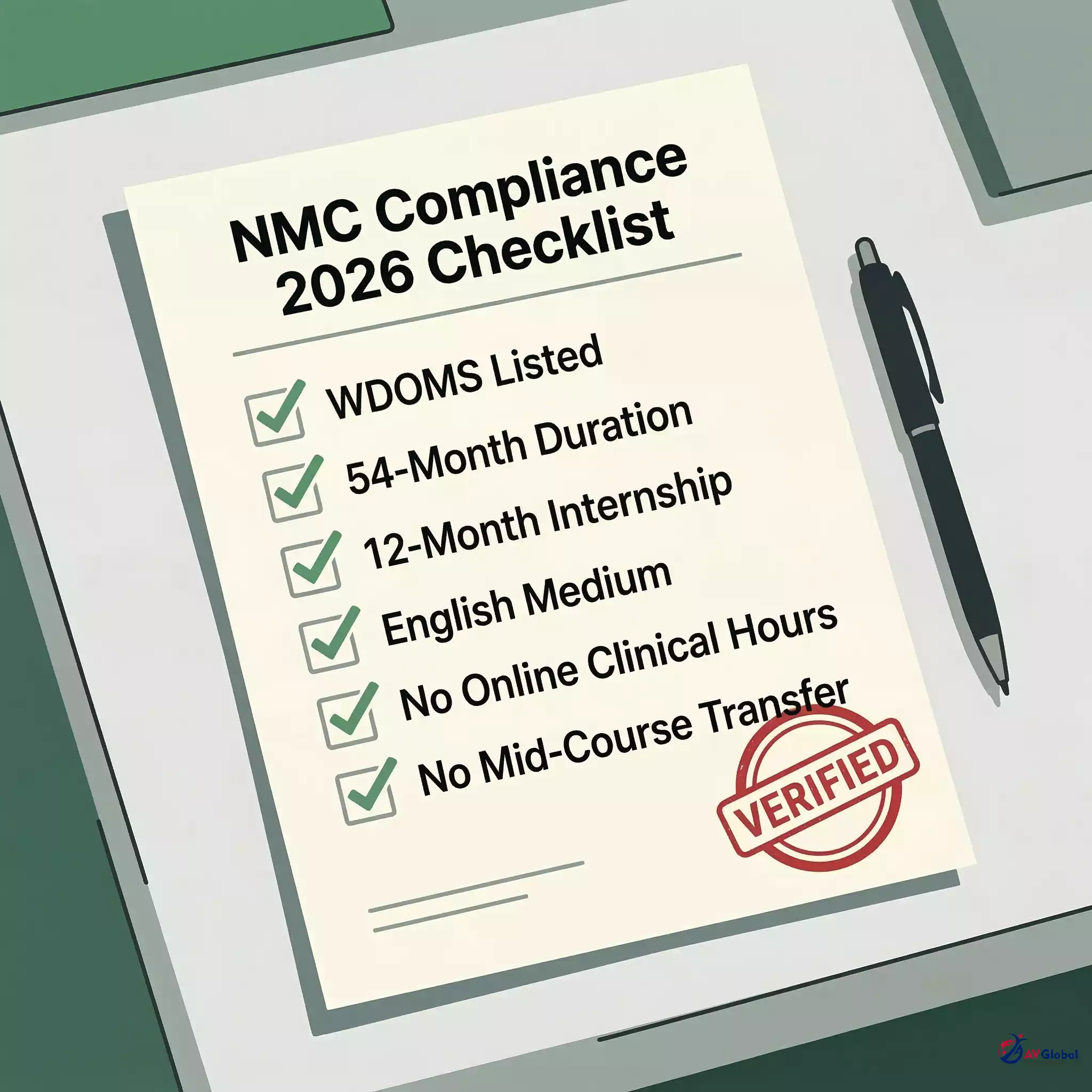
Ulyanovsk State University Medical Faculty holds full recognition from the National Medical Commission (NMC) of India, appearing in the official list of foreign medical institutions approved for Indian student enrollment. The university has been listed in the World Directory of Medical Schools (WDOMS) maintained by FAIMER since 1995, which is a prerequisite for NMC recognition.
Graduates are eligible to appear for the National Exit Test (NExT), which is replacing the Foreign Medical Graduate Examination (FMGE) as the mandatory screening test for foreign medical graduates to obtain medical license in India. Before beginning MBBS abroad, students must obtain an Eligibility Certificate from NMC India by submitting 10th, 12th mark sheets, NEET scorecard, passport copy, and offer letter from the university.
This Eligibility Certificate must be obtained before starting the course, as per NMC regulations effective from 2022-23 academic year. After completing the six-year MD program and obtaining the degree certificate, students must complete a compulsory rotating internship either at the university's affiliated hospitals in Russia or at NMC-approved hospitals in India.
Upon successful completion of internship and passing NExT examination, graduates receive full medical registration from NMC enabling them to practice medicine, pursue post-graduate studies (MD/MS/DNB), or apply for medical officer positions in India. Students and parents should verify the current NMC recognition status of Ulyanovsk State University on the official NMC India website at nmc.
org. in before enrolling, as recognition is subject to periodic review based on university compliance with NMC standards and inspection outcomes.
Year: 2024 | Appeared: 87 | Passed: 31 | Pass Rate: 35. 6% || Year: 2023 | Appeared: 92 | Passed: 33 | Pass Rate: 35.
9% || Year: 2022 | Appeared: 78 | Passed: 26 | Pass Rate: 33.
What Our Students Say
“AV Global guided me from NEET to Russia. The FMGE coaching from Year 3 gave me real confidence. Cleared in the first attempt.”
“AV Global knew every detail about Ulyanovsk State University (Medical Faculty) - visa, hostel, airport pickup. Best decision my family made.”
“Support from AV Global in Russia made everything smooth. The NExT coaching programme is excellent.”
Complete Guide to MBBS at USU
Frequently Asked Questions
Yes, USU is listed in WDOMS and recognized by NMC India. Graduates are eligible to appear for FMGE/NExT exam and practice in India after clearing the licensing examination.
The total 6-year MBBS cost at USU is approximately ₹$30,650 (approx. Rs.
27. 0 Lakhs).
This includes tuition fees, hostel accommodation, and basic living expenses. AV Global provides transparent fee structure with no hidden charges.
USU teaches MBBS in English medium. Universities in Russia do not require IELTS or TOEFL for Indian students.
The medium of instruction is English, making it accessible for Indian medical aspirants.
Indian students need a valid NEET scorecard to apply for MBBS at USU. The cutoff varies each year based on seat availability.
Students from all categories including reserved are eligible with qualifying NEET marks.
Ulyanovsk has a small but growing Indian student community which has encouraged several restaurants to offer Indian-style vegetarian and non-vegetarian dishes. Namaste India Restaurant on Lenin Avenue serves North Indian dishes including dal makhani, paneer butter masala, and rotis with meals costing Rs.
350-600. Spice of India near Goncharov Park offers dosas, idli, and South Indian breakfast items on weekends.
Tandoor House on Radishcheva Street provides tandoori items and biryanis popular among students celebrating special occasions. For daily cooking, Indian grocery stores like Bombay Bazaar and Delhi Store near the university campus stock essential items: basmati rice, atta flour, turmeric, red chili powder, garam masala, pickles, papad, and ready-to-eat MTR packets.
Monthly food costs vary significantly based on lifestyle: cooking at home using hostel kitchen facilities costs approximately Rs. 5,000-9,000 per month buying vegetables from local Russian markets and supplementing with Indian spices.
Eating out regularly at Indian restaurants increases monthly food expenses to Rs. 10,000-18,000.
Most students adopt a mixed approach cooking dal-rice-sabzi on weekdays and enjoying restaurant meals on weekends. Russian cuisine offers vegetarian options like borscht (beetroot soup), pirozhki (stuffed buns), and blini (pancakes) which Indian students gradually appreciate.
The university canteen serves affordable Russian meals at Rs. 80-150 per meal but most Indian students prefer home-cooked food for taste and dietary preferences.
Senior students mentor juniors on shopping locations and cooking basics during the first month.
USU provides well-maintained hostel accommodation for international students. Ulyanovsk State University provides on-campus hostel accommodation within 5 minutes walking distance from the main medical faculty building.
The MBBS program at USU is 6 years including a 1-year internship. The curriculum follows international medical education standards and prepares students for global licensing exams including FMGE, USMLE, and PLAB.
Yes, graduates from USU can practice in India after clearing the FMGE/NExT licensing exam conducted by NMC. The university has a 35% (2024 estimate) FMGE pass rate.
The degree is recognized for medical practice in India.
Ulyanovsk is considered one of the safer medium-sized cities in Russia with relatively low crime rates compared to major metropolitan centers. While Numbeo does not provide specific crime index data for Ulyanovsk separately, the Volga Federal District where Ulyanovsk is located generally scores in the 60-70 range for safety index indicating moderate to high safety levels.
Violent crime against international students is extremely rare. Petty theft and pickpocketing can occur in crowded public transport or markets as in any city, so students are advised to keep valuables secure and avoid displaying expensive electronics conspicuously.
The medical faculty campus is a gated compound with security guards stationed at entry points checking student ID cards. Hostel buildings have 24/7 security with wardens monitoring visitor access and maintaining entry registers.
CCTV surveillance covers hostel corridors, campus pathways, and building entrances providing additional security layer. Female students consistently report feeling safe both on campus and in surrounding residential neighborhoods.
The Zasviyazhsky and Leninsky districts where student hostels are located are well-lit residential areas with regular police patrolling. Students are advised to travel in groups during late evening hours and use official taxi services rather than unmarked vehicles.
The Indian Embassy in Russia is located in Moscow at 6-8 Vorontsovo Pole Street, Moscow 109028, with 24/7 emergency helpline +7-495-783-7535 and consular assistance line +7-495-916-1009. For local emergencies, dial 112 which connects to English-speaking operators who can dispatch police, ambulance, or fire services.
AV Global provides students with a local emergency contact number +7-960-XXX-XXXX of our Ulyanovsk representative who is available 24/7 for any urgent assistance including medical emergencies, documentation issues, or personal safety concerns. The university also has an international student support office with staff who speak English and assist with police registration, visa extensions, and local integration.
Racism or discrimination incidents are uncommon but if students face any uncomfortable situations, they should immediately report to the international office and AV Global representative. Overall, Ulyanovsk offers a secure and welcoming environment for Indian medical students with adequate safety infrastructure and support systems in place.
After MBBS from USU, graduates can practice in India via FMGE/NExT, pursue USMLE for USA, PLAB for UK, or practice in Russia. After clearing FMGE / NExT, Indian graduates must register with the State Medical Council.
PG admissions are via NEET-PG.
Related Articles
Ready to Start Your MBBS Journey?
“AV Global has placed 100+ students at Ulyanovsk State University (Medical Faculty). Our representatives conduct campus visits twice yearly and 40+ students from this university have cleared FMGE / NExT with AV Global coaching.”