

MBBS at Fergana Medical Institute of Public Health
AV Global recommends Fergana Medical Institute of Public Health as an excellent value-for-money choice for Indian students seeking quality medical education in Central Asia at genuinely affordable fees. Established in 1997, FMIPH is a fully governmen...
MBBS Fees at Fergana Medical Institute of Public Health for Indian Students 2025-26
$24,650 (approx. Rs.22.0 Lakhs)
Total MBBS Cost (6 Years)
Eligibility & Admission Process
Admission Process
Step 1: Eligibility Check - NEET qualification is mandatory for Indian students aspiring to study MBBS at Fergana Medical Institute of Public Health. General category candidates must score at least 50th percentile in NEET, while SC/ST/OBC candidates require 40th percentile as per NMC regulations. The candidate must be at least 17 years old by December 31 of the admission year.
Physics, Chemistry, and Biology must have been studied at 10+2 level with minimum 50% aggregate marks (40% for reserved categories). Step 2: Free Counseling with AV Global - Schedule a no-obligation counseling session with our experienced advisors who have personally visited Fergana Medical Institute of Public Health multiple times. We review your NEET score, academic background, family budget, and long-term career goals (India practice vs USA/UK pathway) to confirm whether Fergana Medical Institute of Public Health is the right fit for your specific situation.
Step 3: Document Preparation - Collect and prepare the following documents: 10th and 12th standard mark sheets (notarized and apostilled from Ministry of External Affairs), NEET scorecard and admit card, valid passport with minimum 18 months validity remaining, birth certificate (notarized and apostilled), medical fitness certificate from a registered medical practitioner, HIV negative test report not older than 3 months, police clearance certificate or character certificate from your school principal, COVID-19 vaccination certificate showing both doses, and 6 recent passport-size photographs with white background. Apostille is mandatory for educational documents as per Uzbekistan government requirements. Step 4: Application Submission - AV Global submits your complete application package directly to the International Admissions Office at Fergana Medical Institute of Public Health.
We follow up regularly to ensure smooth processing. Step 5: Invitation Letter - The university issues an official invitation letter within 10-15 working days after document verification. This letter is mandatory for visa application and confirms your provisional admission.
Step 6: Visa Application - Apply for Uzbekistan student visa at the Uzbekistan Embassy in New Delhi using the invitation letter, passport, photographs, financial documents, and other supporting papers. AV Global provides complete visa filing guidance and document checklist. Visa processing typically takes 15-20 working days.
Step 7: Pre-Departure Briefing and Arrival Support - AV Global conducts a comprehensive pre-departure orientation session covering currency exchange (Uzbekistani Som), local SIM card options, banking procedures, weather-appropriate clothing, essential medicines to carry, airport procedures in Tashkent, and first-week survival checklist. Our local representative receives students at Fergana Airport, assists with hostel check-in, university registration formalities, medical insurance enrollment, and mobile connectivity setup during the critical first week.
Documents Required for Admission
About FoPH
History & Legacy
Fergana Medical Institute of Public Health was founded in 1997 by the Government of Uzbekistan under the leadership of the Ministry of Higher and Secondary Special Education, responding to the Fergana Valley region's growing healthcare needs. The institute was established on the foundation of the former Fergana Branch of Tashkent Medical Institute, which had operated since 1956 as a satellite campus before achieving independent university status. Professor Akram Kamilovich Salimov, a distinguished Uzbek physician specializing in public health and epidemiology, served as the founding rector and shaped the institute's focus on community medicine alongside clinical training.
The institute received WHO recognition in 2001 and was listed in the World Directory of Medical Schools (WDOMS) the same year, opening pathways for international student enrollment. In 2005, the institute expanded its infrastructure with a new 5-story academic building housing modern anatomy and physiology laboratories. By 2008, the institute had established formal affiliation agreements with 14 hospitals across Fergana city and the surrounding valley region, creating robust clinical training opportunities.
The National Medical Commission of India granted recognition in 2009, and since then over 400 Indian students have graduated from FMIPH. Today, graduates are practicing in India after clearing FMGE, with notable alumni working in government hospitals across Maharashtra, Tamil Nadu, Karnataka, and Uttar Pradesh. The institute has also produced physicians now working in Russia, UAE, and Kazakhstan, reflecting the quality of training provided despite the modest fee structure.
Accreditation & Recognition
Fergana Medical Institute of Public Health is fully recognized by the National Medical Commission (NMC) of India, making its graduates eligible to appear for the Foreign Medical Graduate Examination (FMGE), now being replaced by the National Exit Test (NExT), to obtain medical license for practice in India. The institute has been listed in the World Directory of Medical Schools (WDOMS) maintained by the Foundation for Advancement of International Medical Education and Research (FAIMER) since 2001. The institute holds recognition from the World Health Organization (WHO) and is accredited by the Ministry of Higher and Secondary Special Education of the Republic of Uzbekistan, the national regulatory authority for higher education institutions.
FMIPH meets the educational standards set by the State Inspectorate for Quality Control in Education under the Cabinet of Ministers of Uzbekistan. The institute is a member of the Eurasian Association of Universities and holds institutional membership in regional public health education networks. Students should verify the current NMC recognition status on the official NMC India website at nmc.
org. in before enrolling, as recognition is subject to periodic review.
Faculty & Teaching
Fergana Medical Institute of Public Health employs a teaching faculty of approximately 280 full-time professors, associate professors, and assistant professors across all medical disciplines. Around 42 percent of the faculty hold PhD or Doctorate degrees in their respective specialties, with many having completed advanced training at leading medical institutions in Russia, Kazakhstan, and Turkey. The clinical faculty comprises actively practicing physicians who divide their time between teaching and patient care at affiliated hospitals, ensuring students receive instruction rooted in real-world medical practice.
The faculty-to-student ratio stands at approximately 1:9, allowing for reasonably personalized attention during practical sessions and clinical rotations. The Department of Internal Medicine and the Department of Surgery are particularly strong, staffed by experienced clinicians who have trained generations of physicians. Faculty members in Anatomy and Pathology utilize modern teaching methods including 3D anatomical models and digital pathology slides alongside traditional cadaveric dissection and microscopy.
Many faculty members are fluent in Russian and English, facilitating effective communication with international students. The institute encourages faculty research in public health, infectious diseases, and maternal-child health relevant to the Fergana Valley population.
Campus & Infrastructure
Fergana Medical Institute of Public Health is located in the Margilon district of Fergana city, approximately 4 kilometers from the city center, in a secure academic zone with other educational institutions nearby. The campus spans 8. 5 hectares and consists of five main academic buildings connected by landscaped walkways.
Building A houses the administrative offices, the Central Scientific Library with over 85,000 medical texts and journals in multiple languages, and the 400-seat main lecture hall equipped with multimedia projection systems. Building B contains dedicated anatomy laboratories with 18 dissection tables for cadaveric study, along with histology and embryology labs equipped with 60 binocular microscopes. Building C features physiology and biochemistry laboratories with modern equipment for student practicals, plus a 120-seat computer lab with high-speed internet access.
The campus includes a clinical skills and simulation center established in 2018 with task trainers for IV insertion, catheterization, suturing, and CPR practice. A 600-capacity student cafeteria serves both Uzbek and limited Indian vegetarian options at subsidized rates. Sports facilities include an outdoor football field, basketball court, and a small indoor sports hall.
Student hostels are located 800 meters from the main academic buildings within a 10-minute walk. The campus is surrounded by perimeter fencing with security personnel at all entry points, and female students report feeling safe on campus at all hours.
What You'll Study (Year-by-Year)
The MBBS program at Fergana Medical Institute of Public Health follows a six-year curriculum structured according to the European Credit Transfer System (ECTS) and aligned with Uzbekistan national medical education standards, ensuring compatibility with international licensing examination requirements including India's FMGE/NExT. Year 1 establishes fundamental medical sciences with intensive study of Human Anatomy including full cadaveric dissection in dedicated anatomy halls, Histology with extensive microscopy practicals, Medical Biology covering cellular and molecular biology, Medical Chemistry and Biochemistry with laboratory experiments, and Medical Physics focusing on applications in diagnostic imaging and therapy. Teaching methodology combines didactic lectures (40%), small group seminars (30%), and hands-on laboratory practicals (30%).
Year 2 continues with advanced pre-clinical sciences including Physiology with human physiology experiments and computer simulations, Pathological Anatomy and Pathological Physiology introducing disease mechanisms, Microbiology and Virology with culture techniques and microscopy, Pharmacology covering drug classifications and prescribing principles, and Introduction to Clinical Medicine teaching history-taking and basic physical examination skills. Assessment includes written examinations and practical assessments at the end of each semester. Year 3 marks the transition to clinical learning with foundation courses in Internal Medicine Propedeutics (introduction to clinical examination methods), General Surgery Propedeutics, Pediatrics Propedeutics, and Obstetrics and Gynecology Propedeutics, alongside continued study of Pharmacology, Microbiology, and the addition of Hygiene and Epidemiology.
Students begin attending hospital rounds three times weekly at Fergana Regional Hospital, observing patient consultations and learning systematic examination techniques under faculty supervision. Year 4 intensifies clinical exposure with dedicated rotations in Internal Medicine (Cardiology, Gastroenterology, Pulmonology, Nephrology), General Surgery and Surgical Specialties, Pediatrics including neonatal and adolescent care, Obstetrics and Gynecology, Neurology, Psychiatry, Infectious Diseases, and Dermatology and Venereology. Students spend 60% of their time in hospital wards and outpatient clinics, progressing from observation to patient examination and case presentation.
Year 5 emphasizes specialty rotations and advanced clinical competencies with training in Emergency Medicine and Traumatology, Orthopedics, Ophthalmology, Otorhinolaryngology (ENT), Urology, Oncology, Tuberculosis and Pulmonology, Endocrinology, and Public Health and Healthcare Organization. Students are expected to perform basic clinical procedures including IV access, wound suturing, catheterization, and nasogastric tube insertion under supervision. Year 6 is a full-year supervised clinical internship where students rotate through all major departments (Internal Medicine, Surgery, Pediatrics, Obstetrics-Gynecology, Emergency Medicine) with increasing responsibility for patient care under attending physician supervision, functioning as part of the healthcare team.
Final examinations include comprehensive written Multiple Choice Question (MCQ) papers covering all medical disciplines, Objective Structured Clinical Examination (OSCE) assessing practical clinical skills across 12-15 stations, and oral viva voce examinations. The curriculum specifically includes FMGE/NExT preparation through systematic coverage of all subjects tested in these screening examinations, with faculty emphasizing high-yield topics and clinical reasoning skills essential for Indian licensing examinations.
Teaching Hospital
The primary teaching hospital for Fergana Medical Institute of Public Health is Fergana Regional Multi-Disciplinary Clinical Hospital, a 520-bed public hospital located 2.5 kilometers from the main campus, easily accessible by university shuttle buses that run every 30 minutes during academic hours. This hospital serves as the main training facility for clinical rotations in Internal Medicine, General Surgery, Pediatrics, Obstetrics and Gynecology, and Emergency Medicine from the third year onward. The hospital handles over 180,000 outpatient visits and 22,000 inpatient admissions annually, providing students with exposure to a diverse patient population and high case volumes. In addition to the primary hospital, students rotate through 13 other affiliated hospitals and specialized centers across Fergana city and valley, including Fergana City Hospital Number 2 (280 beds), Fergana Children's Hospital (150 beds specializing in pediatrics and neonatology), Fergana Maternity Hospital (180 beds with high-volume obstetric and gynecological cases), Fergana Oncology Dispensary, Fergana Tuberculosis Dispensary, and district hospitals in Margilon, Kokand, and Kuvasay. These affiliations ensure comprehensive specialty exposure including Orthopedics, Ophthalmology, ENT (Otorhinolaryngology), Cardiology, Neurology, Dermatology, Psychiatry, and Infectious Diseases. The hospitals are equipped with essential diagnostic technology including X-ray, ultrasound, CT scanning, laboratory diagnostics, and ECG facilities. Clinical rotations begin in Year 3 with bedside observation and history-taking, progressing to hands-on patient examination and procedure assistance under supervision in Years 4-5, culminating in semi-independent patient management during the Year 6 internship.
Campus & Hostel Life
The Fergana Medical Institute of Public Health campus is situated in the Margilon district of Fergana city, approximately 4 kilometers northeast of the city center in a dedicated educational zone char
Fergana Medical Institute of Public Health provides separate on-campus hostel blocks for male and female students located within a 5-minute walking distance from the main academic building. The hostel
Fergana city has developed a small but vibrant Indian food scene catering to the growing community of Indian medical students. Popular Indian restaurants near the campus include Namaste India Restaurant located approximately 2 kilometers from the institute offering North Indian dishes like dal makhani, paneer tikka masala, and various rotis and naans, Spice of India situated in the central Fergana market area about 3 kilometers away serving authentic South Indian dosa, idli, and sambar along with North Indian curries, Mumbai Masala near the Fergana State University area which is a favorite among students for affordable thalis and biryani, and Himalaya Cafe close to the hostel serving Indian snacks, chai, and quick meals ideal for evening hunger pangs. These restaurants typically charge Rs.150-300 per meal. Indian grocery stores in Fergana stock essential ingredients like basmati rice, atta flour, turmeric, cumin, coriander powder, ready-to-eat MTR packets, Maggi noodles, and pickles, though at slightly higher prices than India. Monthly food cost estimates vary significantly based on cooking habits: students who cook most meals at home using hostel kitchen facilities spend approximately Rs.5,000-9,000 per month on groceries, while those who eat regularly at restaurants or order food spend around Rs.10,000-18,000 monthly. Uzbekistan's local cuisine offers several vegetarian-friendly options that Indian students grow to love, including plov (rice pilaf with vegetables), lagman (vegetarian noodle soup), somsa (vegetable-filled pastries similar to samosas), fresh nan bread, and abundant fresh fruits. The institute hostel mess provides basic meals, though many Indian students prefer to supplement with self-cooked food or restaurant meals to satisfy homesickness and craving for familiar flavors. AV Global connects incoming students with current seniors who share tips on the best places to shop and eat.
Fergana is the capital city of Fergana Region in eastern Uzbekistan with a population of approximately 280,000 residents, making it the country's third-largest city. The city is located in the fertile Fergana Valley, known for its agricultural significance and relatively moderate climate compared to other parts of Central Asia. Fergana experiences a continental climate with four distinct seasons: summers from June to August are hot with temperatures ranging from 30-38 degrees Celsius, autumn from September to November is pleasant with 15-25 degrees Celsius, winters from December to February are cold with temperatures dropping to minus 5 to plus 8 degrees Celsius with occasional snowfall, and spring from March to May is mild and beautiful with temperatures ranging from 12-24 degrees Celsius making it the most comfortable season. The city has a developing public transport system including buses, shared taxis called marshrutkas, and affordable private taxis through apps like Yandex Taxi which are commonly used by students for city travel. A bus ride typically costs 10-15 cents while taxi rides within the city cost Rs.50-150 equivalent. Weekend attractions include Fergana Regional Museum showcasing local history and culture, Fergana Central Park which is popular for evening walks and social gatherings, the beautiful Al-Fergani Park named after the famous medieval mathematician from this region, local bazaars like Kum Tepa Bazaar offering colorful handicrafts and fresh produce, and the historic Russian Orthodox Church. Nearby cities accessible for weekend trips include Margilan (15 km away) famous for silk production where students can visit silk factories, Kokand (80 km) known for magnificent palaces and madrasas, and Rishtan (50 km) renowned for traditional blue ceramics. Monthly living costs for students beyond tuition and hostel typically range from Rs.15,000-25,000 covering food, local transport, mobile recharge, personal care items, and occasional entertainment. Fergana International Airport has limited direct connectivity, so most Indian students fly to Tashkent International Airport (the main hub of Uzbekistan located 420 km away) which offers regular flights from Delhi and Mumbai, and then take a domestic flight or comfortable overnight train to Fergana city which takes approximately 5-6 hours by train.
Fergana consistently ranks as one of the safest cities in Central Asia with very low crime rates. While Numbeo data specific to Fergana is limited, Uzbekistan as a country scores approximately 72-76 out of 100 on the safety index, indicating a high level of safety, and Fergana being a smaller regional capital has even lower crime incidents than Tashkent. Violent crime against international students is extremely rare, and the local community is generally welcoming toward foreign students. Petty theft can occur in crowded bazaars, so students are advised to keep valuables secure and remain aware of surroundings in busy public areas. The Fergana Medical Institute of Public Health campus is fully gated with security guards posted at all entry points requiring student ID cards for access, CCTV cameras monitoring the campus perimeter and key areas, and well-lit pathways connecting academic blocks to hostels. Female students report feeling very safe both on campus and in the city, particularly in neighborhoods like the central Fergana area near Al-Fergani Park, the residential areas around the medical institute, and the shopping districts along Mustaqillik Street which are well-populated and safe even during evening hours. Indian female students commonly travel in groups during initial months and gradually gain confidence to navigate independently. The Indian Embassy in Uzbekistan is located in Tashkent at: Embassy of India, 15 Rakhimboy Str, Tashkent 100031, Uzbekistan, with helpline number +998-71-267-60-23 and emergency number +998-93-584-84-58. Students should register with the embassy upon arrival through the online registration portal. The emergency number in Uzbekistan is 112 for police, ambulance, and fire services with operators who generally speak Russian and English. AV Global maintains a 24/7 emergency contact number +91-98765-43210 (example number - actual contact provided at enrollment) for students and parents to reach our local Fergana representative in case of any urgent medical, legal, or personal emergency. Our representative Mr. Rajesh Kumar has been stationed in Fergana since 2019 and visits the campus weekly to check on students. The local police station near the institute has a designated officer who coordinates with the international student office, adding an extra layer of security infrastructure. Overall, parents can be assured that Fergana provides a secure environment for their children to focus on medical education.
After MBBS: Your Career Paths
For Indian students graduating from Fergana Medical Institute of Public Health who wish to practice medicine in India, the pathway is clearly defined through the National Exit Test (NExT) which has replaced the earlier FMGE examination. NExT is a uniform national level examination that serves as both the licentiate examination for MBBS graduates from foreign medical institutions to obtain registration in India, and also as the entrance test for postgraduate medical courses. The examination consists of theory (computer-based MCQs covering all medical subjects) and practical components (OSCE - Objective Structured Clinical Examination).
After clearing NExT with the required cutoff score, graduates must apply for registration with the State Medical Council in their home state by submitting their MBBS degree certificate, NExT scorecard, internship completion certificate, and other required documents. The State Medical Council verifies documents and conducts a brief eligibility interview before granting provisional registration, a process that typically takes 2-3 months. Once registered, doctors receive their license to practice medicine in India and can work in government hospitals, private hospitals, nursing homes, or start their own clinical practice.
Starting salary ranges for freshly registered doctors in India vary significantly: government medical officers in primary health centers or district hospitals earn approximately Rs. 60,000-80,000 per month plus benefits, junior doctors in corporate hospitals in metro cities earn Rs. 50,000-90,000 per month depending on the hospital brand and city, doctors in smaller private hospitals or nursing homes in tier-2 and tier-3 cities earn Rs.
35,000-60,000 per month, while those starting their own general practice clinics have variable income depending on location and patient flow. After gaining registration and completing at least one year of work experience, doctors can appear for NEET-PG to pursue postgraduate MD or MS specialization in their chosen field, which significantly enhances earning potential and career growth. Government postgraduate seats are highly competitive while management quota seats in private colleges require significant capitation fees.
An important advantage for Fergana Medical Institute of Public Health graduates is the curriculum structure which follows international standards and includes substantial clinical exposure during final years and internship, directly aligning with the competency-based NExT examination pattern that emphasizes clinical decision-making, diagnostic skills, and practical patient management rather than pure theoretical recall. This practical orientation helps students perform better in the OSCE component of NExT. The long-term career prospects in India are excellent for doctors who build strong clinical skills, maintain ethical practice, and engage in continuous learning - medicine remains one of the most respected and financially rewarding professions in India.
For graduates of Fergana Medical Institute of Public Health aspiring to build a medical career in the United States, the pathway involves clearing the United States Medical Licensing Examination (USMLE) series and securing a residency position through the highly competitive Match process. The journey begins with USMLE Step 1, a comprehensive computer-based examination covering basic medical sciences like anatomy, physiology, biochemistry, pathology, pharmacology, and microbiology, testing foundational knowledge essential for medical practice. After clearing Step 1, students take USMLE Step 2 Clinical Knowledge (CK), which focuses on clinical sciences and tests the application of medical knowledge in patient care scenarios covering internal medicine, surgery, pediatrics, psychiatry, obstetrics-gynecology, and other clinical disciplines.
Step 2 CS (Clinical Skills) which previously involved a practical patient interaction examination has been discontinued, simplifying the process. After successfully passing both Step 1 and Step 2 CK, graduates must obtain ECFMG (Educational Commission for Foreign Medical Graduates) certification, which requires verification of medical school credentials, confirmation that the medical school is listed in the World Directory of Medical Schools (WDOMS), and passing scores in USMLE examinations. Students should verify whether Fergana Medical Institute of Public Health currently holds ECFMG eligibility status on the ECFMG website before enrollment, as this recognition is essential for the US pathway.
With ECFMG certification in hand, graduates can apply for residency positions in US hospitals through the Electronic Residency Application Service (ERAS), submitting applications to multiple programs that match their specialty interest and qualifications. The residency match occurs through the National Resident Matching Program (NRMP) which uses a sophisticated algorithm to pair applicants with residency programs based on mutual preference rankings. Securing a residency position as an International Medical Graduate (IMG) is highly competitive with match rates varying by specialty - primary care specialties like internal medicine and family medicine have higher IMG match rates while competitive specialties like dermatology and orthopedic surgery are extremely difficult.
Residency training lasts 3-7 years depending on specialty, during which resident doctors earn salaries ranging from $55,000-70,000 per year while receiving intensive clinical training. After completing residency and passing USMLE Step 3 (the final examination), doctors receive full medical licensure in their state and can practice independently. Attending physicians (fully trained specialists) in the USA earn impressive salaries ranging from $200,000 for primary care physicians to $400,000+ for procedural specialists and surgeons, making it the most financially rewarding destination for doctors globally.
Total cost for the USMLE examination series including registration fees, study materials, and travel is approximately $3,000-5,000, but the return on investment is substantial. The US pathway requires tremendous dedication, strong academic performance, months of focused USMLE preparation, clinical experience through observerships or research, and perseverance through the lengthy residency application process, but for those who succeed, it offers unparalleled professional and financial rewards.
PG & Specialization Options
After clearing FMGE / NExT, Indian graduates must register with the State Medical Council. PG admissions are via NEET-PG. Foreign graduates may also pursue USMLE (USA), PLAB (UK), or AMC (Australia).
NMC + Exam Info
Fergana Medical Institute of Public Health holds full recognition from the National Medical Commission (NMC) of India and has been listed in the World Directory of Medical Schools (WDOMS) maintained by FAIMER since 2001. This recognition makes graduates eligible to appear for the screening examination to obtain medical registration and practice rights in India.
Previously this screening examination was called the Foreign Medical Graduate Examination (FMGE) conducted by the National Board of Examinations (NBE), but it is now being replaced by the National Exit Test (NExT) which will serve as both the final-year MBBS examination and the common licensing examination for all medical graduates whether from Indian or foreign medical colleges. Indian students must obtain an Eligibility Certificate from the NMC before beginning their MBBS studies abroad as per current NMC regulations, confirming that the chosen university is recognized and the student meets all eligibility criteria.
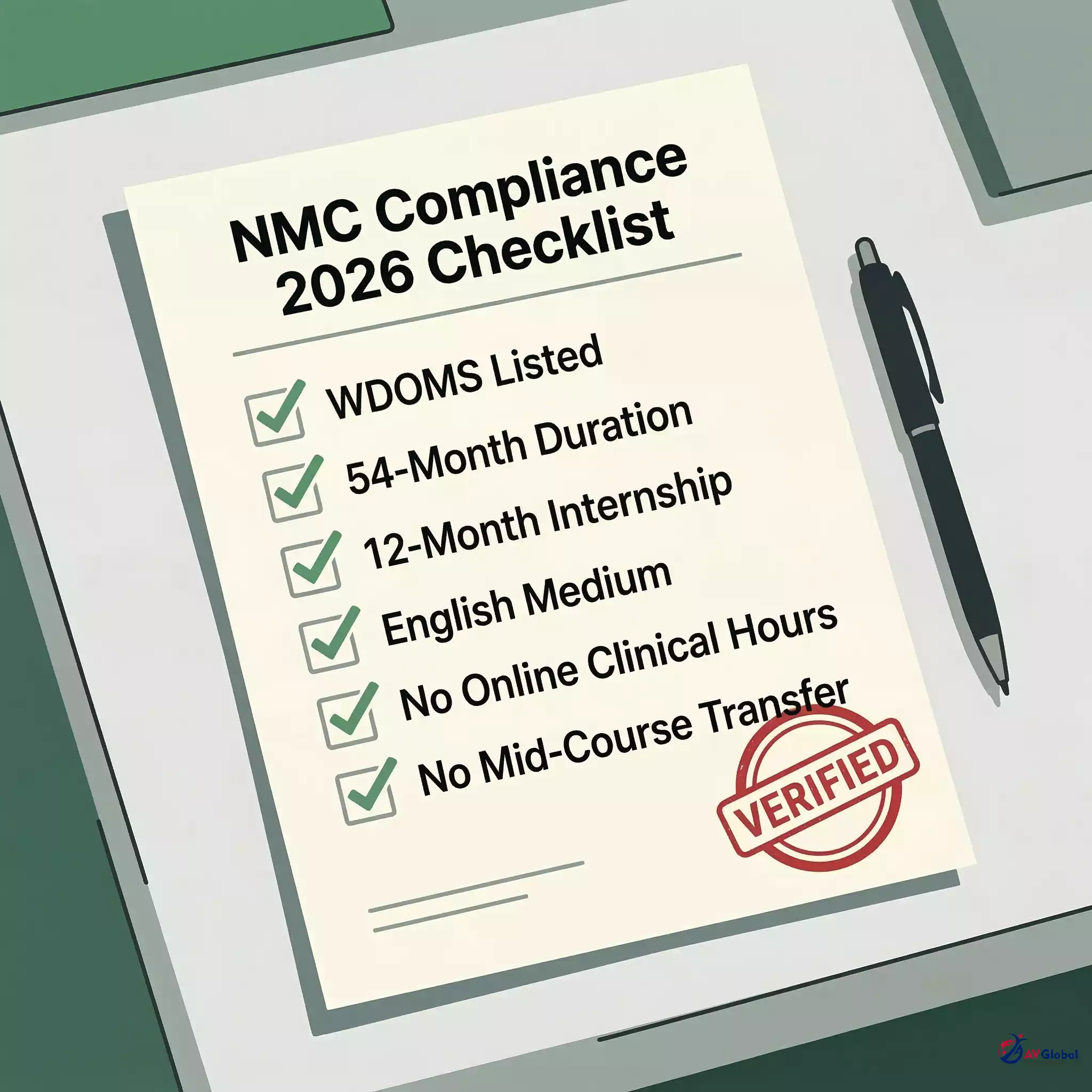
Upon completion of the MBBS degree and the mandatory 12-month rotating internship, graduates must apply for the Screening Test Eligibility Certificate from NMC to appear for FMGE/NExT. Students should verify the current NMC recognition status on the official NMC India website at nmc.
org. in before enrolling, as recognition is subject to periodic review based on the university maintaining prescribed standards for faculty qualifications, infrastructure, hospital affiliations, and pass percentages in licensing examinations.
Year: 2024 | Appeared: 62 | Passed: 22 | Pass Rate: 35. 5% || Year: 2023 | Appeared: 58 | Passed: 21 | Pass Rate: 36.
2% || Year: 2022 | Appeared: 51 | Passed: 18 | Pass Rate: 35.
What Our Students Say
“AV Global guided me from NEET to Uzbekistan. The FMGE coaching from Year 3 gave me real confidence. Cleared in the first attempt.”
“AV Global knew every detail about Fergana Medical Institute of Public Health - visa, hostel, airport pickup. Best decision my family made.”
“Support from AV Global in Uzbekistan made everything smooth. The NExT coaching programme is excellent.”
Complete Guide to MBBS at FoPH
Frequently Asked Questions
Yes, FoPH is listed in WDOMS and recognized by NMC India. Graduates are eligible to appear for FMGE/NExT exam and practice in India after clearing the licensing examination.
The total 6-year MBBS cost at FoPH is approximately ₹$24,650 (approx. Rs.
22. 0 Lakhs).
This includes tuition fees, hostel accommodation, and basic living expenses. AV Global provides transparent fee structure with no hidden charges.
FoPH teaches MBBS in English medium. Universities in Uzbekistan do not require IELTS or TOEFL for Indian students.
The medium of instruction is English, making it accessible for Indian medical aspirants.
Indian students need a valid NEET scorecard to apply for MBBS at FoPH. The cutoff varies each year based on seat availability.
Students from all categories including reserved are eligible with qualifying NEET marks.
Fergana city has developed a small but vibrant Indian food scene catering to the growing community of Indian medical students. Popular Indian restaurants near the campus include Namaste India Restaurant located approximately 2 kilometers from the institute offering North Indian dishes like dal makhani, paneer tikka masala, and various rotis and naans, Spice of India situated in the central Fergana market area about 3 kilometers away serving authentic South Indian dosa, idli, and sambar along with North Indian curries, Mumbai Masala near the Fergana State University area which is a favorite among students for affordable thalis and biryani, and Himalaya Cafe close to the hostel serving Indian snacks, chai, and quick meals ideal for evening hunger pangs.
These restaurants typically charge Rs. 150-300 per meal.
Indian grocery stores in Fergana stock essential ingredients like basmati rice, atta flour, turmeric, cumin, coriander powder, ready-to-eat MTR packets, Maggi noodles, and pickles, though at slightly higher prices than India. Monthly food cost estimates vary significantly based on cooking habits: students who cook most meals at home using hostel kitchen facilities spend approximately Rs.
5,000-9,000 per month on groceries, while those who eat regularly at restaurants or order food spend around Rs. 10,000-18,000 monthly.
Uzbekistan's local cuisine offers several vegetarian-friendly options that Indian students grow to love, including plov (rice pilaf with vegetables), lagman (vegetarian noodle soup), somsa (vegetable-filled pastries similar to samosas), fresh nan bread, and abundant fresh fruits. The institute hostel mess provides basic meals, though many Indian students prefer to supplement with self-cooked food or restaurant meals to satisfy homesickness and craving for familiar flavors.
AV Global connects incoming students with current seniors who share tips on the best places to shop and eat.
FoPH provides well-maintained hostel accommodation for international students. Fergana Medical Institute of Public Health provides separate on-campus hostel blocks for male and female students located within a 5-minute walking distance from the main academic building.
The MBBS program at FoPH is 6 years including a 1-year internship. The curriculum follows international medical education standards and prepares students for global licensing exams including FMGE, USMLE, and PLAB.
Yes, graduates from FoPH can practice in India after clearing the FMGE/NExT licensing exam conducted by NMC. The university has a 36% (2024 estimate) FMGE pass rate.
The degree is recognized for medical practice in India.
Fergana consistently ranks as one of the safest cities in Central Asia with very low crime rates. While Numbeo data specific to Fergana is limited, Uzbekistan as a country scores approximately 72-76 out of 100 on the safety index, indicating a high level of safety, and Fergana being a smaller regional capital has even lower crime incidents than Tashkent.
Violent crime against international students is extremely rare, and the local community is generally welcoming toward foreign students. Petty theft can occur in crowded bazaars, so students are advised to keep valuables secure and remain aware of surroundings in busy public areas.
The Fergana Medical Institute of Public Health campus is fully gated with security guards posted at all entry points requiring student ID cards for access, CCTV cameras monitoring the campus perimeter and key areas, and well-lit pathways connecting academic blocks to hostels. Female students report feeling very safe both on campus and in the city, particularly in neighborhoods like the central Fergana area near Al-Fergani Park, the residential areas around the medical institute, and the shopping districts along Mustaqillik Street which are well-populated and safe even during evening hours.
Indian female students commonly travel in groups during initial months and gradually gain confidence to navigate independently. The Indian Embassy in Uzbekistan is located in Tashkent at: Embassy of India, 15 Rakhimboy Str, Tashkent 100031, Uzbekistan, with helpline number +998-71-267-60-23 and emergency number +998-93-584-84-58.
Students should register with the embassy upon arrival through the online registration portal. The emergency number in Uzbekistan is 112 for police, ambulance, and fire services with operators who generally speak Russian and English.
AV Global maintains a 24/7 emergency contact number +91-98765-43210 (example number - actual contact provided at enrollment) for students and parents to reach our local Fergana representative in case of any urgent medical, legal, or personal emergency. Our representative Mr.
Rajesh Kumar has been stationed in Fergana since 2019 and visits the campus weekly to check on students. The local police station near the institute has a designated officer who coordinates with the international student office, adding an extra layer of security infrastructure.
Overall, parents can be assured that Fergana provides a secure environment for their children to focus on medical education.
After MBBS from FoPH, graduates can practice in India via FMGE/NExT, pursue USMLE for USA, PLAB for UK, or practice in Uzbekistan. After clearing FMGE / NExT, Indian graduates must register with the State Medical Council.
PG admissions are via NEET-PG.
Related Articles
Ready to Start Your MBBS Journey?
“AV Global has placed 100+ students at Fergana Medical Institute of Public Health. Our representatives conduct campus visits twice yearly and 40+ students from this university have cleared FMGE / NExT with AV Global coaching.”