
MBBS at Caucasus International University
AV Global recommends Caucasus International University as one of the most established and affordable private medical universities in Georgia for Indian students seeking quality European medical education. Founded in 1995, CIU holds complete NMC recog...
MBBS Fees at Caucasus International University for Indian Students 2025-26
$43,850 (approx. Rs.39.0 Lakhs)
Total MBBS Cost (6 Years)
Eligibility & Admission Process
Admission Process
Step 1: Eligibility Check - NEET qualification is mandatory for all Indian students applying to Caucasus International University. General category students require a minimum 50th percentile in NEET, while SC/ST/OBC category students require 40th percentile as per NMC regulations. The student must be 17 years of age or older by December 31 of the admission year.
Step 2: Free Counseling with AV Global - Schedule a no-obligation counseling session where our senior advisors review your NEET scorecard, academic profile, financial planning capacity, and long-term career goals. We assess whether Caucasus International University aligns with your aspirations for practicing in India, USA, UK, or other destinations. This session is completely free with no pressure to enroll.
Step 3: Document Preparation - Gather the following documents: 10th standard mark sheet (notarized), 12th standard mark sheet (notarized and apostilled from Ministry of External Affairs), NEET scorecard and admit card (original and notarized copies), valid passport with minimum 18 months validity remaining, birth certificate (notarized and apostilled), medical fitness certificate from a registered physician, HIV negative test report from an authorized laboratory, police clearance certificate or character certificate from your school principal, COVID-19 vaccination certificate showing both doses, and 6 recent passport-size photographs with white background. Apostille must be obtained from MEA regional offices in New Delhi, Mumbai, Chennai, Kolkata, or Hyderabad. Step 4: Application Submission - AV Global submits your complete application package directly to Caucasus International University admissions office with all supporting documents translated into English where necessary.
Step 5: Invitation Letter - The university reviews applications and issues an official invitation letter or offer letter within 10-15 working days confirming your seat reservation for the upcoming academic session starting in September. Step 6: Visa Application Process - Apply for Georgian student visa at the Georgian Embassy in New Delhi using your invitation letter, passport, financial proof showing tuition payment capacity, accommodation confirmation, and travel insurance. Georgian student visa processing takes approximately 15-20 working days.
Step 7: Pre-Departure Briefing and Arrival Support - AV Global conducts a comprehensive pre-departure orientation covering airport pickup arrangements at Tbilisi International Airport, currency exchange guidance (Georgian Lari), local SIM card activation, opening a Georgian bank account, first-week shopping checklist, metro card purchase, and cultural orientation. Our local representative receives you at the airport, accompanies you to the hostel for check-in, assists with university registration formalities, and remains available throughout your first month for settling-in support.
Documents Required for Admission
About CIU
History & Legacy
Caucasus International University was established in 1995 by a group of Georgian medical educators and international academicians who envisioned creating a modern medical institution bridging Western European and Georgian medical education standards. The founding team was led by Professor Kakha Shengelia, a distinguished Georgian physician trained in cardiovascular surgery who served as the first rector and remained committed to internationalizing medical education in Georgia. Initially operating as Caucasus School of Business, the institution expanded into medical sciences in 1998 and was granted full university status in 2000, subsequently renamed Caucasus International University.
The university received World Health Organization recognition and was listed in the World Directory of Medical Schools (WDOMS) in 2001, marking a significant milestone that opened doors for international student enrollment. By 2005, CIU had established partnerships with 18 teaching hospitals across Tbilisi, providing students extensive clinical exposure across multiple specialties. The National Medical Commission of India granted recognition to CIU in 2007, making it one of the earlier Georgian universities approved for Indian students.
Over nearly three decades, CIU has graduated over 1,200 international students from 42 countries. Today, CIU alumni are practicing medicine in India after clearing FMGE, working in NHS hospitals in the United Kingdom, completing residencies in Germany and Poland, and pursuing postgraduate training in the United States. The university expanded its Saburtalo campus in 2018, adding state-of-the-art simulation labs and a 24-hour medical library.
Professor Shengelia's vision of producing globally competent physicians continues under current leadership, with the university maintaining its commitment to affordable, quality medical education that meets international benchmarks while remaining accessible to middle-class Indian families.
Accreditation & Recognition
Caucasus International University is fully recognized by the National Medical Commission (NMC) of India, making all graduates eligible to appear for the Foreign Medical Graduate Examination (FMGE), now being replaced by the National Exit Test (NExT). The university has been listed in the World Directory of Medical Schools (WDOMS) since 2001 and maintains continuous recognition from the World Health Organization (WHO). CIU holds Educational Commission for Foreign Medical Graduates (ECFMG) eligibility, allowing graduates to pursue USMLE pathway for medical practice in the United States.
The university is accredited by the National Center for Educational Quality Enhancement of Georgia, the official quality assurance body under the Georgian Ministry of Education and Science. CIU is an institutional member of the Association for Medical Education in Europe (AMEE) and maintains partnerships with medical councils across Europe. The MD degree awarded by CIU is recognized across European Union member states under the Bologna Process framework.
The university undergoes periodic institutional accreditation reviews every five years to maintain Georgian national standards. Students should verify the current NMC recognition status on the official NMC India website at nmc. org.
in before enrolling, as recognition is subject to periodic review.
Faculty & Teaching
Caucasus International University employs a teaching faculty of 187 full-time medical educators, of whom 68 percent hold PhD or Doctorate degrees in their respective specializations. The faculty comprises Georgian medical professionals trained at Tbilisi State Medical University, European-trained specialists who completed advanced training in Germany, France, and the United Kingdom, and visiting professors from partner institutions in Turkey and Poland. Approximately 40 percent of the clinical faculty actively practice medicine in CIU's affiliated teaching hospitals, ensuring students receive instruction grounded in current medical practice rather than purely theoretical knowledge.
The faculty-to-student ratio stands at approximately 1:12, allowing for personalized attention during practical sessions and clinical rotations. Departments of Internal Medicine, Surgery, and Pediatrics are particularly strong, with senior professors holding international certifications and having published research in peer-reviewed journals. The Anatomy department maintains traditional cadaveric dissection programs led by professors with over 25 years of teaching experience.
Several faculty members have received training in modern pedagogical methods including Problem-Based Learning and OSCE examination techniques. The university recruits English-fluent faculty specifically for international student batches, with continuous faculty development programs ensuring teaching quality remains consistent with European medical education standards.
Campus & Infrastructure
Caucasus International University's main campus is located in the Saburtalo district of Tbilisi, one of the most student-friendly and well-connected neighborhoods in the Georgian capital. The campus spans approximately 3. 2 hectares and houses all essential medical education facilities within a modern academic complex.
Infrastructure includes eight large lecture halls equipped with audiovisual teaching aids and seating capacity ranging from 80 to 200 students, three dedicated Anatomy dissection laboratories with proper ventilation systems and cadaver preservation facilities, Biochemistry and Microbiology laboratories with microscopy equipment and diagnostic instruments, a Clinical Skills and Simulation Center with standardized patient mannequins for practicing procedures like intubation and IV cannulation, a medical library stocking over 18,000 textbooks and medical journals with 24-hour access during examination periods, computer labs with 120 workstations and high-speed internet for accessing online medical databases, a multi-cuisine cafeteria serving Georgian, Indian, and continental meals, an indoor sports complex with table tennis and badminton facilities, and outdoor basketball and football grounds. The campus provides free WiFi connectivity across all academic buildings. Student hostels are located within 1.
5 kilometers of the main campus, accessible via university shuttle buses that run every 30 minutes. The campus has 24-hour security with CCTV surveillance and controlled entry gates. International student support services office assists with visa extensions, residence permits, and general adaptation concerns.
What You'll Study (Year-by-Year)
The six-year MD program at Caucasus International University follows the European Credit Transfer System (ECTS) framework aligned with Georgian national medical education standards while incorporating preparation modules specifically for Indian licensing examinations. Year 1 establishes foundational medical sciences with Anatomy (including full cadaveric dissection of all body systems), Histology with extensive microscopy practicals identifying tissue types, Medical Biology covering cellular and molecular biology, General Chemistry and Biochemistry with laboratory sessions on enzyme kinetics and metabolic pathways, Medical Physics covering biomechanics and diagnostic imaging principles, and Latin Medical Terminology essential for clinical communication. Teaching methodology combines traditional lectures with small-group dissection sessions and laboratory practicals.
Examinations include written theory papers and oral practical assessments. Year 2 advances into systemic study with Physiology covering all organ systems with practical demonstrations of physiological measurements, Pathological Anatomy and Pathophysiology explaining disease mechanisms at cellular and organ levels, Microbiology and Virology with culture techniques and antibiotic sensitivity testing, Immunology covering innate and adaptive immune responses, Pharmacology introducing drug classifications and mechanisms with focus on commonly prescribed medications, and Bioethics addressing medical law and professional conduct. Students begin learning clinical examination techniques through simulated scenarios.
Year 3 marks the transition to clinical medicine with first hospital exposure through Introduction to Internal Medicine where students learn history-taking and physical examination under supervision, Propedeutics of Internal Diseases covering diagnostic approaches, General Surgery principles and minor surgical procedures observation, Introduction to Pediatrics with normal child development and common pediatric conditions, and Obstetrics and Gynecology basics including antenatal care observation. Students spend two half-days weekly in outpatient departments practicing patient interaction skills. Year 4 intensifies clinical training with dedicated rotations in Internal Medicine covering cardiology, pulmonology, gastroenterology, and endocrinology, General Surgery with exposure to pre-operative assessment and post-operative care, Pediatrics including neonatology and pediatric emergency cases, Obstetrics and Gynecology with labor room observation and antenatal clinic participation, Neurology covering stroke, epilepsy, and movement disorders, Psychiatry addressing mood disorders and psychosis, Dermatology and Venereology, and Emergency Medicine focusing on trauma and acute medical emergencies.
Students begin presenting cases during ward rounds and learn to write medical notes. FMGE preparation coaching begins with weekend classes covering high-yield topics. Year 5 consists predominantly of clinical rotations (approximately 75% time in hospitals) with advanced Internal Medicine covering critical care and complex medical cases, advanced Surgery including operating room observation and assisting in minor procedures, advanced Pediatrics with pediatric ICU exposure, Infectious Diseases covering HIV, tuberculosis, and tropical diseases common in India, Orthopedics and Traumatology, Ophthalmology covering cataract, glaucoma, and retinal diseases, ENT covering common head and neck pathologies, Urology, and Community Medicine addressing public health and preventive medicine.
Students maintain logbooks documenting procedures observed and performed. Year 6 is the supervised clinical internship year where students function as junior residents under supervision, rotating through all major departments for 6-8 week blocks. Interns take patient histories independently, perform physical examinations, order and interpret basic investigations, present cases during rounds, and assist in procedures like wound suturing, IV cannulation, catheterization, and nasogastric tube insertion.
Final examinations include comprehensive written MCQ papers covering all clinical subjects, Objective Structured Clinical Examination (OSCE) stations testing practical skills and clinical reasoning, and oral examinations where students defend clinical cases. The entire curriculum is mapped to FMGE/NExT blueprint topics, with dedicated revision sessions in final year covering previous FMGE question patterns. Clinical training follows protocols similar to Indian medical colleges, ensuring graduates transition smoothly when returning to India for internship or residency.
Teaching Hospital
Caucasus International University maintains academic affiliations with 18+ teaching hospitals and medical centers across Tbilisi, providing students comprehensive clinical exposure across multiple specialties and patient demographics. The primary teaching hospital is the S. Khechinashvili University Hospital, a 420-bed multi-specialty facility located in central Tbilisi, approximately 4 kilometers from the main campus. This hospital serves as the main clinical training site for Internal Medicine, General Surgery, and Emergency Medicine rotations. Other major affiliated hospitals include the High Technology Medical Center (specialized cardiovascular and oncology care with 280 beds), Tbilisi Central Hospital (general medicine and trauma care with 350 beds), Iashvili Central Children's Hospital (pediatric specialties with 180 beds), Khomasuridze National Center of Urology (urology and nephrology), and M. Iashvili Children's Clinic and Neonatology Center. Students rotate through Obstetrics and Gynecology departments at the National Center of Surgery and Javakhishvili Tbilisi State Medical University Clinic. Ophthalmology training occurs at Tbilisi Eye Center, while ENT rotations are conducted at LTD Enmedic Clinic. The affiliated hospitals collectively manage over 25,000 inpatient admissions monthly, ensuring students witness diverse clinical presentations across common and rare conditions. Hospitals are equipped with modern diagnostic technology including CT scanners, MRI machines, digital X-ray systems, and fully equipped pathology laboratories. Clinical rotations begin in Year 3 with supervised observation and progress to hands-on patient interaction in Years 4-6. Senior residents and attending physicians supervise student clerking, with formal case presentations and bedside teaching forming core components of clinical education. The university's extensive hospital network ensures that even during peak admission periods, students receive adequate exposure without overcrowding.
Campus & Hostel Life
The Caucasus International University campus occupies a modern academic complex in the Saburtalo district of Tbilisi, positioned along one of the main thoroughfares providing excellent connectivity to
Caucasus International University provides on-campus hostel accommodation located within a 3-minute walking distance from the main academic building, ensuring convenience and safety for international
Tbilisi has developed a vibrant Indian food scene catering to the growing population of Indian medical students across multiple universities. Within walking distance from Caucasus International University campus, students have access to several authentic Indian restaurants including Namaste India Restaurant on Chavchavadze Avenue serving North Indian curries, biryanis, and tandoori items, Bombay Kitchen near Rustaveli Metro offering vegetarian thalis and South Indian dosas, Delhi Darbar in Saburtalo district known for butter chicken and naan breads, and Spice Villa near Freedom Square providing affordable lunch combos popular with students. For students who prefer cooking at home to save money and maintain dietary preferences, Indian grocery stores like Goodwill Supermarket and Carrefour stock essential items including basmati rice, atta flour, toor dal, chana dal, turmeric, red chili powder, garam masala, papad, pickles, and frozen parathas. Monthly food expenses vary significantly based on lifestyle choices. Students who cook most meals at the hostel common kitchen spend approximately Rs.5,000-9,000 per month on groceries. Those who eat out frequently at Indian restaurants or order food delivery spend Rs.10,000-18,000 monthly. A typical meal at an Indian restaurant costs 15-25 Georgian Lari (Rs.450-750). Georgian cuisine itself offers excellent vegetarian options that Indian students enjoy including Lobio (spiced bean stew), Badrijani Nigvzit (eggplant rolls with walnut paste), Pkhali (vegetable pates made from spinach, beets, or beans), fresh Georgian breads, and abundant fresh salads. The university cafeteria provides affordable daily lunch options combining Georgian and international cuisine at 8-12 Lari per meal. Many senior Indian students operate informal weekend cooking groups where they pool resources to prepare large batches of Indian meals, significantly reducing individual costs while maintaining the taste of home food.
Tbilisi, the capital city of Georgia, is home to approximately 1.2 million residents and serves as the cultural, educational, and economic heart of the country. The city experiences four distinct seasons with hot summers from June through August reaching 28-35 degrees Celsius, mild and colorful autumns in September-November with temperatures around 15-22 degrees, cold winters from December through February dropping to minus 2 to plus 8 degrees with occasional snowfall, and beautiful springs from March through May with temperatures climbing from 10 to 24 degrees. The city operates an efficient and affordable metro system with two lines connecting major districts, costing just 1 Lari (Rs.30) per ride with trains running from 6 AM to midnight. Public buses and minibuses called marshrutkas cover routes not served by metro, also charging 1 Lari per journey. Tbilisi offers diverse weekend attractions including the historic Old Town with sulfur baths and narrow cobblestone streets, Narikala Fortress overlooking the city accessible by cable car, the modern Bridge of Peace, Mtatsminda Park amusement area reached by funicular railway, and the Georgian National Museum. Students often take weekend trips to nearby destinations like Mtskheta ancient capital (30 minutes), Gudauri ski resort (2 hours), Kazbegi mountain region (3 hours), Batumi Black Sea coast (6 hours by train), and the wine regions of Kakheti (2 hours). Monthly living expenses for students including hostel rent, food, local transport, mobile phone, occasional entertainment, and personal care items typically range from Rs.18,000 to Rs.28,000 depending on lifestyle choices and spending habits. Tbilisi International Airport (Shota Rustaveli Airport) offers direct flights to India with regular connections through Istanbul, Dubai, and Doha, making travel home for holidays convenient. Turkish Airlines, Qatar Airways, Emirates, and flydubai operate frequent services with total travel time to major Indian cities ranging from 7 to 11 hours including layovers.
Tbilisi consistently ranks as one of the safest capital cities in Eastern Europe and the Caucasus region. According to Numbeo, Tbilisi maintains a crime safety index of approximately 71 out of 100, indicating a high safety level with very low violent crime rates. Petty crime such as pickpocketing can occur in crowded tourist areas and metro stations during peak hours, but remains relatively rare. The Caucasus International University campus operates as a gated and guarded compound with professional security personnel stationed at all entry gates checking identification cards 24 hours daily. CCTV cameras monitor the campus perimeter, hostel entrances, parking areas, and main walkways providing comprehensive surveillance coverage. Female students report feeling very safe both on campus and in the surrounding Saburtalo and Vake neighborhoods where the university is located. These residential districts are well-lit at night, have visible police presence, and are populated by families and other students. Indian female students commonly walk to nearby shops and restaurants during evening hours in groups of two or three without safety concerns. The Georgian people are generally friendly toward international students, and English speakers can usually find assistance when needed. The Indian Embassy in Georgia is located at 5 Akhvlediani Street, Tbilisi 0108, with a helpline number +995 322 98 98 06 available during business hours for consular assistance, passport services, and emergencies involving Indian citizens. The embassy staff maintains regular contact with Indian student communities across Georgian universities. Georgia's national emergency number is 112, which connects to English-speaking operators who can dispatch police, ambulance, or fire services as needed. Response times in Tbilisi city center are generally prompt. AV Global maintains a 24-hour emergency contact number specifically for students studying at Caucasus International University, connecting them to our local representative who can provide immediate assistance with medical emergencies, legal issues, university matters, or any urgent situations requiring adult guidance and support. Our representative visits the campus monthly to check on student welfare and address any concerns before they escalate into problems.
After MBBS: Your Career Paths
The pathway to practicing medicine in India after graduating from Caucasus International University follows the National Exit Test (NExT) framework implemented by the National Medical Commission. Upon completing the six-year MBBS degree including the mandatory final year rotating internship at affiliated teaching hospitals in Georgia, graduates must appear for the NExT examination which combines the screening test and final year MBBS examination. NExT consists of theory papers with multiple-choice questions covering all medical subjects and a practical OSCE (Objective Structured Clinical Examination) component testing clinical skills, patient examination techniques, and diagnostic reasoning.
Clearing NExT with the qualifying marks enables graduates to apply for State Medical Council registration, a process that typically takes 2-3 months involving document verification, degree equivalence confirmation, and issuance of permanent registration number. With this registration, new doctors can begin practicing medicine legally in India. Starting salary ranges vary significantly based on location and employment type.
Fresh MBBS graduates working in private hospitals in tier-2 cities earn approximately Rs. 40,000-65,000 monthly, while those in tier-1 metros may command Rs. 60,000-90,000 depending on hospital reputation and workload.
Government positions through state public service commissions offer Rs. 60,000-80,000 monthly with better job security, defined working hours, and pension benefits. Many graduates pursue postgraduate specialization through NEET-PG, the national entrance examination for MD/MS courses, which opens doors to specialist careers with substantially higher earning potential - consultants in fields like Radiology, Anesthesiology, Dermatology, and Orthopedics earn Rs.
2-8 Lakhs monthly depending on experience and location. Caucasus International University's curriculum includes substantial clinical training from Year 3 onward with bedside teaching and patient interaction at affiliated hospitals, providing the practical exposure that proves invaluable for NExT's clinical case-based questions and OSCE stations that test hands-on skills rather than pure theoretical memorization.
The United States Medical Licensing Examination (USMLE) pathway enables Caucasus International University graduates to pursue residency training and medical careers in the United States, though this route requires significant dedication, financial investment, and typically 2-3 years of focused preparation. The process begins with USMLE Step 1, a comprehensive examination testing basic medical sciences including Anatomy, Physiology, Biochemistry, Pathology, Pharmacology, and Microbiology, typically taken after completing Year 3 or during Year 4 of medical school. Following clinical rotations, graduates take USMLE Step 2 Clinical Knowledge (Step 2 CK) which assesses clinical medicine, diagnostic reasoning, and patient management across all major specialties.
An increasing number of students also complete Step 2 Clinical Skills before or shortly after graduation, though this component has seen format changes recently. Before applying to residency positions, graduates must obtain ECFMG (Educational Commission for Foreign Medical Graduates) certification by passing the required USMLE steps and having their medical credentials verified. Caucasus International University is ECFMG eligible and listed in the FAIMER International Medical Education Directory, making graduates qualified to apply.
Residency applications are submitted through ERAS (Electronic Residency Application Service) with programs considering USMLE scores, medical school performance, letters of recommendation, research experience, and any US clinical experience obtained through observerships or externships. The NRMP (National Resident Matching Program) match process determines residency placements each March. US medical residents earn approximately $55,000-70,000 annually during training (3-7 years depending on specialty), with salaries increasing slightly each year.
Upon completing residency and obtaining board certification, attending physicians earn substantially higher salaries: primary care physicians (Family Medicine, Internal Medicine, Pediatrics) typically earn $200,000-250,000 annually, while specialists in fields like Radiology, Anesthesiology, Surgery, and Cardiology command $300,000-500,000 or more depending on experience and geographic location. The total cost of USMLE examinations including Step 1 (approximately $1,000), Step 2 CK ($1,000), registration fees, and associated study materials and review courses typically totals $8,000-15,000. Students also budget for travel expenses if taking exams at centers outside Georgia.
The pathway to practicing medicine in the United Kingdom after graduating from Caucasus International University requires passing the PLAB (Professional and Linguistic Assessments Board) examinations administered by the General Medical Council (GMC). PLAB Part 1 is a computer-based examination with 180 multiple-choice questions testing clinical knowledge across all medical specialties, commonly taken during final year or shortly after graduation at test centers in various countries including India. The examination fee is approximately GBP 280 (Rs.
30,000). After passing Part 1, candidates proceed to PLAB Part 2, a practical OSCE (Objective Structured Clinical Examination) testing clinical and communication skills through simulated patient scenarios. PLAB Part 2 must be taken at the GMC center in Manchester, UK, costing approximately GBP 890 (Rs.
95,000) plus travel, accommodation, and visa expenses. After successfully completing both PLAB components, candidates apply for GMC registration which grants a license to practice medicine in the UK. With GMC registration, doctors enter the NHS Foundation Programme, a structured two-year training program rotating through various hospital specialties.
Foundation Year 1 (FY1) doctors earn approximately GBP 29,000-34,000 annually (Rs. 31-36 Lakhs), while Foundation Year 2 (FY2) doctors earn slightly more at GBP 34,000-40,000. Following foundation training, doctors compete for specialty training positions in fields such as General Practice, Surgery, Internal Medicine, Pediatrics, Psychiatry, or other specialties lasting an additional 3-8 years depending on the chosen path.
Specialty trainees earn progressively higher salaries ranging from GBP 43,000 in early training years to GBP 63,000 in senior training positions. Fully qualified consultant specialists earn GBP 88,000-119,000 on NHS pay scales, with additional income possible through private practice. Graduates from Caucasus International University are eligible for the UK pathway as the university holds appropriate international recognition.
The total cost of the PLAB pathway including both examinations, GMC registration fees, travel to Manchester for Part 2, study materials, and review courses typically totals GBP 3,000-5,000 (approximately Rs. 3. 2-5.
4 Lakhs) excluding living expenses during the preparation period. Success rates for international medical graduates on PLAB exams vary significantly based on preparation quality, but dedicated students with strong clinical foundations and good English communication skills achieve passing scores and successfully enter the UK medical workforce each year.
Foreign medical graduates can obtain medical licensure to practice in Georgia by completing additional local licensing requirements administered by the Georgian Ministry of Health. This process involves language proficiency testing in Georgian (a challenging requirement for most international students given the unique Georgian alphabet and linguistic structure), passing Georgian medical licensing examinations covering local healthcare laws and clinical protocols, and completing supervised practice periods in Georgian healthcare facilities. After obtaining a Georgian medical license, doctors can work in the Georgian healthcare system with monthly salaries for general practitioners ranging from 2,000-3,500 Georgian Lari (approximately Rs.
54,000-95,000), while specialists earn higher amounts. However, very few Indian students pursue permanent medical careers in Georgia given language barriers, cultural differences, family ties to India, and preference to return home or proceed to Western countries. The option holds more relevance for students who marry Georgian citizens or develop strong personal connections to the country during their studies.
Caucasus International University itself offers postgraduate residency programs in various specialties including Internal Medicine, Surgery, Pediatrics, Obstetrics and Gynecology, and Family Medicine for those who wish to pursue advanced training while remaining in Georgia. These programs are conducted primarily in English and Georgian, lasting 3-4 years depending on the specialty. Some Indian students use Georgian residency programs as a stepping stone while simultaneously preparing for USMLE or PLAB examinations, gaining clinical experience and specialist training in a less competitive environment than India while working toward eventual practice in the US or UK.
This strategic approach allows continued skill development and income generation during what would otherwise be exclusively preparation years after MBBS graduation.
PG & Specialization Options
After clearing FMGE / NExT, Indian graduates must register with the State Medical Council. PG admissions are via NEET-PG. Foreign graduates may also pursue USMLE (USA), PLAB (UK), or AMC (Australia).
NMC + Exam Info
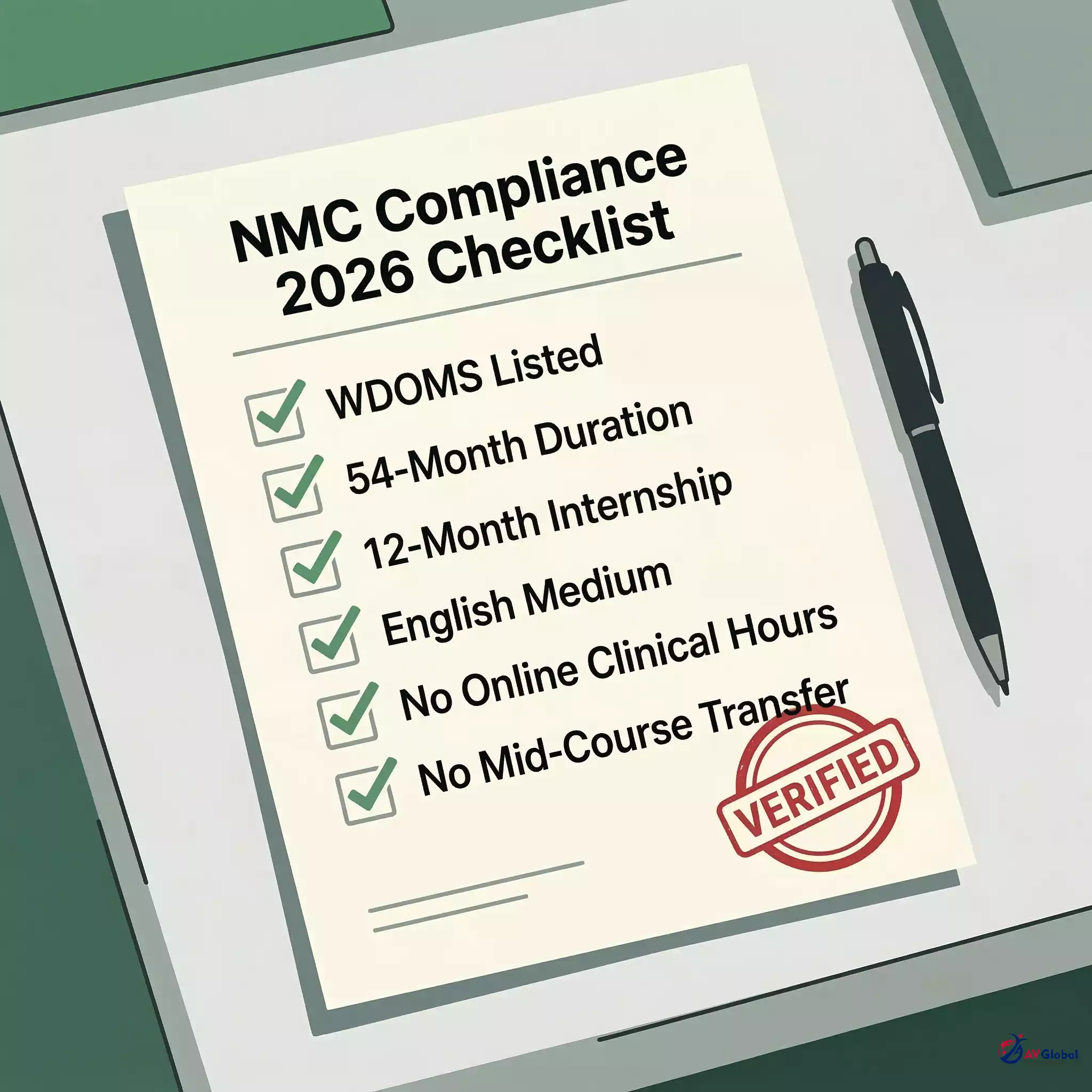
Caucasus International University holds full recognition from the National Medical Commission (NMC) of India and has been listed in the World Directory of Medical Schools (WDOMS) since 2001. This recognition makes all CIU graduates eligible to appear for the National Exit Test (NExT), which is replacing the Foreign Medical Graduate Examination (FMGE) as the screening examination for foreign medical graduates seeking medical practice license in India.
Under current NMC regulations, students must obtain an Eligibility Certificate from the NMC before commencing MBBS abroad by submitting NEET scorecard, educational documents, passport, and offer letter. After completing the MD degree, graduates must obtain a Screening Test Eligibility Certificate and clear NExT to qualify for internship in India and subsequent medical registration.
The NMC mandates that students must complete their medical education within the stipulated timeframe and cannot have any academic gaps exceeding specified limits. CIU's curriculum is designed to prepare students specifically for NExT examination pattern, with coaching modules integrated from Year 4 covering high-yield topics and clinical case discussions.
Students and parents should verify the current NMC recognition status on the official NMC India website at nmc. org.
in before enrolling, as recognition is subject to periodic review. The university maintains continuous communication with NMC to ensure compliance with all evolving regulations.
Students should also register with the Indian Embassy in Tbilisi upon arrival as recommended by NMC guidelines. Maintaining good academic standing, completing mandatory attendance requirements, and clearing all university examinations in first attempt are essential to remain eligible for NExT and subsequent medical practice in India.
Year: 2024 | Appeared: 78 | Passed: 28 | Pass Rate: 36% || Year: 2023 | Appeared: 71 | Passed: 24 | Pass Rate: 34% || Year: 2022 | Appeared: 65 | Passed: 21 | Pass Rate: 32% || Note: Data compiled from NMC screening test results and alumni self-reporting; actual university-wide rates may vary
What Our Students Say
“AV Global guided me from NEET to Georgia. The FMGE coaching from Year 3 gave me real confidence. Cleared in the first attempt.”
“AV Global knew every detail about Caucasus International University - visa, hostel, airport pickup. Best decision my family made.”
“Support from AV Global in Georgia made everything smooth. The NExT coaching programme is excellent.”
Complete Guide to MBBS at CIU
Frequently Asked Questions
Yes, CIU is listed in WDOMS and recognized by NMC India. Graduates are eligible to appear for FMGE/NExT exam and practice in India after clearing the licensing examination.
The total 6-year MBBS cost at CIU is approximately ₹$43,850 (approx. Rs.
39. 0 Lakhs).
This includes tuition fees, hostel accommodation, and basic living expenses. AV Global provides transparent fee structure with no hidden charges.
CIU teaches MBBS in English medium. Universities in Georgia do not require IELTS or TOEFL for Indian students.
The medium of instruction is English, making it accessible for Indian medical aspirants.
Indian students need a valid NEET scorecard to apply for MBBS at CIU. The cutoff varies each year based on seat availability.
Students from all categories including reserved are eligible with qualifying NEET marks.
Tbilisi has developed a vibrant Indian food scene catering to the growing population of Indian medical students across multiple universities. Within walking distance from Caucasus International University campus, students have access to several authentic Indian restaurants including Namaste India Restaurant on Chavchavadze Avenue serving North Indian curries, biryanis, and tandoori items, Bombay Kitchen near Rustaveli Metro offering vegetarian thalis and South Indian dosas, Delhi Darbar in Saburtalo district known for butter chicken and naan breads, and Spice Villa near Freedom Square providing affordable lunch combos popular with students.
For students who prefer cooking at home to save money and maintain dietary preferences, Indian grocery stores like Goodwill Supermarket and Carrefour stock essential items including basmati rice, atta flour, toor dal, chana dal, turmeric, red chili powder, garam masala, papad, pickles, and frozen parathas. Monthly food expenses vary significantly based on lifestyle choices.
Students who cook most meals at the hostel common kitchen spend approximately Rs. 5,000-9,000 per month on groceries.
Those who eat out frequently at Indian restaurants or order food delivery spend Rs. 10,000-18,000 monthly.
A typical meal at an Indian restaurant costs 15-25 Georgian Lari (Rs. 450-750).
Georgian cuisine itself offers excellent vegetarian options that Indian students enjoy including Lobio (spiced bean stew), Badrijani Nigvzit (eggplant rolls with walnut paste), Pkhali (vegetable pates made from spinach, beets, or beans), fresh Georgian breads, and abundant fresh salads. The university cafeteria provides affordable daily lunch options combining Georgian and international cuisine at 8-12 Lari per meal.
Many senior Indian students operate informal weekend cooking groups where they pool resources to prepare large batches of Indian meals, significantly reducing individual costs while maintaining the taste of home food.
CIU provides well-maintained hostel accommodation for international students.
The MBBS program at CIU is 6 years including a 1-year internship. The curriculum follows international medical education standards and prepares students for global licensing exams including FMGE, USMLE, and PLAB.
Yes, graduates from CIU can practice in India after clearing the FMGE/NExT licensing exam conducted by NMC. The university has a 36% (2024 estimate) FMGE pass rate.
The degree is recognized for medical practice in India.
Tbilisi consistently ranks as one of the safest capital cities in Eastern Europe and the Caucasus region. According to Numbeo, Tbilisi maintains a crime safety index of approximately 71 out of 100, indicating a high safety level with very low violent crime rates.
Petty crime such as pickpocketing can occur in crowded tourist areas and metro stations during peak hours, but remains relatively rare. The Caucasus International University campus operates as a gated and guarded compound with professional security personnel stationed at all entry gates checking identification cards 24 hours daily.
CCTV cameras monitor the campus perimeter, hostel entrances, parking areas, and main walkways providing comprehensive surveillance coverage. Female students report feeling very safe both on campus and in the surrounding Saburtalo and Vake neighborhoods where the university is located.
These residential districts are well-lit at night, have visible police presence, and are populated by families and other students. Indian female students commonly walk to nearby shops and restaurants during evening hours in groups of two or three without safety concerns.
The Georgian people are generally friendly toward international students, and English speakers can usually find assistance when needed. The Indian Embassy in Georgia is located at 5 Akhvlediani Street, Tbilisi 0108, with a helpline number +995 322 98 98 06 available during business hours for consular assistance, passport services, and emergencies involving Indian citizens.
The embassy staff maintains regular contact with Indian student communities across Georgian universities. Georgia's national emergency number is 112, which connects to English-speaking operators who can dispatch police, ambulance, or fire services as needed.
Response times in Tbilisi city center are generally prompt. AV Global maintains a 24-hour emergency contact number specifically for students studying at Caucasus International University, connecting them to our local representative who can provide immediate assistance with medical emergencies, legal issues, university matters, or any urgent situations requiring adult guidance and support.
Our representative visits the campus monthly to check on student welfare and address any concerns before they escalate into problems.
After MBBS from CIU, graduates can practice in India via FMGE/NExT, pursue USMLE for USA, PLAB for UK, or practice in Georgia. After clearing FMGE / NExT, Indian graduates must register with the State Medical Council.
PG admissions are via NEET-PG.
Related Articles
Ready to Start Your MBBS Journey?
“AV Global has placed 100+ students at Caucasus International University. Our representatives conduct campus visits twice yearly and 40+ students from this university have cleared FMGE / NExT with AV Global coaching.”