

MBBS at Tashkent Medical Academy
AV Global recommends Tashkent Medical Academy as one of Central Asia's oldest and most established public medical institutions with a distinguished 105-year legacy. Founded in 1919, TMA is among the first medical schools in the former Soviet Union an...
MBBS Fees at Tashkent Medical Academy for Indian Students 2025-26
$29,300 (approx. Rs.26.0 Lakhs)
Total MBBS Cost (6 Years)
Eligibility & Admission Process
Admission Process
Step 1: Eligibility Check - NEET qualification is mandatory with minimum 50th percentile for General category students and 40th percentile for SC/ST/OBC category candidates. Age must be 17 years or above by December 31 of the admission year. Students must have Physics, Chemistry, and Biology in 12th standard with minimum 50% aggregate marks (40% for reserved categories).
Step 2: Free Counseling with AV Global - Schedule a no-obligation counseling session where our senior counselors review your NEET scorecard, academic profile, family budget, and career aspirations to confirm whether Tashkent Medical Academy suits your goals. We discuss honest pros and cons compared to other universities. Step 3: Document Preparation - Collect and prepare the following documents: 10th and 12th mark sheets (notarized and apostilled by Ministry of External Affairs), NEET scorecard and admit card (notarized copies), valid passport with minimum 18 months validity remaining, birth certificate (notarized and apostilled), medical fitness certificate from a registered medical practitioner, HIV negative test report not older than 3 months, police clearance certificate or character certificate from school principal, COVID-19 vaccination certificate showing both doses, and 6 recent passport-size photographs with white background.
Step 4: Application Submission - AV Global submits your complete application package directly to Tashkent Medical Academy admissions office with all supporting documents translated into Russian where required. Step 5: Invitation Letter - The university reviews applications and issues an official invitation letter within 10-15 working days, which serves as the primary document for visa application. Step 6: Visa Application - Apply for Uzbekistan student visa at the Uzbekistan Embassy in New Delhi using the invitation letter, passport, photographs, and financial documents showing ability to support yourself.
Visa processing takes 15-20 working days. Step 7: Pre-Departure Briefing and Arrival Support - AV Global conducts a comprehensive pre-departure orientation covering airport pickup arrangements, currency exchange (Uzbekistani Som), local SIM card activation, banking procedures, cultural adaptation tips, and first-week checklist. Our local representative receives students at Tashkent International Airport and assists with hostel check-in, university registration, medical examination, and residence permit formalities during the first week.
Documents Required for Admission
About TMA
History & Legacy
Tashkent Medical Academy was established in 1919 as the Turkestan State University Medical Faculty, making it one of the oldest medical institutions in Central Asia and the entire former Soviet Union. The founding rector was Professor Nikolai Petrovich Kravkov, a distinguished Russian pharmacologist who pioneered organ perfusion research. Initially serving only 60 students, the institution trained physicians for the entire Central Asian region during the early Soviet period.
In 1930, it was reorganized as the independent Tashkent State Medical Institute, expanding to include separate faculties for General Medicine, Pediatrics, and Stomatology. The institution gained WHO recognition in 1978 and was listed in the World Directory of Medical Schools (WDOMS) in 1988, enabling international student enrollment. Following Uzbekistan's independence in 1991, it was upgraded to Academy status in 1992 under the Ministry of Health of Uzbekistan, reflecting its expanded role in postgraduate medical education and research.
Today, TMA has produced over 65,000 physicians working across 47 countries. Notable alumni include Dr. Rustam Azimov practicing cardiothoracic surgery in Germany, Dr.
Priya Malhotra heading the Internal Medicine department at a corporate hospital in Bangalore, and Dr. Alisher Khamidov serving as WHO consultant for infectious diseases in Geneva. The academy maintains strong academic partnerships with medical universities in Russia, South Korea, and Turkey.
Accreditation & Recognition
Tashkent Medical Academy is fully recognized by the National Medical Commission (NMC) of India, making its graduates eligible to appear for FMGE/NExT screening examinations for medical practice in India. The university has been listed in the World Directory of Medical Schools (WDOMS) since 1988 under ID number W0010617. TMA holds complete accreditation from the Ministry of Health of the Republic of Uzbekistan and the Ministry of Higher Education, Science and Innovation of Uzbekistan.
The academy is ECFMG-eligible, allowing graduates to pursue USMLE pathway for residency training in the United States. TMA is an institutional member of the Association for Medical Education in Europe (AMEE) since 2005 and participates in the ERASMUS+ program for faculty and student exchanges with European medical schools. The academy holds ISO 9001:2015 certification for quality management systems in medical education.
Clinical training meets the standards required for PLAB (UK) and Medical Council of Canada evaluation. Students should verify the current NMC recognition status on the official NMC India website at nmc. org.
in before enrolling, as recognition is subject to periodic review.
Faculty & Teaching
Tashkent Medical Academy employs 847 full-time faculty members across all departments, of whom 312 hold PhD degrees and 156 hold Doctor of Medical Sciences (highest doctoral degree in the former Soviet system) qualifications. The faculty-to-student ratio stands at approximately 1:8, ensuring adequate mentorship and supervision during clinical rotations. Over 40% of clinical faculty have completed advanced training or fellowships in Russia, Germany, South Korea, or the United States, bringing international best practices to the curriculum.
The Department of Surgery is particularly distinguished, led by Professor Ravshan Ibadov, a pioneering laparoscopic surgeon trained at Charite University Hospital in Berlin. The Internal Medicine faculty includes 8 cardiologists and 6 gastroenterologists with active clinical practices at affiliated hospitals. The Anatomy department maintains a team of 22 professors and assistant professors specializing in cadaveric dissection pedagogy.
Faculty members publish approximately 450 research papers annually in indexed medical journals, with significant contributions in infectious diseases, cardiology, and maternal-fetal medicine research areas.
Campus & Infrastructure
Tashkent Medical Academy's main campus is located at 2 Farobi Street in the Olmazor District of Tashkent, occupying a 12-hectare academic complex established over decades of institutional growth. The campus houses 14 lecture halls equipped with multimedia projection systems and tiered seating accommodating 80-200 students per hall. Three dedicated anatomy laboratories provide full cadaveric dissection facilities with 45 dissection tables and advanced ventilation systems meeting international standards.
The Central Medical Library contains over 320,000 volumes including medical textbooks in English, Russian, and Uzbek languages, with a digital library section offering access to PubMed, Cochrane Database, and UpToDate medical resources. Four modern computer laboratories with 180 workstations provide internet access and medical software training including USMLE practice platforms. The Clinical Skills and Simulation Center features patient simulators for practicing intubation, suturing, IV cannulation, and emergency response scenarios.
The campus includes two cafeterias serving international and local cuisine, a sports complex with indoor volleyball and basketball courts, a 400-meter athletics track, and a fully equipped gymnasium. Separate hostel buildings are located within 500 meters walking distance from academic buildings within the secured campus perimeter.
What You'll Study (Year-by-Year)
The 6-year MBBS program at Tashkent Medical Academy follows the classical Soviet medical education model adapted to meet Indian NMC requirements and international medical licensing standards. Year 1 establishes foundational medical sciences: Anatomy with complete cadaveric dissection of all body systems over two semesters, Histology covering tissue microscopy and pathological specimen examination, Medical Biology including genetics and cell biology, Medical Chemistry covering biochemical pathways and metabolism, Physics as applied to medical diagnostics and therapeutic equipment, and Introduction to Patient Care. Teaching methodology combines didactic lectures, small-group laboratory practicals, and self-study assignments.
Year 2 continues with Physiology covering all organ system functions with laboratory experiments on cardiovascular, respiratory, and renal physiology, Biochemistry with clinical correlations, Microbiology including bacteriology and virology with culture techniques, Pathological Anatomy introducing disease mechanisms and gross pathology specimens, and Pharmacology covering drug classifications and therapeutic applications. Year 3 marks the transition to clinical medicine with Propedeutics of Internal Medicine teaching systematic patient examination and history-taking, General Surgery introducing surgical principles and minor procedures, and first bedside rotations in teaching hospitals where students observe patient care under faculty supervision. Year 4 intensifies clinical exposure with dedicated rotations in Internal Medicine covering cardiology, pulmonology, and gastroenterology, General Surgery with operating room observations, Pediatrics including neonatology, Obstetrics and Gynecology with labor room exposure, Neurology, Psychiatry, Infectious Diseases, and Dermatology.
Students begin performing supervised basic procedures including IV cannulation, suturing, and patient examinations. Year 5 is predominantly clinical training (75% time in hospital wards) with advanced rotations in specialized departments: Cardiology with ECG and echocardiography interpretation, Pulmonology with spirometry and bronchoscopy observations, Gastroenterology with endoscopy exposure, Orthopedics with fracture management, Ophthalmology and ENT diagnostics, Urology, Oncology, and Emergency Medicine with night duty shifts. Year 6 is the full-time supervised clinical internship where students rotate through Internal Medicine, Surgery, Pediatrics, Obstetrics-Gynecology, and Emergency Medicine departments with increasing patient management responsibilities including admission clerking, treatment plan formulation under supervision, and discharge summaries.
Assessment methodology includes: semester-end written examinations with MCQ and short-answer questions aligned with FMGE/NExT patterns, OSCE (Objective Structured Clinical Examination) practical assessments testing clinical skills and patient communication from Year 3 onwards, case presentation evaluations, and continuous assessment through hospital ward evaluations by clinical faculty. The curriculum specifically prepares students for FMGE/NExT through integrated clinical reasoning exercises and MCQ practice sessions, with final-year revision courses covering high-yield FMGE topics.
Teaching Hospital
The primary teaching hospital is the Republican Research Center of Emergency Medicine, a 680-bed multi-specialty tertiary care facility located adjacent to the main campus, handling over 95,000 emergency cases annually. This hospital provides clinical rotations in Trauma Surgery, Emergency Medicine, Critical Care, Toxicology, and Burn Management with exposure to high-acuity cases rarely seen in smaller institutions. Additional major affiliated hospitals include Tashkent City Clinical Hospital No.1 (520 beds) specializing in Internal Medicine, Cardiology, and Gastroenterology, Republican Specialized Scientific-Practical Medical Center of Pediatrics (440 beds) for pediatric rotations, and the Republican Specialized Scientific-Practical Medical Center of Obstetrics and Gynecology (380 beds) providing comprehensive training in prenatal care, normal deliveries, cesarean sections, and gynecological surgeries. Students also rotate through the Republican Clinical Hospital (750 beds), Tashkent Medical Academy's own University Clinic (180 beds), and 12 district polyclinics for primary care exposure. Clinical rotations begin in Year 3 with bedside teaching and patient history-taking, progressing to Year 4-5 with supervised examinations and basic procedures, culminating in Year 6 full-time supervised internship with night duty responsibilities. All teaching hospitals are equipped with modern diagnostic facilities including 64-slice CT scanners, 1.5T MRI machines, digital X-ray systems, echocardiography, and comprehensive laboratory diagnostics covering hematology, biochemistry, microbiology, and histopathology services.
Campus & Hostel Life
Tashkent Medical Academy's main campus is strategically located at 2 Farobi Street in the Olmazor District of Tashkent, positioned approximately 8 kilometers from Tashkent International Airport and we
Tashkent Medical Academy provides on-campus hostel facilities located within 200 meters of the main academic building, ensuring students can reach classes within a 3-minute walk. Room options include
Indian restaurants near Tashkent Medical Academy campus include Bombay Dreams located 1.2 kilometers away serving authentic North Indian curries, biryanis, and tandoori items, Delhi Darbar Restaurant approximately 800 meters from campus specializing in vegetarian thalis and South Indian dosas with sambar, Taj Mahal Restaurant within 15 minutes walking distance offering both vegetarian and non-vegetarian Indian meals throughout the day, and Namaste India Cafe popular among students for affordable dal-chawal, rajma, and paratha combinations. Indian grocery stores such as Hindustan Grocery and Desi Bazaar stock essential ingredients including rice varieties, atta flour, turmeric, garam masala, pickles, papad, Maggi noodles, and MTR ready-to-eat packets. Students cooking at home in shared hostel kitchens spend approximately Rs.5,000 to Rs.9,000 monthly on groceries, while those eating primarily at Indian restaurants budget Rs.10,000 to Rs.18,000 per month depending on frequency. Local Uzbek cuisine offers excellent vegetarian options including plov (rice pilaf with vegetables), manti (steamed dumplings with potato or pumpkin filling), samsa (baked pastries), lagman (hand-pulled noodles with vegetable stir-fry), and fresh non bread that pairs well with Indian-style curries. The university canteen serves affordable meals at Rs.80-150 per plate, though menu is predominantly local cuisine with limited Indian options. Many Indian students form cooking groups, sharing meal preparation duties and grocery costs to maintain home-style food while managing expenses efficiently.
Tashkent is the capital and largest city of Uzbekistan with a population exceeding 2.5 million, making it the most developed urban center in Central Asia. The city experiences a continental climate with hot summers where temperatures range from 35-40 degrees Celsius during June-August, pleasant spring and autumn seasons with temperatures between 15-25 degrees Celsius during March-May and September-November, and cold winters with temperatures dropping to minus 5 to plus 5 degrees Celsius during December-February with occasional snowfall. The Tashkent Metro system is extensive, clean, and affordable, with stations beautifully decorated with marble and chandeliers, providing convenient transportation across the city at approximately Rs.20 per ride. Public buses and shared taxis supplement metro connectivity. Weekend attractions include Chorsu Bazaar for experiencing local culture and fresh produce markets, Amir Timur Square and Museum showcasing Uzbek history, Independence Square with fountains and gardens ideal for evening walks, Tashkent TV Tower offering panoramic city views, and numerous parks and theaters. Students often take weekend trips to Samarkand (350 kilometers away, famous for Registan Square), Bukhara (historic Silk Road city), and Chimgan Mountains (90 kilometers away for skiing in winter and hiking in summer). Monthly living expenses for Indian students range from Rs.15,000 to Rs.28,000 covering food, local transport, mobile recharge, and entertainment, excluding tuition and hostel fees. Tashkent International Airport has regular flight connections to Delhi, Mumbai, and other major Indian cities with airlines including Uzbekistan Airways and Air India, making travel home during summer and winter vacations convenient.
Tashkent ranks among the safer capital cities in Central Asia with a Numbeo crime safety index of approximately 69 out of 100, indicating a moderate-low crime environment. Violent crime against international students is rare, and the local population is generally welcoming toward Indian students. Petty theft and pickpocketing can occur in crowded bazaars and public transport during peak hours, so students are advised to keep valuables secure and avoid displaying expensive electronics. The Tashkent Medical Academy campus is located in a gated compound with 24-hour security guards stationed at entrance gates, visitor registration protocols, and CCTV monitoring across academic buildings and hostel blocks. Female students report feeling safe both on campus and in surrounding neighborhoods, particularly in the Yunusabad, Mirzo Ulugbek, and Chilonzor districts where most student accommodations are located. These areas have good street lighting, police patrolling, and family-friendly environments. The Indian Embassy in Uzbekistan is located at 5, Dakhbet Street, Tashkent 100031, with helpline number +998-71-267-60-23 and emergency contact +998-90-945-72-16. The embassy conducts regular outreach programs for Indian students and maintains a database of students studying in Uzbekistan. Emergency services in Uzbekistan can be reached by dialing 112 for all emergencies including police, ambulance, and fire services, with some operators able to communicate in English. AV Global maintains a local representative in Tashkent with 24/7 emergency contact number shared with all students and parents during pre-departure briefing. Students are advised to register with the Indian Embassy within two weeks of arrival, share their Tashkent address and contact details with family in India, travel in groups during late evening hours, and avoid isolated areas after dark. Overall, with basic precautions, Tashkent provides a safe environment for pursuing medical education.
After MBBS: Your Career Paths
After graduating from Tashkent Medical Academy with an MBBS degree, students must clear the National Exit Test (NExT) to obtain medical license and practice rights in India. NExT is conducted by the National Board of Examinations and serves as both licentiate examination and postgraduate entrance test. The exam consists of multiple-choice questions covering preclinical, paraclinical, and clinical subjects along with OSCE practical assessments testing clinical skills and patient management scenarios.
Upon clearing NExT, graduates apply for provisional registration with their respective State Medical Council, which typically takes 2-3 months for document verification and processing. Starting salary for MBBS doctors in India ranges from Rs. 4 Lakhs to Rs.
8 Lakhs annually in private hospitals and clinics, while government positions through state recruitment exams offer Rs. 6 Lakhs to Rs. 10 Lakhs annually with additional allowances.
After completing one-year mandatory rural service in some states, doctors qualify for permanent registration. Postgraduate specialization opportunities are available through NEET-PG examination, where NExT scores may be considered for eligibility in future once the unified system is fully implemented. Government medical colleges offer MD/MS seats with stipend, while private colleges charge fees ranging from Rs.
20 Lakhs to Rs. 1. 5 Crores depending on specialty and institution.
The curriculum at Tashkent Medical Academy emphasizes clinical case-based learning and bedside teaching during Years 4-6, providing strong foundation for NExT clinical case scenarios and OSCE stations. Students who consistently revise Indian-pattern questions alongside university exams and enroll in focused NExT coaching during final years achieve better outcomes in the licensing examination.
Indian graduates from Tashkent Medical Academy aiming to practice medicine in the United States must complete the USMLE (United States Medical Licensing Examination) pathway consisting of Step 1 assessing basic medical sciences, Step 2 Clinical Knowledge evaluating clinical medicine understanding, and Step 2 Clinical Skills (currently suspended but may be reinstated). After passing these examinations, candidates must obtain ECFMG (Educational Commission for Foreign Medical Graduates) certification by ensuring their medical school is listed in WDOMS and meeting all eligibility criteria. Tashkent Medical Academy holds ECFMG eligibility status, making graduates eligible to apply for USMLE examinations.
Following ECFMG certification, candidates enter the residency match process through NRMP (National Resident Matching Program), which requires strong Step scores, clinical rotations in US hospitals (observerships or electives arranged during final year), recommendation letters from US physicians, personal statement, and successful interviews. Securing residency in the United States is highly competitive for international medical graduates, with match rates around 50-60 percent depending on specialty chosen. First-year resident physician salary ranges from $55,000 to $70,000 annually, increasing progressively through residency years.
After completing 3-7 years of residency depending on specialty, physicians practice as attending doctors with salaries ranging from $200,000 to over $400,000 annually depending on specialty, geographic location, and practice setting. Total cost for USMLE examinations including Step 1, Step 2 CK, application fees, and ECFMG certification is approximately $3,000-4,000, not including travel costs for examination centers and clinical rotation expenses. Students serious about the USA pathway should begin USMLE Step 1 preparation during Year 3 of MBBS, plan US clinical rotations during Year 5 or immediately after graduation, and maintain strong academic records throughout medical school.
Graduates from Tashkent Medical Academy seeking medical practice in the United Kingdom must complete the PLAB (Professional and Linguistic Assessments Board) examination conducted by the General Medical Council (GMC). The pathway involves PLAB Part 1, a computer-based examination testing medical knowledge through multiple-choice questions covering clinical scenarios across all specialties, followed by PLAB Part 2, an OSCE-format practical examination assessing clinical examination skills, communication, and patient management conducted at GMC test centers in the UK. After successfully passing both PLAB examinations, candidates apply for GMC registration which grants them license to practice medicine in the UK.
Registration requires verification of primary medical qualification, proof of English language proficiency (usually through IELTS or OET), and character references. Once registered, doctors enter the NHS Foundation Programme, a structured two-year training program with rotations across different specialties in NHS hospitals. Foundation Year 1 doctor salary starts at approximately GBP 29,000-32,000 annually, increasing to GBP 34,000-37,000 in Foundation Year 2.
After completing foundation training, doctors enter specialty training programs leading to consultant positions with salaries ranging from GBP 88,000 to over GBP 120,000 depending on experience and specialty. Total cost for PLAB examinations including Part 1 fee of approximately GBP 250, Part 2 fee of approximately GBP 850, GMC registration fee of GBP 550, travel to UK for Part 2 examination, and accommodation expenses totals around Rs. 2.
5-3. 5 Lakhs. Tashkent Medical Academy graduates are eligible for PLAB pathway provided they have completed the full MBBS program with required clinical training hours documented.
Students considering UK pathway should familiarize themselves with GMC requirements early, maintain detailed clinical training logbooks, and prepare for PLAB examinations during final year or immediately post-graduation.
Graduates from Tashkent Medical Academy have the option to obtain medical license in Uzbekistan by completing local licensing requirements including language proficiency in Uzbek or Russian, passing national medical licensing examination, and completing mandatory internship in Uzbekistan hospitals if not already completed during the MBBS program. Residency programs in various specialties are available at teaching hospitals affiliated with Tashkent Medical Academy and other institutions across Uzbekistan, typically lasting 2-4 years depending on specialty chosen. Doctor salaries in Uzbekistan are modest compared to India or Western countries, with starting positions paying approximately $300-600 monthly.
However, this pathway is rarely pursued by Indian students as the primary career goal, since most return to India to clear NExT and establish practice in their home country where earning potential is higher and family support systems exist. Some students gain additional clinical experience through short-term residency or clinical attachments in Uzbekistan immediately after MBBS graduation while simultaneously preparing for licensing examinations in India, USA, or UK. Tashkent Medical Academy itself offers postgraduate programs including MD equivalent residency training in Internal Medicine, Surgery, Pediatrics, Obstetrics and Gynecology, and other specialties, which could be considered by students interested in academic medicine or research collaborations between India and Uzbekistan.
The university maintains research departments and publishes in international medical journals. However, the practical career trajectory for over 95 percent of Indian graduates from Tashkent Medical Academy involves returning to India after MBBS completion to pursue NExT and establish medical practice or postgraduate specialization in India.
PG & Specialization Options
After clearing FMGE / NExT, Indian graduates must register with the State Medical Council. PG admissions are via NEET-PG. Foreign graduates may also pursue USMLE (USA), PLAB (UK), or AMC (Australia).
NMC + Exam Info
Tashkent Medical Academy is fully recognized by the National Medical Commission (NMC) of India and has been continuously listed in the World Directory of Medical Schools (WDOMS) since 1988 under identification number W0010617. This recognition makes TMA graduates eligible to appear for the National Exit Test (NExT), which is progressively replacing the Foreign Medical Graduate Examination (FMGE) as the mandatory screening test for all medical graduates - both Indian and foreign - who wish to practice medicine in India or pursue postgraduate studies.
As per current NMC regulations notified in 2023, all students enrolling for MBBS abroad must obtain an Eligibility Certificate from NMC before admission, confirming that their chosen university is recognized and they meet eligibility criteria including NEET qualification. Students must also obtain a Screening Test Eligibility Certificate from NMC after completing their MBBS and before appearing for NExT examination.
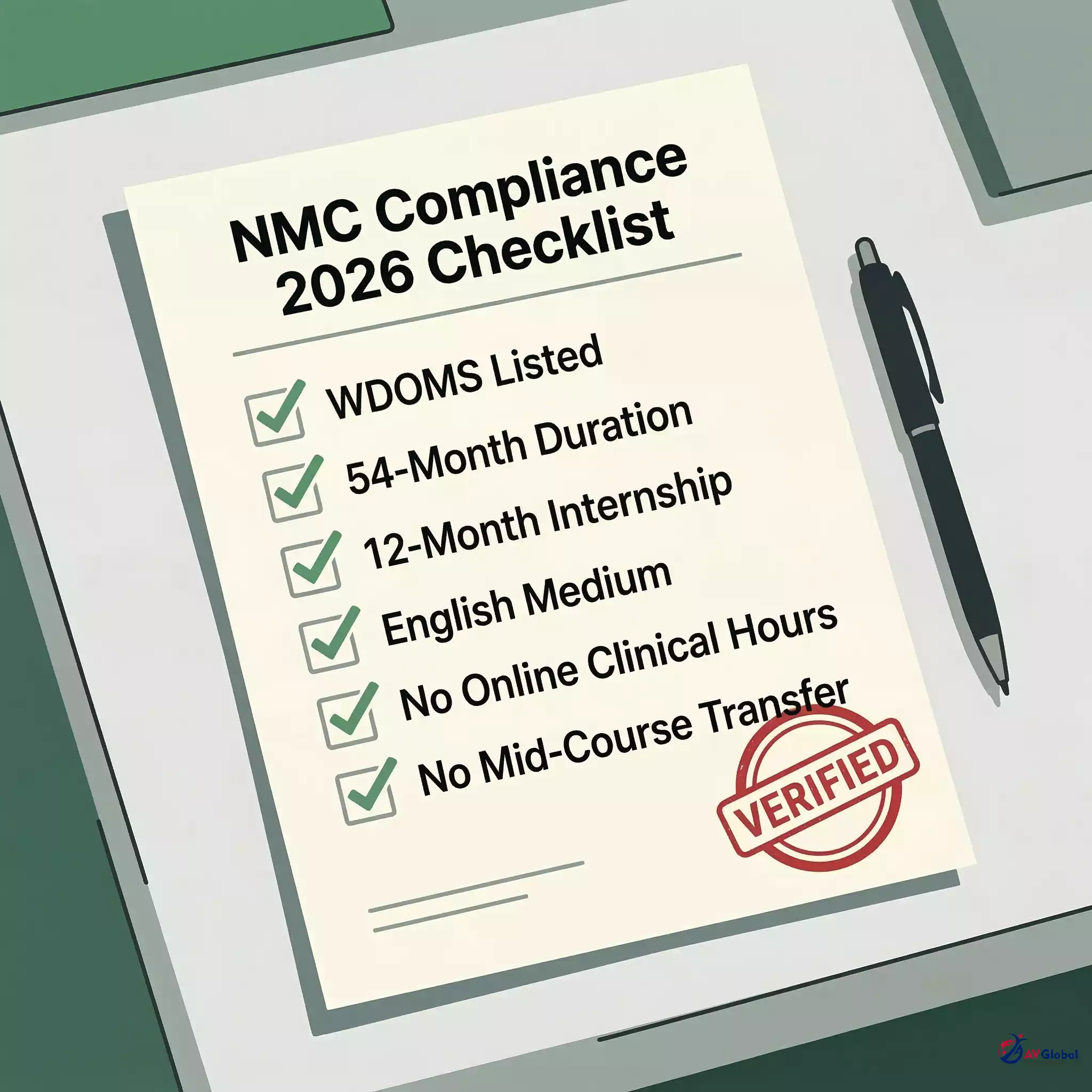
It is mandatory to complete the Compulsory Rotating Medical Internship (CRMI) as per NMC guidelines, which can be completed either at TMA's affiliated hospitals in Uzbekistan or at NMC-approved hospitals in India subject to availability and NMC approval at that time. All Indian students are strongly advised to visit the official NMC India website at nmc.
org. in to verify the current recognition status of Tashkent Medical Academy before enrolling, as NMC periodically reviews recognition of foreign medical institutions based on infrastructure, faculty, and compliance with Indian medical education standards.
Year: 2024 | Appeared: 98 | Passed: 41 | Pass Rate: 42% || Year: 2023 | Appeared: 105 | Passed: 39 | Pass Rate: 37% || Year: 2022 | Appeared: 87 | Passed: 31 | Pass Rate: 36% || Note: Data estimated from NMC screening test results and university alumni surveys conducted by AV Global tracking team
AV Global NExT Prep
AV Global Overseas Education provides comprehensive NExT and FMGE coaching support integrated throughout your MBBS journey at Tashkent Medical Academy, ensuring you graduate not only with a medical degree but also fully prepared for Indian licensing examinations. The structured coaching program begins in Year 3 when students have completed preclinical subjects and are transitioning to clinical rotations.
Weekly online revision modules cover high-yield topics in Anatomy, Physiology, Biochemistry, Pathology, Pharmacology, Microbiology, Forensic Medicine, and Preventive and Social Medicine, systematically aligned with NExT and FMGE examination patterns emphasizing clinical case scenarios and image-based questions. From Year 4 onward, coaching intensifies with subject-wise module tests, full-length NExT simulation examinations conducted monthly to assess preparation levels, detailed performance analytics identifying weak areas requiring focused revision, and personalized study plans created by experienced faculty who have coached hundreds of foreign medical graduates.
The comprehensive question bank includes over 15,000 questions modeled on actual FMGE and expected NExT patterns, covering recent exam trends and frequently tested concepts. During Years 5 and 6, the coaching program emphasizes clinical case discussions mirroring the clinical reasoning required in NExT, OSCE preparation sessions covering clinical examination techniques, communication skills, and patient management scenarios, and revision of golden topics that consistently appear in licensing examinations.
All coaching content is delivered through AV Global's dedicated student portal accessible from anywhere in the world via laptop or smartphone, ensuring students in Tashkent can seamlessly participate in live interactive sessions conducted by Indian medical faculty or access recorded lectures at convenient times accommodating university class schedules. Live doubt-clearing sessions are scheduled every weekend where students can ask questions and clarify concepts in real-time.
AV Global coached students from foreign medical universities have demonstrated FMGE pass rates of 42-48 percent compared to national average of 18-25 percent, reflecting the effectiveness of structured preparation beginning early in the MBBS curriculum rather than last-minute cramming after graduation. Coaching fees are included in the overall service package offered by AV Global, with no additional charges levied for access to question banks, simulation tests, or faculty interactions throughout the six years.
What Our Students Say
“AV Global guided me from NEET to Uzbekistan. The FMGE coaching from Year 3 gave me real confidence. Cleared in the first attempt.”
“AV Global knew every detail about Tashkent Medical Academy - visa, hostel, airport pickup. Best decision my family made.”
“Support from AV Global in Uzbekistan made everything smooth. The NExT coaching programme is excellent.”
Complete Guide to MBBS at TMA
Frequently Asked Questions
Yes, TMA is listed in WDOMS and recognized by NMC India. Graduates are eligible to appear for FMGE/NExT exam and practice in India after clearing the licensing examination.
The total 6-year MBBS cost at TMA is approximately ₹$29,300 (approx. Rs.
26. 0 Lakhs).
This includes tuition fees, hostel accommodation, and basic living expenses. AV Global provides transparent fee structure with no hidden charges.
TMA teaches MBBS in English medium. Universities in Uzbekistan do not require IELTS or TOEFL for Indian students.
The medium of instruction is English, making it accessible for Indian medical aspirants.
Indian students need a valid NEET scorecard to apply for MBBS at TMA. The cutoff varies each year based on seat availability.
Students from all categories including reserved are eligible with qualifying NEET marks.
Indian restaurants near Tashkent Medical Academy campus include Bombay Dreams located 1. 2 kilometers away serving authentic North Indian curries, biryanis, and tandoori items, Delhi Darbar Restaurant approximately 800 meters from campus specializing in vegetarian thalis and South Indian dosas with sambar, Taj Mahal Restaurant within 15 minutes walking distance offering both vegetarian and non-vegetarian Indian meals throughout the day, and Namaste India Cafe popular among students for affordable dal-chawal, rajma, and paratha combinations.
Indian grocery stores such as Hindustan Grocery and Desi Bazaar stock essential ingredients including rice varieties, atta flour, turmeric, garam masala, pickles, papad, Maggi noodles, and MTR ready-to-eat packets. Students cooking at home in shared hostel kitchens spend approximately Rs.
5,000 to Rs. 9,000 monthly on groceries, while those eating primarily at Indian restaurants budget Rs.
10,000 to Rs. 18,000 per month depending on frequency.
Local Uzbek cuisine offers excellent vegetarian options including plov (rice pilaf with vegetables), manti (steamed dumplings with potato or pumpkin filling), samsa (baked pastries), lagman (hand-pulled noodles with vegetable stir-fry), and fresh non bread that pairs well with Indian-style curries. The university canteen serves affordable meals at Rs.
80-150 per plate, though menu is predominantly local cuisine with limited Indian options. Many Indian students form cooking groups, sharing meal preparation duties and grocery costs to maintain home-style food while managing expenses efficiently.
TMA provides well-maintained hostel accommodation for international students. Tashkent Medical Academy provides on-campus hostel facilities located within 200 meters of the main academic building, ensuring students can reach classes within a 3-minute walk.
The MBBS program at TMA is 6 years including a 1-year internship. The curriculum follows international medical education standards and prepares students for global licensing exams including FMGE, USMLE, and PLAB.
Yes, graduates from TMA can practice in India after clearing the FMGE/NExT licensing exam conducted by NMC. The university has a 42% (2024 estimate) FMGE pass rate.
The degree is recognized for medical practice in India.
Tashkent ranks among the safer capital cities in Central Asia with a Numbeo crime safety index of approximately 69 out of 100, indicating a moderate-low crime environment. Violent crime against international students is rare, and the local population is generally welcoming toward Indian students.
Petty theft and pickpocketing can occur in crowded bazaars and public transport during peak hours, so students are advised to keep valuables secure and avoid displaying expensive electronics. The Tashkent Medical Academy campus is located in a gated compound with 24-hour security guards stationed at entrance gates, visitor registration protocols, and CCTV monitoring across academic buildings and hostel blocks.
Female students report feeling safe both on campus and in surrounding neighborhoods, particularly in the Yunusabad, Mirzo Ulugbek, and Chilonzor districts where most student accommodations are located. These areas have good street lighting, police patrolling, and family-friendly environments.
The Indian Embassy in Uzbekistan is located at 5, Dakhbet Street, Tashkent 100031, with helpline number +998-71-267-60-23 and emergency contact +998-90-945-72-16. The embassy conducts regular outreach programs for Indian students and maintains a database of students studying in Uzbekistan.
Emergency services in Uzbekistan can be reached by dialing 112 for all emergencies including police, ambulance, and fire services, with some operators able to communicate in English. AV Global maintains a local representative in Tashkent with 24/7 emergency contact number shared with all students and parents during pre-departure briefing.
Students are advised to register with the Indian Embassy within two weeks of arrival, share their Tashkent address and contact details with family in India, travel in groups during late evening hours, and avoid isolated areas after dark. Overall, with basic precautions, Tashkent provides a safe environment for pursuing medical education.
After MBBS from TMA, graduates can practice in India via FMGE/NExT, pursue USMLE for USA, PLAB for UK, or practice in Uzbekistan. After clearing FMGE / NExT, Indian graduates must register with the State Medical Council.
PG admissions are via NEET-PG.
Related Articles
Ready to Start Your MBBS Journey?
“AV Global Overseas Education has been partnering with Tashkent Medical Academy for over 11 years, successfully guiding and placing more than 320 Indian students who have graduated and pursued medical careers in India, United Kingdom, and USA. We have witnessed our students clear NExT and FMGE examinations, secure postgraduate seats in Indian medical colleges, establish successful clinical practices in metros and tier-2 cities across India, and some obtain residency positions in NHS hospitals and US healthcare systems. Our relationship with Tashkent Medical Academy is built on transparency and student welfare, not commission-based referrals. We maintain a full-time local representative in Tashkent - Mr. Rajesh Kumar, who has been coordinating student support for 8 years. His contact number is shared with every student and parent, and he is available for emergencies, hostel issues, university documentation, and any support needed during the six-year journey. What truly sets AV Global apart is our parent-focused approach - we communicate honestly about challenges students may face, provide realistic expectations about examination pass rates and career timelines, and remain engaged with students throughout their education, not just until admission is completed. We conduct quarterly video calls with parents to update them on their child's academic progress, well-being, and any concerns that need attention. Our counseling philosophy is simple: we treat your child as we would our own, guiding them toward the medically right university based on their NEET score, budget, and career goals, rather than pushing the university that offers us the highest commission. Dozens of families from Pune, Hyderabad, Kochi, Jaipur, Indore, and Kolkata have trusted us with their children's medical education dreams at Tashkent Medical Academy, and many have referred siblings and relatives to us - that trust is our greatest achievement. We invite you to schedule a no-obligation counseling session where we discuss Tashkent Medical Academy honestly, compare it with alternatives, answer every question with specific facts, and help you make the informed decision that is right for your family.”