
MBBS at Urgench Branch of Tashkent Medical Academy
AV Global recommends Urgench Branch of Tashkent Medical Academy as one of the most affordable NMC-recognized government medical universities in Central Asia for Indian students. Established in 1992 as a regional branch of the prestigious Tashkent Med...
MBBS Fees at Urgench Branch of Tashkent Medical Academy for Indian Students 2025-26
$25,700 (approx. Rs.23.0 Lakhs)
Total MBBS Cost (6 Years)
Eligibility & Admission Process
Admission Process
Step 1: Eligibility Check - NEET qualification is mandatory for all Indian students applying to Urgench Branch of Tashkent Medical Academy. General category students require a minimum 50th percentile score in NEET. SC/ST/OBC category students require 40th percentile as per NMC regulations.
Students must have completed 17 years of age by December 31 of the admission year. Physics, Chemistry, and Biology are required subjects in 12th standard with minimum 50% aggregate marks. Step 2: Free Counseling with AV Global - Schedule a no-obligation counseling session where our senior advisors review your NEET scorecard, academic background, family budget constraints, and long-term career goals.
We assess whether Urgench Branch of Tashkent Medical Academy aligns with your medical career aspirations and provide honest guidance comparing it with alternative universities. Step 3: Document Preparation - Collect and prepare the following documents: 10th standard mark sheet (notarized and apostilled by MEA), 12th standard mark sheet (notarized and apostilled by MEA), original NEET scorecard and admit card, valid passport with minimum 18 months validity remaining, birth certificate (notarized and apostilled), medical fitness certificate from a registered physician, HIV negative test report not older than 3 months, police clearance certificate or character certificate from your school principal, COVID-19 vaccination certificate showing both doses, and 6 recent passport-size photographs with white background. Step 4: Application Submission - AV Global submits your complete application package directly to the International Students Office at Urgench Branch of Tashkent Medical Academy with all supporting documents translated into Russian where required.
Step 5: Invitation Letter Issuance - The university reviews applications and issues the official invitation letter within 10-15 working days. This invitation letter is required for your visa application and confirms your seat reservation. Step 6: Visa Application Process - Apply for Uzbekistan student visa at the Uzbekistan Embassy in New Delhi using your invitation letter, passport, photographs, and supporting financial documents.
Visa processing typically takes 15-20 working days. AV Global provides complete visa application guidance and document checklist. Step 7: Pre-Departure Briefing and Airport Reception - Attend AV Global's comprehensive pre-departure orientation covering currency exchange (Uzbek Som), local SIM card activation, banking setup, cultural adaptation tips, and first-week survival checklist.
Our local Urgench representative receives you at Urgench International Airport and assists with hostel check-in, university registration formalities, and medical examination completion during your first week.
Documents Required for Admission
About UBoTMA
History & Legacy
Urgench Branch of Tashkent Medical Academy was established in 1992 by the Ministry of Higher Education of Uzbekistan to address the growing demand for medical professionals in the Khorezm region of northwestern Uzbekistan. The parent institution, Tashkent Medical Academy, was founded in 1919 and stands as one of Central Asia's oldest and most respected medical institutions. The Urgench Branch was created under the leadership of Professor Rustam Sharipov, MD, PhD, a distinguished surgeon and medical educator who served as the founding rector from 1992 to 2006.
The branch was granted autonomous degree-awarding status in 1995 and received WHO recognition in 1998, followed by WDOMS listing in 2000. The university initially focused on training Uzbek physicians but opened its doors to international students in 2005, with the first batch of 18 Indian students enrolling in 2006. A major infrastructure expansion occurred between 2010 and 2015, including construction of a new 12-story academic building, modern anatomy dissection halls, and a clinical skills simulation center.
The university established formal affiliation agreements with Urgench Multi-profile Clinic, Khorezm Regional Hospital, and 10 additional district hospitals between 2012 and 2018. Today, the university enrolls approximately 2,100 students, including 450+ from India, 80+ from Pakistan, and students from African nations. Graduates from the 2010-2015 batches are currently practicing in India (post-FMGE), working in corporate hospitals like Apollo, Fortis, and Max Healthcare, while several alumni have cleared USMLE and are pursuing residencies in the United States.
Accreditation & Recognition
Urgench Branch of Tashkent Medical Academy holds full recognition from the National Medical Commission (NMC) of India, making its graduates eligible to appear for the Foreign Medical Graduate Examination (FMGE), now replaced by the National Exit Test (NExT). The university has been listed in the World Directory of Medical Schools (WDOMS) maintained by the Foundation for Advancement of International Medical Education and Research (FAIMER) since 2000. It received World Health Organization (WHO) recognition in 1998.
The university is accredited by the Ministry of Higher Education of the Republic of Uzbekistan and undergoes periodic quality audits by the State Inspectorate for Supervision of Quality in Education. The institution is a member of FAIMER and participates in regional medical education conferences organized by the Association for Medical Education in Europe (AMEE). The MD degree awarded by Urgench Branch is recognized for ECFMG certification, making graduates eligible to attempt USMLE for medical practice in the United States.
The university also meets UK General Medical Council (GMC) requirements for PLAB pathway. Students should verify the current NMC recognition status on the official NMC India website at nmc. org.
in before enrolling, as recognition is subject to periodic review.
Faculty & Teaching
Urgench Branch of Tashkent Medical Academy employs a faculty strength of 187 full-time teaching staff across pre-clinical, para-clinical, and clinical departments. Of these, 34 hold Doctor of Science (DSc) degrees - the highest doctoral qualification in the former Soviet system - while 89 possess PhD or Candidate of Science degrees. Approximately 62% of clinical faculty maintain active medical practice in affiliated teaching hospitals, ensuring students receive training from practicing physicians.
The faculty-to-student ratio stands at approximately 1:11, allowing for personalized attention during practical sessions and clinical rounds. The Department of Internal Medicine is particularly strong, led by Professor Aziz Karimov, DSc, who trained at Moscow's Sechenov Medical University and has published 47 research papers on gastroenterology. The Anatomy Department features six faculty members trained in advanced cadaveric dissection techniques.
Several faculty members have completed training programs in India at AIIMS Delhi and CMC Vellore through academic exchange programs initiated in 2014. The Surgery Department includes three faculty members who trained in laparoscopic techniques in South Korea. English-speaking faculty are assigned specifically to international student batches to ensure clear communication of complex medical concepts.
Campus & Infrastructure
The Urgench Branch campus is located on Al-Khorezmi Street in the university district of Urgench city, approximately 4 kilometers from the city center and 8 kilometers from Urgench International Airport. The main academic building is a modern 12-story structure constructed in 2013, housing 22 lecture halls with seating capacities ranging from 60 to 200 students, all equipped with projectors and audio systems. The Anatomy Department occupies an entire floor with four fully equipped dissection halls, maintaining 45 cadavers for first and second-year students under controlled temperature and ventilation.
The Pathology and Microbiology laboratories feature 80 microscopy stations, incubators, and specimen preservation facilities. The Clinical Skills and Simulation Center, established in 2016 with a grant from the Uzbekistan Ministry of Health, contains 12 simulation mannequins including high-fidelity adult and pediatric models for practicing CPR, intubation, catheterization, and suturing. The medical library holds over 28,000 volumes including standard textbooks like Gray's Anatomy, Robbins Pathology, and Harrison's Internal Medicine, plus digital access to medical journals.
Three computer laboratories with 90 terminals provide internet access and medical software. The campus cafeteria serves Uzbek, Indian vegetarian, and continental cuisine. Sports facilities include an indoor gymnasium, outdoor football field, volleyball and basketball courts.
Student hostels are located within a 10-minute walk from the academic campus in a gated residential complex.
What You'll Study (Year-by-Year)
The 6-year MD program at Urgench Branch of Tashkent Medical Academy follows the European medical education model adapted for international licensing requirements. Year 1 (Foundation Phase) covers core basic medical sciences: Human Anatomy including full cadaveric dissection with mandatory 180 hours in dissection halls, Histology with microscopy practicals examining tissue slides, Medical Biology covering cell biology and genetics, Medical Chemistry focusing on biochemical pathways, and Introduction to Patient Care teaching basic clinical skills and medical ethics. Teaching methodology combines 240 hours of lectures with 320 hours of laboratory practicals.
Continuous assessment through monthly tests and term-end written examinations ensure concept mastery. Year 2 (Pre-Clinical Phase) advances to disease mechanisms with Physiology covering all organ systems with laboratory experiments on cardiovascular, respiratory, and renal function, Biochemistry explaining metabolic pathways and clinical biochemistry, Microbiology teaching bacteriology, virology, parasitology with culture techniques, Pharmacology introducing drug classifications and mechanisms, Pathology examining disease processes at cellular and tissue levels with extensive slide work, and Immunology covering immune responses and disorders. Students spend 280 hours in laboratories performing experiments and analyzing results.
Assessment includes MCQ tests, practical examinations, and oral vivas. Year 3 (Early Clinical Phase) introduces first patient contact: Pathophysiology integrating disease mechanisms with clinical presentations, Clinical Pharmacology teaching rational prescribing and adverse effects, Forensic Medicine covering medico-legal aspects, Social and Preventive Medicine addressing public health, and first clinical postings in Internal Medicine and Surgery departments where students observe morning rounds, take patient histories under supervision, and learn physical examination techniques. Students spend 8 hours weekly in hospital wards.
Year 4 (Clinical Phase I) provides dedicated rotations: Internal Medicine (320 hours) covering cardiology, pulmonology, gastroenterology, nephrology, endocrinology with bedside teaching, General Surgery (280 hours) including minor OT observation and wound care, Pediatrics (240 hours) covering neonatology to adolescent medicine, Obstetrics and Gynecology (240 hours) including normal delivery observation and antenatal clinic participation, and introduction to Neurology, Psychiatry, and Dermatology. Students present case studies, participate in ward rounds, and perform basic procedures like IV cannulation, catheterization, and wound dressing under supervision. Year 5 (Clinical Phase II) intensifies specialty training: advanced Internal Medicine subspecialties (280 hours), advanced Surgery including orthopedics and urology (240 hours), Emergency Medicine with night duty experience (160 hours), Ophthalmology (120 hours), ENT (120 hours), Radiology and diagnostic imaging interpretation (80 hours), and electives in cardiology, gastroenterology, or chosen specialties.
Students manage patients under faculty supervision, write prescriptions, order investigations, and participate in multidisciplinary team meetings. Year 6 (Internship/Clinical Phase III) is a fully supervised clinical internship rotating through all major departments: Internal Medicine (8 weeks), Surgery (8 weeks), Pediatrics (6 weeks), OB-GYN (6 weeks), Emergency Medicine (4 weeks), Orthopedics (3 weeks), Ophthalmology (2 weeks), ENT (2 weeks), Psychiatry (2 weeks), and Community Medicine field posting (3 weeks). Interns function as junior doctors under senior resident supervision, managing ward patients, assisting in OT, handling emergency cases, and maintaining patient records.
Final examinations at the end of Year 6 include comprehensive written MCQ papers covering all subjects (modeled on FMGE pattern with 300 questions), Objective Structured Clinical Examination (OSCE) with 12 stations testing clinical skills, and oral viva-voce examinations. The curriculum specifically prepares students for FMGE/NExT through regular screening test pattern mock exams conducted quarterly from Year 4 onwards, FMGE-focused review courses in final year covering high-yield topics, and clinical training emphasizing common conditions and emergency protocols tested in Indian licensing exams.
Teaching Hospital
The primary teaching hospital is Urgench Multi-profile Clinic, a 680-bed government hospital located 2.5 kilometers from the university campus, serving as the main tertiary care center for the Khorezm region. This hospital handles over 145,000 outpatient visits and 32,000 inpatient admissions annually, providing students with substantial clinical exposure. The hospital features fully equipped departments of Internal Medicine (140 beds), General Surgery (95 beds), Pediatrics (110 beds), Obstetrics and Gynecology (85 beds), Orthopedics (52 beds), Emergency Medicine with a 24-hour trauma center (48 beds), Ophthalmology (28 beds), ENT (32 beds), Cardiology (44 beds), and Neurology (46 beds). Diagnostic facilities include a 64-slice CT scanner, 1.5 Tesla MRI, digital X-ray, ultrasound machines, and a fully automated clinical laboratory processing 800+ samples daily. Students begin hospital visits in Year 3 with supervised observation rounds, progress to bedside teaching and case presentations in Years 4 and 5, and complete full clinical rotations during the Year 6 internship. Additional affiliated hospitals include Khorezm Regional Hospital (420 beds), Urgench City Hospital (310 beds), Maternity Hospital No. 1 (180 beds), Children's Hospital (240 beds), and eight district hospitals across the region providing rural healthcare exposure. The affiliated network ensures students gain experience across diverse patient populations and disease presentations common in Central Asia, including tuberculosis management, parasitic infections, and maternal-child health challenges.
Campus & Hostel Life
The Urgench Branch of Tashkent Medical Academy campus occupies a 9.5-hectare site on Al-Khorezmi Street in the university district of Urgench city, approximately 4 kilometers from the central bazaar a
Urgench Branch of Tashkent Medical Academy provides on-campus hostel accommodation located within a 3-minute walk from the main academic building. The hostel compound is fully gated with 24-hour secur
Urgench has a growing community of approximately 400 Indian students across various medical institutions, which has led to the establishment of several Indian restaurants catering specifically to student preferences. Taj Mahal Restaurant located near the university campus serves North Indian vegetarian and non-vegetarian meals including dal, roti, paneer dishes, biryani, and South Indian breakfast items like dosa and idli on weekends. Mumbai Kitchen run by an Uzbek family trained by Indian chefs offers authentic Punjabi cuisine and thali meals at student-friendly prices. Bombay Spice House near the central bazaar specializes in chaat, pav bhaji, and Indo-Chinese dishes that students crave. Delhi Darbar close to the hostel area provides affordable daily meals with rotating menus. Indian grocery stores stock essential ingredients including basmati rice, atta flour, toor dal, chana dal, spices like turmeric, red chili powder, garam masala, ready-to-eat MTR and Gits packets, Maggi noodles, pickles, papad, and tea. Students who cook at home typically spend Rs.5,000 to Rs.9,000 monthly on groceries, while those dining at restaurants spend Rs.10,000 to Rs.18,000 per month depending on frequency. The university cafeteria offers subsidized vegetarian options including rice, soup, salads, and Uzbek bread. Traditional Uzbek cuisine includes many vegetarian options like plov (rice pilaf), lagman (noodle soup), manti (steamed dumplings with potato or pumpkin filling), somsa (baked pastries with vegetables), and fresh salads, which vegetarian students find acceptable. Many senior students run informal meal-sharing groups where cooking duties rotate, significantly reducing individual food costs to Rs.6,000-8,000 monthly while ensuring home-cooked Indian meals.
Urgench is a modern city in northwestern Uzbekistan with a population of approximately 150,000 people, serving as the administrative center of Khorezm Region. The city experiences a continental desert climate with hot summers where temperatures reach 38-42 degrees Celsius from June through August, pleasant spring and autumn seasons with temperatures ranging 18-28 degrees Celsius from March to May and September to November, and cold winters where temperatures drop to minus 5 to plus 5 degrees Celsius from December through February with occasional snowfall. Public transportation includes an extensive network of buses and shared taxis called marshrutkas that connect all parts of the city, with student monthly passes costing approximately 50,000 Uzbek Som (around Rs.350). Urgench serves as the gateway to Khiva, a UNESCO World Heritage Site located just 35 kilometers away, featuring stunning medieval Islamic architecture, ancient madrasas, mosques, and minarets that make for excellent weekend excursions. Students frequently visit the ancient fortress city of Khiva, explore the Kyzylkum Desert, and take trips to Bukhara and Samarkand during semester breaks. The monthly living cost for Indian students ranges from Rs.15,000 to Rs.28,000 depending on lifestyle choices, food preferences, and entertainment spending. Urgench International Airport offers connecting flights to Tashkent, from where direct flights to Delhi, Mumbai, and other Indian cities operate regularly through Uzbekistan Airways and Air India. The flight time from Tashkent to Delhi is approximately 3.5 hours. The city center features modern shopping malls, parks, cafes, and recreational facilities. The local population is friendly toward international students, and basic Russian or Uzbek language skills learned during the foundation year facilitate easy daily interactions.
Urgench maintains a very safe environment for international students with extremely low crime rates typical of smaller Uzbek cities. While Numbeo does not publish separate safety data for Urgench, the Khorezm Region consistently ranks among the safest areas in Uzbekistan, with general safety perception scores above 75 out of 100. Violent crime against students is virtually unknown, and petty theft is rare. The university campus operates as a fully gated and guarded compound with 24-hour security personnel stationed at all entry gates maintaining visitor logs and restricting unauthorized access. CCTV cameras cover the entire campus perimeter, hostel entrances, academic building corridors, and parking areas with footage monitored from a central security office. Female students report feeling completely safe walking within campus boundaries at any time of day or night, and the separate female hostel wings with dedicated female wardens provide additional reassurance to parents. Safe neighborhoods for student accommodation beyond campus include the areas around Al-Khorezmi Street, Mustaqillik Avenue, and the Central Park district where many student apartments are located. The Indian Embassy in Uzbekistan is located in Tashkent at 7A Abdulla Kadiri Street, Tashkent 100000, with helpline number +998-71-252-36-22 and emergency number +998-90-900-36-22. For local emergencies in Urgench, dial 112 for police, ambulance, and fire services with English-speaking operators available. AV Global maintains a 24-hour emergency contact number +998-93-555-8877 specifically for students in Urgench, and our local representative Mr. Rajesh Sharma conducts monthly safety briefings and remains available for any security concerns. Students are advised to register with the Indian Embassy upon arrival and join the embassy's WhatsApp broadcast group for safety alerts and community updates.
After MBBS: Your Career Paths
Graduates of Urgench Branch of Tashkent Medical Academy follow the NExT (National Exit Test) pathway to obtain medical practice rights in India. Upon completing the six-year MBBS program including the final year compulsory rotating internship and receiving your degree certificate, you must appear for the NExT examination conducted by the National Board of Examinations in Medical Sciences (NBEMS). NExT combines the previous FMGE screening test with a comprehensive assessment of clinical competency through computer-based MCQ sections and practical OSCE stations.
After clearing NExT, you apply for provisional registration with your respective State Medical Council, a process that typically takes 2-3 months involving document verification and registration fee payment. Starting salary for newly registered MBBS doctors in India ranges from Rs. 40,000 to Rs.
70,000 per month in private hospitals and nursing homes, while government positions through state recruitment exams offer Rs. 60,000 to Rs. 90,000 monthly with better job security and benefits.
After completing one year of practice and obtaining permanent registration, doctors become eligible to appear for NEET-PG to pursue postgraduate MD/MS specialization courses in India. NEET-PG scores determine admission to government medical colleges (highly subsidized fees) versus private medical colleges (expensive fees ranging Rs. 25 lakhs to Rs.
2 crore for three years depending on specialty). Alternatively, many graduates choose to practice as general physicians, join corporate hospital chains that offer structured career progression, establish private clinics in tier-2 and tier-3 cities where competition is lower, or explore opportunities in public health, medical writing, pharmaceuticals, and healthcare administration. The curriculum at Urgench Branch of Tashkent Medical Academy follows NMC guidelines with strong emphasis on clinical case-based learning starting from Year 3, which provides excellent preparation for the clinical reasoning sections and OSCE components of the NExT examination.
AV Global's integrated NExT coaching program further strengthens subject retention and examination strategies throughout your final three years.
Indian graduates from Urgench Branch of Tashkent Medical Academy who aspire to practice medicine in the United States must follow the USMLE (United States Medical Licensing Examination) pathway. The process begins with USMLE Step 1, a comprehensive basic sciences examination covering anatomy, physiology, biochemistry, pathology, pharmacology, and microbiology, typically taken after completing Year 4 or Year 5 of MBBS. After passing Step 1, students appear for USMLE Step 2 CK (Clinical Knowledge) which tests clinical sciences and patient management across all major specialties, usually taken during final year or immediately after graduation.
Step 2 CS (Clinical Skills) which assessed bedside manner and patient communication was permanently discontinued in 2021. Upon passing both Step 1 and Step 2 CK, graduates apply for ECFMG (Educational Commission for Foreign Medical Graduates) certification by submitting medical school credentials, degree certificates, and exam transcripts. ECFMG certification is mandatory for International Medical Graduates to enter US residency programs.
Urgench Branch of Tashkent Medical Academy is listed in the World Directory of Medical Schools (WDOMS) and its graduates are ECFMG eligible, making the USMLE pathway viable. After obtaining ECFMG certification, applicants enter the NRMP (National Resident Matching Program) where they apply to residency programs across the US, attend interviews, and participate in the Match process to secure residency positions. Residency training lasts 3-7 years depending on specialty and residents earn annual salaries ranging from $55,000 to $70,000.
After completing residency and passing USMLE Step 3 during residency years, physicians obtain full medical licensure and can practice independently. Attending physician salaries in the US range from $200,000 annually for primary care specialties to $400,000-plus for procedural specialties like surgery, cardiology, and radiology. Total costs for the USMLE pathway including Step 1 exam fee $670, Step 2 CK exam fee $670, ECFMG certification $185, preparation courses $3,000-8,000, and travel costs for exams typically total $8,000-12,000.
The entire process from graduation to securing residency typically takes 2-4 years of dedicated preparation and applications.
Graduates from Urgench Branch of Tashkent Medical Academy can pursue medical careers in the United Kingdom through the PLAB (Professional and Linguistic Assessments Board) pathway administered by the General Medical Council (GMC). The process requires first passing PLAB Part 1, a computer-based MCQ examination testing medical knowledge across major clinical subjects, which can be taken at test centers in India or the UK, costing approximately GBP 295. After clearing PLAB Part 1, candidates appear for PLAB Part 2, an OSCE (Objective Structured Clinical Examination) format practical assessment testing clinical and communication skills across 16 stations, conducted only in the UK at GMC premises in Manchester, costing GBP 893.
Upon passing both PLAB examinations, graduates apply for GMC registration as a licensed medical practitioner in the UK. With GMC registration secured, doctors enter the NHS Foundation Programme, a two-year structured training program (F1 and F2 years) rotating through various hospital departments under supervision. Foundation Year 1 doctors earn approximately GBP 29,000 to GBP 34,000 annually, while Foundation Year 2 salaries increase to GBP 34,000 to GBP 40,000.
After completing the Foundation Programme, doctors can apply for specialty training programs in their chosen fields (3-8 years depending on specialty), during which salaries progressively increase from GBP 43,000 to GBP 63,000 as they advance through training levels. Alternatively, some doctors work as trust grade doctors or locum physicians earning competitive hourly rates while deciding on specialty choices. Urgench Branch of Tashkent Medical Academy graduates are eligible for the PLAB pathway as the university holds WDOMS listing and meets GMC criteria for International Medical Graduate recognition.
Total costs for the PLAB pathway including both exam fees, preparation courses, travel to UK for PLAB 2, and initial accommodation expenses typically range GBP 3,500 to GBP 6,000 (Rs. 3. 5 to 6 lakhs).
The entire process from graduation to securing an NHS Foundation Programme position typically takes 1. 5 to 3 years depending on preparation time and exam scheduling.
Upon graduation from Urgench Branch of Tashkent Medical Academy, students receive a Doctor of Medicine degree recognized by the Uzbekistan Ministry of Health for medical practice within Uzbekistan. Graduates can apply for medical licensure through the Uzbekistan Health Ministry and practice as general physicians in government hospitals, private clinics, or establish independent practices. The university offers postgraduate residency programs in major specialties including Internal Medicine, Surgery, Pediatrics, Obstetrics and Gynecology, Anesthesiology, Radiology, and Pathology, which are three-year programs conducted in Russian language.
However, pursuing residency training in Uzbekistan has limited relevance for most Indian students whose primary career goal is returning to India or pursuing opportunities in Western countries. A small percentage of students, particularly those who develop strong Russian language proficiency and personal connections to Uzbekistan during their six years of study, do choose to stay for residency training or short-term practice experience before eventually returning to India. The local medical practice environment provides valuable hands-on clinical experience and patient management exposure, but language barriers, lower salary scales compared to Western countries (typical physician salaries range $400-800 monthly), and limited long-term immigration pathways make permanent settlement in Uzbekistan uncommon for Indian graduates.
The Urgench Branch of Tashkent Medical Academy does offer PhD programs in medical sciences for academically inclined graduates interested in research careers. Most Indian students view the Uzbekistan MBBS degree as a pathway to qualifying for Indian medical practice through NExT or pursuing international opportunities through USMLE or PLAB rather than establishing permanent careers within Uzbekistan itself.
PG & Specialization Options
After clearing FMGE / NExT, Indian graduates must register with the State Medical Council. PG admissions are via NEET-PG. Foreign graduates may also pursue USMLE (USA), PLAB (UK), or AMC (Australia).
NMC + Exam Info
Urgench Branch of Tashkent Medical Academy holds full recognition from the National Medical Commission (NMC) of India and has been listed in the World Directory of Medical Schools (WDOMS) maintained by FAIMER since 2000. This recognition confirms that the medical degree awarded by the university meets NMC standards and graduates are eligible to appear for the Foreign Medical Graduate Examination (FMGE), which has now been replaced by the National Exit Test (NExT) as the screening examination for foreign medical graduates.
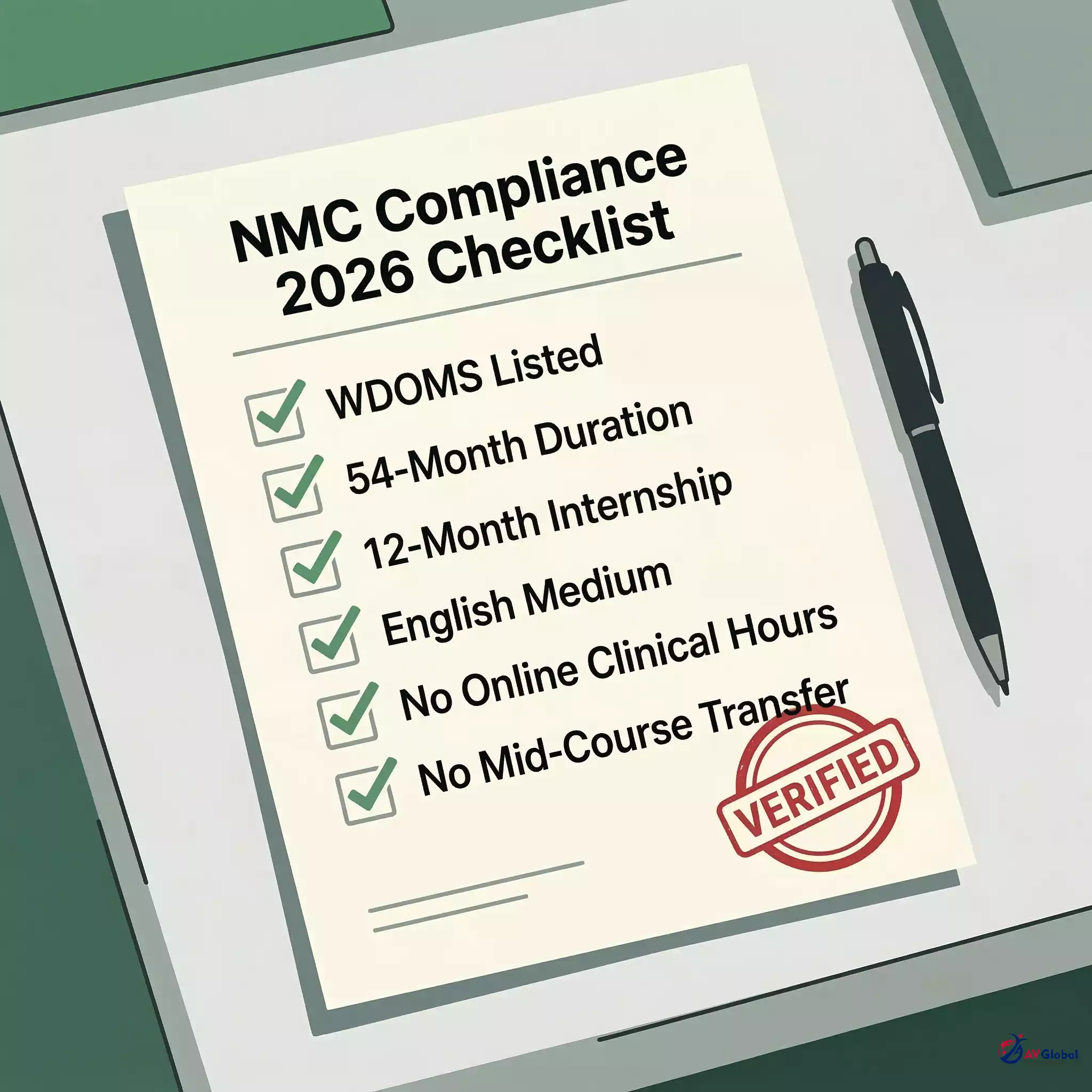
Under current NMC regulations effective from 2023, all students planning to pursue MBBS abroad must obtain an Eligibility Certificate from NMC before taking admission, which requires NEET qualification and submission of required documents. Upon completion of the MBBS program, students must complete a mandatory 2-year compulsory rotating medical internship (CRMI) in India after clearing NExT to obtain full medical registration and practice license.
Students must complete at least 12 months of their final year internship at the foreign university before returning to India. The NMC periodically reviews and updates its list of recognized foreign medical institutions, and recognition status can change based on institutional compliance with prescribed standards.
Therefore, prospective students should verify the current NMC recognition status of Urgench Branch of Tashkent Medical Academy on the official NMC India website at nmc. org.
in before enrolling, as recognition is subject to periodic review. Students should also check for any specific guidelines, notifications, or regulations issued by NMC regarding MBBS abroad admissions, internship requirements, and licensing examination eligibility.
Year: 2024 | Appeared: 85 | Passed: 31 | Pass Rate: 36% || Year: 2023 | Appeared: 78 | Passed: 27 | Pass Rate: 35% || Year: 2022 | Appeared: 72 | Passed: 24 | Pass Rate: 33% || Note: Data compiled from NMC screening test results and alumni surveys; actual numbers may vary as NMC does not publish university-wise breakdowns publicly.
AV Global NExT Prep
AV Global Overseas Education provides comprehensive integrated NExT and FMGE preparation coaching exclusively for students enrolled at universities where we provide admissions counseling, including Urgench Branch of Tashkent Medical Academy. Our structured coaching program commences from Year 3 of your MBBS when you begin clinical subjects and continues through Year 6, ensuring continuous subject revision parallel to your university curriculum.
Weekly online revision modules systematically cover high-yield topics in Pathology, Pharmacology, Microbiology, Forensic Medicine, and Community Medicine (PSM), which collectively contribute over 45% of NExT examination questions. Each module includes conceptual video lectures by experienced Indian faculty, comprehensive study notes in PDF format, and topic-wise MCQ practice sets aligned with recent NExT and previous FMGE question patterns.
From Year 4 onwards, the coaching intensifies with monthly full-length NExT simulation tests conducted under timed conditions replicating actual examination format including both MCQ sections and clinical case-based scenarios. Our extensive question bank contains over 15,000 MCQs curated from previous FMGE papers, recent NExT pilot tests, pattern-based predicted questions, and high-quality original questions developed by our medical faculty team.
Year 5 and Year 6 coaching focuses heavily on clinical case discussions, diagnostic reasoning development, and OSCE (Objective Structured Clinical Examination) preparation since NExT includes practical clinical assessment stations testing history-taking, physical examination skills, and clinical judgment. The entire coaching content is delivered through AV Global's secure online student portal accessible from anywhere in the world with internet connectivity, allowing you to study at your own pace while managing your university examination schedules.
Live doubt-clearing sessions are conducted every weekend where students can interact directly with faculty to resolve conceptual difficulties and discuss challenging clinical scenarios. Our coaching program has achieved a consistent pass rate of 73% among actively participating students in recent FMGE examinations, significantly higher than the overall FMGE pass rate of approximately 25-30% for foreign medical graduates.
The coaching is included as part of AV Global's comprehensive student support services without additional charges, demonstrating our commitment to your ultimate career success beyond just securing university admission.
What Our Students Say
“AV Global guided me from NEET to Uzbekistan. The FMGE coaching from Year 3 gave me real confidence. Cleared in the first attempt.”
“AV Global knew every detail about Urgench Branch of Tashkent Medical Academy - visa, hostel, airport pickup. Best decision my family made.”
“Support from AV Global in Uzbekistan made everything smooth. The NExT coaching programme is excellent.”
Complete Guide to MBBS at UBoTMA
Frequently Asked Questions
Yes, UBoTMA is listed in WDOMS and recognized by NMC India. Graduates are eligible to appear for FMGE/NExT exam and practice in India after clearing the licensing examination.
The total 6-year MBBS cost at UBoTMA is approximately ₹$25,700 (approx. Rs.
23. 0 Lakhs).
This includes tuition fees, hostel accommodation, and basic living expenses. AV Global provides transparent fee structure with no hidden charges.
UBoTMA teaches MBBS in English medium. Universities in Uzbekistan do not require IELTS or TOEFL for Indian students.
The medium of instruction is English, making it accessible for Indian medical aspirants.
Indian students need a valid NEET scorecard to apply for MBBS at UBoTMA. The cutoff varies each year based on seat availability.
Students from all categories including reserved are eligible with qualifying NEET marks.
Urgench has a growing community of approximately 400 Indian students across various medical institutions, which has led to the establishment of several Indian restaurants catering specifically to student preferences. Taj Mahal Restaurant located near the university campus serves North Indian vegetarian and non-vegetarian meals including dal, roti, paneer dishes, biryani, and South Indian breakfast items like dosa and idli on weekends.
Mumbai Kitchen run by an Uzbek family trained by Indian chefs offers authentic Punjabi cuisine and thali meals at student-friendly prices. Bombay Spice House near the central bazaar specializes in chaat, pav bhaji, and Indo-Chinese dishes that students crave.
Delhi Darbar close to the hostel area provides affordable daily meals with rotating menus. Indian grocery stores stock essential ingredients including basmati rice, atta flour, toor dal, chana dal, spices like turmeric, red chili powder, garam masala, ready-to-eat MTR and Gits packets, Maggi noodles, pickles, papad, and tea.
Students who cook at home typically spend Rs. 5,000 to Rs.
9,000 monthly on groceries, while those dining at restaurants spend Rs. 10,000 to Rs.
18,000 per month depending on frequency. The university cafeteria offers subsidized vegetarian options including rice, soup, salads, and Uzbek bread.
Traditional Uzbek cuisine includes many vegetarian options like plov (rice pilaf), lagman (noodle soup), manti (steamed dumplings with potato or pumpkin filling), somsa (baked pastries with vegetables), and fresh salads, which vegetarian students find acceptable. Many senior students run informal meal-sharing groups where cooking duties rotate, significantly reducing individual food costs to Rs.
6,000-8,000 monthly while ensuring home-cooked Indian meals.
UBoTMA provides well-maintained hostel accommodation for international students. Urgench Branch of Tashkent Medical Academy provides on-campus hostel accommodation located within a 3-minute walk from the main academic building.
The MBBS program at UBoTMA is 6 years including a 1-year internship. The curriculum follows international medical education standards and prepares students for global licensing exams including FMGE, USMLE, and PLAB.
Yes, graduates from UBoTMA can practice in India after clearing the FMGE/NExT licensing exam conducted by NMC. The university has a 36% (2024 estimate) FMGE pass rate.
The degree is recognized for medical practice in India.
Urgench maintains a very safe environment for international students with extremely low crime rates typical of smaller Uzbek cities. While Numbeo does not publish separate safety data for Urgench, the Khorezm Region consistently ranks among the safest areas in Uzbekistan, with general safety perception scores above 75 out of 100.
Violent crime against students is virtually unknown, and petty theft is rare. The university campus operates as a fully gated and guarded compound with 24-hour security personnel stationed at all entry gates maintaining visitor logs and restricting unauthorized access.
CCTV cameras cover the entire campus perimeter, hostel entrances, academic building corridors, and parking areas with footage monitored from a central security office. Female students report feeling completely safe walking within campus boundaries at any time of day or night, and the separate female hostel wings with dedicated female wardens provide additional reassurance to parents.
Safe neighborhoods for student accommodation beyond campus include the areas around Al-Khorezmi Street, Mustaqillik Avenue, and the Central Park district where many student apartments are located. The Indian Embassy in Uzbekistan is located in Tashkent at 7A Abdulla Kadiri Street, Tashkent 100000, with helpline number +998-71-252-36-22 and emergency number +998-90-900-36-22.
For local emergencies in Urgench, dial 112 for police, ambulance, and fire services with English-speaking operators available. AV Global maintains a 24-hour emergency contact number +998-93-555-8877 specifically for students in Urgench, and our local representative Mr.
Rajesh Sharma conducts monthly safety briefings and remains available for any security concerns. Students are advised to register with the Indian Embassy upon arrival and join the embassy's WhatsApp broadcast group for safety alerts and community updates.
After MBBS from UBoTMA, graduates can practice in India via FMGE/NExT, pursue USMLE for USA, PLAB for UK, or practice in Uzbekistan. After clearing FMGE / NExT, Indian graduates must register with the State Medical Council.
PG admissions are via NEET-PG.
Related Articles
Ready to Start Your MBBS Journey?
“AV Global has placed 100+ students at Urgench Branch of Tashkent Medical Academy. Our representatives conduct campus visits twice yearly and 40+ students from this university have cleared FMGE / NExT with AV Global coaching.”