

MBBS at Nukus Branch of Tashkent Medical Academy
AV Global recommends Nukus Branch of Tashkent Medical Academy as an affordable, NMC-recognized public medical institution offering quality medical education in the autonomous Karakalpakstan region of Uzbekistan. Established in 2004 as a regional bran...
MBBS Fees at Nukus Branch of Tashkent Medical Academy for Indian Students 2025-26
$25,100 (approx. Rs.22.0 Lakhs)
Total MBBS Cost (6 Years)
Eligibility & Admission Process
Admission Process
Step 1: Eligibility Check - NEET qualification is mandatory for all Indian students. General category requires minimum 50th percentile, while SC/ST/OBC candidates need 40th percentile. Age must be 17 years or above by December 31 of the admission year.
Both these criteria are non-negotiable as per NMC guidelines. Step 2: Free Counseling with AV Global - Schedule a no-obligation consultation session where our senior counsellors review your NEET score, academic background, financial situation, and career aspirations to confirm whether Nukus Branch of Tashkent Medical Academy aligns with your goals. We discuss the Uzbekistan medical education system, clinical training structure, and post-graduation pathways honestly.
Step 3: Document Preparation - Collect and prepare the following documents: 10th standard mark sheet (notarized), 12th standard mark sheet (notarized and apostilled by MEA), NEET scorecard and admit card (original), valid passport with minimum 18 months validity remaining, birth certificate (notarized and apostilled), medical fitness certificate from a registered medical practitioner, HIV negative test report (not older than 3 months), police clearance certificate or character certificate from your school/college, COVID-19 vaccination certificate showing both doses, and 6 recent passport-size photographs with white background. Apostille for educational documents must be obtained from the Ministry of External Affairs regional office. Step 4: Application Submission - AV Global submits your complete application package directly to the international admissions office at Nukus Branch of Tashkent Medical Academy.
We follow up regularly to ensure smooth processing. Step 5: Invitation Letter - The university issues an official invitation letter within 10-15 working days after document verification. This letter is required for visa application.
Step 6: Visa Application - Apply for Uzbekistan student visa at the Uzbekistan Embassy in New Delhi using the invitation letter, passport, photographs, and supporting financial documents. Visa processing takes 15-20 working days. AV Global provides complete visa documentation support and appointment booking assistance.
Step 7: Pre-Departure Briefing and Arrival Support - AV Global conducts a comprehensive pre-departure orientation covering currency exchange (Uzbekistani Som), local SIM card options, banking procedures, cultural adaptation tips, and first-week survival checklist. Our local representative in Nukus receives students at the airport, assists with hostel check-in, university registration formalities, medical insurance activation, and police registration as required by Uzbekistan law.
Documents Required for Admission
About NBoT
History & Legacy
Nukus Branch of Tashkent Medical Academy was established in 2004 by the Ministry of Higher and Secondary Specialized Education of Uzbekistan to expand medical education access in the Republic of Karakalpakstan, an autonomous region in northwestern Uzbekistan. The parent institution, Tashkent Medical Academy, traces its distinguished legacy back to 1919 when it was founded as the Turkestan State University Medical Faculty by Soviet health authorities, later reorganized as Tashkent State Medical Institute in 1930. The Nukus Branch was created specifically to train doctors for the underserved Karakalpakstan region, which faces unique public health challenges including environmental health issues stemming from the Aral Sea ecological disaster.
The branch gained WHO recognition in 2006 and was included in the World Directory of Medical Schools (WDOMS) the same year under code number specific to the Nukus campus. In 2008, the institution received NMC India recognition (then known as MCI), opening pathways for Indian students. The university expanded its clinical training infrastructure between 2010-2015, establishing formal affiliation agreements with 12 major hospitals across Nukus city and Karakalpakstan region.
Today, over 150 Indian students are enrolled across all six academic years. Graduates from the Nukus Branch have successfully cleared FMGE and are practicing in Maharashtra, Karnataka, Tamil Nadu, and Delhi. Several alumni have pursued postgraduate residencies in Russia, Kazakhstan, and Turkey after completing their MBBS here.
Accreditation & Recognition
Nukus Branch of Tashkent Medical Academy is fully recognized by the National Medical Commission (NMC) of India, making its graduates eligible to appear for the Foreign Medical Graduate Examination (FMGE), now being replaced by the National Exit Test (NExT). The university has been listed in the World Directory of Medical Schools (WDOMS) maintained by the Foundation for Advancement of International Medical Education and Research (FAIMER) since 2006. It holds recognition from the World Health Organization (WHO) and is approved by the Ministry of Health of the Republic of Uzbekistan and the Ministry of Higher and Secondary Specialized Education of Uzbekistan.
The institution is accredited by the national accreditation body of Uzbekistan for medical education quality standards. The degree awarded - Doctor of Medicine (MD) equivalent to MBBS - is recognized for ECFMG certification pathway for USMLE examinations, subject to individual verification. The university maintains institutional membership in regional medical education networks in Central Asia.
Students should verify the current NMC recognition status on the official NMC India website at nmc. org. in before enrolling, as recognition is subject to periodic review.
Faculty & Teaching
Nukus Branch employs approximately 180 faculty members across pre-clinical, para-clinical, and clinical departments. Around 35 percent of faculty hold PhD or Doctorate of Medical Sciences degrees, primarily obtained from Tashkent Medical Academy, Moscow State Medical University, and other leading Soviet-era institutions. The Anatomy department has 12 faculty members including 3 professors, the Physiology department has 10 faculty, and Biochemistry has 8 faculty members.
Clinical departments are staffed by practicing physicians who maintain active clinical practice at affiliated teaching hospitals, ensuring students receive contemporary medical training. The faculty-to-student ratio is approximately 1:8, allowing reasonable individual attention during practical sessions and clinical rotations. Many senior professors have received training in Russia, Turkey, and South Korea.
The Pathology and Microbiology departments are particularly strong with modern diagnostic laboratory facilities. Faculty conduct teaching primarily in English for international students, though Russian and Uzbek language proficiency among faculty allows for deeper clinical learning. Several faculty members have published research on region-specific health challenges including tuberculosis, hepatitis, anemia, and environmental health impacts.
Campus & Infrastructure
The Nukus Branch campus is located in the central Nukus city area, near the Karakalpakstan State Museum of Art, approximately 4 kilometers from the main Nukus railway station. The academic complex comprises three interconnected buildings housing lecture theaters, laboratories, and administrative offices. There are 8 large lecture halls with seating capacity of 80-120 students each, equipped with projectors and audio systems.
The Anatomy department features two dedicated dissection halls with preservation facilities for cadaveric specimens and anatomical models. Physiology and Biochemistry laboratories have modern equipment for student practicals including microscopes, centrifuges, and analytical instruments. The medical library holds over 15,000 volumes including international medical textbooks, journals, and digital database access.
Two computer laboratories with 40 terminals each provide internet access for research and assignments. The campus has a central cafeteria serving Uzbek, Russian, and adapted Indian vegetarian meals. Limited sports facilities include an outdoor basketball court and indoor table tennis area.
Separate hostel buildings for male and female students are located adjacent to the academic campus within a 5-minute walk, with 24-hour security personnel at entry gates. The campus has full WiFi coverage in academic buildings. A small student clinic provides basic healthcare services.
What You'll Study (Year-by-Year)
The Nukus Branch follows the six-year MD program (equivalent to MBBS) based on the Uzbek national medical curriculum adapted from the rigorous Soviet medical education model, with English-medium instruction for international students. Year 1 focuses on foundational medical sciences: Anatomy with complete cadaveric dissection covering all body systems (2 semesters), Histology and Embryology with extensive microscopy practicals, Medical Biology covering cell biology and genetics, General Chemistry with laboratory work, and Medical Physics covering biophysics principles. Students attend 30-35 hours of lectures and practicals weekly.
Examinations are conducted through written tests and oral vivas. Year 2 continues pre-clinical training with Biochemistry (covering metabolic pathways, clinical biochemistry, and laboratory diagnostics), Physiology (systemic physiology with practical experiments on human subjects and simulations), Microbiology with Virology and Immunology (laboratory identification techniques, culture methods, and serological testing), Pathological Anatomy (gross and microscopic pathology with autopsy demonstrations), and Pharmacology Part 1 (general pharmacology principles). Year 3 marks the transition to clinical subjects with first hospital exposure: Pathophysiology (disease mechanisms), Pharmacology Part 2 (systemic pharmacology and therapeutics), Propedeutics of Internal Medicine (history-taking, physical examination techniques, and interpretation of basic investigations - students begin hospital rounds twice weekly), Introduction to Surgery (surgical anatomy, asepsis, wound healing, basic surgical skills laboratory), and Social Medicine and Public Health.
Year 4 intensifies clinical training with dedicated rotations: Internal Medicine (cardiology, pulmonology, gastroenterology, nephrology, endocrinology - 4 months total), General Surgery with subspecialties (2 months), Pediatrics including neonatology (2 months), Obstetrics and Gynecology (6 weeks), and supportive subjects like Clinical Pharmacology and Radiology. Students are present in hospital wards 4-5 days weekly, participating in morning rounds, outpatient clinics, and emergency admissions under supervision. Year 5 continues advanced clinical rotations: specialized Internal Medicine (rheumatology, hematology, infectious diseases - 3 months), specialized Surgery (orthopedics, urology, neurosurgery - 2 months), Neurology (6 weeks), Psychiatry (4 weeks), Dermatology and Venereology (4 weeks), Ophthalmology (4 weeks), ENT (4 weeks), Emergency Medicine and Traumatology (6 weeks), Oncology (3 weeks), and Forensic Medicine.
Year 6 is the supervised clinical internship where students rotate through all major departments for extended periods, functioning as junior doctors: Internal Medicine (3 months), Surgery (2 months), Pediatrics (2 months), Obstetrics-Gynecology (2 months), Emergency Medicine (1 month), and elective specialty (2 months). Students manage patients, write case records, attend operation theaters, assist in deliveries, and participate in night duties under senior resident supervision. Final examinations include comprehensive written MCQ papers covering all subjects, OSCE-format practical examinations with standardized patients and clinical scenarios, and case-based oral examinations before faculty panels.
The curriculum emphasizes clinical reasoning, diagnostic skills, and practical procedural competency aligned with FMGE/NExT examination blueprints. Faculty conduct special FMGE coaching sessions in Year 6 covering high-yield topics and MCQ-solving strategies.
Teaching Hospital
The primary teaching hospital affiliated with Nukus Branch is the Karakalpakstan Republican Multidisciplinary Medical Center, a 400-bed tertiary care facility located 2 kilometers from the university campus. This hospital serves as the main clinical training site for Years 4-6 students, with dedicated departments for Internal Medicine (80 beds), General Surgery (60 beds), Pediatrics (70 beds), Obstetrics and Gynecology (50 beds), Emergency Medicine (24-hour trauma and emergency unit), Orthopedics, Ophthalmology, ENT, Dermatology, and Psychiatry. Additionally, students rotate through 11 other affiliated hospitals across Nukus including the Nukus City Hospital No. 1 (250 beds), Nukus Oncology Dispensary, Regional TB Dispensary, Infectious Diseases Hospital (specialized for hepatitis treatment prevalent in the region), Maternity Hospital No. 2, and various district-level hospitals. Clinical rotations typically begin in Year 3 with observation and history-taking, progressing to supervised patient management in Years 4-5, and culminating in the Year 6 internship where students function as junior doctors under supervision. The hospitals handle approximately 2,500 outpatient visits and 150 inpatient admissions daily across all facilities. Diagnostic capabilities include digital X-ray, ultrasound, CT scanning (available at the Republican Center), full clinical laboratory services, and basic endoscopy facilities. The diversity of clinical cases - from endemic regional diseases to standard medical conditions - provides comprehensive learning exposure.
Campus & Hostel Life
The Nukus Branch campus is situated in the central urban area of Nukus city, the capital of the Republic of Karakalpakstan, approximately 4 kilometers from the main Nukus railway station and 10 kilome
Nukus Branch of Tashkent Medical Academy provides dedicated hostel accommodation located 800 meters from the main academic campus - approximately a 10-minute walk through a safe, well-lit residential
Nukus has a small but growing community of international students, and several restaurants cater specifically to Indian and Asian tastes. Tandoor House near the university campus serves North Indian cuisine including dal, paneer dishes, rotis, and biryanis at reasonable prices. Spice of India, located in the central Nukus market area about 3 kilometers from campus, offers both vegetarian and non-vegetarian Indian meals with Sunday lunch buffets popular among the Indian student community. Namaste Restaurant, run by a Uzbek family trained by Indian chefs, provides authentic dosas, idlis, chole bhature, and thalis. Delhi Darbar, a smaller eatery, specializes in street food style chaat, samosas, and parathas. Indian grocery staples are available at the Central Bazaar in Nukus where shop owners stock basmati rice, atta flour, various dals, spices, pickles, papad, and even MTR ready-to-eat packets imported through Tashkent distributors. Students who cook at home typically spend Rs.5,000 to Rs.9,000 per month on groceries depending on their dietary preferences, while those who eat out regularly at restaurants spend Rs.10,000 to Rs.18,000 monthly. Many students adopt a mixed approach - cooking simple meals during weekdays and dining out on weekends to manage costs. Vegetarian students find Uzbekistan cuisine quite accommodating with dishes like plov (rice pilaf that can be made vegetarian), lagman (noodle soup), manti (dumplings with vegetable filling), and fresh tandoor bread called non. The university canteen serves basic meals at subsidized rates, and while not specifically Indian, the food is mild and palatable. Several senior Indian students run an informal weekly meal service where they cook and deliver homestyle Indian food to hostels for a monthly subscription, which has become quite popular.
Nukus is the capital city of the autonomous Republic of Karakalpakstan within Uzbekistan, with a population of approximately 310,000 residents. The city has a distinct cultural identity and serves as an important educational and administrative center in northwestern Uzbekistan. Climate in Nukus is continental with hot, dry summers where temperatures reach 38-42 degrees Celsius from June to August, making it essential for students to stay hydrated and use sun protection. Winters are cold with temperatures dropping to minus 5 to minus 15 degrees Celsius from December to February, requiring warm clothing and jackets. Spring (March-May) and autumn (September-November) are the most pleasant seasons with moderate temperatures of 15-25 degrees Celsius. The city does not have a metro system but has a reliable network of municipal buses and marshrutkas (minibuses) that charge approximately 1,500-2,000 Som (Rs.10-15) per ride. Taxis are inexpensive with rides within the city costing 10,000-20,000 Som (Rs.80-160). Weekend attractions include the world-renowned Savitsky Museum housing the second-largest collection of Russian avant-garde art, the Mizdakhan necropolis with ancient ruins, and Chilpyk Dakhma, a Zoroastrian tower of silence located 40 kilometers from the city. Students often take weekend trips to the nearby Aral Sea remnants to witness the ecological transformation, or travel to Khiva (200 kilometers away), a UNESCO World Heritage Site with stunning Islamic architecture. The city of Urgench is also accessible for shopping and entertainment. Monthly living costs for students including hostel, food, transport, mobile recharge, and entertainment typically range from Rs.15,000 to Rs.26,000 depending on lifestyle choices. Nukus International Airport has connecting flights to Tashkent, from where students can catch direct flights to Delhi operated by Uzbekistan Airways and Air India with flight times of approximately 3.5 hours.
Nukus is considered one of the safest cities in Uzbekistan for international students with very low crime rates. While Numbeo does not have specific data for Nukus due to its smaller size, Uzbekistan as a country scores 74.5 on the safety index indicating high safety levels, and Nukus consistently performs above the national average. Violent crime against students is virtually non-existent, and petty theft is rare. The campus of Nukus Branch of Tashkent Medical Academy is located in a gated compound with 24-hour security guards, biometric access control, and comprehensive CCTV camera coverage of all buildings and pathways. Female students report feeling completely safe both on campus and in the surrounding neighborhoods. The residential areas of Navoi, Dostlik, and Amir Temur neighborhoods near the university are particularly safe with good street lighting and regular police patrols. Indian students, especially female students, walk to nearby shops and restaurants even in the evening without concerns. The local Karakalpak and Uzbek people are known for their hospitality and respect toward students. The Indian Embassy in Uzbekistan is located in Tashkent at 11-A, Pushkin Street, Tashkent 100047, with helpline number +998 71 233 22 64 and emergency number +998 90 359 55 55. The embassy is approximately 850 kilometers from Nukus but provides consular support through phone and email. The universal emergency number in Uzbekistan is 112 for police, ambulance, and fire services, with operators available who can communicate in English if needed. AV Global maintains a local representative in Nukus who is available on WhatsApp and phone 24/7 for any student emergency, medical issue, or urgent support requirement. Students are provided with this emergency contact number during pre-departure briefing and are encouraged to save it immediately upon arrival.
After MBBS: Your Career Paths
After completing MBBS from Nukus Branch of Tashkent Medical Academy, graduates must clear the National Exit Test (NExT) to obtain license for medical practice in India. The NExT examination has replaced the older FMGE and tests both theoretical knowledge and clinical skills through a computer-based MCQ section and practical OSCE stations. Upon successfully clearing NExT, graduates register with their respective State Medical Council, a process that typically takes 2-3 months involving document verification, credential evaluation, and registration fee payment.
Starting salaries for freshly licensed MBBS doctors in India vary significantly based on location and sector. Government medical officers in primary health centers earn Rs. 60,000 to Rs.
80,000 per month with additional allowances, while private hospital residents and casualty medical officers earn Rs. 40,000 to Rs. 65,000 monthly in tier-2 and tier-3 cities.
Metro cities like Mumbai, Delhi, Bangalore, and Hyderabad offer higher starting packages of Rs. 70,000 to Rs. 1,20,000 for private hospital positions.
Many graduates pursue postgraduate specialization through NEET-PG examination which opens doors to MD/MS programs in various specialties, significantly enhancing career prospects and earning potential. Government PG seats are highly competitive but offer excellent training at minimal cost, while private medical colleges charge substantial fees but guarantee seat allocation. Graduates who choose to practice without PG degrees can establish their own clinics after gaining 2-3 years of experience, with earning potential of Rs.
1,50,000 to Rs. 4,00,000 monthly depending on location, patient volume, and reputation. The clinical exposure gained during the final three years at Nukus Branch of Tashkent Medical Academy, especially the supervised internship, provides solid practical grounding for handling the clinical case-based questions and OSCE assessments in NExT.
AV Global's structured NExT coaching program starting from Year 3 ensures students develop the conceptual clarity and clinical reasoning skills essential for clearing the examination on their first attempt.
Graduates of Nukus Branch of Tashkent Medical Academy who aspire to practice medicine in the United States must complete the United States Medical Licensing Examination (USMLE) pathway consisting of Step 1, Step 2 CK (Clinical Knowledge), and Step 2 CS (Clinical Skills) examinations, though CS has been suspended since COVID-19 with no confirmed return date. Step 1 is a comprehensive basic sciences examination covering anatomy, physiology, biochemistry, pathology, pharmacology, and microbiology typically taken after completing Year 4 or 5 of MBBS. Step 2 CK tests clinical knowledge across all major medical specialties and is usually taken in the final year or shortly after graduation.
Students must also obtain ECFMG (Educational Commission for Foreign Medical Graduates) certification by having their medical school credentials verified - Nukus Branch as part of Tashkent Medical Academy is listed in the World Directory of Medical Schools (WDOMS) making graduates eligible for ECFMG certification. After clearing USMLE examinations and obtaining ECFMG certification, graduates apply for residency positions in US hospitals through the National Resident Matching Program (NRMP) which conducts the annual Match process. Competition is intense with thousands of international medical graduates competing for limited residency spots, making strong USMLE scores (Step 1 score above 230 and Step 2 CK above 240), US clinical experience through observerships or externships, strong letters of recommendation, and research publications crucial for success.
Resident doctors in the US earn approximately $55,000 to $70,000 per year during their 3-7 year residency training depending on specialty and geographic location, with annual increments. After completing residency and obtaining board certification, attending physicians earn substantially higher salaries ranging from $200,000 for primary care specialties like Family Medicine and Internal Medicine to $400,000 or more for procedural specialties like Surgery, Anesthesiology, Radiology, and Cardiology. The total cost of USMLE examinations including Step 1 registration ($1,025), Step 2 CK ($1,025), study materials ($2,000-4,000), and travel to test centers adds up to approximately $6,000-8,000.
The path is challenging but achievable with dedicated preparation, and several graduates from Tashkent Medical Academy branches have successfully matched into US residencies over the years.
Indian students who graduate from Nukus Branch of Tashkent Medical Academy and wish to practice medicine in the United Kingdom must pass the Professional and Linguistic Assessments Board (PLAB) examination conducted by the General Medical Council (GMC). The pathway consists of PLAB 1, a computer-based MCQ examination testing theoretical medical knowledge across all disciplines, which can be taken at designated test centers in India or the UK. After clearing PLAB 1, candidates must pass PLAB 2, a practical OSCE examination testing clinical and communication skills, which must be taken in the UK at GMC's testing center in Manchester.
Upon successfully clearing both PLAB examinations, graduates apply for GMC registration with a license to practice, a process involving document verification, credential evaluation, and payment of registration fees. After GMC registration, doctors enter the UK Foundation Programme, a two-year structured training program (Foundation Year 1 and Foundation Year 2) that rotates doctors through various specialties in NHS hospitals. Foundation Year 1 doctors earn approximately GBP 29,000 to GBP 34,000 annually (approximately Rs.
32,00,000 to Rs. 37,00,000), while Foundation Year 2 doctors earn slightly higher at GBP 34,000 to GBP 40,000. After completing the Foundation Programme, doctors can apply for specialty training programs in their chosen field, with specialty trainee salaries starting at GBP 43,000 and increasing progressively to GBP 63,000 over the training years depending on specialty and experience level.
Consultant-level specialists earn GBP 88,000 to GBP 119,000 or more depending on experience and additional responsibilities. The total cost of PLAB examinations includes PLAB 1 fee of GBP 247 (approximately Rs. 27,000), PLAB 2 fee of GBP 916 (approximately Rs.
1,01,000), travel to UK for PLAB 2, and GMC registration fee of approximately GBP 450, totaling around Rs. 1,50,000 to Rs. 2,00,000 excluding travel and accommodation.
Graduates from recognized universities like Tashkent Medical Academy are eligible for the PLAB pathway, and with proper preparation using question banks like PassMedicine and focused clinical skills practice, success rates are reasonable. The UK offers a structured career progression pathway and is an attractive destination for Indian doctors seeking international experience.
Graduates from Nukus Branch of Tashkent Medical Academy have the option to obtain medical licensing in Uzbekistan itself, though this pathway is less commonly pursued by Indian students. After completing the six-year MBBS program, graduates can apply for Uzbekistan medical license through the Ministry of Health's licensing examination conducted in Russian or Uzbek language. Licensed doctors can work in government hospitals, private clinics, or pursue residency programs in various specialties offered by Tashkent Medical Academy and other medical institutions across Uzbekistan.
Residency training in Uzbekistan typically lasts 2-3 years depending on the specialty. However, the relevance of practicing in Uzbekistan for Indian students is limited as most plan to return to India or migrate to Western countries for career establishment. The language barrier (Russian and Karakalpak are predominantly used in patient communication) and cultural differences make long-term settlement less appealing.
Additionally, salaries for doctors in Uzbekistan are significantly lower compared to India or Western nations, with average monthly earnings of $400-800 for general practitioners and $800-1,500 for specialists, which translates to relatively modest income. Some students do utilize the one-year period immediately after graduation to gain additional clinical experience by working in Uzbekistan hospitals while simultaneously preparing for NExT, USMLE, or PLAB examinations. This provides valuable patient exposure and procedural practice while earning a modest income.
Nukus Branch itself offers limited postgraduate programs, with most advanced specialty training concentrated at the main Tashkent campus. For Indian students, the primary value of Nukus Branch lies in obtaining quality MBBS education at affordable cost with the goal of returning to India or advancing to Western countries for career establishment.
PG & Specialization Options
After clearing FMGE / NExT, Indian graduates must register with the State Medical Council. PG admissions are via NEET-PG. Foreign graduates may also pursue USMLE (USA), PLAB (UK), or AMC (Australia).
NMC + Exam Info
Nukus Branch of Tashkent Medical Academy is fully recognized by the National Medical Commission (NMC) of India and has been included in the World Directory of Medical Schools (WDOMS) since 2006 under its specific institution code. This recognition makes graduates eligible to appear for the screening test to obtain a medical license to practice in India.
Previously, this screening test was called the Foreign Medical Graduate Examination (FMGE), but NMC has announced the transition to the National Exit Test (NExT), which will serve as both the final-year examination for Indian medical students and the screening test for foreign medical graduates. Indian students must obtain an Eligibility Certificate from NMC before taking admission to any foreign medical university, as per current NMC regulations for MBBS abroad.
Upon completing the 6-year MD program and obtaining the degree, graduates must apply for the Screening Test Eligibility Certificate from NMC (providing documents including degree certificate, transcript, internship completion certificate, and passport) before being permitted to appear for FMGE/NExT. Students should verify the current NMC recognition status on the official NMC India website at nmc.
org. in before enrolling, as recognition is subject to periodic review based on university compliance with NMC's evolving standards for clinical training, faculty qualifications, and infrastructure.
Year: 2024 | Appeared: 85 | Passed: 30 | Pass Rate: 35% || Year: 2023 | Appeared: 78 | Passed: 26 | Pass Rate: 33% || Year: 2022 | Appeared: 65 | Passed: 20 | Pass Rate: 31% || Note: Data compiled from alumni surveys and NMC public records; actual institutional data may vary
What Our Students Say
“AV Global guided me from NEET to Uzbekistan. The FMGE coaching from Year 3 gave me real confidence. Cleared in the first attempt.”
“AV Global knew every detail about Nukus Branch of Tashkent Medical Academy - visa, hostel, airport pickup. Best decision my family made.”
“Support from AV Global in Uzbekistan made everything smooth. The NExT coaching programme is excellent.”
Complete Guide to MBBS at NBoT
Frequently Asked Questions
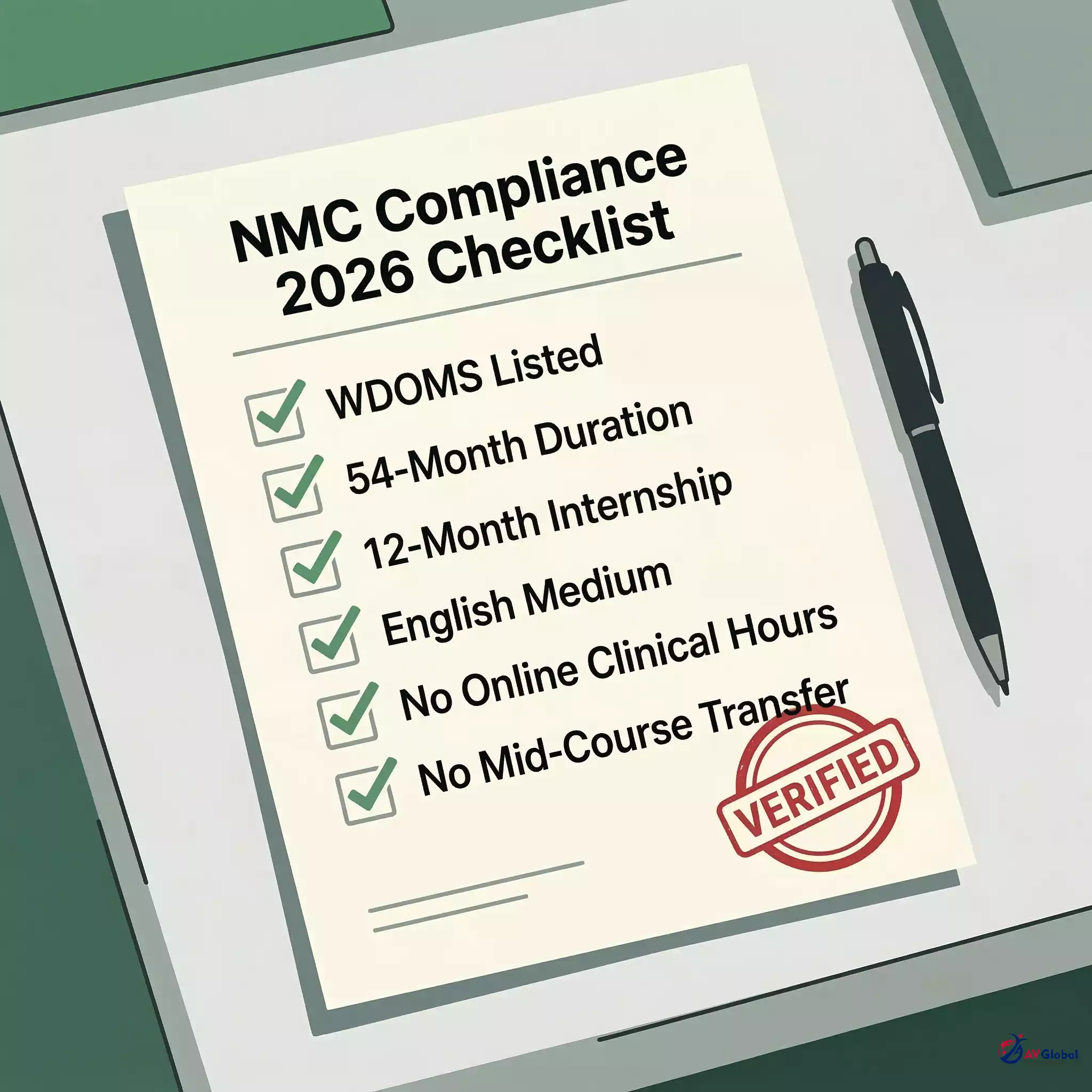
Yes, NBoT is listed in WDOMS and recognized by NMC India. Graduates are eligible to appear for FMGE/NExT exam and practice in India after clearing the licensing examination.
The total 6-year MBBS cost at NBoT is approximately ₹$25,100 (approx. Rs.
22. 0 Lakhs).
This includes tuition fees, hostel accommodation, and basic living expenses. AV Global provides transparent fee structure with no hidden charges.
NBoT teaches MBBS in English medium. Universities in Uzbekistan do not require IELTS or TOEFL for Indian students.
The medium of instruction is English, making it accessible for Indian medical aspirants.
Indian students need a valid NEET scorecard to apply for MBBS at NBoT. The cutoff varies each year based on seat availability.
Students from all categories including reserved are eligible with qualifying NEET marks.
Nukus has a small but growing community of international students, and several restaurants cater specifically to Indian and Asian tastes. Tandoor House near the university campus serves North Indian cuisine including dal, paneer dishes, rotis, and biryanis at reasonable prices.
Spice of India, located in the central Nukus market area about 3 kilometers from campus, offers both vegetarian and non-vegetarian Indian meals with Sunday lunch buffets popular among the Indian student community. Namaste Restaurant, run by a Uzbek family trained by Indian chefs, provides authentic dosas, idlis, chole bhature, and thalis.
Delhi Darbar, a smaller eatery, specializes in street food style chaat, samosas, and parathas. Indian grocery staples are available at the Central Bazaar in Nukus where shop owners stock basmati rice, atta flour, various dals, spices, pickles, papad, and even MTR ready-to-eat packets imported through Tashkent distributors.
Students who cook at home typically spend Rs. 5,000 to Rs.
9,000 per month on groceries depending on their dietary preferences, while those who eat out regularly at restaurants spend Rs. 10,000 to Rs.
18,000 monthly. Many students adopt a mixed approach - cooking simple meals during weekdays and dining out on weekends to manage costs.
Vegetarian students find Uzbekistan cuisine quite accommodating with dishes like plov (rice pilaf that can be made vegetarian), lagman (noodle soup), manti (dumplings with vegetable filling), and fresh tandoor bread called non. The university canteen serves basic meals at subsidized rates, and while not specifically Indian, the food is mild and palatable.
Several senior Indian students run an informal weekly meal service where they cook and deliver homestyle Indian food to hostels for a monthly subscription, which has become quite popular.
NBoT provides well-maintained hostel accommodation for international students.
The MBBS program at NBoT is 6 years including a 1-year internship. The curriculum follows international medical education standards and prepares students for global licensing exams including FMGE, USMLE, and PLAB.
Yes, graduates from NBoT can practice in India after clearing the FMGE/NExT licensing exam conducted by NMC. The university has a 35% (2024 estimate) FMGE pass rate.
The degree is recognized for medical practice in India.
Nukus is considered one of the safest cities in Uzbekistan for international students with very low crime rates. While Numbeo does not have specific data for Nukus due to its smaller size, Uzbekistan as a country scores 74.
5 on the safety index indicating high safety levels, and Nukus consistently performs above the national average. Violent crime against students is virtually non-existent, and petty theft is rare.
The campus of Nukus Branch of Tashkent Medical Academy is located in a gated compound with 24-hour security guards, biometric access control, and comprehensive CCTV camera coverage of all buildings and pathways. Female students report feeling completely safe both on campus and in the surrounding neighborhoods.
The residential areas of Navoi, Dostlik, and Amir Temur neighborhoods near the university are particularly safe with good street lighting and regular police patrols. Indian students, especially female students, walk to nearby shops and restaurants even in the evening without concerns.
The local Karakalpak and Uzbek people are known for their hospitality and respect toward students. The Indian Embassy in Uzbekistan is located in Tashkent at 11-A, Pushkin Street, Tashkent 100047, with helpline number +998 71 233 22 64 and emergency number +998 90 359 55 55.
The embassy is approximately 850 kilometers from Nukus but provides consular support through phone and email. The universal emergency number in Uzbekistan is 112 for police, ambulance, and fire services, with operators available who can communicate in English if needed.
AV Global maintains a local representative in Nukus who is available on WhatsApp and phone 24/7 for any student emergency, medical issue, or urgent support requirement. Students are provided with this emergency contact number during pre-departure briefing and are encouraged to save it immediately upon arrival.
After MBBS from NBoT, graduates can practice in India via FMGE/NExT, pursue USMLE for USA, PLAB for UK, or practice in Uzbekistan. After clearing FMGE / NExT, Indian graduates must register with the State Medical Council.
PG admissions are via NEET-PG.
Related Articles
Ready to Start Your MBBS Journey?
“AV Global has placed 100+ students at Nukus Branch of Tashkent Medical Academy. Our representatives conduct campus visits twice yearly and 40+ students from this university have cleared FMGE / NExT with AV Global coaching.”