Every year in India, roughly 1.8 million students appear for NEET.
Roughly 50,000 government MBBS seats are available.
The rest either pay one crore or more for a private seat, take a drop year and try again, or give up on medicine entirely.
Or they discover Georgia.
Georgia has quietly become one of the most trusted MBBS destinations for Indian students. NMC approved universities. Fully English-medium teaching. Six-year total costs that fit inside Rs 25 to 35 lakhs. A safe, student-friendly country that has been welcoming Indian medical students for over two decades.
The problem is not Georgia itself. The problem is what happens when a family starts researching online. Fifteen websites. Fifteen different answers. Conflicting timelines, contradictory document lists, and agents who seem more interested in collecting a fee than in actually helping.
This guide is different. It is written by a team that has personally walked more than 10,000 Indian students through this exact process since 2009. Every step below reflects what actually happens on the ground, not what sounds good on paper.
Read it once carefully. By the end, you will know exactly what to do, in what order, and what to watch out for at every stage.
Why the MBBS in Georgia Admission Process Feels Confusing (And Why It Actually Is Not)
The confusion mostly comes from two sources.
The first is agents who deliberately make the process sound complicated so that families feel they cannot do it without paying for help. The second is generic MBBS abroad articles written by people who have never actually counselled a single student.
The reality is that the MBBS Georgia admission process follows a clean, logical sequence. Every family that gets through it smoothly followed the same basic pattern: start early, prepare documents correctly, choose the right university, file a clean visa application, and have someone experienced on the ground when the student arrives.
That is it. Eight steps. Let us go through each one.
Step 1: Confirm eligibility Before You Look at a Single University Brochure
This step takes thirty minutes and saves weeks of wasted effort. Before budgets, before university names, before anything else, check these five things.
Your child must have completed 10+2 with Physics, Chemistry, and Biology from a recognised board. The NMC-mandated minimum is 50 percent aggregate in PCB for General category students. For SC, ST, and OBC students, the minimum is 40 percent.
This is the most misunderstood point in the entire MBBS abroad conversation. Georgian universities do not demand a high NEET rank. However, India's National Medical Commission requires every student who studies MBBS abroad to hold a valid NEET qualification in order to appear for the NExT licensing exam after returning to India.
NExT is the exam that gives your child the legal right to practice medicine in India. Without a valid NEET qualification, your child cannot sit for NExT. Without NExT, six years of MBBS abroad produce a degree that cannot be used in India.
NEET is therefore not a Georgian requirement. It is an Indian career requirement. Treat it as non-negotiable.
The student must have completed 17 years of age by 31 December of the admission year. There is no upper age limit for MBBS, though gaps longer than two years need proper explanation during visa processing.
A valid Indian passport with at least 12 months of remaining validity at the time of application is required. If your passport is expiring in the next year, get it renewed before you do anything else. One expired passport has delayed entire admission timelines by months.
A basic medical fitness certificate is required by both the university and the Georgian consulate for visa processing. Students with significant ongoing health conditions should discuss this honestly with their counsellor from day one.
If all five are clear, move to Step 2.
Step 2: Build a Focused University Shortlist (This Decision Shapes the Next Six Years)
Choosing the wrong university is the most expensive mistake a family can make in this entire process. It is more expensive than any agent fee and more damaging than any document delay.
What changed in Georgia for 2026
Georgia's government recently announced that state-funded universities will no longer accept international students for new admissions from 2026 onward. Many families read this headline and panicked.
Here is what the headline missed. The universities that Indian students have been attending successfully for years, the ones with the strongest NMC approval records, the best FMGE data, and the most established Indian student communities, are all private universities. This policy does not affect them.
Georgian American University, David Tvildiani Medical University, New Vision University, Caucasus International University, Geomedi Medical University, and several others remain fully open for Indian admissions in 2026. The landscape has not changed for serious applicants who were already considering the right institutions.
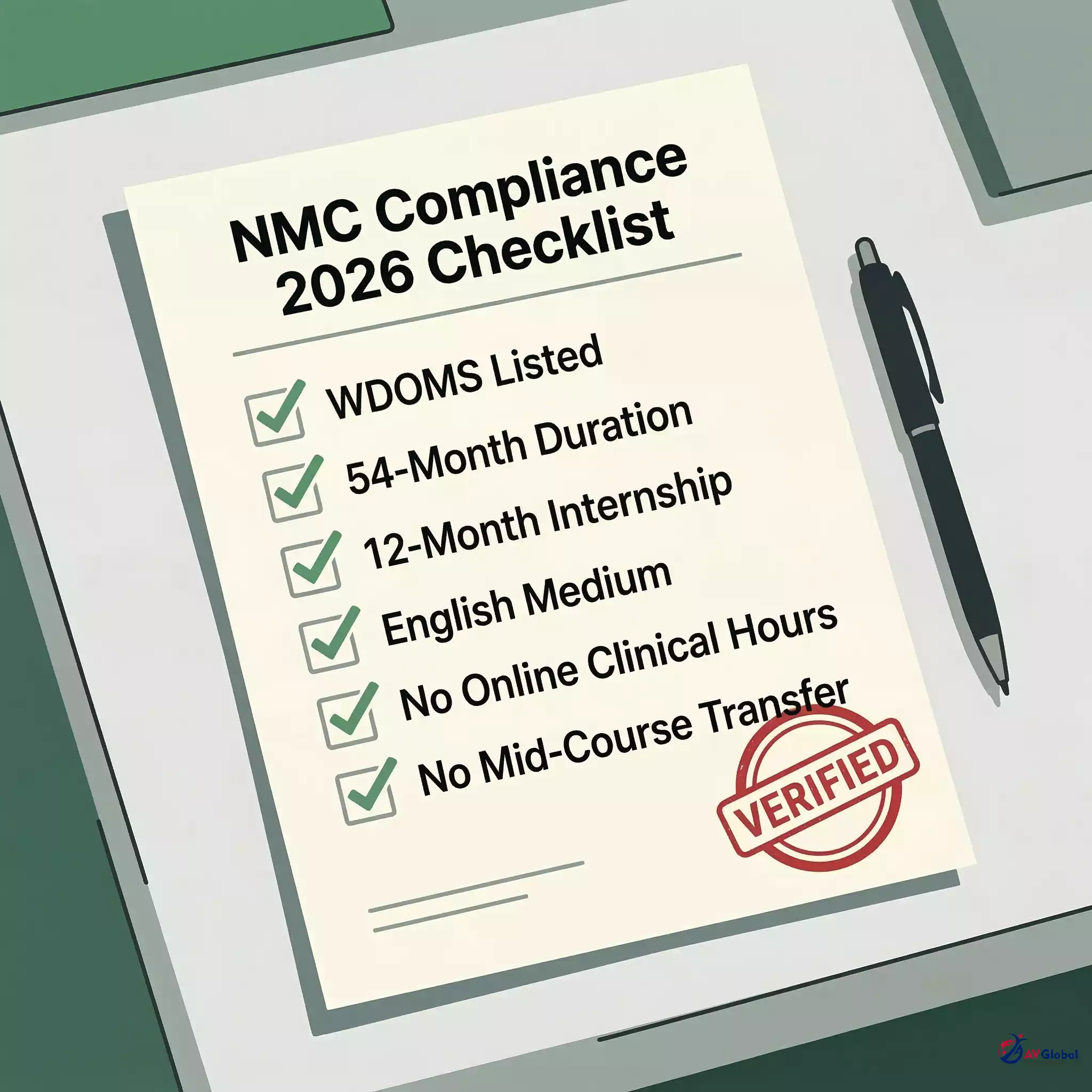
The five things to verify before adding any university to your shortlist
- Confirm current NMC approval. Do not rely on a list an agent shows you. Check the live NMC website directly. Approval status can change.
- Confirm the university is listed in WHO's World Directory of Medical Schools. Known as WDOMS. Both NMC and WDOMS recognition together protect your child's degree for practice in India and internationally.
- Ask for actual FMGE and NExT pass rate data. For Indian students from that specific university. Not national averages. Not the consultancy's internal marketing numbers. Data for that university, for the last three years. A university that cannot or will not share this data is not worth considering.
- Ask about the clinical training environment. Are Indian students placed in real hospital wards from early years? Are anatomy labs and simulation facilities genuinely available? The difference between a university that talks about clinical exposure and one that actually delivers it becomes visible only in the NExT exam results.
- Check the total cost honestly. First year fees are only one number. Add six years of tuition, hostel, food, transport, insurance, travel home once a year, and a buffer for unexpected expenses. The family that plans this properly from the start never faces a crisis mid-degree.
Step 3: Prepare Your Documents Before Submitting a Single Application
Document problems are responsible for more admission delays than any other single factor. The solution is simple: prepare everything before you need it, not while you need it.
Collect original and clear scanned copies of Class 10 mark sheet and passing certificate, Class 12 mark sheet and passing certificate with PCB subjects clearly visible, and the NEET scorecard from the qualifying attempt.
Passport with at least 12 months of validity remaining. Birth certificate showing exact date of birth. Recent passport-size photographs as per Georgian consulate specifications.
Basic medical fitness certificate with blood test reports as specified by the university. Police clearance certificate or character certificate from the local police station or appropriate authority.
Several documents will need to be apostilled before the Georgian consulate accepts them at the visa stage. Apostille is an official government authentication stamp that verifies the document is genuine. The process runs through the Ministry of External Affairs in India and takes time.
Do not leave apostille for the last week before your visa appointment. Build it into your timeline from the moment your shortlist is confirmed.
Sit down right now and compare the name spelling across every document. Passport, 10th certificate, 12th certificate, birth certificate. A single spelling difference, even one letter, can stall an application for weeks. Catch it early.
Step 4: Submit University Applications Through the Right Channels
With documents organised, applications go to your shortlisted universities. Most Georgian private universities accept clear scanned documents initially for eligibility verification. Originals and apostilled copies come into play at the visa stage.
The application sequence typically looks like this.
The student fills the official application form with counsellor guidance. Scanned documents are submitted through the university's portal or official email. The university reviews the application and may request additional documents or a clarification call. Once satisfied, the university issues an Admission Letter, sometimes also called an Invitation Letter. This document is the single most important piece of paper in the entire process. It is what the Georgian consulate needs to process the student visa.
Some universities issue a conditional letter first, pending original document verification, and convert it to an unconditional letter afterward. Both are valid for initiating the visa process.
Timeline for 2026 intake
For September to October 2026 intake, leading Georgian universities typically open application windows between January and April. Admission letters are issued within 7 to 21 days of a complete application. The families who apply in January or February get first choice of universities, first choice of hostel rooms, and the most comfortable timeline for visa processing. Families who apply in July are the ones calling us in a panic.
Step 5: Plan Your Finances and Prepare Financial Proof Properly
The visa stage requires financial documentation that tells a clear, credible story. Getting this wrong is the leading cause of Georgian student visa complications.
The Georgian consulate reviewing a student visa application is asking one central question: is this family genuinely able to fund six years of medical education abroad, or are they stretching beyond their means with borrowed or manipulated money?
A genuine, honest file passes this test. A file with last-minute large deposits, inconsistent income proofs, or financial numbers that do not add up creates suspicion even when the applicant is completely legitimate.
Stable bank statements going back at least six months. Not three weeks of sudden deposits. Six months of genuine account activity.
Income proof for the sponsoring parent or guardian showing a consistent, credible income source that can support the education costs.
A clear breakdown of how first year fees, hostel costs, and living expenses will be funded.
Many Georgian universities require partial fee payment before issuing the final invitation letter for the visa. Plan for this payment to appear in your account naturally, not as a panic transfer two days before the deadline.
Step 6: File Your Georgian Student Visa Application
With the admission letter and financial documents ready, the next step is the Georgian D3 category student visa, applied through the Georgian Embassy in India or through the designated VFS centre.
Completed visa application form. Valid passport and photographs. University admission and invitation letters. Apostilled 12th certificates and NEET scorecard. Six months of bank statements and income proof. Hostel confirmation or accommodation proof. Medical fitness certificate.
Visa decisions are typically issued within 3 to 6 weeks depending on application volume and document completeness. Well-prepared files often come through faster.
Most genuine visa rejections are not because the student is ineligible. They happen because the file is disorganised, the financial story does not hold together, documents have inconsistencies, or the application gives the impression that something is being hidden. A clean, honest, well-organised file from a student who genuinely meets the criteria rarely faces serious problems.
Step 7: Pre-Departure Preparation in the Final Weeks Before Travel
Visa approved. Flight to book. And now, the two to three weeks before departure that most families underestimate completely.
- Flights: Book with enough buffer before the university's official reporting date. Arriving two to three days early is far better than rushing off a connecting flight straight to an enrolment queue.
- Money: Carry a mix of US dollars and Georgian Lari for the first week. ATMs in Tbilisi are widely available but having local currency on arrival prevents stress on Day 1. Set up an international student card before departure.
- Packing for Georgia: Georgia experiences four proper seasons. September arrival means mild autumn weather. By November it is noticeably colder. By January it is genuinely cold in Tbilisi and significantly more so in other cities. Students who pack only for September arrivals are the ones buying winter coats in a panic in November. Pack for the full first year.
- Pre-departure orientation: Every student heading to Georgia through AV Global attends a structured pre-departure session. In person at our offices or live online. Parents attend. The session covers daily life in Tbilisi, how to navigate university registration on Day 1, local SIM cards and banking, food options for Indian students, safety basics, cultural adjustment, and a clear list of what to do and what to avoid in the first month.
This single session answers 80 percent of the questions parents call us with in the weeks before departure. Attend it.
Step 8: Arrival, Hostel, Registration and Settling In
Landing in a foreign country at 17 or 18 years old, often for the first time, with six years of medical school ahead, is a genuinely significant moment.
How the first 72 hours go matters more than most families realise.
AV Global's local representative team receives students at Tbilisi's Shota Rustaveli International Airport. Not a taxi booking. Not a phone call. A known face with a sign, who helps with luggage, drives to the hostel, checks the student in, and stays available through the first week.
In the first two to three weeks in Georgia, students need to complete university enrolment formalities and collect their student ID, a medical check-up as required by the university, a local SIM card and basic banking setup, and the residence permit application, which converts the short-term entry visa to long-term resident status under Georgian law.
AV Global's on-ground team guides students through all of this. Parents sitting in Nagpur, Mumbai, Pune, or anywhere in India know that there is a real office, a real team, and real people in Tbilisi looking after their child. Not just until the plane lands. Throughout the degree.
A Word on Why Shortcuts Destroy Futures
Every admission season, a small number of families choose agents who promise to manage everything quickly and cheaply, without proper documentation, without following the correct sequence, and sometimes by falsifying financial records or submitting applications to universities that are not genuinely NMC-approved.
The consequences are not small inconveniences. They are visa bans, invalid degrees, lost years, and destroyed savings. One family we spoke to had paid a fraudulent agent Rs 4 lakhs, received a fake admission letter for a university that had lost NMC approval two years earlier, and discovered the truth only after their child had landed in Tbilisi.
The MBBS in Georgia admission process is not complicated. But it must be done properly, in the right sequence, with genuine documents, real universities, and honest guidance. The extra few weeks it takes to do this correctly are nothing compared to the six years it protects.
Frequently Asked Questions: MBBS in Georgia Admission Process 2026
For a well-prepared family, the process from initial eligibility check to visa approval typically takes 8 to 14 weeks. Starting immediately after NEET results, targeting a May or June application for September intake, gives the most comfortable timeline.
Technically yes. Practically, most families choose not to. Coordinating document apostille, multi-university applications across time zones, financial document preparation, visa filing, and on-ground arrival support is manageable with experienced guidance and extremely stressful without it.
The admission letter is submitted to the Georgian consulate along with your financial and educational documents to apply for the D3 student visa. Once the visa is approved, pre-departure preparation and travel follow.
Most universities require partial payment, typically the first semester or first year fee, before issuing the final invitation letter. Balance payments are usually made after arrival or at the start of subsequent academic years. This varies by university.
Most Georgian private universities do not conduct formal entrance exams for Indian students. Some conduct a brief screening video call, particularly for competitive intakes. A valid NEET qualification and 12th marks are the primary academic requirements.
A rejection is not the end. Most genuine rejections are caused by document issues or financial documentation gaps, not by fundamental ineligibility. A well-prepared reapplication with corrected documents succeeds in most cases. Experienced visa guidance significantly reduces the chances of a first rejection.
Yes. Georgia consistently ranks among the safest countries in Eastern Europe and the Caucasus region. Tbilisi has a well-established Indian student community, functioning Indian restaurants and grocery options, and a culture that is genuinely welcoming to international students.
The Bottom Line for Every Parent Reading This
The families who have the best experiences with MBBS in Georgia are not the ones with the highest NEET scores or the largest budgets.
They are the families who started early, prepared documents properly, chose the right university for their child's specific profile, filed a clean honest visa application, and had experienced people with them at every step.
If you want the entire journey from eligibility check to university seat, visa approval, and safe arrival in Tbilisi handled in an organised, ethical, and experienced way, book a free counselling session with AV Global Overseas.
Our counsellors will review your child's complete profile and give you a clear, honest answer about Georgia, the specific universities where your child is best placed, realistic costs, and the exact timeline to follow. No pressure. No commission-driven shortcuts. No false promises.
Book Your Free Counselling Session Today
If you're reviewing country-wise FMGE/NExT passing rates, don't miss our analysis on MBBS in Kazakhstan.