
By: AV Global Overseas Education Counselling Team | Published: April 5, 2026 | Read Time: 12 minutes
Let me be direct with you. If your child is considering MBBS in Uzbekistan, or if you have already paid fees to an agent for admission in a university there, stop everything and read this post carefully.
On April 1, 2026, the National Medical Commission (NMC) issued an official advisory - not a rumour, not a WhatsApp forward, but a formal government alert - specifically warning Indian students against pursuing MBBS in certain medical institutions in Uzbekistan. This is the latest in a series of NMC communications that started with public notices in August 2023 and November 2024, followed by an advisory in May 2025 and another alert note in July 2025.
This time, the NMC has gone further. They have named specific universities. They have cited specific violations. And they have made it absolutely clear that students who ignore this advisory may find themselves permanently ineligible to practice medicine in India.
At AV Global Overseas, we have been counselling families about MBBS abroad for over fifteen years. We have always told our students and parents the truth about Uzbekistan - the good, the bad, and the complicated. Today, we need to talk about what this advisory means, which universities are affected, and how you can protect your child's career.
What Exactly Did the NMC Say? The April 1, 2026 Advisory Explained
The advisory was issued under reference number No. U-15021/1/2024-UGMEB (e-8264469), signed by Dr. Raghav Langer, Secretary of the National Medical Commission. It was triggered by a formal communication from the Embassy of India in Tashkent, the Uzbekistan capital.
Here is what the NMC has flagged, in plain language:
The Indian Embassy in Tashkent reported serious concerns about the quality of medical education being delivered to Indian students in Uzbekistan. These are not minor bureaucratic complaints. The Embassy found that certain universities are admitting far more students than their infrastructure can handle, that hands-on clinical training is severely compromised because teaching is not actually happening in English, and that agents facilitating these admissions are engaging in malpractice.
The NMC also received separate complaints about serious violations of the FMGL Regulations 2021, specifically involving an offshore campus model where a Uzbekistan university branch was running operations from Bangalore.
Which Universities Has the NMC Named?
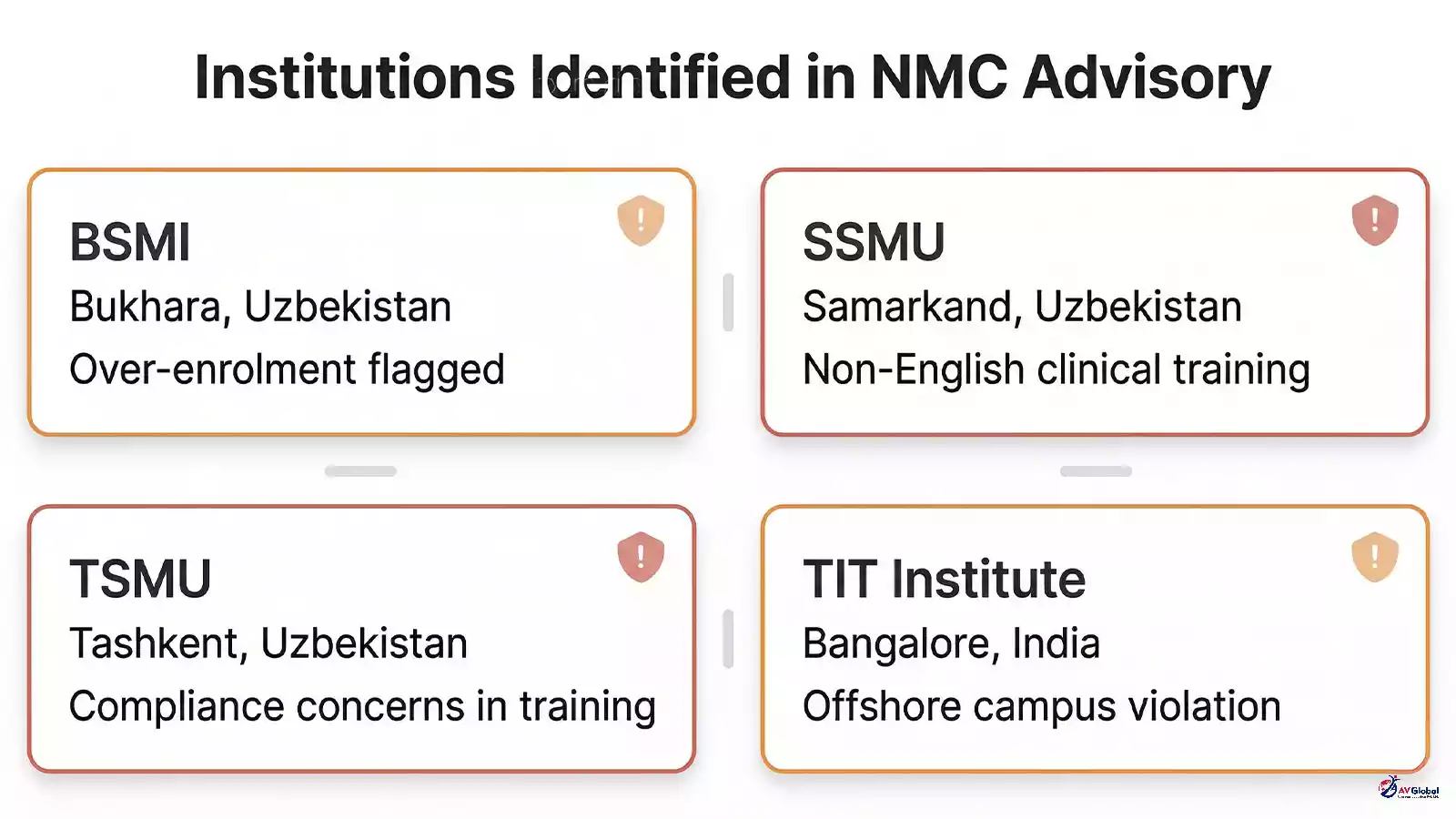
The advisory specifically names four institutions:
1. Bukhara State Medical Institute (BSMI) - Located in Bukhara, Uzbekistan. The Embassy flagged admissions beyond approved intake capacity and inadequate clinical training for Indian students.
2. Samarkand State Medical University (SSMU) - Located in Samarkand, Uzbekistan. Similar concerns about over-enrolment and lack of genuine English-medium instruction affecting hands-on training.
3. Tashkent State Medical University (TSMU) - The flagship medical institution in the capital city. The advisory raises concerns about the overall standards at this institution.
4. TIT Institute of Medical Sciences, Bangalore - This is an offshore campus operating in India on behalf of TSMU Termez Branch (Uzbekistan). The NMC has explicitly flagged this model as being in violation of Indian regulatory norms.
The advisory also mentions that the Embassy shared testimonies from Indian students at Bukhara State University who were admitted through a private contractor called RARE Company, raising additional concerns about the role of middlemen in these admissions.
Why Is This Advisory So Serious? Understanding the Real Risks
I want to be very honest with you here. Many parents hear the word "advisory" and assume it is a suggestion. It is not. When the NMC issues an advisory of this nature, they are telling you that students graduating from non-compliant institutions will be held ineligible for licensing exams in India. The NMC has explicitly stated that the onus of this disqualification lies solely with the student.
Let me spell out what this means in practical terms.
Your child studies for six years in Uzbekistan. They invest Rs 20-30 lakhs. They complete their degree. They fly back to India expecting to appear for the FMGE or NExT exam. And then the NMC says: your institution did not comply with our regulations. You are not eligible to sit for the licensing exam. You cannot register as a doctor in India.
Six years. Lakhs of rupees. And no medical licence.
This is not a hypothetical scenario. This is what the NMC is warning will happen to students who attend non-compliant universities. We have seen it happen to students from other countries before - students who chose the cheapest option, who trusted an agent's promise, who did not verify FMGL compliance. And those families came to us afterwards, asking what could be done. By that point, the answer was very difficult to hear.
The FMGL Regulations 2021 - The Six Rules That Can Make or Break Your Child's Career
The NMC advisory specifically references the Foreign Medical Graduate Licentiate (FMGL) Regulations, 2021, which came into effect on November 18, 2021. These regulations are not optional. They are the legal framework that determines whether a foreign medical degree will be recognized in India.
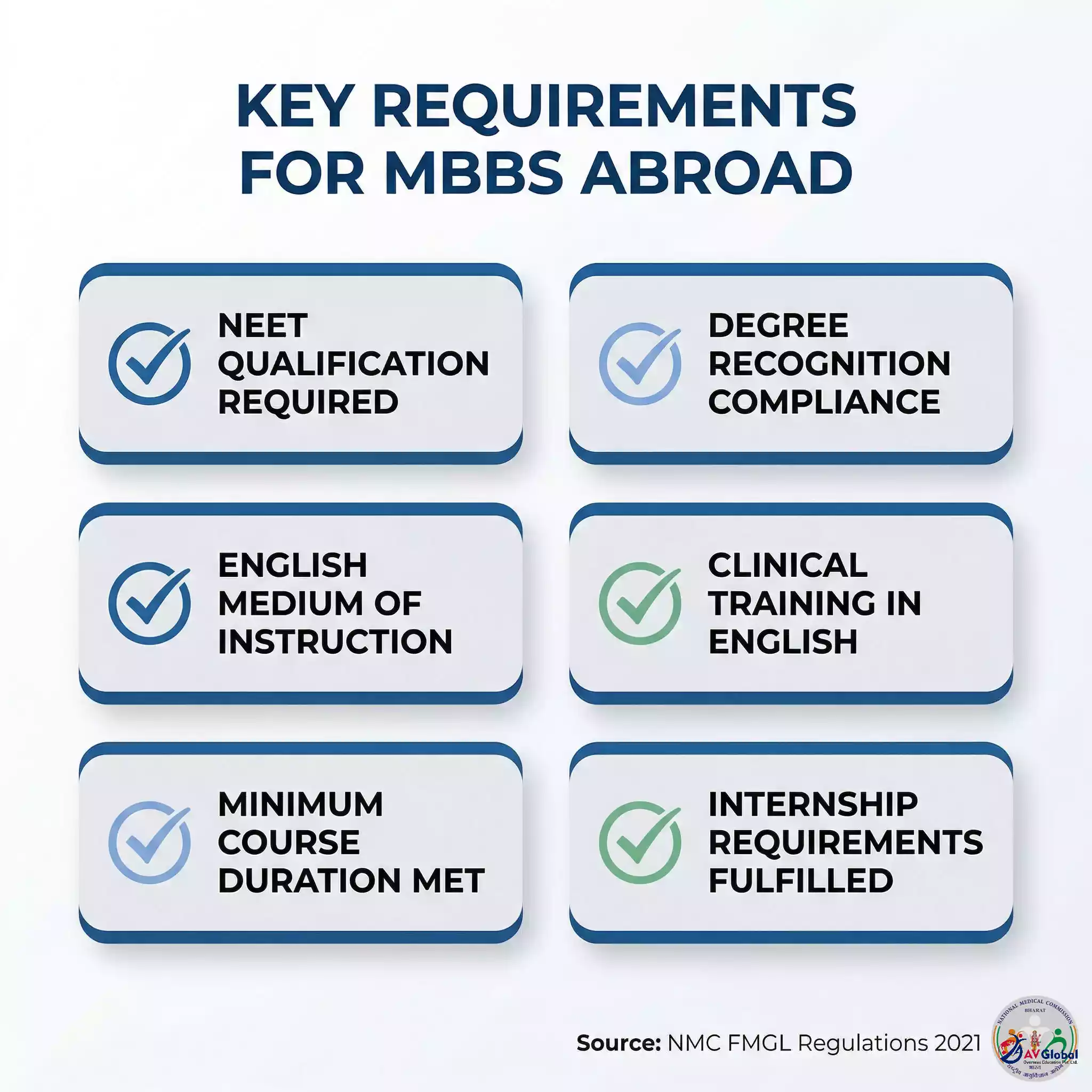
Here are the six key requirements that every parent and student must memorise:
1. Minimum 54 months of education at a single institution. Your child must complete at least four and a half years of medical education at one university. Not two universities. Not partly online. One physical institution, one campus, one country.
2. 12-month internship at the same foreign university. After completing the coursework, the internship must be done at the same institution abroad. It cannot be split between countries. It cannot be done in India as a substitute.
3. Clinical training must not be done in parts or across different countries. The entire clinical component - the part where your child actually sees patients, performs procedures, and learns bedside medicine - must happen in the country where the degree is awarded.
4. Medium of instruction must be English. This is where many Uzbekistan universities fall short. The NMC requires the entire course to be taught in English. If lecturers are teaching in Uzbek or Russian and Indian students cannot communicate with patients during clinical rotations, the FMGL compliance is broken.
5. Mandatory subjects as specified in Schedule-I must be covered. The curriculum must align with what Indian medical graduates study. The subjects, sequence, and clinical exposure must match NMC standards.
6. Registration with the local regulatory body. After graduating, the student must be registered or eligible for registration in the country where they studied - at par with local citizens of that country. This means the degree must have equal standing domestically.
Any deviation from even one of these requirements can result in disqualification from obtaining registration to practice medicine in India.
What Specifically Went Wrong in Uzbekistan?
Based on the NMC advisory and the Indian Embassy's communication, the following problems have been identified at the named institutions:
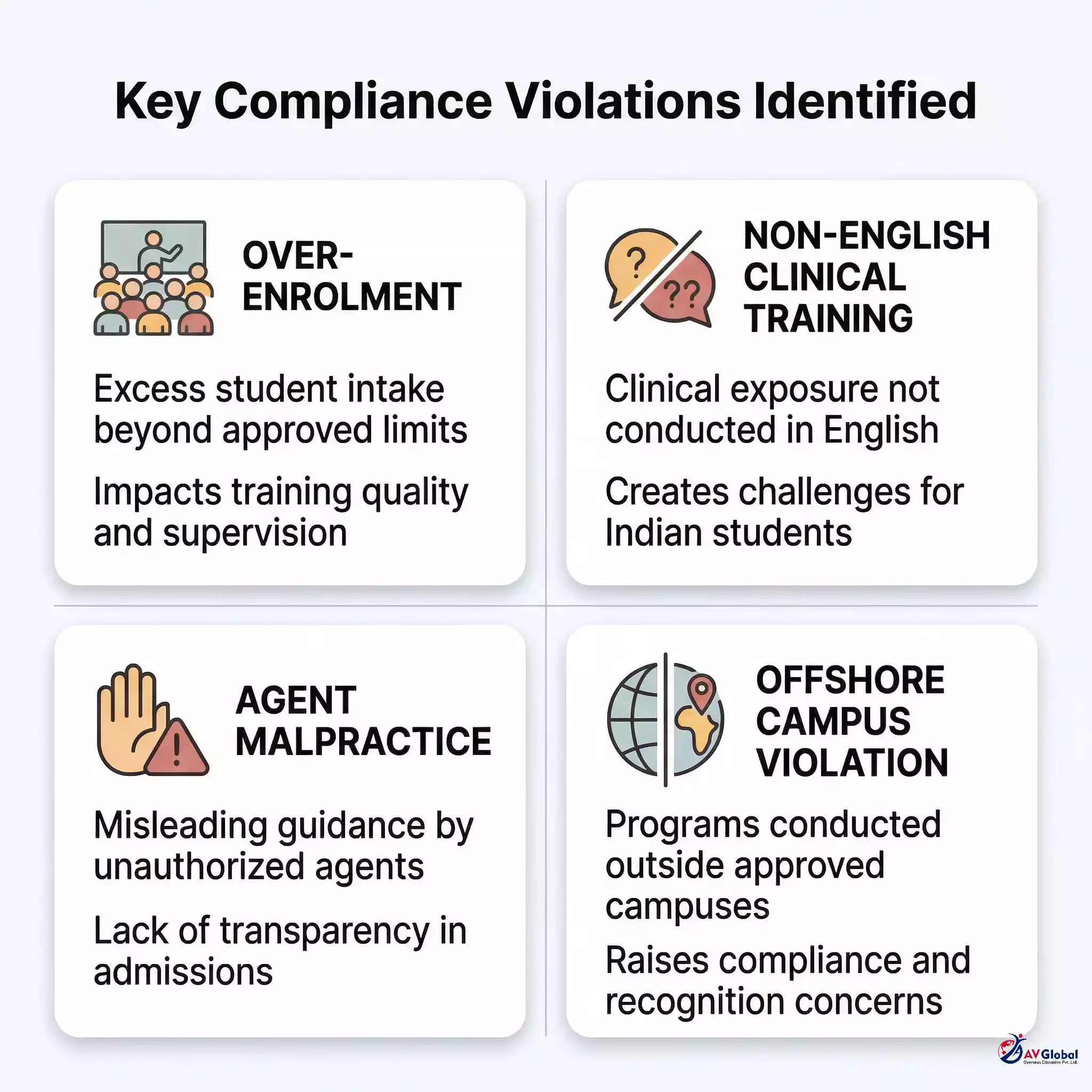
Over-enrolment beyond approved capacity. Some of these universities have been admitting far more Indian students than their classrooms, labs, and hospital affiliations can support. When a medical college designed for 100 students admits 300, the quality of education collapses. There are not enough cadavers for anatomy. Not enough hospital beds for clinical rotations. Not enough faculty to supervise practical training. The students pay the same fees, but they receive a fraction of the education.
Non-English clinical environment. This is a particularly dangerous problem. Universities market their programs as "English-medium" to attract Indian students. And perhaps the lectures are delivered in English - or at least some of them. But the clinical environment - the hospitals, the patient interactions, the ward rounds - operates in Uzbek or Russian. Indian students cannot communicate with patients. They cannot understand case discussions. They stand in hospital corridors watching procedures they cannot participate in. This is not clinical training. This is tourism with a stethoscope.
Agent-driven malpractice. The advisory specifically mentions agents and private contractors facilitating admissions through misleading promises. We have heard these promises ourselves from families who come to us after being burned. Guarantees of placement without proper NEET scores. Promises that FMGL compliance will be "taken care of." Assurances that the degree will definitely be recognised. None of these guarantees hold any legal weight.
Offshore campus violations. The TIT Institute of Medical Sciences in Bangalore, operating as an extension of TSMU Termez Branch, represents a model that directly violates NMC regulations. The FMGL 2021 is absolutely clear - the entire medical education must happen at a single foreign institution in that country. An offshore campus in India defeats the entire purpose and structure of these regulations.
"But My Agent Said It's Fine" - Why You Cannot Trust Verbal Assurances
This is the conversation we have with at least ten families every single week. The agent said the university is NMC-approved. The agent said FMGL compliance is not an issue. The agent said students from this university are already practising in India.
Here is what we tell them.
An agent's verbal assurance is worth nothing in front of an NMC regulation. When your child goes to apply for the FMGE or NExT exam, the NMC will not ask what the agent told you. They will check whether the university complied with every clause of FMGL 2021 at the time your child was enrolled. If it did not, the application will be rejected. The agent will have moved on to the next batch of students. Your child will be left with a degree that cannot be used in India.
We have also seen a disturbing pattern where agents specifically target families with lower NEET scores, offering Uzbekistan as a "safe, cheap" option. The fees are certainly low - some programs cost as little as Rs 20-22 lakhs for the entire six years. But a degree from a non-compliant university is not cheap. It is the most expensive mistake you can make, because the cost is your child's entire career.
How to Verify if a University Is FMGL Compliant - A Step-by-Step Guide
If your child is currently enrolled in a Uzbekistan university, or if you are in the process of applying, here is exactly what you need to do:
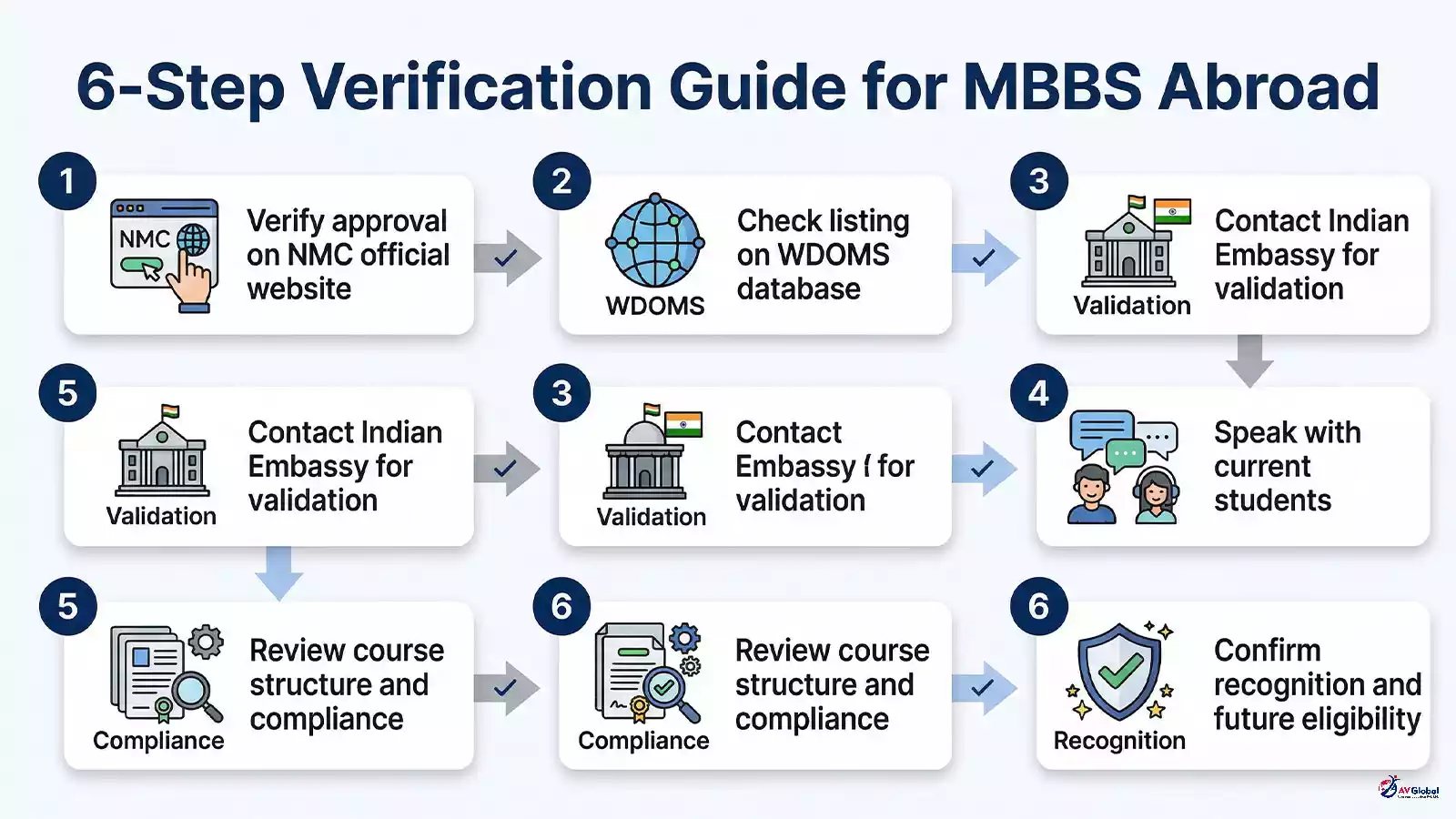
Step 1: Check the NMC website. Visit nmc.org.in and look for the latest advisories, alerts, and public notices about foreign medical institutions. Bookmark this page. Check it regularly.
Step 2: Verify WDOMS listing. The university must be listed in the World Directory of Medical Schools at wdoms.org. But remember - WDOMS listing alone does not guarantee FMGL compliance. A university can be listed in WDOMS and still violate FMGL regulations on medium of instruction, internship structure, or intake capacity.
Step 3: Contact the Indian Embassy. The Embassy of India in Tashkent is the ground-level authority that actually knows what is happening at these universities. Reach out to them before committing any fees. They have first-hand information about which institutions are delivering what they promise and which ones are not.
Step 4: Verify the medium of instruction independently. Do not rely on the university's website or the agent's claims. Speak to current Indian students at the university. Ask them directly: are classes actually in English? Can you communicate with patients during clinical rotations? Are you receiving hands-on training or just observing?
Step 5: Check for offshore arrangements. If any part of your education, training, or internship is being offered in India or any country other than Uzbekistan, this is a clear FMGL violation. Walk away immediately.
Step 6: Consult a trusted MBBS abroad consultancy. Not all consultancies are created equal. Many are simply extensions of the agents flagged in this advisory. Look for a consultancy that is transparent about risks, that does not promise guaranteed admissions, and that openly discusses FMGL compliance with you before talking about fees.
What the NMC Wants You to Do - Direct Advice from the Advisory
The NMC advisory explicitly lays out the following instructions for students and parents. These are not our recommendations - these come directly from the regulatory body:
Do not fall for fraudulent offers. No institution or agent can guarantee admission outside the prescribed NEET process. If someone is promising your child a seat without proper NEET qualification, they are lying to you.
Verify before making any payment. Ensure the institution is duly recognised and compliant with all applicable regulations before you commit or pay any fees. Once money is paid to an overseas institution through an agent, getting it back is extremely difficult.
Check recognition and compliance carefully. Verify the recognition status of the foreign medical university and ensure it adheres to every clause of the FMGL Regulations, 2021. Not just the ones that are convenient.
Avoid unverified agents. Do not rely on unauthorised or unverified agents or intermediaries for securing admission. The NMC is not going to hold the agent accountable. They will hold your child accountable.
Seek official guidance. Consult the National Medical Commission and Indian diplomatic missions abroad wherever necessary.
Report suspicious activities. If any institution or individual is offering illegal or misleading medical admissions, report them to the NMC directly.
Is All of Uzbekistan Off the Table? An Honest Assessment
This is the question every parent reading this post is asking. And the answer requires nuance.
The NMC advisory specifically names four institutions. It does not say that every university in Uzbekistan is non-compliant. There are other medical institutions in Uzbekistan - some of which are smaller, less commercially driven, and may well be meeting FMGL requirements more seriously.
However, and this is critical, the advisory uses the phrase "Uzbekistan or similar destinations" when advising extreme caution. This is the NMC casting a wider net. They are signalling that the problems they have found at these four institutions may exist at others as well.
At AV Global Overseas, our position has always been clear. Uzbekistan offers some of the most affordable MBBS programs available to Indian students, with total budgets ranging from Rs 20 to 32 lakhs for the full six-year course. That affordability is genuine. But affordability means nothing if the degree cannot be used in India.
We have always been transparent about the FMGE pass rates from Uzbekistan universities. They are not high. Clinical training quality has been a concern we have raised with families even before this advisory. And we have consistently told parents that the cost advantage of Uzbekistan must be weighed against these realities.
If you are still considering Uzbekistan, do not proceed without verifying FMGL compliance at the specific university you are looking at. And if the university is one of the four named in this advisory, our strong recommendation is to explore alternatives.
Safer Alternatives: Where AV Global Students Are Studying MBBS Abroad Right Now
For families who were considering Uzbekistan primarily for affordability, here are the alternatives we actively support. Each of these destinations has universities where we maintain on-ground teams, Indian food facilities, and verified FMGL compliance:
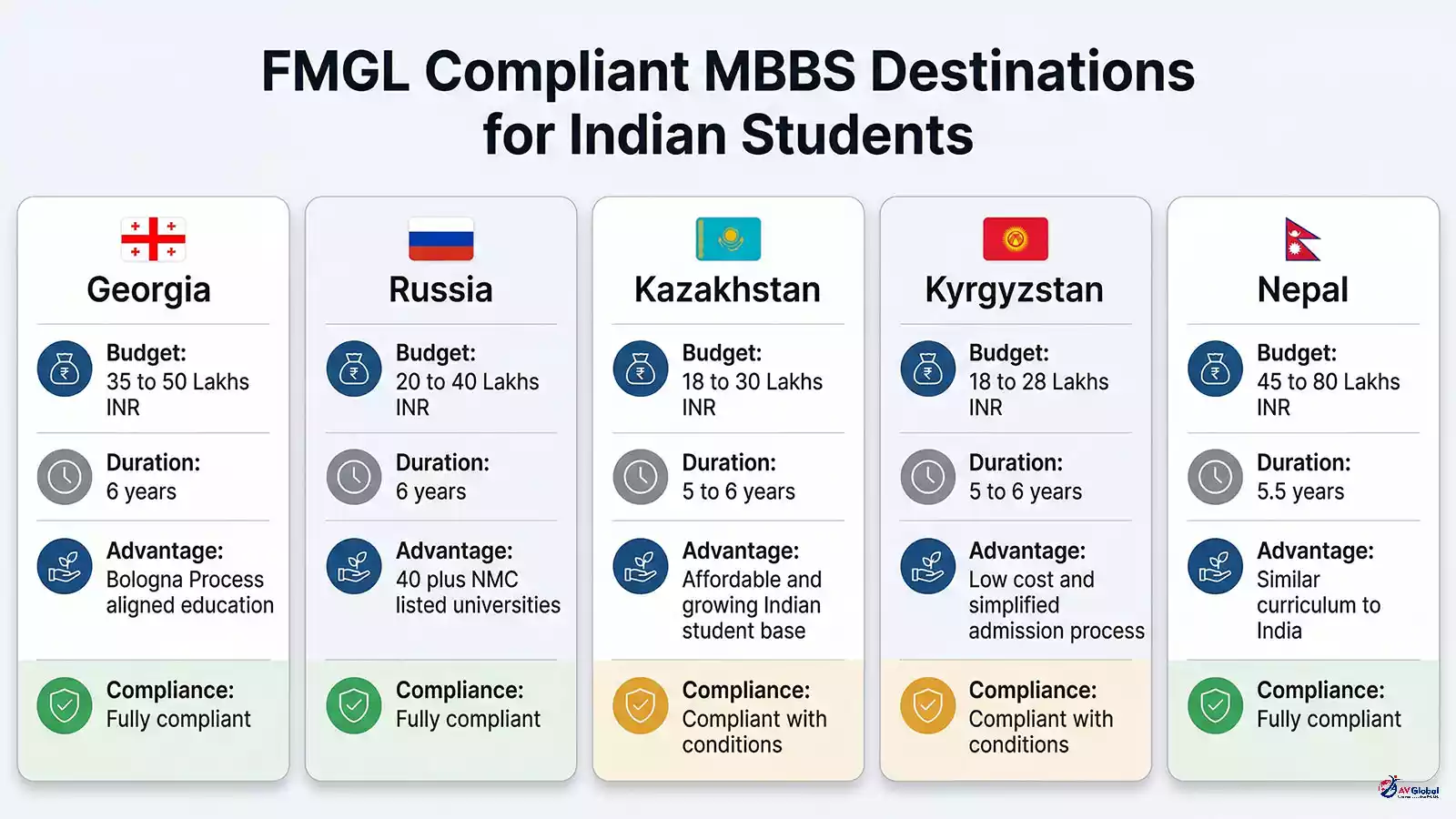
Georgia (Rs 25–38 lakhs all-inclusive for 6 years): English-medium instruction in a European country. Bologna Process member. Strong clinical training in modern teaching hospitals. Universities like Tbilisi State Medical University, David Tvildiani Medical University, and European University Georgia have established track records with Indian students. FMGE pass rates from top Georgian universities are among the best for any MBBS abroad destination.
Russia (Rs 28–45 lakhs all-inclusive for 6 years): Over 40 NMC-listed universities. Established medical education system with decades of experience training Indian students. City-wise budget flexibility from affordable options like Kazan and Kursk to premium choices in Moscow and St. Petersburg. Strong clinical exposure in large teaching hospitals.
Kazakhstan (Rs 26–40 lakhs all-inclusive for 5 years): Growing medical education hub with universities like KazNMU that carry international rankings. Modern infrastructure, English-medium programs, and a safe environment. Slightly higher cost than Uzbekistan but significantly better clinical training infrastructure.
Kyrgyzstan (Rs 25–38 lakhs all-inclusive for 6 years): A trusted Central Asian option that many Indian families choose for its proximity advantage, established Indian student community, and genuine English-medium instruction. Smaller class sizes mean better clinical access.
Nepal (Rs 28–60 lakhs all-inclusive for 5.5 years): The closest international option. NMC-pattern curriculum alignment. No visa required. SAARC quota pathway available. Familiar food, culture, and climate. Higher cost than Central Asian options but eliminates almost all logistical concerns.
Each of these destinations has its own trade-offs, and we discuss those openly with every family during counselling. But all of them offer something that the flagged Uzbekistan institutions cannot guarantee right now: a clear, verified pathway to practicing medicine in India.
What Should You Do If Your Child Is Already Studying in One of These Universities?
If your child is currently enrolled at Bukhara State Medical Institute, Samarkand State Medical University, Tashkent State Medical University, or TIT Institute of Medical Sciences in Bangalore, here is our practical advice:
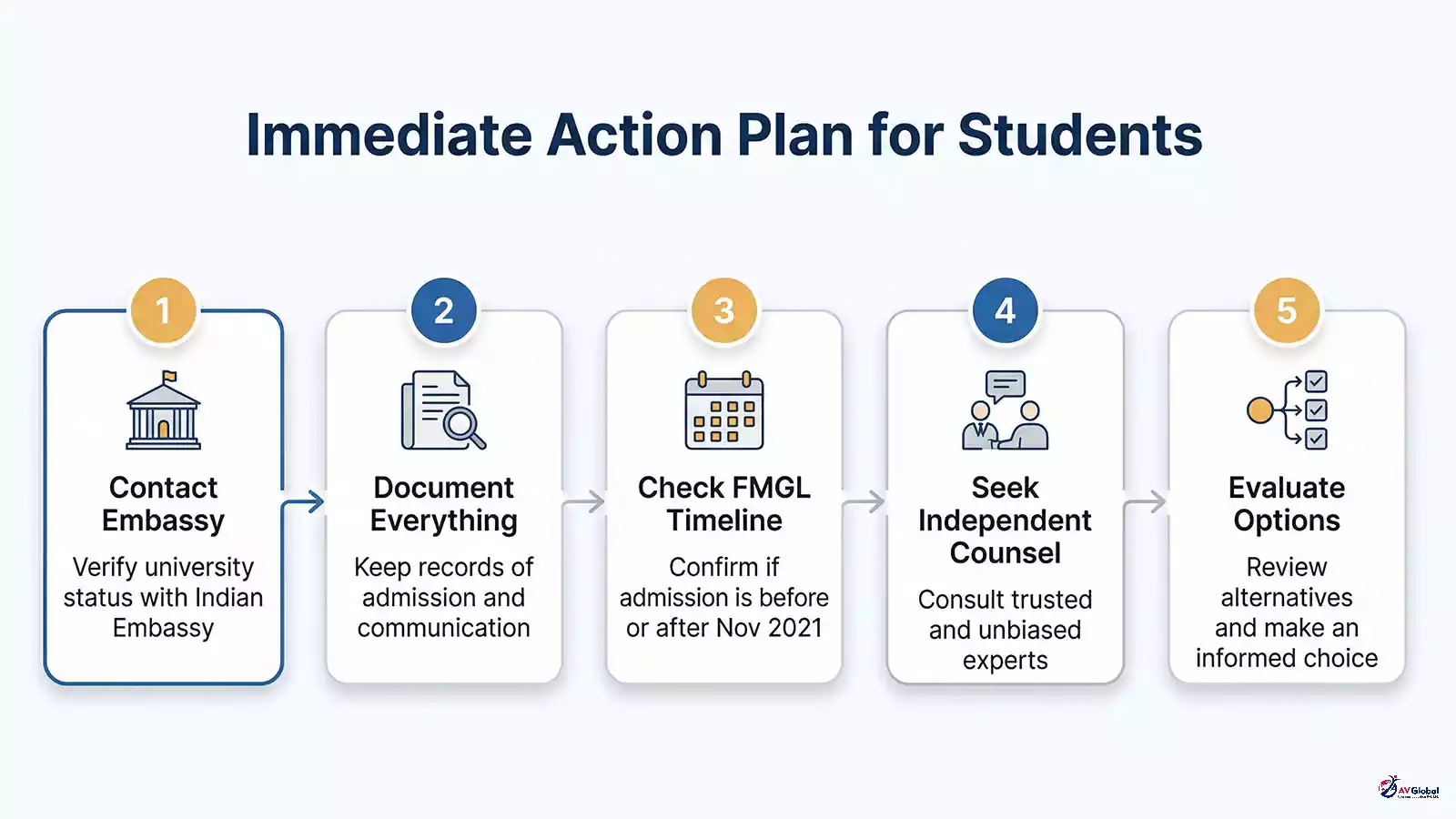
Do not panic, but do act quickly. Contact the Indian Embassy in Tashkent immediately and ask for the latest status on your institution's compliance.
Document everything. Save all your admission letters, fee receipts, communication with agents, and any written guarantees you were given. These may be important if legal or regulatory questions arise later.
Assess your year of study. Students who enrolled before November 18, 2021 (when FMGL 2021 took effect) may be governed by the older Screening Test Regulations, 2002. This distinction matters. Consult the NMC directly to confirm which regulatory framework applies to you.
Consider a transfer carefully. The FMGL 2021 requires the entire medical education to be completed at a single institution. Transferring mid-course to another university creates its own complications. Get professional guidance before making this decision.
Consult a qualified MBBS abroad counsellor - not the same agent who placed you. You need independent advice at this stage, not reassurance from someone who has a financial interest in keeping you enrolled.
This Is Not the First Warning - A Timeline of NMC Alerts
One thing that concerns us deeply is that this is not the first time the NMC has raised alarms about foreign medical institutions. The April 2026 advisory itself references a chain of earlier communications:
August 8, 2023 - Public Notice: NMC first cautioned students about ensuring FMGL compliance before taking admission abroad.
November 22, 2024 - Public Notice: A follow-up notice reiterating the same warnings, suggesting the problem was growing rather than resolving.
May 19, 2025 - Advisory: NMC escalated from a public notice to a formal advisory, a more serious regulatory instrument.
July 21, 2025 - Alert Note: Another escalation, this time using the "Alert Note" format, indicating specific violations were being reported.
April 1, 2026 - Alert Note (Current): The most specific and detailed communication yet, naming institutions, citing Embassy reports, and detailing violations.
The trajectory is clear. The NMC started with gentle warnings and has progressively become more specific and more forceful. If the pattern continues, the next step could be formal derecognition of specific universities. Families who ignore this trajectory are taking an enormous gamble with their child's career.
.webp "Timeline of NMC Warnings About Foreign Medical Institutions (2023–2026)")
How AV Global Overseas Protects Our Students
We understand that after reading an advisory like this, trust becomes the most important currency. Here is how we operate, and why families who work with us are protected from situations like this:
We only recommend NMC-listed, FMGL-compliant universities. Before we add any university to our partner list, we verify its NMC listing, WDOMS registration, FMGL compliance on every parameter, and clinical training infrastructure. If a university does not meet even one criterion, we do not work with them - regardless of how attractive the fees look.
We disclose risks honestly. We have always been upfront about FMGE pass rates, clinical training quality, and country-specific concerns. Our counselling sessions are designed to give you the complete picture, not the picture that closes a deal.
We maintain on-ground teams. In every country where we send students, we have local coordinators who monitor university compliance, student welfare, clinical training quality, and hostel conditions throughout the year. We do not place students and walk away.
We never guarantee admission outside the NEET process. Because the NMC does not allow it, and we do not make promises we cannot keep.
We provide FMGE and NExT preparation support. Getting a degree is only half the journey. We help our students prepare for the licensing exams they need to clear to practice in India, because that is what actually matters.
The Bottom Line
The NMC advisory of April 1, 2026, is not a routine communication. It is a specific, evidence-based warning backed by the Indian Embassy's ground-level observations. It names universities, describes violations, and explicitly warns of career-ending consequences for non-compliance.
If you are considering MBBS in Uzbekistan, treat this advisory as a red flag that demands investigation, not dismissal. Verify every claim made by your agent. Check every regulation. And if your child is being directed toward one of the four named institutions, explore alternatives immediately.
Your child's dream of becoming a doctor is not something to gamble with. The cheapest degree is never the cheapest option if it cannot be used.
At AV Global Overseas, we are here to help you navigate this situation. Whether you need guidance on safer alternatives, verification of a specific university's compliance, or advice on what to do if your child is already enrolled at a flagged institution - our counsellors are available for a free, honest consultation.
Because in fifteen years of doing this work, we have learned one thing: the families who take the time to verify, to ask questions, and to choose carefully are the families whose children become doctors. Every single time.

Frequently Asked Questions
Q: Is the NMC advisory saying all Uzbekistan universities are banned?
No. The advisory specifically names four institutions - BSMI, SSMU, TSMU, and TIT Institute Bangalore. However, the NMC advises "extreme caution" for Uzbekistan as a destination overall, and uses the phrase "or similar destinations." This means heightened scrutiny across the board, not just for the named institutions.
Q: My child enrolled before November 18, 2021. Does this advisory affect them?
Students who began their course before the FMGL 2021 notification date are generally governed by the older Screening Test Regulations, 2002. However, verification is critical. Contact the NMC directly with your admission date and documentation to confirm which regulatory framework applies.
Q: Can my child transfer to another university after this advisory?
The FMGL 2021 requires the entire medical education to be completed at a single institution. A mid-course transfer creates regulatory complications. Before making any transfer decision, consult with the NMC and a qualified MBBS abroad counsellor to understand the implications.
Q: Our agent says this advisory does not apply to our university. Should we believe them?
No verbal assurance from an agent holds any regulatory weight. The NMC advisory is a public, legally significant document. Verify compliance independently through the NMC website, the Indian Embassy, and by speaking to current students at the university.
Q: What is an offshore campus and why is it a problem?
An offshore campus is when a foreign university runs a branch or extension of its program in India (or another country). Under FMGL 2021, the entire medical course and training must be completed at one institution in the country of the degree. An offshore campus model violates this fundamental requirement.
Q: What are the safest MBBS abroad destinations right now for Indian students?
Based on current NMC compliance status and our on-ground verification, the safest destinations include Georgia, Russia, Kazakhstan, Kyrgyzstan, and Nepal. Each has different cost structures and advantages. A personalised counselling session can help you find the best fit for your child's profile and budget.
Important Links and Resources
- NMC Official Website: www.nmc.org.in
- WDOMS (World Directory of Medical Schools): www.wdoms.org
- Embassy of India, Tashkent: www.indembassy.uz
- FMGL Regulations 2021 (Full Text): Available on the NMC website under Regulations section
- AV Global Overseas Education: www.avglobaloverseas.com
- Free Counselling Helpline: +91-8097510888 / +91-8530450888
Related Reading
- MBBS in Uzbekistan - Complete Guide
- Study MBBS Abroad - All Countries
- MBBS in Georgia for Indian Students
- MBBS in Russia for Indian Students
- MBBS in Kazakhstan for Indian Students
- MBBS in Kyrgyzstan for Indian Students
- NEET Score Required for MBBS Abroad 2026
- MBBS Abroad Scholarships 2026
Disclaimer: This article is based on the official NMC advisory dated April 1, 2026 (Ref: No. U-15021/1/2024-UGMEB). All information is sourced from publicly available NMC communications and news reports. Students and parents are advised to verify the latest status directly with the NMC and Indian diplomatic missions before making any admissions or financial decisions. AV Global Overseas Education provides counselling and guidance services and is not responsible for regulatory actions taken by the NMC or foreign institutions.
AV Global Overseas Education | MBBS Abroad Counselling Since 2009 | 10,000 Plus Students Guided | avglobaloverseas.com | +91-8097510888 | +91-8530450888
Offices in Nagpur, Mumbai, Navi Mumbai and Pune