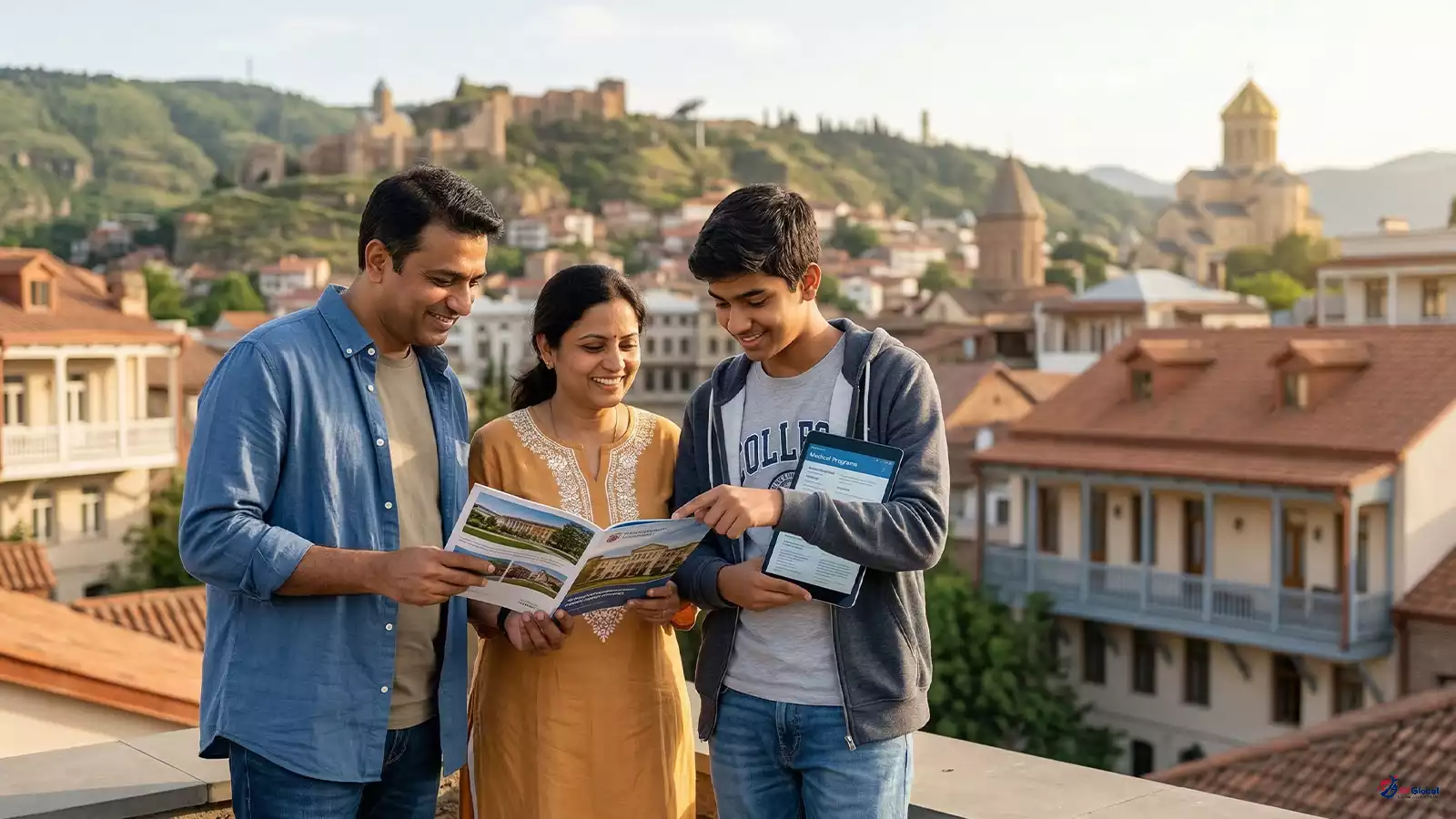
When parents come to us, fees and FMGE pass rates are usually the first two things they want to talk about. But somewhere around the middle of that conversation, a parent will pause and ask the question that actually keeps them up at night "Will my child be okay there? Will they eat properly? Is it safe?"
And honestly, that is the most human question in this entire decision. No matter how good the university is, no parent wants to send their 17 or 18-year-old across the world to a place that feels foreign, unsafe, or uncomfortable. So in this post, we are going to talk about life real, daily life in Georgia for Indian medical students. The food, the safety, the weather, the community, the monthly budget, the flights, and everything in between.
By the time you finish reading, we want you and your child to feel genuinely excited about Georgia not just academically convinced, but personally comfortable.
Safety in Georgia: The First Thing Every Parent Wants to Know
Georgia consistently ranks as one of the safest countries in the world for international students, and the data backs this up.
Georgia's Global Peace Index ranking places it among the more peaceful nations in the broader European and Eurasian region. The country has a very low street crime rate, petty theft is uncommon compared to most major European cities, and violent crime targeting foreigners is extremely rare. Indian students including female students consistently report feeling safe walking around Tbilisi and Batumi at any time of day or night.
Here is what specifically makes Georgia safe for Indian students:
- University hostels have 24x7 security, CCTV, and controlled entry all students pass through a security check
- The local Georgian population is genuinely warm and hospitable Georgians have a deep cultural tradition of welcoming guests, which extends to international students
- Tbilisi is a well-lit, well-connected city with active streets and public spaces even in the evenings
- Indian student communities are well-established there are WhatsApp groups, senior student networks, and on-ground support structures that help new students navigate the city quickly and safely
- Emergency services are accessible Georgia has reliable police (112 emergency number), hospitals, and pharmacies
- No active conflict or political instability affecting student daily life in Tbilisi or Batumi
A word specifically for parents of female students: Georgia is considered one of the better destinations for female Indian students studying abroad. University hostels typically have separate secured floors for female students, hostel wardens, and strict visitor policies. Many Indian families specifically ask us about this, and we are happy to address it directly Georgia is a safe, respectful environment for young women studying medicine.
Indian Food in Georgia: You Will Not Miss Home as Much as You Think
Food is always in the top three concerns for Indian students going abroad. And honestly, Georgia has made this much easier than most other MBBS destinations.
Indian Restaurants and Dhabas
Both Tbilisi and Batumi have a growing number of Indian restaurants that serve genuine North and South Indian cuisine. Some of the well-known ones in Tbilisi include places like Sanjha Chulha, Spice Garden, and others that have been specifically set up catering to the large Indian student population. Batumi has options like Maharajah that serve familiar Indian meals. The cuisine dal, chapati, rice, sabzi, curry is genuinely close to home cooking.
A meal at an Indian restaurant in Georgia costs approximately Rs. 300 to Rs. 500, which is affordable for an occasional treat.
Indian Mess and Tiffin Services
Near most major medical universities in Tbilisi and Batumi, you will find Indian tiffin or mess services run by Indian or South Asian families. These provide daily home-cooked Indian meals breakfast, lunch, and dinner for approximately $100 to $150 per month (roughly Rs. 8,900 to Rs. 13,350). For students who do not want to cook, this is the most comfortable and cost-effective solution.
Some universities, including BAU International University, even have their hostels set up with Indian food prepared by experienced cooks in the canteen, so students get familiar meals without leaving campus.
Indian Grocery Stores
This is the detail that makes a real difference in day-to-day comfort. Indian grocery items rice, dal, atta, masalas, ghee, Maggi, spices, canned vegetables, and even popular Indian snacks are available in specialty grocery stores in both Tbilisi and Batumi. Students who have been there a semester or two know exactly which stores stock which items.
Students who cook at home regularly keep their monthly food cost down to Rs. 6,000 to Rs. 8,000 very manageable.
Georgian Food Worth Trying
Beyond Indian food, Georgia has its own wonderful cuisine that students quickly fall in love with. Two dishes every Indian student discovers in their first week:
- Khachapuri A warm, cheesy bread that is as comforting as it sounds. There are regional varieties, but all of them are delicious and filling. A large Khachapuri costs about Rs. 200 to Rs. 300
- Khinkali Georgian dumplings filled with spiced meat or vegetables, similar in some ways to momos. Students buy them by the dozen from local restaurants for Rs. 150 to Rs. 250
Georgian bread, fresh produce, dairy, and street food are all excellent quality and extremely affordable.
Cost of Living: City-by-City Monthly Budget
Georgia has three main cities where Indian MBBS students study Tbilisi (the capital), Batumi (the Black Sea coastal city), and Kutaisi (a smaller, more budget-friendly city). Costs vary meaningfully between them.
Monthly Expense Breakdown for Indian Students
| Expense Category | Tbilisi | Batumi | Kutaisi |
|---|---|---|---|
| University Hostel / On-Campus Stay | Rs. 8,000 to Rs. 14,900 | Rs. 9,550 to Rs. 14,900 | Rs. 9,550 to Rs. 14,900 |
| Shared Apartment (Off-Campus) | Rs. 14,900 to Rs. 23,900 | Rs. 11,950 to Rs. 19,900 | Rs. 8,950 to Rs. 14,900 |
| Food Cooking at Home | Rs. 6,000 to Rs. 8,000 | Rs. 5,500 to Rs. 7,500 | Rs. 5,000 to Rs. 7,000 |
| Food Eating Out (Occasional) | Rs. 8,000 to Rs. 12,000 | Rs. 6,500 to Rs. 10,000 | Rs. 5,000 to Rs. 8,000 |
| Groceries (Monthly) | Rs. 5,500 to Rs. 8,900 | Rs. 5,500 to Rs. 8,900 | Rs. 5,000 to Rs. 7,500 |
| Public Transport | Rs. 1,500 to Rs. 2,500 | Rs. 1,500 to Rs. 2,500 | Rs. 1,000 to Rs. 1,800 |
| Internet and Phone | Rs. 800 to Rs. 1,500 | Rs. 800 to Rs. 1,500 | Rs. 700 to Rs. 1,200 |
| Utilities (if in private flat) | Rs. 2,000 to Rs. 4,000 | Rs. 2,000 to Rs. 3,500 | Rs. 1,500 to Rs. 3,000 |
| Personal / Miscellaneous | Rs. 3,000 to Rs. 5,000 | Rs. 2,500 to Rs. 4,500 | Rs. 2,000 to Rs. 3,500 |
| Monthly Total (Hostel + Cooking) | Rs. 25,000 to Rs. 32,000 | Rs. 22,000 to Rs. 28,000 | Rs. 19,000 to Rs. 25,000 |
The key takeaway: a student living in a university hostel and cooking most meals at home can comfortably manage on Rs. 22,000 to Rs. 28,000 per month across all three cities. Tbilisi is slightly more expensive, but the difference is not dramatic.
Students who eat out frequently or move into private apartments will naturally spend more a realistic upper budget in Tbilisi for a comfortable lifestyle is around Rs. 35,000 to Rs. 40,000 per month.
Climate: What to Expect Season by Season
One of the often-overlooked advantages of Georgia for Indian students is how familiar the climate feels at least partially.
Georgia has four distinct seasons, which is similar to Northern and Central India:
| Season | Months | Temperature Range | What It Feels Like |
|---|---|---|---|
| Spring | March to May | 10°C to 22°C | Pleasant and fresh, similar to Delhi in March |
| Summer | June to August | 25°C to 35°C | Warm and sunny; very comfortable for Indian students |
| Autumn | September to November | 10°C to 22°C | Mild and colourful; beautiful in Tbilisi |
| Winter | December to February | -2°C to 10°C | Cold but manageable with warm clothing |
Batumi, being coastal, is warmer and more humid year-round which many South Indian students find more familiar. Tbilisi has slightly harsher winters, but nothing extreme. Most university hostels have heating, and warm clothing is easily available in the city's markets at affordable prices.
Students from Rajasthan, UP, or MP typically adjust to Georgia's summer easily. Students from coastal states like Kerala or Tamil Nadu tend to prefer Batumi. The main adjustment is winter bring good thermals, a warm jacket, and indoor footwear. That is really the whole preparation needed.
The Indian Student Community in Georgia: You Are Never Truly Alone
Over 8,000 Indian students are currently studying medicine in Georgia, spread across Tbilisi, Batumi, and Kutaisi. This is not a small, scattered group it is a genuine, established, active community.
Here is what that community means practically for a new student:
- WhatsApp and Telegram groups for each university and each batch you get added before you even land
- Senior students (India connection) who help freshers with orientation, grocery store locations, cheap food spots, and navigating the city
- Diwali, Holi, and other Indian festivals are celebrated actively on campus and in the city many universities encourage cultural celebrations
- Indian cultural associations at most major Georgian medical universities
- Local Indian stores and restaurant owners who have been serving the student community for years and are a support network in themselves
Students consistently report that the first two weeks feel challenging the homesickness, the adjustment, the new environment but within a month, most students have found their friend group, figured out their routine, and genuinely started enjoying the experience.
The one advice we always give to incoming students: join the Indian student groups for your university before you leave India. The orientation starts online, months before you land.
Georgian Language: Do You Need to Learn It?
Classes, textbooks, exams, clinical case discussions all of this happens in English at Georgian medical universities. You will never need Georgian in your academic life.
However, learning a few basic Georgian phrases makes a meaningful difference in your clinical rotation experience and your daily city life. Georgian script looks completely different from any Indian or European script it is uniquely their own but the spoken phrases are not difficult to pick up.
Here are the most useful phrases every MBBS student in Georgia should know:
| Georgian Phrase | Pronunciation | Meaning |
|---|---|---|
| გამარჯობა | Gamarjoba | Hello |
| გმადლობთ | Gmadlobt | Thank you |
| კი / არა | Ki / Ara | Yes / No |
| სად არის? | Sad aris? | Where is it? |
| Რამდენი ღირს? | Ramdeni ghirs? | How much does it cost? |
| ექიმი | Ekhimi | Doctor |
| ავადმყოფი | Avadmyofi | Patient |
| ტკივილი | Tkivili | Pain |
| საავადმყოფო | Saavadmyopo | Hospital |
During clinical rotations from Year 2 onwards, patients in Georgian hospitals will naturally speak Georgian. Students who have picked up basic medical vocabulary in Georgian can take better histories, communicate with patients more effectively, and get significantly more out of their clinical training hours. Senior Indian students at most universities will coach juniors on these basics informally, but the earlier you start, the better.
Getting There: Flights from India to Georgia
There are no direct flights from India to Georgia, but the connections are straightforward and well-travelled. Most students reach Tbilisi International Airport (TBS) within 8 to 12 hours total travel time with one stopover.
Most popular flight routes for Indian students:
| Departure City | Route | Travel Time | Approx. One-Way Fare |
|---|---|---|---|
| Delhi (DEL) | Via Dubai / Doha / Istanbul | 9 to 12 hours | Rs. 25,000 to Rs. 40,000 |
| Mumbai (BOM) | Via Dubai / Abu Dhabi | 9 to 11 hours | Rs. 30,000 to Rs. 45,000 |
| Bengaluru (BLR) | Via Istanbul / Dubai | 11 to 13 hours | Rs. 32,000 to Rs. 48,000 |
| Chennai (MAA) | Via Sharjah / Abu Dhabi | 10 to 12 hours | Rs. 35,000 to Rs. 50,000 |
| Hyderabad (HYD) | Via Dubai / Istanbul | 10 to 12 hours | Rs. 30,000 to Rs. 45,000 |
Most popular connecting airlines: Qatar Airways, Turkish Airlines, Emirates, Air Arabia, flydubai, Air Astana.
Booking tip: Book 2 to 3 months in advance for the September or October intake. Flights in August and early September are peak season and prices go up by Rs. 10,000 to Rs. 15,000 on average if you book last minute. Students from North India tend to find the best fares via Delhi on Turkish Airlines through Istanbul.
For students heading to Batumi, there is Batumi International Airport (BUS) with connections via Istanbul. If your university is in Batumi, this is the more convenient arrival point.
Getting Around in Tbilisi and Batumi
Georgia has a reliable and affordable public transport system, and students figure it out within the first week.
- Metro (Tbilisi): Tbilisi has an underground metro system with two lines covering most major areas. A single ride costs 1 GEL (approximately Rs. 30). A student Metromoney card is the most convenient option load it with credit and tap to ride
- Minibus (Marshrutka): These shared minibuses run fixed routes throughout both Tbilisi and Batumi, costing 1 to 1.20 GEL per ride (Rs. 30 to Rs. 36)
- Bolt and Yandex Go: These are the primary ride-hailing apps used in Georgia, similar to Ola or Uber in India. A short trip across town in Tbilisi costs Rs. 90 to Rs. 200. Students use these apps from Day 1 and find them reliable and affordable
- Walking: Most university areas in Tbilisi have hostels and accommodations within walking distance. Students often walk to class, which saves money and doubles as daily exercise
First Week Practical Checklist: What to Carry, What to Do
Every student we send to Georgia gets this guidance from us before departure. Here is the condensed version:
Bring from India:
- Essential spices, ready-to-eat snacks, Maggi, pickles for the first week
- A pressure cooker (if staying in a hostel with kitchen access)
- Thermals and a good winter jacket for December to February months
- Power adapter (Georgia uses European Type C/F sockets same as most European countries; Indian flat-pin plugs will not fit directly)
- Printed copies of all documents in a folder
- Some USD or Euros for the first few days (exchange to GEL on arrival)
Do in the first week:
- Get a local Georgian SIM card (Magti or Geocell both are good; a basic plan costs Rs. 500 to Rs. 800/month)
- Download Bolt, Yandex Go, and Google Maps with offline map of Tbilisi/Batumi
- Join your university's Indian Students WhatsApp group
- Register at the university with your original documents
- Find the nearest Indian grocery store (your seniors will show you)
- Explore your neighbourhood you will be surprised how quickly it starts feeling familiar
Frequently Asked Questions
Yes, Georgia is consistently regarded as one of the safest countries for international students in the Europe-Eurasia region. It has a very low street crime rate, a welcoming local population, and well-secured university hostels with 24x7 safety measures. Female students in particular consistently report feeling safe in Tbilisi and Batumi.
Yes. Indian restaurants, Indian mess and tiffin services, and Indian grocery stores are all available in Tbilisi and Batumi. Items like rice, dal, masalas, ghee, atta, and Maggi are stocked in specialty stores. Students who cook at home regularly keep their monthly food cost between Rs. 6,000 and Rs. 8,000.
A student in Tbilisi spending on hostel accommodation and cooking at home can manage on Rs. 25,000 to Rs. 32,000 per month comfortably. In Batumi and Kutaisi the cost is slightly lower at Rs. 19,000 to Rs. 28,000 per month. Students in private apartments or eating out frequently may spend up to Rs. 40,000 per month.
Georgia has four seasons. Summers (June to August) are warm, 25 to 35 degrees Celsius, very familiar for Indian students. Winters (December to February) are cold, dipping to around minus 2 to 10 degrees Celsius in Tbilisi, requiring thermals and a warm jacket. Spring and autumn are mild and pleasant. Batumi is warmer and more coastal year-round.
There are no direct flights between India and Georgia currently. Students fly via a single stopover in Dubai, Doha, Istanbul, or Abu Dhabi. Total travel time ranges from 8 to 13 hours depending on the departure city and connection. One-way fares range from approximately Rs. 25,000 to Rs. 50,000 depending on the season and how early you book.
Georgian is not required for academic classes, which are fully in English. However, learning basic Georgian words especially medical terms like patient, pain, doctor, hospital is very helpful during clinical rotations in Georgian hospitals. Most students pick up conversational basics within their first year naturally through daily city life.
Yes, there are over 8,000 Indian students studying medicine in Georgia, spread across Tbilisi, Batumi, and Kutaisi. Most universities have active Indian Students Associations, and festivals like Diwali and Holi are celebrated together. The Indian student community is one of the strongest support systems for new students arriving in Georgia.
A Note From Our Team at AV Global Overseas Education
We have sent students to Georgia from across India from Maharashtra, Gujarat, Rajasthan, Tamil Nadu, Andhra Pradesh, Punjab, and many more states. And when those students call us after their first semester, the feedback is almost always the same: "It is much better than I expected. I am comfortable, I am studying well, and I feel settled."
That is what we want for every student who chooses Georgia through us. Not just a good university seat, but a genuinely good experience academically, personally, and practically.
If you want to understand exactly what to expect before your child leaves for Georgia, we are always happy to connect you with a current student or Georgia-returned student from our network for a real, unfiltered conversation. Just reach out to us.
Visit www.avglobaloverseas.com to book a free counselling session, get your personalised university recommendation, or simply talk to someone who can answer your questions honestly about life in Georgia, not just academics.
If you're reviewing country-wise FMGE/NExT passing rates, don't miss our analysis on MBBS in Kazakhstan.